

A new paper suggests that 15 percent of global warming comes from overlooked pollutants.
Record-high global temperatures aren’t driven only by well-known greenhouse gas culprits.

There is very little authorities in Nepal could have done to prevent the deaths and devastation caused by the flash flood on its border with Tibet in late August, scientists with the World Weather Attribution (WWA) group have said.
Launching a study that highlighted the role of climate change in causing the glacial rock and ice collapse that triggered the Himalayan flood, WWA co-founder Friederike Otto told reporters that “no amount of local adaptation can fully shield vulnerable people downstream from this scale of destruction”.
The findings released on Thursday are likely to strengthen Nepal’s case for emergency support from the UN’s Fund for Responding to Loss and Damage. Its board members met informally on Wednesday to discuss whether to grant the country a maximum of $20 million towards its estimated $4.8 billion cost of recovery and reconstruction, but no decision has yet been taken.
Nepal’s foreign minister Shisir Khanal told Climate Home News last week that the destructive flood was “exactly the kind of climate-driven catastrophe the Fund was created to address”.
Hard to predict
The WWA study found that rock-ice avalanches are very hard to predict and that moving people out of areas vulnerable to such floods is difficult as their livelihoods revolve around the rivers along which the floods travel.
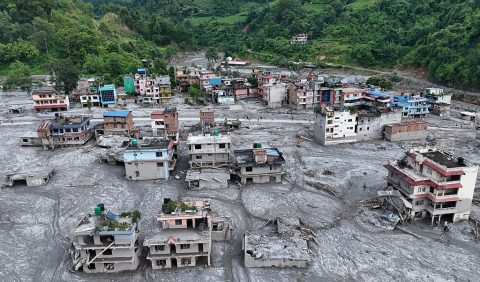
The recent disaster began on the morning of August 26, when an avalanche started falling beneath a glacier. This caused huge amounts of rocks and glacier ice to fall over a kilometre to a valley floor, where they then picked up more rock and ice and became a flood of debris heading downhill and downstream along the border of Nepal and Tibet.
The torrent entered the narrow Lhende Khola gorge and crashed through the busy Gyirong port border crossing at 170 kilometres an hour. It continued many kilometres downstream before eventually turning from rock and ice to water and slowing down.
The flood swept through villages, roads, bridges and hydropower stations, killing over 1,300 people in Nepal with more than 5,000 still missing. The flood also killed at least 40 people in Chinese-run Tibet.
Those on higher ground away from the river mainly survived but the flood’s speed meant that many people received no warning to seek higher ground or shelter.
While Nepal has early warning systems for flooding caused by rain and glacial lake outbursts, the WWA study noted that rock-ice avalanches are complex and understudied, with methods to monitor them still being explored.
Co-author Walter Immerzeel, mountain hydrology professor at Utrecht University, told journalists that with current methods, the disaster could not have been predicted.
But, he said, in the future it may be possible to use remote sensing techniques to analyse glaciers and rocks to generate a warning before a collapse occurs.
A technique called radar interferometry can detect hotspots which should be monitored with field-based sensors and drones, he said, adding that early warning systems could be installed in these areas using seismometers, water-level measurements and CCTV.
Because doing this for thousands of glaciers across the Himalayas would be difficult, authorities could monitor only the rock and ice faces that are a danger to the river valleys with the most people and infrastructure in them, he added. But this would still require lots of investment together with international collaboration and coordination, he warned.
The study found that another potential adaptation strategy – restricting development in flood-prone river valleys – is socially, economically and politically difficult.
The scientists said habitable land is scarce in these steep river valleys and economic activities like transport and hydropower generation are dependent on the river itself.
Madhab Uprety, a Nepali scientist from the Red Cross Red Crescent Climate Centre, said that, while new development should assess the risks of floods, many existing communities and buildings are already at risk.
Loss and damage
Otto said the flood should be discussed in the context of loss and damage as “there is no doubt that climate change is one of the drivers” and “it’s also one of the types of events that are absolutely outside of the limits we can possibly adapt to”.
As well as the deaths, a Nepali government’s assessment has found that a large amount of infrastructure was damaged, including more than 7,500 homes, 105 bridges, 48 public buildings, 47 cultural heritage assets, 18 schools, 13 hydropower facilities, seven health facilities, and numerous shops, hotels, restaurants, irrigation systems and farms. Over 30,000 people were affected.
Developing countries have called for the loss and damage fund’s board to hold an emergency meeting to discuss how to respond to Nepal’s request for funding. Instead of a full board meeting though, board members met only informally and online on Wednesday, Climate Home News understands. A source with knowledge of discussions said the informal nature of the meeting meant they were not able to take decisions or agree on next steps, which have been left up to the board’s co-chairs.
-
Foreign minister: Nepal needs “meaningful” international support to face climate threats
Following its recent Himalayan flooding disaster, the South Asian nation is seeking urgent help from a new UN climate fund, appealing for “stronger global solidarity” -
Loss and damage fund urged to hold crisis meeting on Nepal
The new fund is coming under pressure from developing nations to respond quickly to climate disasters rather than just financing longer-term projects -
Nepal’s EV revolution pays off as oil crisis causes pain at the pumps
Import subsidies, abundant hydropower and charging investments have spurred EV adoption, with electric vehicles now making up about three-quarters of new car sales


Speaking before that meeting started, Nepali climate negotiator Manjeet Dhakal said he had “heard of an extremely positive response” to Nepal’s request from board members. “Hopefully there will be something – a decision that the fund will do for exactly the reason that the fund was established,” he said.
Ajay Mathur, former Indian climate negotiator and now head of The Energy and Resources Institute in New Delhi, told a separate press briefing on Wednesday that the Nepal flood disaster would push loss and damage higher up the agenda of international climate talks, particularly if the United Nations Secretary-General decides to champion the cause at the UN General Assembly in New York next week.
Murat Kurum, Turkish environment minister and president-designate of COP31, told Climate Home News last week that he would be “pleased” if the fund could support Nepal and that he will keep calling in every speech for countries to give money to the loss and damage fund.
Jennifer Morgan, former German climate envoy and now a senior fellow at the Fletcher School of Law and Diplomacy, called for the loss and damage fund – which currently has around $630 million in contributions – to be topped up with new pledges from governments as well as solidarity levies on things like luxury air travel, super-rich individuals and fossil fuel firms’ windfall profits.
The post Nepal flood destruction shows “limits to adaptation”, scientists say appeared first on Climate Home News.
Nepal flood destruction shows “limits to adaptation”, scientists say
Global fossil-fuel emissions are set to fall by around 0.5% in 2026 amid the fallout from the Hormuz crisis, according to Carbon Brief analysis.
The US-Iran war has severely disrupted trade through the strait of Hormuz, causing a spike in oil and gas prices that continues to ripple around the global economy.
Each month of disruption – and each new flashpoint, such as in Yemen – is increasing the incentive to switch to alternatives.
Those alternatives include coal, with the latest forecasts pointing to a 1.2% rise in coal demand this year – apparently supporting media claims of a “return to coal” in the wake of the crisis.
Yet Carbon Brief’s analysis shows the rise in emissions associated with this increased coal use, much of which is unrelated to Hormuz, is set to be more than offset by declines for oil and gas.
The estimated overall impact on carbon dioxide (CO2) emissions from fossil fuels in 2026 is shown in the figure below and amounts to a reduction of around 0.5% from 2025 levels.
(Fossil fuels account for two-thirds of global greenhouse gas emissions.)
The emissions estimates for each fossil fuel are based on the latest forecasts from the International Energy Agency (IEA) for coal, oil and gas, in light of the ongoing global energy crisis.
For example, the agency initially estimated that global coal demand would decline this year. In its 2025 coal report, published in mid-December, it said that declining coal demand in China would outweigh the impact of pro-coal policies under US president Donald Trump.
In contrast, the latest update, published in September 2026, said that global coal demand would rise by 1.2% in 2026, instead of the small decline that had been expected.
The report highlighted the boost to coal demand from higher gas prices in the wake of Hormuz. However, there are limits to this, because few countries can switch from gas to coal at large scale.
The IEA’s latest report also noted the role of a strong El Niño, which is pushing up the need for cooling and depressing hydropower output in key markets. Other short-term factors are also affecting coal demand this year, including a rising amount of “wasted” wind and solar in China.
For gas, the IEA did not initially update its previous forecast that global gas demand would rise by 2.0% in 2026, which had been published in January of this year.
Its most recent forecast – published in July – already pointed to a 0.6% drop in demand in 2026. Since then, pressure on gas demand from high prices has only grown stronger.
For oil, there has been an even more dramatic shift in forecasts since the start of the year.
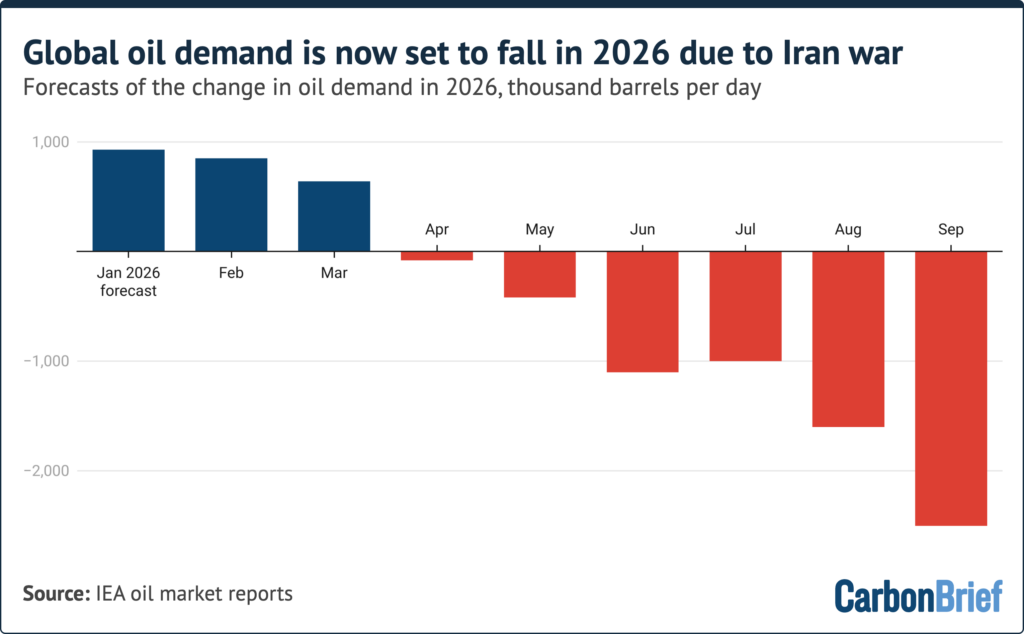
In its January 2026 oil market report, the IEA forecast a rise in demand in 2026 of 930,000 barrels per day (bpd). As shown in the figure below, this has been steadily revised downwards over the course of the year, as the Hormuz crisis was first ignited – and then extended.
By September, the IEA was forecasting a 2,500,000bpd drop in oil demand in 2026, equivalent to a reduction of 2.4% from 2025 levels.
(A 15 September research note from Morgan Stanley, not available online, found a “consensus” forecast of a 2,415,000bpd drop in demand in 2026.)
While there are many short-term factors at play in the shifting forecasts for 2026, it is clear that the latest energy crisis will also affect fossil-fuel demand in the next year and beyond.
For example, whereas the IEA initially forecast that oil demand would rebound in 2027 to well above 2025 levels, it is now expecting use of the fuel to be effectively flat for two years.
This puts a question mark over its previous expectation – published in October last year – that global oil demand would not peak until as late as 2030.
“For every month the conflict lasts, the probability of permanent [oil] demand destruction increases,” wrote Sverre Alvik, vice president at consultancy DNV in a late August analysis.
As fuel prices have surged, electric vehicles (EVs) have captured record shares of major car markets, from Australia and China through to Europe, Indonesia and Thailand.
In July, EV sales nearly doubled year-on-year in “new markets”, noted Alvik, pointing to countries outside China, Europe and North America.
The IEA says the 2027 outlooks for coal and gas are interdependent, with coal demand potentially increasing again if gas prices remain elevated – or dropping back if gas prices ease.
At the same time, governments in countries that had planned to rely on imports of liquefied natural gas (LNG) have been signalling shifts towards favouring domestic clean energy instead – or continuing to use coal for longer.
The current crisis, therefore, has the potential to not only lower fossil-fuel use and emissions in the short term, but also on a more lasting basis.
Related

CCC: Heathrow expansion could push flights to ‘80% of UK emissions by 2050’
Analysis: China’s CO2 emissions fall in Q2 2026 due to plummeting oil use
Explainer: The CMIP7 emissions scenarios – and how they explore future climate change

Q&A: What do China’s provincial five-year plans say about climate and energy?
The post Analysis: Global fossil-fuel emissions set to fall in 2026 amid Hormuz crisis appeared first on Carbon Brief.
Analysis: Global fossil-fuel emissions set to fall in 2026 amid Hormuz crisis
Aviation is on track to be responsible for 80% of the UK’s carbon dioxide (CO2) emissions by 2050, according to the Climate Change Committee (CCC).
Emissions from flying have more than doubled since 1990 – driven by rising passenger numbers – even as the climate impact of every other sector in the UK economy has fallen.
The UK does not have “credible” policies in place to reverse this trend of rising emissions, says the CCC in new advice to the government on future aviation policy.
The government has signalled its support for expanding Heathrow, the nation’s largest airport, while relying on “techno-fixes” such as “sustainable aviation fuels” (SAFs) to cut emissions.
Yet, even without Heathrow expansion, the CCC says aviation emissions are on track to be higher in 2050 than they are today – reaching 38m tonnes of CO2 (MtCO2).
As the chart below shows, this would account for most of the remaining CO2 from the UK economy, all of which would need to be removed from the atmosphere in order to meet the legal target of net-zero emissions.
Expanding Heathrow would add another 2.4MtCO2 in 2050, amounting to around 5% of all the UK’s emissions. (This would increase to 4.5MtCO2 when expansion is complete in 2054.)
With a final decision on Heathrow expansion expected by 2029, the government asked the CCC for its advice on whether the plan is compatible with the UK’s climate targets.
The CCC has concluded that the UK simply lacks sufficient policies to reduce aviation emissions and “expanding Heathrow would compound the problem”. In a press briefing, CCC chair Nigel Topping told journalists:
“The UK does not currently have a credible plan to reduce [aviation emissions] in line with net-zero, so that creates a serious challenge for meeting our climate commitments.”
The “jet-zero strategy”, launched by the previous Conservative government in 2022, set out plans to cut aviation emissions. However, the Labour government has since accepted that the strategy’s expectations for SAFs, electric planes and fuel-efficiency improvements were unrealistic.
The CCC says a “credible and robust net-zero policy framework for aviation” should be set out in a revised strategy, which is planned for 2027. Only then could Heathrow expansion be aligned with the net-zero goal, adds the committee.
As part of this new strategy, the CCC says the “aviation sector needs to take responsibility for its emissions”. It says policies should be designed based on the “polluter pays” principle, requiring the aviation industry to fund its own SAFs and CO2 removal.
Specifically, the committee says funding will be needed for “engineered removal” technologies, such as direct air carbon capture and storage (DACCS).
These technologies are currently “not yet available at the scale required”, but are vital for the kind of permanent CO2 removal needed to mop up aviation emissions, says the CCC.
(“Natural solutions” such as tree planting are the other main way CO2 is expected to be removed from the atmosphere. However, the CCC envisages these removals offsetting the remaining methane emissions from livestock agriculture in the UK, whereas it says “engineered removals” would be required to remove and store CO2 from flights.)
The CCC acknowledges that placing decarbonisation costs on airlines would likely lead to higher ticket prices. It estimates that this could mean an increase, in 2024 prices, of around £150 for a return trip to Alicante, Spain, and £400 for a return trip to New York by 2050.
However, it says this is preferable to a public spending approach, which would result in the roughly 50% of the population who do not fly paying for flight-related CO2 removals.
In addition, the committee notes that higher costs would help to manage demand for flights, which would otherwise be expected to increase considerably over the coming decades.
related

The post CCC: Heathrow expansion could push flights to ‘80% of UK emissions by 2050’ appeared first on Carbon Brief.
CCC: Heathrow expansion could push flights to ‘80% of UK emissions by 2050’



-
Climate Change1 year ago
Guest post: Why China is still building new coal – and when it might stop
-

 Greenhouse Gases2 years ago
嘉宾来稿:满足中国增长的用电需求 光伏加储能“比新建煤电更实惠”
-
Greenhouse Gases1 year ago
Guest post: Why China is still building new coal – and when it might stop
-

 Climate Change2 years ago
嘉宾来稿:满足中国增长的用电需求 光伏加储能“比新建煤电更实惠”
-

 Renewable Energy11 months ago
Sending Progressive Philanthropist George Soros to Prison?
-
Climate Change2 years ago
Bill Discounting Climate Change in Florida’s Energy Policy Awaits DeSantis’ Approval
-
Greenhouse Gases1 year ago
嘉宾来稿:探究火山喷发如何影响气候预测
-

 Carbon Footprint2 years ago
US SEC’s Climate Disclosure Rules Spur Renewed Interest in Carbon Credits