Anne Jellema is executive director of 350.org and David Hillman is director of Stamp Out Poverty.
This coming week, as record-breaking heat has morphed into killer wildfires, major oil and gas companies will report their second-quarter earnings and are widely expected to announce profits that have doubled or even quadrupled in the last three months. The obscenity of that contradiction is impossible to ignore.
Oxfam analysis, released as the Q2 earnings season gets underway, shows that the world’s six largest fossil fuel corporations – BP, Chevron, Eni, ExxonMobil, Shell and TotalEnergies – are on course to nearly double their combined net income compared with the first quarter of the year, from $23 billion to around $45 billion.
Andy Burnham cuts bus fares and household electricity tax in a boost for climate action – some of it paid for by switching the UK’s contribution to a new global forest fund from a grant to a loan
Economic competitiveness, energy security and green industrialisation are driving real-world change – but will this damage our collective mission for a fair green shift?
Their projected full-year profits of $147 billion would exceed everything the six firms made combined over the previous 21 months. Chevron’s profits alone are expected to have quadrupled to $1,200 a second over the last three months; ExxonMobil’s have roughly tripled to $1,800 a second. The juxtaposition of profit on that scale, arriving in the same weeks that communities are counting the cost of deadly heatwaves, forest fires and high energy bills, is increasingly difficult to ignore.
Covering the cost of climate damage
Not long ago, the idea that fossil fuel companies should contribute directly towards the cost of climate damage was dismissed as activist rhetoric. Today it is reflected in legislation, litigation and mainstream policy debate.
Several US states have passed “Climate Superfund” laws requiring major fossil fuel companies to help fund climate adaptation and disaster recovery. Courts are hearing cases seeking compensation for climate harms, while governments across Europe continue to debate the future of windfall taxes on outsized energy profits.
These developments may appear disconnected, but they reflect a broader shift in public thinking: if societies are paying an ever higher price as our climate warms, should the excessively profitable fossil fuel companies whose products have substantially caused those costs not bear more of the burden of paying for them?
Europe’s heatwaves fuelled by emissions
The events of this summer have only sharpened that question. Europe has experienced repeated heatwaves, with temperatures exceeding 40°C across parts of Spain, Portugal, France and Germany. England recorded its hottest June on record, while wildfires have affected communities across southern Europe and, increasingly, parts of the UK.
According to researchers at the London School of Hygiene & Tropical Medicine and Imperial College London, more than 2,300 heat-related deaths occurred across twelve European cities during one recent ten-day heatwave alone, with climate change estimated to have roughly tripled the number of deaths.
Separate Oxfam analysis of academic data published in Nature goes further, finding that the emissions of just five of these corporations – BP, Chevron, ExxonMobil, Shell and TotalEnergies – were sufficient to cause around one in four of the heatwaves reported globally between 2000 and 2023: heatwaves that would have been virtually impossible without human-made climate change.
Nor is Europe unique. There is looming famine in Uganda and India endured prolonged pre-monsoon temperatures above 48°C earlier this year. North America has faced successive heat domes, while smoke from hundreds of Canadian wildfires has periodically produced some of the world’s worst urban air quality, affecting millions of people across Canada and the United States.
Scientists have become increasingly confident in attributing many of these extremes to human-caused climate change. Rapid attribution studies, pioneered over the past decade, now routinely assess how much more likely or more intense individual weather events have become because of greenhouse gas emissions.
‘Polluter pays’ principle in law
Against this backdrop, the “polluter pays” principle is a basic standard of responsible behaviour: if you cause damage, it is on you to pay for it. It is a longstanding concept in environmental law and economics that those responsible for creating pollution should bear a proportionate share of the costs it imposes on society.
In 2025 a survey found that 81% of people supported increased fossil fuel taxes being directed to help communities most impacted by extreme weather. And it is no longer just a hypothetical prospect.
A mandatory surtax on highly polluting industries is gaining support as part of the UN Convention on International Tax Cooperation, alongside robust measures to prevent jurisdiction-shopping and anchor taxing rights in real economic activity. Governments meeting in New York next month to negotiate the framework convention should seize the moment to get behind both.
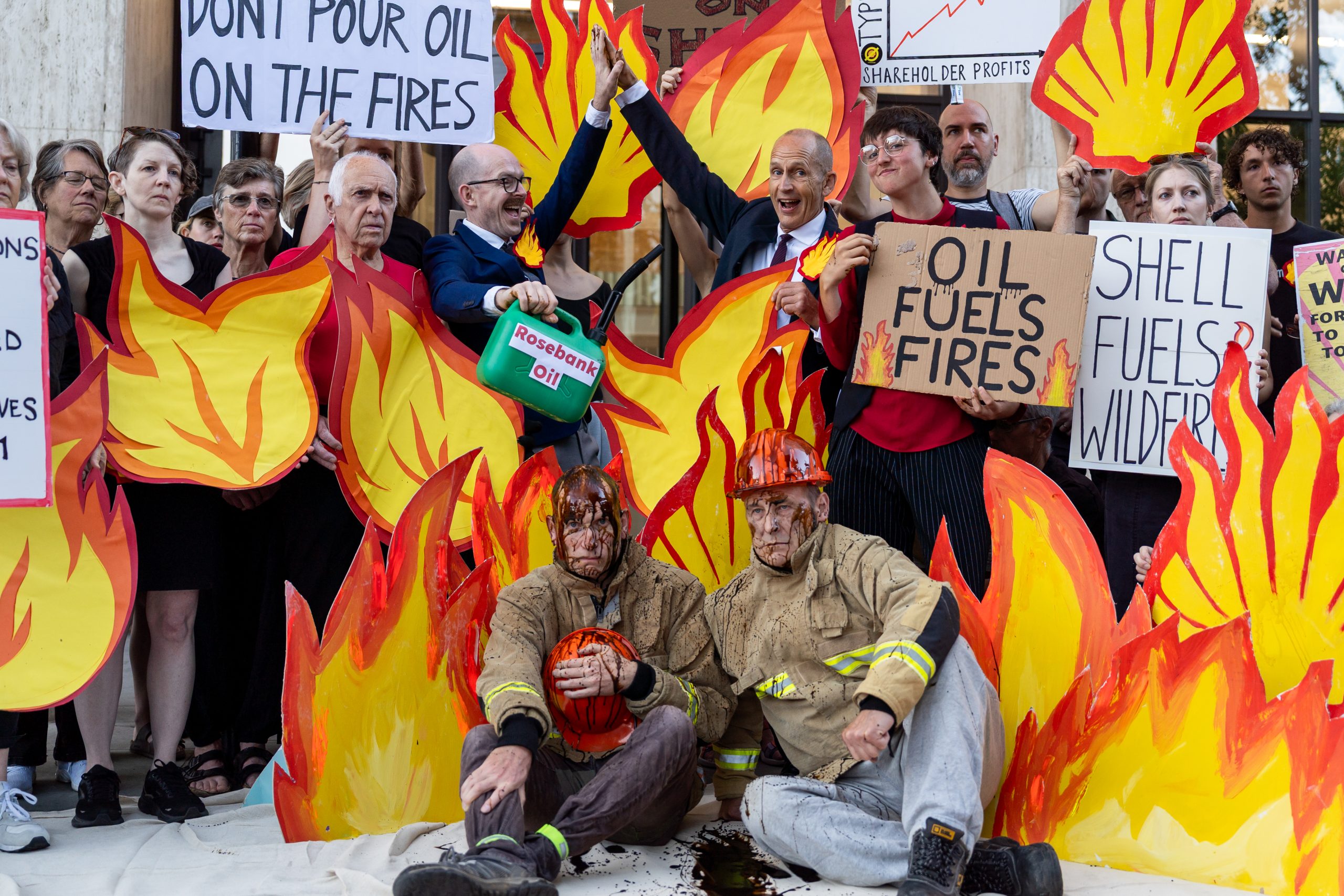
Campaigners from Fossil Free London dressed as firefighters while others poured a black liquid resembling oil over their heads, during a protest outside Shell’s global headquarters ahead of its Q2 results announcement, on July 29 2026. (Photo: Fossil Free London)
Campaigners from Fossil Free London dressed as firefighters while others poured a black liquid resembling oil over their heads, during a protest outside Shell’s global headquarters ahead of its Q2 results announcement, on July 29 2026. (Photo: Fossil Free London)
The stakes are high because the economics of the energy transition are increasingly clear. Renewable electricity is now among the cheapest forms of new power generation in much of the world. Yet many countries with abundant renewable resources continue to face prohibitively expensive borrowing costs, limiting their ability to invest at the speed required. Meanwhile, massive fossil fuel profits remain only lightly taxed or entirely avoided in many jurisdictions.
Analysis by the Global Alliance for Tax Justice and partners estimated that a 20% surtax on the profits of the world’s 100 largest oil and gas companies could have generated more than US$1 trillion since the Paris Agreement was signed in 2015.
Time to design mechanisms for justice
Whether governments choose that particular mechanism is ultimately a political decision. But the analysis illustrates a broader point: claims that public investment in climate resilience or clean energy is unaffordable sit uneasily alongside the scale of profits regularly generated by the fossil fuel industry, profits that, this quarter, are on course to nearly double in three months.
There are legitimate debates about the design of windfall taxes, competitiveness, investment incentives and international coordination. But the wider principle – that those who have benefited most from fossil fuel extraction should pay more towards managing its consequences – is no longer confined to campaign groups.
It is increasingly part of mainstream discussions among policymakers, economists and legal scholars and, if well designed, such mechanisms will incentivise investment where it’s needed and strengthen international coordination.
This summer has made that conversation harder to avoid. The question is no longer whether fossil fuel giants should pay for the enormous economic and human costs being suffered by communities every day due to our rapidly warming climate. It is when will governments step up and make them pay, for the damage already done and to build the resilience we need going forward?
After repeated delays, the Africa Energy Bank (AEB) was officially launched this week – tasked with financing oil and gas projects across the continent as global lenders retreat from such investments due to climate concerns.
Even as the world aims to transition away from fossil fuels, many African leaders have made clear they want to continue exploring and extracting the continent’s large oil and gas deposits – estimated at about 125 billion barrels of crude and more than 600 trillion cubic feet of gas – to fund economic development.
“The creation of the Africa Energy Bank reaffirms African governments’ determination to secure their own energy future,” said a statement announcing the institution’s launch at a meeting in Abuja, adding that the bank’s founders believed oil and gas remained vital to the continent’s energy systems.
The delays to the bank’s launch had raised questions about its momentum and whether it could mobilise investment to finance major African hydrocarbons initiatives in an era of energy transition.
The initial plan for the energy bank – a joint initiative of the African Petroleum Producers’ Organization (APPO) and the African Export-Import Bank (Afreximbank) – was to start operations in January 2025, but the bank’s opening was repeatedly pushed back.
Quest for investment
The bank said it had authorised capital of $5 billion but did not disclose how much of that had been subscribed or paid in by shareholders. It vowed to focus on projects that would help strengthen productive capacity, reduce reliance on imported fuels and promote trade in energy goods across the continent.
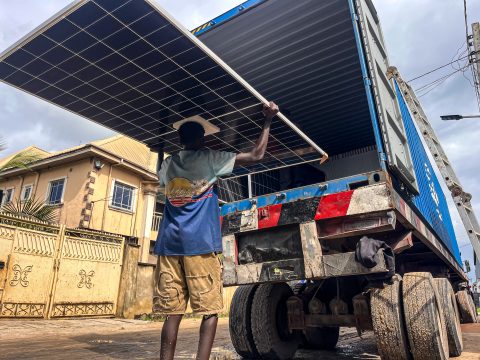
A solar power revolution is gathering pace in Africa and Nigeria wants a slice of the fast-growing industry, but competing with Chinese imports won’t be easy
With hundreds of millions of Africans still lacking electricity access, global electrification goals must reflect the continent’s realities and deliver development alongside connections
Critics of the African nation’s oil ambitions say referencing the International Energy Agency’s most pessimistic scenario for climate action is a risky policy
It estimates Africa’s energy investment needs at $200 billion, and energy analysts told Climate Home News the institution could struggle to mobilise enough resources to advance large-scale projects.
However, its backers said at the weekend launch that the bank would seek investment from governments, national oil companies, financial institutions and private investors across the continent to ensure that “Africa’s energy future is shaped by Africans”.
African-led approach to energy financing
Backers said the bank was needed because many traditional international lenders have curtailed financing for oil and gas projects, potentially hindering a more extended and gradual energy transition advocated by many African leaders as a way to ensure economic and social development.
Chantal Naidoo, executive director at Rabia – a South Africa-based just transition think-tank – said the creation of a bank to invest in fossil fuel projects reflected the complexities of switching to clean energy for African countries – noting the high cost of financing for clean energy projects.
At the same time, Naidoo said, the continent is expected to transition within a global system in which the rules are not applied equally – citing recent support for continued oil and gas development by the British and Norwegian governments.
“A binary choice between fossil fuels and renewables does little to address these complexities,” Naidoo said.
“Momentum lies with renewables”
But many climate campaigners say the bank should prioritise renewable energy investment as Africa builds out much of its energy system for the first time, fueling growth in solar power.
Data from energy think-tank Ember, published in August, projects that the continent will install a record 17 gigawatts (GW) of solar capacity in 2026 – equal to about 100,000 solar panels every day. This would mark the third consecutive year of record growth, following increases of 51% in 2025 and 25% in 2024.
Joseph Ibrahim, Nigeria campaign director for Secure Energy Project, a global advocacy organisation working to accelerate the energy transition, said Africa receives only about 2% of global clean energy spending, leaving plenty of scope for more.
“A new African energy bank should build on that momentum, not pull scarce public money away from it,” Ibrahim said.
With three-quarters of the year now past, it is virtually certain that 2026 will be the warmest or second-warmest year on record.
A rapidly strengthening El Niño, alongside human-caused global warming, made this year’s August the warmest on record and September the second-warmest.
El Niño is the warm phase of a recurring climate pattern in the tropical Pacific that releases heat from the ocean into the atmosphere and temporarily boosts global temperatures.
Carbon Brief’s analysis gives 2026 a 67% chance of surpassing 2024 as the warmest year on record across an average of six global temperature datasets.
In January, it is likely the groups that report global surface temperatures will be divided on whether 2026 officially beat 2024’s record.
Currently, the odds for a record year range from as high as 97% in Berkeley Earth’s dataset to less than 20% in European Copernicus/ECMWF’s ERA5 reanalysis product.
With El Niño expected to intensify into the winter, Carbon Brief projects that 2027 will be 1.7C above pre-industrial levels, with a 96% chance that it is the warmest year on record.
In this latest “state of the climate” quarterly update, Carbon Brief finds:
August 2026 was the warmest August on record in all six major datasets, at around 0.12C above the previous record. September was the second-warmest September, behind 2023.
January-September was the second-warmest such period on record, at around 1.45C above pre-industrial levels, behind only 2024.
El Niño broke the daily “Niño3.4” region record in September and has stayed above the previous record every day since. Nearly all forecast model runs have it as the strongest El Niño on record, with a peak of around 4C occurring this winter.
Around 22% of the world’s surface saw its warmest July-September on record, including much of the tropical Pacific, the western Mediterranean and Iberia. Western Europe had its hottest summer on record and Spain its warmest September, beating the previous record by 0.7C.
Carbon Brief projects that 2026 will end up around 1.52C above pre-industrial levels, with a 67% chance of beating 2024’s record.
Whether 2026 is declared the warmest year depends on the dataset; a record is likely in Berkeley Earth and NASA GISTEMP, is too close to call in HadCRUT5, JRA-3Q and NOAA and is unlikely in ERA5.
Earth’s energy imbalance has more than doubled since the start of the satellite record, from around 0.5 watts per metre squared (W/m2) in the 2000s to around 1.25W/m2 over the past decade.
The Arctic sea ice minimum was tied for 10th lowest in the satellite record, while Antarctic sea ice saw its third-lowest winter peak.
This year’s record-setting El Niño will have its largest effect on global temperatures in 2027. Carbon Brief projects 2027 at around 1.7C above pre-industrial levels, with a 96% chance that it will be the warmest year on record.
A record August and the second-warmest year to date
Carbon Brief analyses records from six different groups that report global surface temperatures: