

A judge reversed a 2022 decision by the Texas Commission on Environmental Quality that involved its controversial “one-mile rule” to deny hearing requests.
For the second time in three weeks, a court struck down an air pollution permit issued by Texas’ environmental regulator.
Texas Court Strikes Down Air Pollution Permit for Gulf Coast Oil Terminal


The board of the Fund for Responding to Loss and Damage (FRLD) will decide on Thursday on whether to “provisionally set aside” $20 million for Nepal to deal with some of the effects of the climate-driven flood it suffered in August.
The motion, seen by Climate Home News, has been drafted by a group of board members from both developed and developing countries and so is likely to pass easily at the fund’s first-ever extraordinary board meeting on October 22.
It invites the government of Nepal to submit a proposal for how to use the money, with the board then deciding at one of its regular board meetings whether to approve the proposal or not.
While Nepali officials have described $20 million as merely “symbolic” in the face of the $4.8 billion estimated costs of recovery and reconstruction, it would be the first time the new FRLD – agreed in 2022 months after devastating floods in Pakistan – has set aside money for a specific disaster.
Until now the fund has only taken requests through a single call for proposals, launched at COP30 in Belém last November, that gave countries six months to submit requests.
Most of the 180 projects the FRLD is currently considering are designed to help countries avoid damage from future climate disasters, for example by strengthening responses to floods in Bangladesh and Lagos.
The draft decision says Nepal’s proposal will serve as a pilot for how funding requests can be submitted outside of the fund’s current timetable. That could let governments seek funds quickly after a climate disaster strikes, rather than waiting for the next call.
This arrangement would set the fund apart from other United Nations funds designed for climate adaptation or cutting emissions like the Green Climate Fund.
Climate campaigners from Fill the Fund said the draft decision is “a real step forward” as it is “the first time this Fund has moved to respond to a specific disaster”.
Too little, too late
The FRLD was agreed by governments at COP27, set up and operationalised at COP28 in 2023 but has yet to award any money. The 180 funding requests it is currently considering would cost around $2.8 billion, but it only has $350 million to allocate.
The United Nations Secretary-General António Guterres has described the amount of money available in the fund as “ridiculously small” and Fill the Fund said $20 million “is a meaningful signal but it is a drop against an ocean of need”.
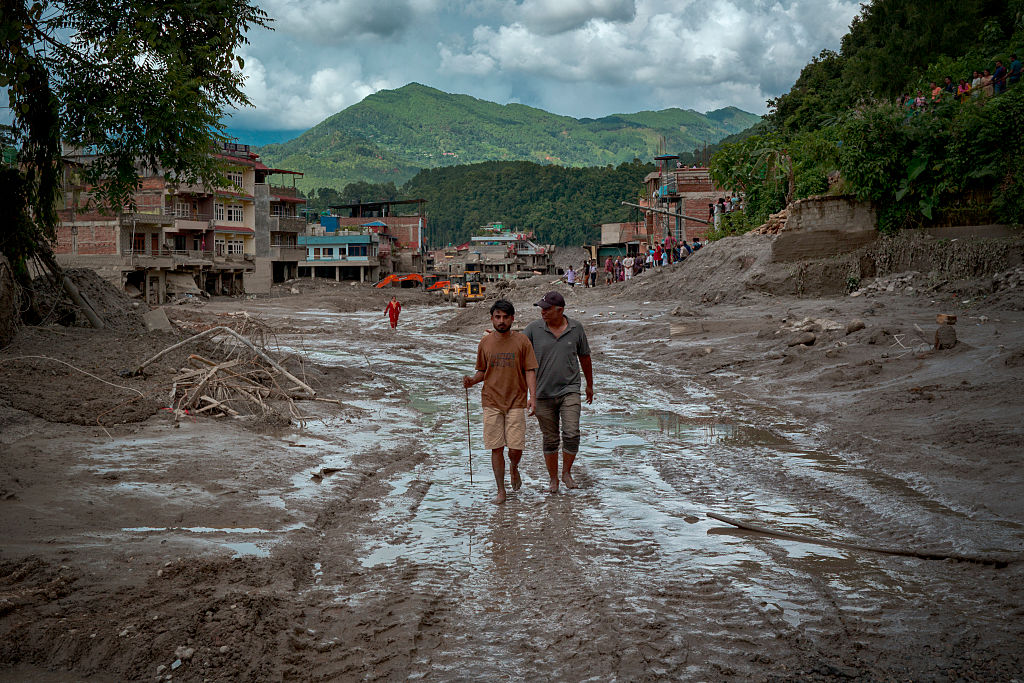
A glacial rock and ice collapse sent a torrent of water and debris through Nepal and the Chinese-administered region of Tibet on August 26. It killed more than 1,400 people, left thousands more missing and destroyed homes, bridges, roads and hydropower plants. Nepal’s finance and environment ministers quickly appealed to the FRLD board for funds, saying that “time is of the essence”.
Their call was followed swiftly by a letter from developing country FRLD board members urging the board’s co-chairs to organise an extraordinary meeting to allocate funds to Nepal.
But developed countries initially called for an informal consultation rather than a full board meeting. It took a further 45 days for the board’s co-chairs to organise an extraordinary board meeting for October 22 and to draft a motion for adoption.
Fill the Fund called for a permanent way of the fund rapid responding to disasters as “Nepal should not have required historic letters, an informal drafting group and the Fund’s first-ever extraordinary meeting simply to unlock an emergency response. The next country cannot wait two months and a bureaucratic marathon. Speed must be built in, not improvised.”
The post UN’s loss and damage fund set to give Nepal $20m for flood recovery appeared first on Climate Home News.
UN’s loss and damage fund set to give Nepal $20m for flood recovery
Some 58% of countries have met a UN call to submit new pledges on addressing nature loss – two years after the original deadline – according to Carbon Brief analysis.
Countries were asked to submit new pledges, known as national biodiversity strategies and action plans (NBSAPs), by the start of the COP16 biodiversity summit in October 2024.
After only 15% of nations met the original deadline, countries agreed at the summit to a new text that “urges” countries to release their NBSAPs “as soon as possible”.
Carbon Brief analysis shows that 113 countries have now come forward with new NBSAPs – up from 55 nations a year ago.
Countries will gather in Yerevan, Armenia, next week for COP17.
COP17 marks the halfway point of the Kunming-Montreal Global Biodiversity Framework (GBF), a landmark agreement made in 2022 to reverse nature decline by 2030.
The summit will provide the stage for the first global review of countries’ progress towards meeting the targets of the GBF.
Global review
In Montreal, Canada, in 2022, nearly every country in the world agreed to the GBF. The overall “mission” of the framework is to “halt and reverse” biodiversity loss by 2030.
The GBF includes a list of 23 targets for 2030. They cover an expansive range of topics, including restoring ecosystems, addressing climate change and providing developing nations with finance to help cover the costs of protecting nature.
As part of the GBF and its underlying documents, countries agreed to a schedule for monitoring their progress towards achieving the 2030 targets.
This included the preparation of a “global report” of progress coordinated by the UN, which will inform a “global review” undertaken by countries at COP17.
The global report draws on countries’ NBSAPs and national targets. It also draws on countries’ seventh national reports, which were due to be submitted to the UN in February of this year.
Carbon Brief analysis shows that 113 out of 196 parties (58%) have now met the call to produce a new NBSAP – up from 55 nations just a year ago.
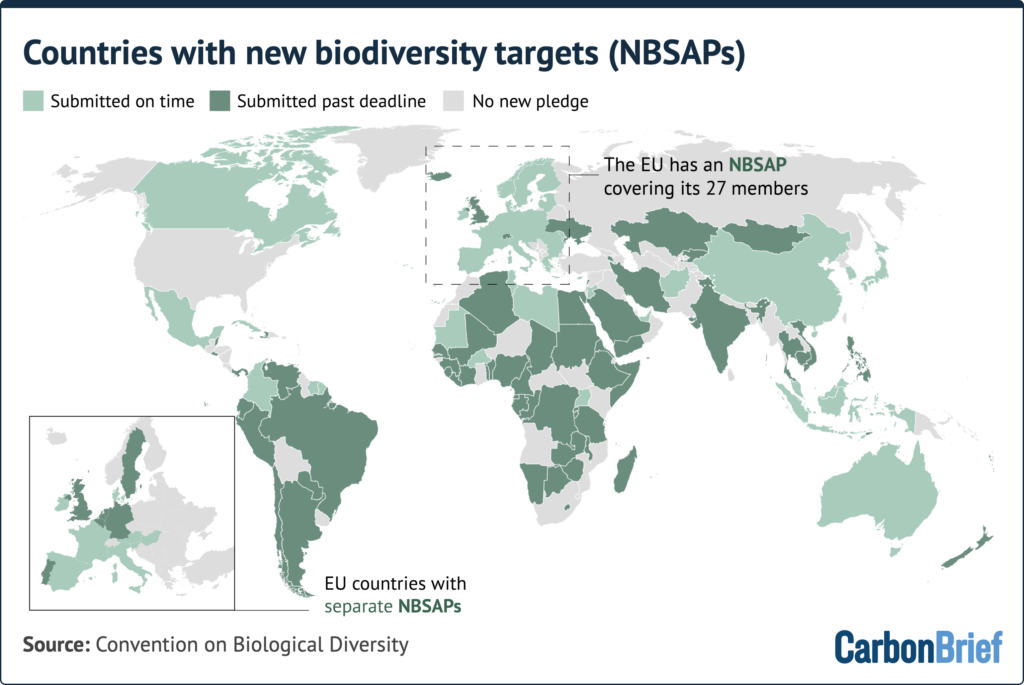
Since last year, many African nations have now published new NBSAPs.
African countries that have released new plans in the last year include: Algeria, Benin, Botswana, Cameroon, Comoros, Congo, Côte d’Ivoire, the Democratic Republic of Congo, Egypt, Equatorial Guinea, Eritrea, Ethiopia, Gabon, Gambia, Guinea, Lesotho, Liberia, Madagascar, Malawi, Mali, Namibia, Rwanda, Senegal, Sierra Leone, Somalia, Sudan, Zambia and Zimbabwe.
More South American nations have also published new NBSAPs. This includes Brazil – the world’s most biodiverse nation – as well as Belize and Chile.
COP17 host nation Armenia published its new NBSAP in April.
According to the GBF and its underlying documents, countries that were “not in a position” to meet the deadline to submit NBSAPs ahead of COP16 were requested to instead submit national targets.
Unlike NBSAPs, national targets simply list biodiversity goals that countries will aim for, without an accompanying plan for how they will be achieved.
Four of the world’s megadiverse nations – countries that account for the majority of Earth’s species – have not yet published new NBSAPs. These countries are Papua New Guinea, Peru, South Africa and the US.
The US is the only UN member country that is not a signatory to the UN Convention on Biological Diversity.
The country with the most land on Earth, Russia, has also not produced a new NBSAP.
By the end of COP16, some 119 parties had produced at least one national target. Two years later, this figure has risen to 175, or 89% of countries.
In addition, around half of countries met the deadline to produce their seventh national reports by February of this year. This figure has now risen to 73% of countries.
Over the past two years, many developing countries have expressed concerns that a lack of available funding has prevented them from publishing their NBSAPs.
A spokesperson for the Global Environment Facility (GEF), the multilateral fund that provides funding to help with the preparation of NBSAPs, told Carbon Brief in 2025 that 120 out of 139 countries that had requested financial support since COP16 had been able to access it.
The spokesperson added that the UN Environment Programme was “working to resolve outstanding issues” to allow the remaining 19 countries to access financial assistance.
Related

The post COP17: Which countries have released new pledges to tackle nature loss? appeared first on Carbon Brief.
COP17: Which countries have released new pledges to tackle nature loss?
The World Bank president said on Friday his organisation will continue to support some gas projects in developing countries alongside renewables, nuclear and hydropower, despite criticism from climate campaigners who say fossil gas is expensive and polluting.
“Homes, mines, factories, farms, and growing cities – what do they need? Reliable, affordable baseload power,” Ajay Banga told the bank’s annual meeting in Bangkok on Friday. “Our approach is balanced by design – a full mix of renewables, hydro, gas where appropriate, nuclear when it makes sense, transmission, grids, storage – the whole thing.”
His comments come in a week during which he faced pressure from the US to finance more gas projects and from climate campaigners to stop funding fossil fuels altogether, part of a tightrope he has walked on the bank’s climate policy since Donald Trump’s re-election in 2025.
The bank ended its support for coal around ten years ago and last year, for the first time, funded no oil projects. It has ended support for gas exploration but still backs some projects to do with transporting and using gas, such as a $140-million project to help Benin, Côte d’Ivoire and Togo in West Africa to import liquefied natural gas (LNG).
While its overall support for fossil fuels wanes, the bank’s support for clean energy has been at historic highs over the last few years, with funding of just under $10 billion a year in 2023, 2024 and 2025 – compared to under $1.5 billion a year for fossil fuels.
On Monday, the head of Pakistan’s Indus Consortium, Hussain Jarwar, asked Banga at a civil society townhall meeting why the bank is supporting a “volatile” energy source like LNG, which is pushing economies and consumers into debt “when real renewable energy solutions like solar [are] available and supporting communities and industries for clean, accessible and affordable energy source”. Global LNG prices hit record highs earlier this year as the Iran war squeezed supplies.
Banga replied that the bank is working with countries to source “baseload productive power” and that “if Pakistan wants to build an energy system that is more self-reliant by going further on different forms of baseload plus top-up energy, we’re more than happy to work with it”. “We’ve got no biases in the system – our job is that electricity and water are human rights,” he added.
His answer did not satisfy climate campaigners. Sunil Acharya, just transition lead at Recourse, an NGO that works on sustainable development finance, said in a statement that the bank is moving in the wrong direction and Banga’s “framing of wind and solar as a ‘top-up’ to nuclear, hydropower and gas misses the opportunity to transform energy systems”.
“Fossil gas is bad economics – it exposes countries to volatile global markets and debt while locking public resources into costly infrastructure,” the Nepali campaigner said. “The World Bank must stop reproducing the extractive development model of the fossil fuel era and redirect public finance towards 100% renewable economies that deliver energy for all, protect people and nature, and put people’s priorities before private profit.”
US pressure from Scott Bessent
On Wednesday, however, Banga was pressured from the other direction. US Treasury Secretary Scott Bessent, who skipped the Bangkok meeting, issued a statement praising the bank for “beginning to refocus on its core mission of reducing poverty and raising economic growth” after what he called “years of mission creep”.
He said the bank should “formally retire its prohibition on financing” gas and oil exploration and production as it “cannot credibly invoke country ownership while categorically excluding upstream projects before their development merits are even assessed”. He argued that supporting gas projects would help extend electricity access in Africa.
The US is a major gas exporter and analysts are warning its gas companies will struggle to sell their product abroad in the coming years, as US LNG production expands while buyers in Europe and Asia move away from gas to cleaner sources of electricity.
-
World Bank’s climate work can endure without finance target, experts say
Even though the global lender has ditched a headline goal for its financing with climate benefits, it has decided to continue its climate action plan in the face of US pressure -
In a major reversal, the World Bank is backing mega dams
Despite opposition, the bank has approved the first of five big dam projects expected to get its support in the coming months -
Countries urged to ramp up “insufficient” nature policies at COP17
A major UN report that will inform biodiversity negotiations in Armenia shows countries have made some progress but are still off track for a landmark goal to protect 30% of land and oceans by 2030
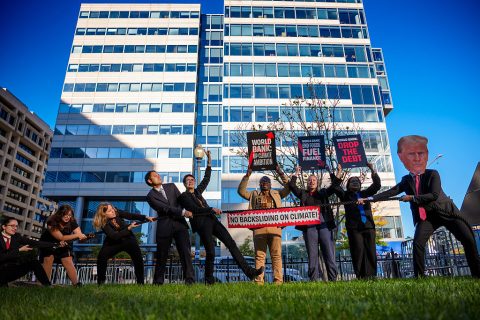


In July, under US pressure, the World Bank scrapped its target for 45% of its finance to go to climate projects. But, with support from a broad majority of countries, it renewed its climate change action plan. The compromise “could have been a lot worse”, E3G climate policy advisor Danny Scull said at the time.
Other multilateral development banks that have the US as a major shareholder, like the Inter-American Development Bank and Asian Development Bank, are now expected to face pressure to scrap their climate finance targets too.
In June 2025, the World Bank ended its ban on support for nuclear power – a move that was welcomed by the US. In his speech on Friday, Banga said the bank would