

Some 58% of countries have met a UN call to submit new pledges on addressing nature loss – two years after the original deadline – according to Carbon Brief analysis.
Countries were asked to submit new pledges, known as national biodiversity strategies and action plans (NBSAPs), by the start of the COP16 biodiversity summit in October 2024.
After only 15% of nations met the original deadline, countries agreed at the summit to a new text that “urges” countries to release their NBSAPs “as soon as possible”.
Carbon Brief analysis shows that 113 countries have now come forward with new NBSAPs – up from 55 nations a year ago.
Countries will gather in Yerevan, Armenia, next week for COP17.
COP17 marks the halfway point of the Kunming-Montreal Global Biodiversity Framework (GBF), a landmark agreement made in 2022 to reverse nature decline by 2030.
The summit will provide the stage for the first global review of countries’ progress towards meeting the targets of the GBF.
Global review
In Montreal, Canada, in 2022, nearly every country in the world agreed to the GBF. The overall “mission” of the framework is to “halt and reverse” biodiversity loss by 2030.
The GBF includes a list of 23 targets for 2030. They cover an expansive range of topics, including restoring ecosystems, addressing climate change and providing developing nations with finance to help cover the costs of protecting nature.
As part of the GBF and its underlying documents, countries agreed to a schedule for monitoring their progress towards achieving the 2030 targets.
This included the preparation of a “global report” of progress coordinated by the UN, which will inform a “global review” undertaken by countries at COP17.
The global report draws on countries’ NBSAPs and national targets. It also draws on countries’ seventh national reports, which were due to be submitted to the UN in February of this year.
Carbon Brief analysis shows that 113 out of 196 parties (58%) have now met the call to produce a new NBSAP – up from 55 nations just a year ago.
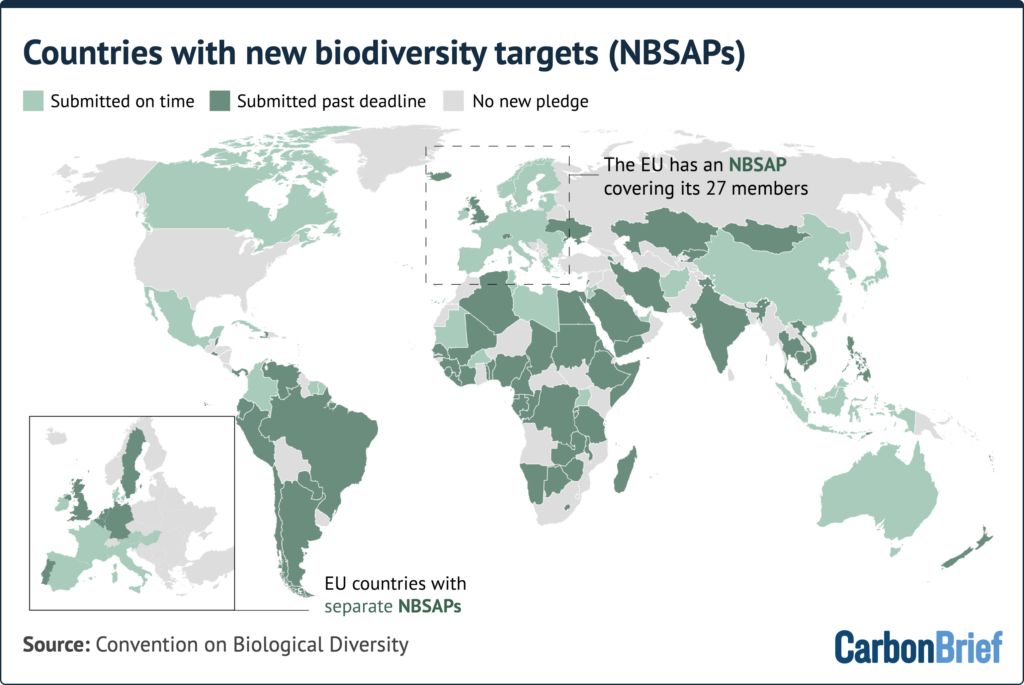
Since last year, many African nations have now published new NBSAPs.
African countries that have released new plans in the last year include: Algeria, Benin, Botswana, Cameroon, Comoros, Congo, Côte d’Ivoire, the Democratic Republic of Congo, Egypt, Equatorial Guinea, Eritrea, Ethiopia, Gabon, Gambia, Guinea, Lesotho, Liberia, Madagascar, Malawi, Mali, Namibia, Rwanda, Senegal, Sierra Leone, Somalia, Sudan, Zambia and Zimbabwe.
More South American nations have also published new NBSAPs. This includes Brazil – the world’s most biodiverse nation – as well as Belize and Chile.
COP17 host nation Armenia published its new NBSAP in April.
According to the GBF and its underlying documents, countries that were “not in a position” to meet the deadline to submit NBSAPs ahead of COP16 were requested to instead submit national targets.
Unlike NBSAPs, national targets simply list biodiversity goals that countries will aim for, without an accompanying plan for how they will be achieved.
Four of the world’s megadiverse nations – countries that account for the majority of Earth’s species – have not yet published new NBSAPs. These countries are Papua New Guinea, Peru, South Africa and the US.
The US is the only UN member country that is not a signatory to the UN Convention on Biological Diversity.
The country with the most land on Earth, Russia, has also not produced a new NBSAP.
By the end of COP16, some 119 parties had produced at least one national target. Two years later, this figure has risen to 175, or 89% of countries.
In addition, around half of countries met the deadline to produce their seventh national reports by February of this year. This figure has now risen to 73% of countries.
Over the past two years, many developing countries have expressed concerns that a lack of available funding has prevented them from publishing their NBSAPs.
A spokesperson for the Global Environment Facility (GEF), the multilateral fund that provides funding to help with the preparation of NBSAPs, told Carbon Brief in 2025 that 120 out of 139 countries that had requested financial support since COP16 had been able to access it.
The spokesperson added that the UN Environment Programme was “working to resolve outstanding issues” to allow the remaining 19 countries to access financial assistance.
Related

The post COP17: Which countries have released new pledges to tackle nature loss? appeared first on Carbon Brief.
COP17: Which countries have released new pledges to tackle nature loss?

China’s carbon dioxide (CO2) emissions fell by 3.1% in the third quarter of 2026, as the Hormuz crisis continued to hit oil demand and coal use also dropped.
This guest post is by:
Lauri Myllyvirta, lead analyst at the Centre for Research on Energy and Clean Air
This was the largest quarterly reduction since the 2022 Covid lockdowns and means that China’s CO2 emissions have now fallen by an estimated 0.5% in the year to date.
The new analysis for Carbon Brief, based on official figures and commercial data, shows that coal use fell by 3% year-on-year in the third quarter of 2026, while oil was down 4%.
The main drivers were a fall in power-sector coal consumption, a continued sharp reduction in transport oil consumption and slowing growth in the coal-to-chemical industry.
The sharp decline in China’s CO2 emissions extends a “flat or falling” trend that began in March 2024 and has now lasted more than two years, as shown in the figure below.
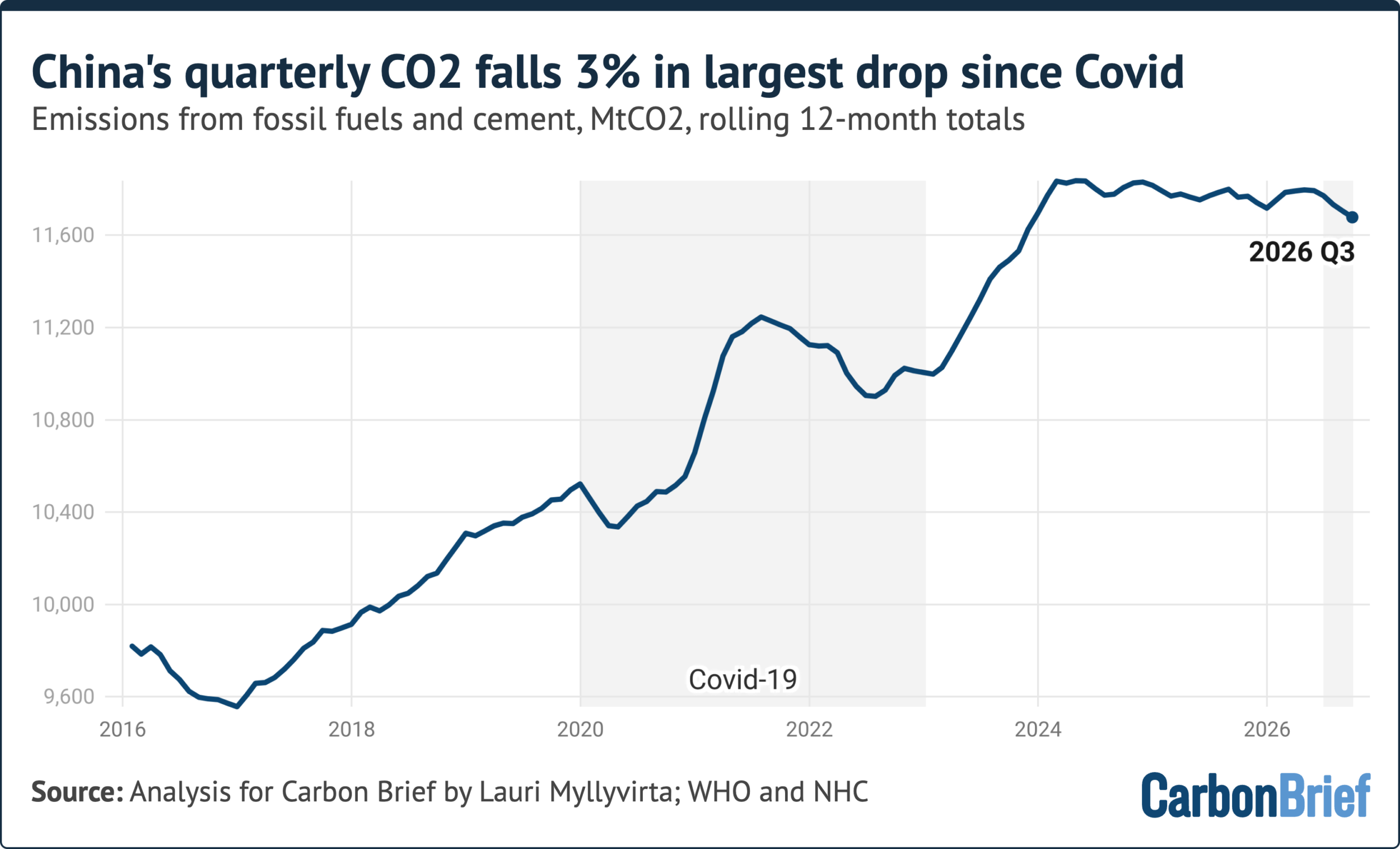
The outlook for China’s CO2 emissions depends on the balance between rising energy demand, clean-energy growth and the government response to a GDP slowdown.
Decline drivers
Key drivers of the fall in CO2 in the third quarter of 2026 included a 3.3% drop in coal-power generation, after demand growth slowed and the amount of “wasted” wind and solar fell.
Power generation from solar, wind and nuclear increased by 110 terawatt hours (TWh) year-on-year, more than twice as much as the growth in total electricity demand. This added clean-power generation equal to Germany’s total power output in the same time period.
The fall in coal-power output and CO2 emissions came despite the fact that China continues to build new coal-power capacity at near-record rates. This means that average running hours for coal plants are falling even faster than total generation, eroding their profits.
Meanwhile, transport oil consumption continued to fall sharply, down 9% year-on-year in the third quarter of 2026. Electric vehicles (EVs) continued to gain market share, hitting a record 67% of passenger car sales and 50% of heavy trucks in September.
The amount of electricity used by EVs grew by 53%, much faster than the number of EVs on the road, showing increased usage of the existing fleet in preference to fuelled vehicles.
Elsewhere, growth in the coal-to-chemical industry continued to slow down in the third quarter of 2026. The sector has been a key source of emissions growth, but high coal prices have weakened profitability and higher output prices hurt downstream demand.
Finally, CO2 emissions from cement and steel production continued to fall in the third quarter, as the contraction in construction volumes accelerated.
Outlook for emissions
Energy consumption growth has been falling after a period of exceptionally high growth during Covid, while clean-power growth has been robust.
This makes it likely that the growth in clean-power generation will exceed total energy demand growth this year, maintaining the structural fall in fossil-fuel use.
Looking ahead, this balance also relies on progress in removing barriers to new solar and wind power being added to the grid, which result in some clean electricity being “wasted”.
The recent slowdown in energy demand growth is partly – but not fully – explained by exceptionally mild weather in the third quarter.
Another key factor is weaker GDP growth. Since reported GDP growth remains within target, however, there is reduced pressure for further stimulus policies.
The focus of the economic stimulus announced to date is “six networks”, which includes the power grid and the transportation network.
These networks are highly relevant for energy and emissions – and they are already covered by policies that emphasise “green” and zero-carbon solutions.

The post Analysis: China’s quarterly CO2 falls 3% in largest drop since Covid appeared first on Carbon Brief.
Analysis: China’s quarterly CO2 falls 3% in largest drop since Covid
Climate Change
Coles, Woolworths grilled as beef buyers receive fail grade on new deforestation scorecard
MELBOURNE, Friday 6 November 2026 — As Coles holds its Annual General Meeting today, Greenpeace Australia Pacific has branded the major supermarkets with a fail grade on their commitment to source deforestation-free beef, with an updated scorecard revealing none of the major beef buyers are following through on forest sustainability commitments.
It comes after Woolworths’s AGM last week where the board copped a grilling by environmentalists and shareholders over its failed sustainability commitments. Both Coles and Woolworths committed to eliminating deforestation in their supply chains by the end of 2025, but a year past the deadline, neither company could guarantee that their beef was not sourced from deforested pastures.
From outside the Coles AGM, Adele Chasson, Nature Policy Lead at Greenpeace Australia Pacific, said:
“This is a report card Coles and Woolworths should be ashamed to take home. While all major beef buyers had promised to take deforestation off the shelves, none of them followed through. Shareholders and the public demanded answers from Woolworths last week and from Coles today, and we will continue to hold their feet to the fire on their promises.
“Beef is the leading cause of deforestation in Australia, and Coles and Woolworths keep putting off action while koalas continue losing their homes. Aussies must be able to get their groceries without having to worry if their dinner is contributing to the bulldozing of forests or driving extinction of iconic Australian animals.
“Without strong, rapid implementation plans, these companies continue with business as usual, flying in the face of Australia’s deforestation crisis. Big beef buyers like Coles and Woolworths must stop the bulldozers now, make good on their sustainability promises and play their part in stopping Australian forest destruction.”
The scorecard assesses how eight of Australia’s largest beef buyers stack up against a conversion and deforestation-free target. It charts whether the major supermarkets, Aldi, McDonalds, Hungry Jacks, Teys, Metcash/IGA and JBS are taking proper action to end Australia’s deforestation crisis. They all failed.
-ENDS-
Media contact: Kimberley Bernard on 0407 581 404 or kbernard@greenpeace.org
Coles, Woolworths grilled as beef buyers receive fail grade on new deforestation scorecard
Özgür Özel is the leader of Turkey’s main opposition “New Party” and a member of parliament from Manisa.
The world is running out of time to deliver on the Paris Agreement. The UN Environment Programme’s latest Emissions Gap Report concludes that the chance of keeping warming below 1.5C without overshooting it is gone. Even if every country delivers its current national pledges, the planet is heading for about 2.6C of warming this century.
This is the backdrop as governments and their leaders gather in Antalya for COP31, ten years after the Paris Agreement took effect. Turkey lies in the Mediterranean, one of the regions most exposed to climate change, and hosting the summit is a real opportunity.
It is also a responsibility, and that responsibility begins at home. The world does not lack targets. What it has lacked – almost everywhere – is delivery. If Antalya is remembered for anything, it should be for shifting the focus from what countries promise to what they actually do.
For many people in Turkey, the climate crisis is already part of daily life. In 2021, forests in Manavgat, a district of Antalya, burned for more than a week. Last year, wildfires forced more than 50,000 people from their homes around the western coast city of Izmir. This October, Istanbul had its heaviest rainfall in more than 80 years, with the floods killing at least eight people.
COP31 Briefing: What to expect from the Antalya climate summit?
Electrification, the fossil fuel transition, adaptation to rising impacts, climate science and trade are key themes as governments gather for COP31 in Türkiye
