

The World Bank president said on Friday his organisation will continue to support some gas projects in developing countries alongside renewables, nuclear and hydropower, despite criticism from climate campaigners who say fossil gas is expensive and polluting.
“Homes, mines, factories, farms, and growing cities – what do they need? Reliable, affordable baseload power,” Ajay Banga told the bank’s annual meeting in Bangkok on Friday. “Our approach is balanced by design – a full mix of renewables, hydro, gas where appropriate, nuclear when it makes sense, transmission, grids, storage – the whole thing.”
His comments come in a week during which he faced pressure from the US to finance more gas projects and from climate campaigners to stop funding fossil fuels altogether, part of a tightrope he has walked on the bank’s climate policy since Donald Trump’s re-election in 2025.
The bank ended its support for coal around ten years ago and last year, for the first time, funded no oil projects. It has ended support for gas exploration but still backs some projects to do with transporting and using gas, such as a $140-million project to help Benin, Côte d’Ivoire and Togo in West Africa to import liquefied natural gas (LNG).
While its overall support for fossil fuels wanes, the bank’s support for clean energy has been at historic highs over the last few years, with funding of just under $10 billion a year in 2023, 2024 and 2025 – compared to under $1.5 billion a year for fossil fuels.
On Monday, the head of Pakistan’s Indus Consortium, Hussain Jarwar, asked Banga at a civil society townhall meeting why the bank is supporting a “volatile” energy source like LNG, which is pushing economies and consumers into debt “when real renewable energy solutions like solar [are] available and supporting communities and industries for clean, accessible and affordable energy source”. Global LNG prices hit record highs earlier this year as the Iran war squeezed supplies.
Banga replied that the bank is working with countries to source “baseload productive power” and that “if Pakistan wants to build an energy system that is more self-reliant by going further on different forms of baseload plus top-up energy, we’re more than happy to work with it”. “We’ve got no biases in the system – our job is that electricity and water are human rights,” he added.
His answer did not satisfy climate campaigners. Sunil Acharya, just transition lead at Recourse, an NGO that works on sustainable development finance, said in a statement that the bank is moving in the wrong direction and Banga’s “framing of wind and solar as a ‘top-up’ to nuclear, hydropower and gas misses the opportunity to transform energy systems”.
“Fossil gas is bad economics – it exposes countries to volatile global markets and debt while locking public resources into costly infrastructure,” the Nepali campaigner said. “The World Bank must stop reproducing the extractive development model of the fossil fuel era and redirect public finance towards 100% renewable economies that deliver energy for all, protect people and nature, and put people’s priorities before private profit.”
US pressure from Scott Bessent
On Wednesday, however, Banga was pressured from the other direction. US Treasury Secretary Scott Bessent, who skipped the Bangkok meeting, issued a statement praising the bank for “beginning to refocus on its core mission of reducing poverty and raising economic growth” after what he called “years of mission creep”.
He said the bank should “formally retire its prohibition on financing” gas and oil exploration and production as it “cannot credibly invoke country ownership while categorically excluding upstream projects before their development merits are even assessed”. He argued that supporting gas projects would help extend electricity access in Africa.
The US is a major gas exporter and analysts are warning its gas companies will struggle to sell their product abroad in the coming years, as US LNG production expands while buyers in Europe and Asia move away from gas to cleaner sources of electricity.
-
World Bank’s climate work can endure without finance target, experts say
Even though the global lender has ditched a headline goal for its financing with climate benefits, it has decided to continue its climate action plan in the face of US pressure -
In a major reversal, the World Bank is backing mega dams
Despite opposition, the bank has approved the first of five big dam projects expected to get its support in the coming months -
Countries urged to ramp up “insufficient” nature policies at COP17
A major UN report that will inform biodiversity negotiations in Armenia shows countries have made some progress but are still off track for a landmark goal to protect 30% of land and oceans by 2030



In July, under US pressure, the World Bank scrapped its target for 45% of its finance to go to climate projects. But, with support from a broad majority of countries, it renewed its climate change action plan. The compromise “could have been a lot worse”, E3G climate policy advisor Danny Scull said at the time.
Other multilateral development banks that have the US as a major shareholder, like the Inter-American Development Bank and Asian Development Bank, are now expected to face pressure to scrap their climate finance targets too.
In June 2025, the World Bank ended its ban on support for nuclear power – a move that was welcomed by the US. In his speech on Friday, Banga said the bank would support nuclear retrofits – the modernisation of existing nuclear power stations – alongside the International Atomic Energy Agency, noting that this was “the first such work in 50 years for the bank”.
The post Under US pressure, World Bank says it will back gas “where appropriate” appeared first on Climate Home News.
Under US pressure, World Bank says it will back gas “where appropriate”

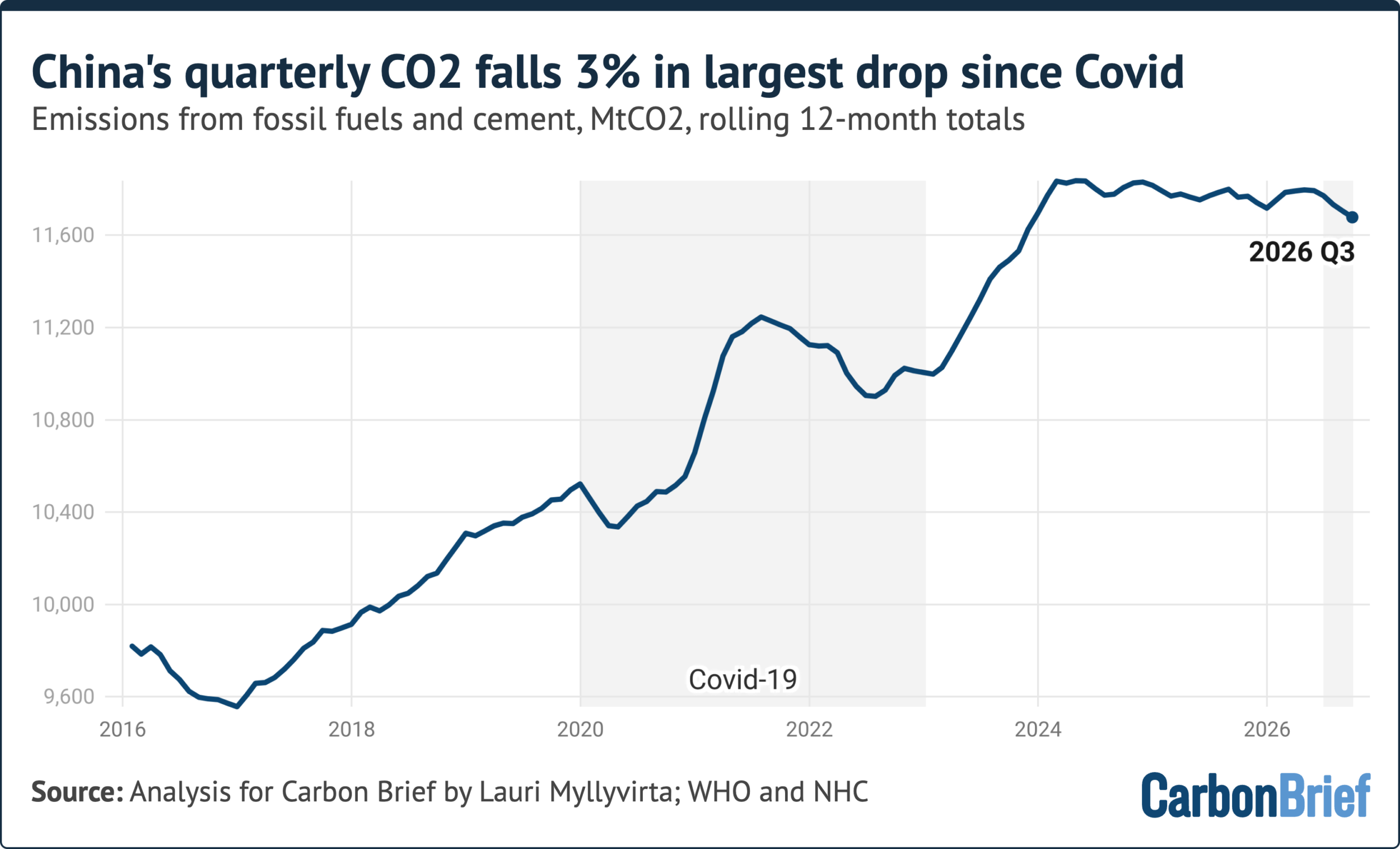
China’s carbon dioxide (CO2) emissions fell by 3.1% in the third quarter of 2026, as the Hormuz crisis continued to hit oil demand and coal use also dropped.
This guest post is by:
Lauri Myllyvirta, lead analyst at the Centre for Research on Energy and Clean Air
This was the largest quarterly reduction since the 2022 Covid lockdowns and means that China’s CO2 emissions have now fallen by an estimated 0.5% in the year to date.
The new analysis for Carbon Brief, based on official figures and commercial data, shows that coal use fell by 3% year-on-year in the third quarter of 2026, while oil was down 4%.
The main drivers were a fall in power-sector coal consumption, a continued sharp reduction in transport oil consumption and slowing growth in the coal-to-chemical industry.
The sharp decline in China’s CO2 emissions extends a “flat or falling” trend that began in March 2024 and has now lasted more than two years, as shown in the figure below.
The outlook for China’s CO2 emissions depends on the balance between rising energy demand, clean-energy growth and the government response to a GDP slowdown.
Decline drivers
Key drivers of the fall in CO2 in the third quarter of 2026 included a 3.3% drop in coal-power generation, after demand growth slowed and the amount of “wasted” wind and solar fell.
Power generation from solar, wind and nuclear increased by 110 terawatt hours (TWh) year-on-year, more than twice as much as the growth in total electricity demand. This added clean-power generation equal to Germany’s total power output in the same time period.
The fall in coal-power output and CO2 emissions came despite the fact that China continues to build new coal-power capacity at near-record rates. This means that average running hours for coal plants are falling even faster than total generation, eroding their profits.
Meanwhile, transport oil consumption continued to fall sharply, down 9% year-on-year in the third quarter of 2026. Electric vehicles (EVs) continued to gain market share, hitting a record 67% of passenger car sales and 50% of heavy trucks in September.
The amount of electricity used by EVs grew by 53%, much faster than the number of EVs on the road, showing increased usage of the existing fleet in preference to fuelled vehicles.
Elsewhere, growth in the coal-to-chemical industry continued to slow down in the third quarter of 2026. The sector has been a key source of emissions growth, but high coal prices have weakened profitability and higher output prices hurt downstream demand.
Finally, CO2 emissions from cement and steel production continued to fall in the third quarter, as the contraction in construction volumes accelerated.
Outlook for emissions
Energy consumption growth has been falling after a period of exceptionally high growth during Covid, while clean-power growth has been robust.
This makes it likely that the growth in clean-power generation will exceed total energy demand growth this year, maintaining the structural fall in fossil-fuel use.
Looking ahead, this balance also relies on progress in removing barriers to new solar and wind power being added to the grid, which result in some clean electricity being “wasted”.
The recent slowdown in energy demand growth is partly – but not fully – explained by exceptionally mild weather in the third quarter.
Another key factor is weaker GDP growth. Since reported GDP growth remains within target, however, there is reduced pressure for further stimulus policies.
The focus of the economic stimulus announced to date is “six networks”, which includes the power grid and the transportation network.
These networks are highly relevant for energy and emissions – and they are already covered by policies that emphasise “green” and zero-carbon solutions.

The post Analysis: China’s quarterly CO2 falls 3% in largest drop since Covid appeared first on Carbon Brief.
Analysis: China’s quarterly CO2 falls 3% in largest drop since Covid
Climate Change
Coles, Woolworths grilled as beef buyers receive fail grade on new deforestation scorecard
MELBOURNE, Friday 6 November 2026 — As Coles holds its Annual General Meeting today, Greenpeace Australia Pacific has branded the major supermarkets with a fail grade on their commitment to source deforestation-free beef, with an updated scorecard revealing none of the major beef buyers are following through on forest sustainability commitments.
It comes after Woolworths’s AGM last week where the board copped a grilling by environmentalists and shareholders over its failed sustainability commitments. Both Coles and Woolworths committed to eliminating deforestation in their supply chains by the end of 2025, but a year past the deadline, neither company could guarantee that their beef was not sourced from deforested pastures.
From outside the Coles AGM, Adele Chasson, Nature Policy Lead at Greenpeace Australia Pacific, said:
“This is a report card Coles and Woolworths should be ashamed to take home. While all major beef buyers had promised to take deforestation off the shelves, none of them followed through. Shareholders and the public demanded answers from Woolworths last week and from Coles today, and we will continue to hold their feet to the fire on their promises.
“Beef is the leading cause of deforestation in Australia, and Coles and Woolworths keep putting off action while koalas continue losing their homes. Aussies must be able to get their groceries without having to worry if their dinner is contributing to the bulldozing of forests or driving extinction of iconic Australian animals.
“Without strong, rapid implementation plans, these companies continue with business as usual, flying in the face of Australia’s deforestation crisis. Big beef buyers like Coles and Woolworths must stop the bulldozers now, make good on their sustainability promises and play their part in stopping Australian forest destruction.”
The scorecard assesses how eight of Australia’s largest beef buyers stack up against a conversion and deforestation-free target. It charts whether the major supermarkets, Aldi, McDonalds, Hungry Jacks, Teys, Metcash/IGA and JBS are taking proper action to end Australia’s deforestation crisis. They all failed.
-ENDS-
Media contact: Kimberley Bernard on 0407 581 404 or kbernard@greenpeace.org
Coles, Woolworths grilled as beef buyers receive fail grade on new deforestation scorecard
Özgür Özel is the leader of Turkey’s main opposition “New Party” and a member of parliament from Manisa.
The world is running out of time to deliver on the Paris Agreement. The UN Environment Programme’s latest Emissions Gap Report concludes that the chance of keeping warming below 1.5C without overshooting it is gone. Even if every country delivers its current national pledges, the planet is heading for about 2.6C of warming this century.
This is the backdrop as governments and their leaders gather in Antalya for COP31, ten years after the Paris Agreement took effect. Turkey lies in the Mediterranean, one of the regions most exposed to climate change, and hosting the summit is a real opportunity.
It is also a responsibility, and that responsibility begins at home. The world does not lack targets. What it has lacked – almost everywhere – is delivery. If Antalya is remembered for anything, it should be for shifting the focus from what countries promise to what they actually do.
For many people in Turkey, the climate crisis is already part of daily life. In 2021, forests in Manavgat, a district of Antalya, burned for more than a week. Last year, wildfires forced more than 50,000 people from their homes around the western coast city of Izmir. This October, Istanbul had its heaviest rainfall in more than 80 years, with the floods killing at least eight people.
COP31 Briefing: What to expect from the Antalya climate summit?
Electrification, the fossil fuel transition, adaptation to rising impacts, climate science and trade are key themes as governments gather for COP31 in TürkiyeBrazil’s fossil fuel roadmap sketches out first global timetable
The COP30 presidency’s voluntary timetable asks countries to plan first, then build up clean energy – only turning to oil and gas supplies from 2031


Measurable outcomes
Two weeks of climate negotiations cannot deliver everything that is needed to resolve the crisis, but COP31 can push for a few things that can be measured. The first is a voluntary fossil-fuel transition roadmap, with national milestones for 2030 and 2035 reported in the same format every year.
The second is a stronger commitment to protecting forests, with progress tracked over time. The third is yearly reporting on progress towards the agreed $1.3 trillion a year in climate finance by 2035, backed by a financial roadmap.
On adaptation, the indicators agreed in Belém should become funded national plans. By COP32, we should be able to see how many countries have an adaptation plan and the financial commitment behind each one.
Regional resilience partnership
The summit also has an unusual shape. Turkey hosts, Australia leads the negotiations, and the Pacific island nations play a central role. Climate diplomacy now sits at the centre of energy security, trade and development, and Turkey, which bridges developed and developing economies, is well placed to help build consensus between them. The lasting value of its presidency will depend on the practical partnerships it leaves behind.
One such partnership could connect two very different regions. On a map, the Mediterranean and the Pacific seem to have little in common, but their problems look similar: eroding coastlines, salt creeping into aquifers, failing harvests, fishing towns with fewer fish.
Turkey and Australia could launch a Mediterranean–Pacific Climate Resilience Partnership, linking coastal cities, scientists, institutions including development banks and island governments. It does not need a new bureaucracy. It can start with a few projects: shared satellite data and early-warning systems, better coastal flood defences, and trials of water-saving farming in the communities most at risk. What matters is visible results on the ground, not a ceremony.