


Sustainable Aviation Fuel
Introduction Sustainability in Cathay Pacific Airways
In today’s rapidly changing world, sustainability has become an imperative for businesses across all industries.
As environmental concerns continue to grow, the aviation sector, in particular, faces scrutiny for its carbon emissions and ecological impact.
However, amidst these challenges, Cathay Pacific Airways, a renowned airline operating in the Asia-Pacific region, has emerged as a trailblazer in the pursuit of sustainability in aviation.
Cathay Pacific Airways understands the urgent need to address environmental issues and has embraced a comprehensive sustainability strategy that encompasses every aspect of its operations. From fleet management to waste reduction, the airline is committed to reducing its carbon footprint, promoting responsible practices, and inspiring positive change within the industry.
In this article, we will delve into the various sustainability initiatives undertaken by Cathay Pacific Airways. By exploring their commitment to sustainable fleet management, carbon offsetting programs, operational efficiency, waste management, and community engagement, we will uncover how the airline is leading the way towards a more sustainable future in aviation.
Cathay Pacific Airways: A Commitment to Sustainability in Aviation
In an era of growing environmental concerns, the aviation industry has come under scrutiny for its impact on the planet. However, some airlines have recognized the urgency of addressing sustainability issues and have taken significant steps to reduce their carbon footprint.
Cathay Pacific Airways, one of the leading airlines in the Asia-Pacific region, has emerged as a trailblazer in the pursuit of sustainable aviation. With a clear commitment to environmental responsibility and a comprehensive sustainability strategy, Cathay Pacific is setting new benchmarks for the industry.
Sustainable Fleet Management:
Cathay Pacific understands that one of the most significant contributors to its carbon emissions is its fleet of aircraft. To address this, the airline has adopted a multi-pronged approach to sustainable fleet management. It has invested in modern and fuel-efficient aircraft, such as the Boeing 777-9 and Airbus A350, which offer improved fuel efficiency and reduced carbon emissions. Additionally, Cathay Pacific actively pursues research and development of sustainable aviation fuels (SAF) to reduce the carbon intensity of its operations.
Carbon Offsetting Initiatives:
Recognizing that it cannot eliminate all carbon emissions entirely, Cathay Pacific has implemented carbon offset programs to neutralize the environmental impact of its flights. Through partnerships with reputable organizations, the airline invests in projects that promote renewable energy, reforestation, and energy efficiency, effectively offsetting a significant portion of its carbon footprint. By supporting such initiatives, Cathay Pacific ensures that its flights have a minimal net impact on the environment.
Operational Efficiency:
Improving operational efficiency is another key aspect of Cathay Pacific’s sustainability strategy. The airline continuously evaluates its processes and systems to identify opportunities for reducing waste, optimizing fuel consumption, and minimizing environmental impact. This includes initiatives such as weight reduction measures, enhanced flight planning systems, and efficient ground operations. By streamlining operations, Cathay Pacific aims to achieve significant reductions in fuel consumption and emissions.
Waste Management and Recycling:
Cathay Pacific recognizes the importance of responsible waste management. The airline actively promotes recycling and waste reduction initiatives across its operations. From in-flight services to ground operations and offices, Cathay Pacific encourages the separation and recycling of waste materials. Furthermore, the company is actively exploring innovative solutions to reduce single-use plastics and enhance the circularity of its materials, ensuring that waste is minimized and resources are conserved.
Community Engagement and Education:
Cathay Pacific believes in the power of education and community engagement in driving sustainable practices. The airline actively collaborates with various stakeholders, including employees, passengers, and local communities, to raise awareness about sustainability and inspire positive action. Through educational campaigns, training programs, and partnerships with non-profit organizations, Cathay Pacific seeks to create a culture of sustainability and empower individuals to make environmentally conscious choices.
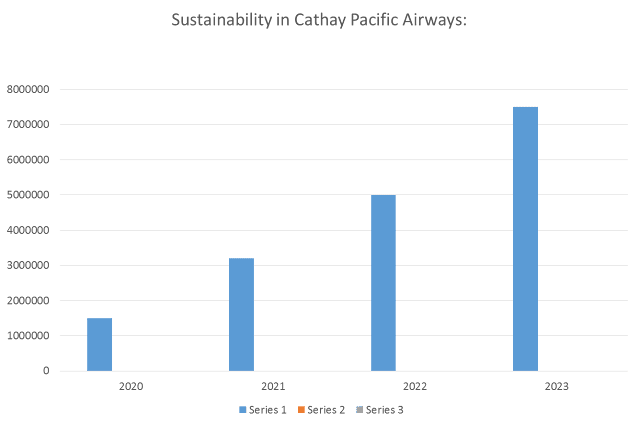
Fact and Data Sustainability in Cathay Pacific Airways
Cathay Pacific Airways has firmly established itself as a leader in sustainability within the aviation industry. Through its comprehensive approach to sustainable fleet management, carbon offsetting initiatives, operational efficiency improvements, waste management efforts, and community engagement, the airline is making significant strides toward reducing its environmental impact.
By setting ambitious goals and implementing innovative solutions, Cathay Pacific is proving that sustainability and profitability can go hand in hand, serving as an inspiring example for the entire aviation sector. As travelers, we can support their efforts by choosing airlines that prioritize sustainability, helping to create a more sustainable future for the industry and the planet as a whole
Sustainable Fleet Management:
Cathay Pacific Airways has invested in modern and fuel-efficient aircraft, such as the Boeing 777-9 and Airbus A350. These aircraft offer improved fuel efficiency, leading to reduced carbon emissions.
The airline has set a target to achieve carbon-neutral growth from 2020 onwards.
Cathay Pacific has conducted trials and tests with sustainable aviation fuels (SAF) to explore their viability as a low-carbon alternative.
Carbon Offsetting Initiatives:
Cathay Pacific has implemented carbon offset programs to neutralize its carbon emissions. It invests in projects that promote renewable energy, reforestation, and energy efficiency to offset its environmental impact.
The airline has partnered with organizations such as ClimateCare and Natural Capital Partners to support verified carbon offset projects.
Operational Efficiency:
Cathay Pacific has adopted various measures to improve operational efficiency, leading to reduced fuel consumption and emissions.
The airline utilizes advanced flight planning systems to optimize routes and reduce fuel burn.
Cathay Pacific has implemented weight reduction initiatives, including the use of lighter materials onboard its aircraft, to improve fuel efficiency.
Waste Management and Recycling:
Cathay Pacific actively promotes recycling and waste reduction initiatives throughout its operations.
The airline segregates waste materials on flights and promotes recycling practices at airports, offices, and catering facilities.
Cathay Pacific is exploring alternatives to reduce single-use plastics and enhance the circularity of materials used onboard its flights.
Community Engagement and Education:
Cathay Pacific conducts educational campaigns and collaborates with various stakeholders to raise awareness about sustainability.
The airline offers sustainability training to its employees and engages with passengers through educational materials and initiatives.
Cathay Pacific supports community-based projects and partners with non-profit organizations to drive sustainability initiatives.
Recognitions and Awards:
Cathay Pacific has been recognized for its sustainability efforts. It received the “Eco-Company of the Year” award at the Hong Kong Green Awards in 2020.
The airline has consistently achieved high rankings in sustainability indices, such as the Dow Jones Sustainability Index (DJSI) and the Hang Seng Corporate Sustainability Index.
Conclusion for Sustainability in Cathay Pacific Airways
Cathay Pacific Airways has demonstrated a strong commitment to sustainability in the aviation industry.
Through its comprehensive sustainability strategy, the airline has implemented numerous initiatives to reduce its environmental impact and promote responsible practices.
By investing in fuel-efficient aircraft, exploring sustainable aviation fuels, and improving operational efficiency, Cathay Pacific is actively working towards reducing its carbon emissions.
The airline’s carbon offset programs, in partnership with reputable organizations, play a crucial role in neutralizing its remaining carbon footprint. By supporting renewable energy projects, reforestation, and energy efficiency initiatives, Cathay Pacific is actively contributing to global sustainability goals.
Cathay Pacific’s dedication to waste management and recycling is commendable. By promoting recycling practices, reducing single-use plastics, and exploring circularity options, the airline is striving to minimize waste and conserve resources.
Furthermore, Cathay Pacific understands the importance of community engagement and education in driving sustainable practices. Through collaborations with stakeholders, sustainability training for employees, and educational campaigns for passengers, the airline is inspiring positive action and fostering a culture of sustainability.
The airline’s efforts have not gone unnoticed, as Cathay Pacific has received awards and recognitions for its sustainability initiatives. This acknowledgment highlights the airline’s commitment and sets a benchmark for the industry.
As Cathay Pacific Airways continues to prioritize sustainability, it serves as an inspiring example for the aviation industry as a whole. By integrating environmental responsibility into its operations, the airline is demonstrating that profitability and sustainability can go hand in hand. As passengers, we can support their efforts by choosing airlines that prioritize sustainability and contribute to a greener future for aviation.
Cathay Pacific Airways stands at the forefront of sustainable practices in the aviation industry, and its ongoing commitment to environmental stewardship sets a positive trajectory for a more sustainable and responsible future in air travel.
https://www.exaputra.com/2023/05/sustainability-in-cathay-pacific-airways.html




 Whoa. Let’s take a step back. Is it really either A or B?
You could on the side of the morons, those incapable of any level of critical thinking, like the author of the meme here.
 The United States seems set on propelling itself backwards.
 Maybe, as they say, “Hell has a special place reserved in it” for people like Thom Tillis, Republican Senator from North Carolina, who enabled Trump to rape and destroy the United States.
That was until it became clear to Tillis that he could jump ship, write a scathing book about the president, get all over mainstream news promoting it, and go on to enjoy another chapter of political success.
That we Americans are so stupid that we accept this blatant hypocrisy and criminality is sad proof that we’re not the people we were 20 years ago. Maybe what many people are saying are correct: we deserved what we got.



-
Climate Change1 year ago
Guest post: Why China is still building new coal – and when it might stop
-

 Greenhouse Gases2 years ago
嘉宾来稿:满足中国增长的用电需求 光伏加储能“比新建煤电更实惠”
-
Greenhouse Gases1 year ago
Guest post: Why China is still building new coal – and when it might stop
-

 Climate Change2 years ago
嘉宾来稿:满足中国增长的用电需求 光伏加储能“比新建煤电更实惠”
-

 Renewable Energy12 months ago
Sending Progressive Philanthropist George Soros to Prison?
-
Climate Change2 years ago
Bill Discounting Climate Change in Florida’s Energy Policy Awaits DeSantis’ Approval
-
Greenhouse Gases1 year ago
嘉宾来稿:探究火山喷发如何影响气候预测
-

 Climate Change2 years ago
Analysis: China’s CO2 falls 1% in Q2 2024 in first quarterly drop since Covid-19