Countries attending a first-of-its-kind summit have walked away with plans to develop national roadmaps away from fossil fuels, along with new tools to address harmful subsidies and carbon-intensive trade.
The first conference on “transitioning away” from fossil fuels held in Santa Marta, Colombia, from 24-29 April saw 57 countries – representing one-third of the world’s economy – debate practical ways to move away from coal, oil and gas.
Against a backdrop of war, a global oil crisis and worsening extreme weather events, ministers and envoys from across the world sat side-by-side in small meeting rooms to have open and frank conversations about the barriers they face in transitioning from fossil fuels to clean energy.
This new format – devised by co-hosts Colombia and the Netherlands – was described as “refreshing”, “highly successful” and “groundbreaking” by countries attending the talks.
The event also featured a “science pre-conference” attended by 400 global academics, which included the launch of a new science panel that will aim to provide agile and bespoke analysis to nations wanting to accelerate their transition away from fossil fuels.
At the summit’s conclusion, Tuvalu and Ireland were announced as the co-hosts of the second transitioning away from fossil fuels summit, which will take place in the Pacific island nation in 2027.
Below, Carbon Brief outlines all of the key takeaways from the talks.
- Colombia and Netherlands leadership
- High-level segment
- Academic meeting
- Indigenous and civil society participation
Colombia and Netherlands leadership
The idea for a specific fossil-fuel transition conference hosted in Colombia first emerged during tense end-game negotiations at the COP30 climate summit in Belém, Brazil.
Amid a push by a group of around 80 nations to refer to a “roadmap” away from fossil fuels in the formal COP30 outcome text, Colombia and the Netherlands jointly announced that they would co-host a summit in Santa Marta in April.
The calls for a fossil-fuel “roadmap” to be mentioned in COP30’s outcome text ultimately failed. However, the Brazilian COP30 presidency promised to bring forward an “informal” fossil-fuel roadmap, drawing on the discussions and debates in Santa Marta.
The Santa Marta conference took place from 24-29 April. It included a “science pre-conference” from 24-25, a day for subnational governments, parliamentarians and other stakeholders and a “high-level segment” with ministers and climate envoys from 28-29.
Colombian environment minister Irene Vélez Torres – herself a former academic – was particularly keen to emphasise the importance of science to the conference, telling journalists: “We need to go back to science and base our decisions on science.” (See: Academic meeting)
From the outset, the hosts stressed that the high-level segment was not a space for negotiations, but rather a forum for countries and other stakeholders to discuss practical steps to move away from fossil fuels.
This format was widely praised by ministers and climate envoys, who described the conversational atmosphere in break-out sessions as “refreshing”, “highly successful” and “groundbreaking”. (See: Closed-door discussions.)
A total of 57 countries participated in the conference, according to the Colombian government.
These countries were: Angola, Antigua and Barbuda, Australia, Austria, Bangladesh, Belgium, Brazil, Cameroon, Canada, Chile, Colombia, Denmark, Dominican Republic, the EU, the Federated States of Micronesia, Finland, France, Germany, Ghana, Guatemala, Iceland, Ireland, Italy, Jamaica, Kenya, Luxembourg, Malawi, the Maldives, the Marshall Islands, México, Mongolia, the Netherlands, Nepal, Nigeria, Norway, New Zealand, Palau, Panama, Philippines, Portugal, Saint Lucia, Senegal, Singapore, Slovenia, the Solomon Islands, Spain, Sweden, Switzerland, Tanzania, Turkey, Tuvalu, Uganda, the UK, Uruguay, Vanuatu, the Vatican and Vietnam.
At the summit’s opening press conference on 24 April, Vélez Torres confirmed that Colombia and the Netherlands had decided to only invite a select group of countries to the conference.
Vélez Torres told journalists that countries including China, Russia and the US were not invited. She suggested that they had not shown the necessary spirit to be part of the “coalition of the willing” and that Colombia wanted to avoid a rehashing of the lengthy debates at COP30. (Carbon Brief understands that India was also not invited.)
In a later press huddle, Dutch climate minister Stientje van Veldhoven clarified that the two co-hosts had partially based their invitation criteria on who showed support for the fossil-fuel roadmap at COP30, saying:
“It was a combination of what happened in Belém and all the existing initiatives that have been driving this agenda for a long time already.”
However, it is worth noting that some countries that had opposed a formal reference to a fossil-fuel roadmap in the COP30 outcome were invited to Santa Marta, according to Carbon Brief’s analysis of the “informal list” of those against the idea in Belém.
For example, Tanzania was invited to take part in the Santa Maria talks, despite appearing on the list of countries opposed to the roadmap in Belém.
On the other hand, neither China nor India were invited, despite having rejected media coverage portraying them as the “blockers” of the fossil-fuel roadmap at COP30.
Country officials and observers expressed a range of views on whether excluding certain countries from the conference was the right approach.
Juan Carlos Monterrey Gómez, Panama’s special representative on climate change, told a small group of journalists that he thought it was the “right decision”, adding:
“This first meeting had to be done with those that wanted something to be done. Otherwise, it would have been a repeat of a UNFCCC meeting.”
UK special representative for climate, Rachel Kyte, told a press huddle that China should feel “welcome to be here”, adding:
“China has to be part of this equation for multiple reasons.”
One veteran observer told Carbon Brief that their impression was that Colombia and the Netherlands had been “overly cautious” about who would have caused disruption if invited to the conference, saying:
“Yes, maybe there is an argument for not inviting countries that have a long history of blocking progress, such as the Gulf states. But, if we look at what countries are really doing on the ground – including JETP [Just Energy Transition Partnerships] initiatives – then more countries should have been here, including Indonesia, for example.”
However, they also urged caution on reading too much into which countries were and were not present, adding that this could also partially be explained by “scheduling and countries’ availability”.
During the summit’s final plenary, van Veldhoven stated that, going forward, it was the Netherlands and Colombia’s wish to create an “open coalition”, including by extending an “invitation for others to join us”.
Dr Maina Talia, the climate minister of Tuvalu, who will co-host the second transitioning away from fossil fuels summit alongside Ireland, told journalists that the island nations would “revisit” and “improve” the criteria used for inviting countries to the conference.
[anchor]3″>
National statements and pledges
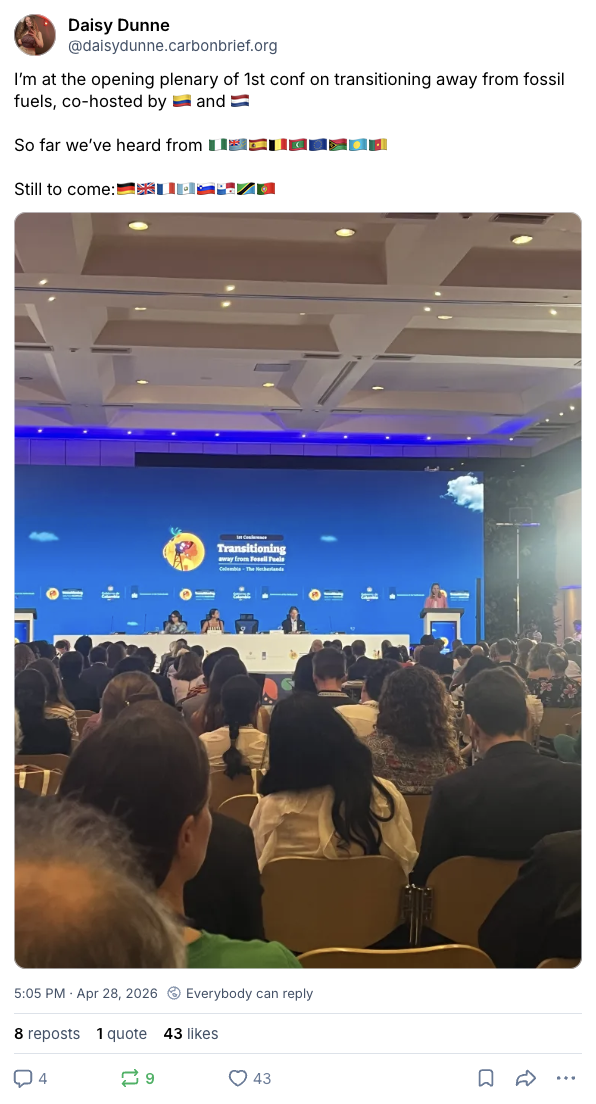
The two-day high-level segment began with an opening plenary, which saw more than 20 countries put forward their views on the need to transition away from fossil fuels.
Developed and developing nations alike spoke of the need to transition away from fossil fuels not only to tackle worsening climate change, but also the high prices, insecurity and volatility associated with continued reliance on coal, oil and gas.
Opening the plenary alongside Colombia, Dutch climate minister Stientje van Veldhoven told countries:
“Price volatility and dependence on imports are structurally and unacceptably impacting our economies. We need to move away from fossil fuels not only because it is good for the climate, but because it strengthens our energy security. Investment in clean energy also lays the foundation for a more resilient and sustainable economy, capable of mitigating these shocks.”
First to speak in plenary was Nigerian minister, Abubakar Momoh, who said:
“Nigeria is actively diversifying its economy away from extracting oil, which accounts for around 80% of our exports. Nigeria strongly believes that it is not whether extraction should decline, but how to organise it so it is manageable, fair and politically viable across countries.”
Also speaking during the session, UK special representative for climate Rachel Kyte said it “would be irresponsible to ignore the second fossil-fuel crisis in five years”.
Several nations also used their interventions to lament a lack of progress in addressing fossil-fuel use during the last 30 years of annual UN climate negotiations.
Dr Maina Talia, climate minister for Tuvalu, said that “for years, international climate negotiations have circled around fossil fuels without directly confronting the core issues”.
Juan Carlos Monterrey Gómez, Panama’s special representative on climate change, told countries:
“For 34 years, we have negotiated the symptoms of the climate crisis and bulletproofed its cause. Thirty-four years of pledges. And where are we now?
“Economies built on fossil fuels are unravelling in real time. Fossil fuels are not just dirty. They are unreliable, they are dangerous and they must end.”
A small number of nations from the Pacific and Africa used their interventions to show their support for the Fossil Fuel Treaty initiative, an idea to negotiate a new legally binding agreement to control fossil-fuel use, currently supported by 18 countries. (The treaty did not feature in the summit’s final outcome.)
France’s special climate envoy, Benoît Faraco, used his intervention to announce that the nation has produced a new roadmap for transitioning away from fossil fuels.
Later on, on the first day, Colombian president Gustavo Petro also gave a speech at the summit, telling countries:
“What I see is resistance and inertia within the power structures and the economy of this archaic energy system. Today, fossil fuels bring death; undoubtedly, that form of capital could commit suicide, taking humanity and life itself. Humanity cannot allow that.”
Closed-door discussions
Following the opening plenary, ministers and climate envoys spent much of the two-day high-level segment in closed-door “breakout sessions”, discussing issues ranging from “planned phase down and closure of fossil-fuel extraction” to “closing gaps in financial and investment systems”.
Carbon Brief understands that each session featured 12 ministers and envoys representing different countries sitting in an inner circle, with an outer circle made up of civil society members and other stakeholders. Each session was led by a different minister, appointed by the co-hosts.
In a departure from UN climate negotiations, the conversations that took place were free-flowing, with ministers and stakeholders given equal opportunities to contribute, observers told Carbon Brief.

Many countries were highly complimentary of this informal format, describing it in the closing plenary as “refreshing”, “highly successful” and a “safe space for discussion”.
UK special representative on climate, Rachel Kyte, told a huddle of journalists that there was “real value” to having informal conversations with other country officials, saying:
“I have to say that it is really nice to sit in a small circle…In a negotiation, it’s very, very fast-moving and transactional. But now we have had two days to think about [fossil-fuel transition issues] and this only.”
Speaking to Carbon Brief, Panama’s special representative on climate change, Juan Carlos Monterrey Gómez, said the format was “groundbreaking”, adding:
“I’m going to be honest. [At] first I was like: ‘What the f*ck am I doing here? I don’t know where this is going’.
“But then, as the workshop started, I realised there were ministers, envoys, civil society leaders and Indigenous people. They put us in a format where we could not open our computers, so we had to speak from our minds and our hearts. That completely flipped my perception. That kind of space I haven’t seen in my 10-year history with the UNFCCC.”
All of the sessions were held under the Chatham House rule, meaning discussions were not attributable to individual speakers to encourage more open debate.
Co-host nations Colombia and the Netherlands gave a broad overview of the topics and themes discussed during the sessions in a takeaways report. (See: Final outcomes.)
Final outcomes
At the conference’s final plenary session on 29 April, co-host nations Colombia and the Netherlands presented a range of “key outcomes” from the summit.
The first outcome was confirmation of the news that Tuvalu and Ireland will co-host a second transitioning away from fossil fuels conference in the Pacific island nation in 2027.
The co-hosts also announced the establishment of three “workstreams” on issues to bring forward to the second summit.
The first of these workstreams will focus on developing national and regional roadmaps away from fossil fuels.
Speaking in plenary, Vélez Torres said that the roadmaps should be “connected” to countries’ UN climate plans, known as nationally determined contributions (NDCs). She added that it would be important for the roadmaps to be “very clear and honest” about “emissions exported from producing countries”.
The development of the roadmaps will be supported by the newly established science panel for global energy transition and the NDC Partnership, a global initiative helping nations prepare their NDCs, she added.
(At the final press conference, it was clarified that countries are not obligated to produce a new fossil-fuel roadmap and that participation in all of the work streams is voluntary.)
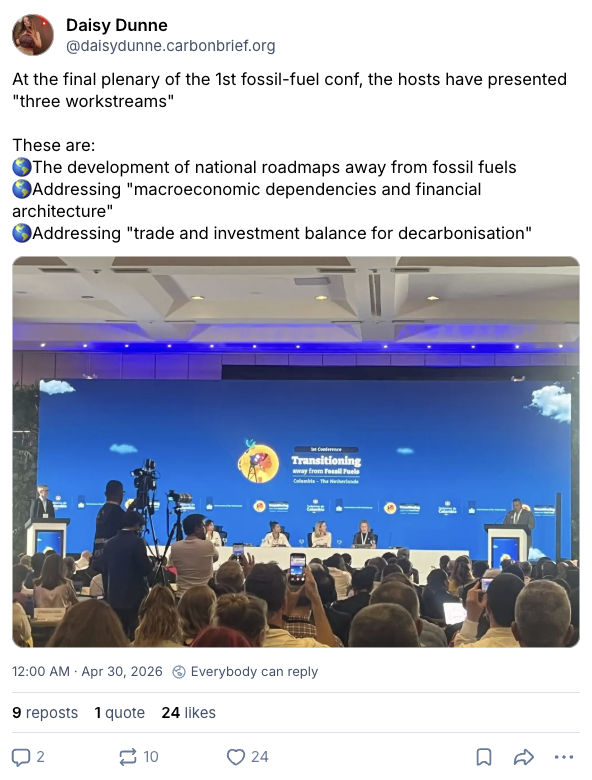
The second workstream will be focused on changing the financial system to better facilitate the transition away from fossil fuels.
This will include work to identify fossil-fuel subsidies and find solutions to “debt traps”. It will be supported by the International Institute for Sustainable Development thinktank, the co-hosts said.
Separately, Dutch climate minister van Veldhoven said that all countries would be invited via “email” to begin a process for identifying and reporting their fossil-fuel subsidies. (The Netherlands is the co-chair of COFFIS, a group of 17 nations that have pledged to remove fossil-fuel subsidies.)
The final workstream will address fossil-fuel-intensive trade, with the aim of “advancing progress towards a fossil fuel-free trade system”, Vélez Torres said. This workstream will be supported by the Organisation for Economic Co-operation and Development (OECD) group of wealthy nations.
A document summing up the co-chair’s takeaways from the summit says that other key outcomes include the establishment of a “coordination group [to] ensure continuity towards the second and subsequent conferences”, adding:
“It will consist of countries leading different alliances and initiatives that are implementing elements of the transition away from fossil fuels, and of the co-hosts of the first and second conferences, Colombia, the Netherlands, Tuvalu and Ireland.”
The document adds that a key task will be delivering the findings of this conference to the COP30 presidency, which is currently preparing a global fossil-fuel roadmap to present at COP31 in November.
Academic meeting
The summit kicked off with a “science pre-conference” attended by around 400 academics from across the globe from 24-25 April, held at the University of Magdalena in Santa Marta.
At the behest of the Colombian government, these scientists split into 11 different “workstreams” to debate a vast array of topics related to transitioning away from fossil fuels.
These ranged from “fossil-fuel phaseout policies” and the role of methane, to “just transitions and economic diversity” and the role of multilateralism.
Speaking on the summit’s first day, Colombian environment minister Irene Vélez Torres – herself a former academic – stressed the importance of science in political decision-making. She told a press conference:
“There has been a growing gap between science and governments, and governmental decisions, and it happens because there is a lot of denialism. There is a lot of economic and political lobbying as well. That is actually deviating [from] scientific rationale.
“The true belief of the countries that are here is that we need to go back to science and base our decisions on science, and back up our decision-making, processes and pathways with science.”
Science panel for global energy transition
The pre-conference saw the announcement of three new scientific initiatives.
The first was a new global science panel, calling itself the “science panel for global energy transition”, which was launched by Dr Johan Rockström, director of the Potsdam Institute for Climate Impact Research in Germany and Dr Carlos Nobre, an eminent researcher on the Amazon rainforest from the University of São Paulo in Brazil.
They announced at a public event in Santa Marta that the panel will involve “50-100 scientists” from around the world and will be based at the University of São Paulo.
The scientists on the panel will aim to provide rapid analysis on how to transition away from fossil fuels for countries and multilateral talks, including bespoke information for nations that request it, they said.

Speaking at its launch, Rockström said the panel will be split into four working groups, focusing on “transition pathways”, “technology solutions”, “policy design and evaluation” and “finance instruments and governments”.
It will have three co-chairs: Dr Vera Songwe, an economist and climate finance expert from Cameroon; Prof Ottmar Edenhofer, chief economist at the Potsdam Institute for Climate Impact Research; and Prof Gilberto M Jannuzzi, professor of energy systems at Universidade Estadual de Campinas in Brazil.
Speaking to Carbon Brief, Nobre said that he and Rockström were first approached with the idea for a new panel by Ana Toni, Brazilian economist and CEO of the COP30 climate summit, while the negotiations were taking place in Belém. He said:
“Johan and myself, we’re not energy transition scientists, but we were the creators of the planetary science pavilion at COP30, that’s why Ana Toni came to us. And we have already invited three top energy transition experts to join us.”
At the launch, Rockström said the panel would be different in several ways from the world’s existing global climate science panel, the Intergovernmental Panel on Climate Change (IPCC).
He said that, in comparison to the “seven-year cycle” for IPCC reports, this panel will “be able to come up with annual updates” and “be able to scale down to the national level”.
Nobre told Carbon Brief that he was among scientists who have grown “frustrated” with some aspects of the IPCC’s process, including the line-by-line approval of summaries for policymakers by all of the world’s governments. He said:
“A long time ago, when I was working as a scientist studying the Amazon, I wanted to include some information about the risks the Amazon faces in one of the summaries. But a representative from my own country [Brazil] said no.
“This panel is totally independent. There is no way for somebody to say ‘you can’t say that’ or ‘you can’t do that’.”
Action insights report
The second new science initiative to emerge from the academic conference was a new “synthesis report”, offering “12 action insights” for how countries can transition away from fossil fuels.
First covered by Carbon Brief, the report contains some explicit “action recommendations” for countries, such as “halt all new fossil-fuel expansion” and “prohibit fossil fuel advertising…recognising fossil fuels as health-harming products”.
The report was first put together by an “ad-hoc” group of 24 scientists at the request of the Colombian government. It was then further debated and refined by many of the 400 scientists gathered at the academic pre-conference in Santa Marta.
A preliminary version of the report was circulated to governments attending the talks.
In addition, one of the report’s coordinating authors, Prof Andrea Cardoso Diaz, from the University of Magdalena, was given a two-minute slot in the opening plenary of the “high-level segment” to highlight its findings to gathered ministers.
Colombia’s fossil-fuel roadmap
The final scientific initiative unveiled at the academic segment was a new roadmap for how Colombia can transition away from fossil fuels. This was drafted by a team led by Prof Piers Forster, head of the Priestley Centre for Climate Futures at the University of Leeds.
The roadmap says that Colombia can cut its emissions from energy use to 90% below 2015 levels by 2050, through ambitious policies to move away from fossil fuels and electrify its transport sector.
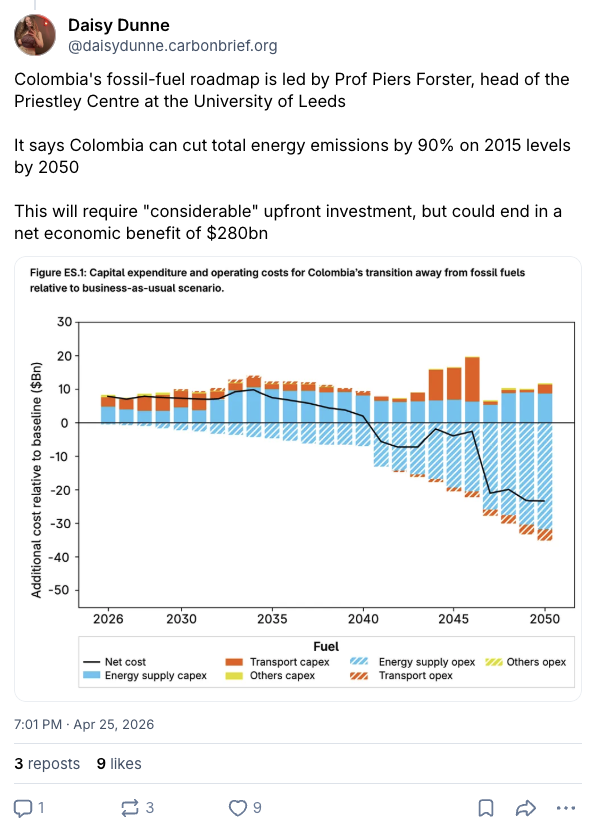
This would require “considerable” upfront investment, with the roadmap estimating the cost to be an average annual investment of around $10bn above a business-as-usual scenario.
However, by the 2040s, Colombia could see net economy-wide savings from transitioning away from fossil fuels, says the analysis, which could reach $23bn annually by 2050.
Speaking to Carbon Brief, Forster said his experience as interim chair of the UK’s Climate Change Committee highlighted to him the importance of presenting national roadmaps in economic terms. He said:
“The biggest issues facing countries are economic and to do with the cost of living. To convince our own government back in the UK to sign up to our recommended carbon budget, we put a lot of work into the economic aspect. So that was also the focus of this work for Colombia.”
Indigenous and civil society participation
In addition to holding a dedicated meeting for scientists, the Colombian government also organised a “People’s Assembly”. This brought together hundreds of Indigenous peoples, Afro-descendent peoples, peasant farmers, trade representatives, women and children and other civil society members.
The goal was to gather the thoughts from these groups on the summit’s main “pillars” of addressing fossil-fuel production, economic constraints and global governance and multilateralism.
According to Climate Lens News, Óscar Daza, the secretary general of the Organisation of Indigenous Peoples of the Colombian Amazon, Karebaju people, told the gathering:
“The Indigenous peoples of the world have made historic demands, such as the non-extraction of natural resources from our territories, so that our resources that are there in the territory remain intact, remain still.
“As Indigenous peoples, we want those historic struggles to somehow be reflected and taken up here by the different states.”

Following on from the meetings, the Colombian government summarised the main talking points discussed by each of these groups in a series of “contributions” documents.
Indigenous peoples and civil society groups were also allocated opportunities to speak during the summit’s high-level segment.
In a departure from UN climate summits – where inputs from civil society are usually heard after countries have finished speaking – the Santa Marta summit invited a range of representatives to speak alongside ministers in the opening and closing plenary sessions.
This included an intervention in the opening plenary by Larissa Baldwin-Roberts, a climate leader from the Bundjalung Nations, who told countries:
“This is the last time we will be a token. You want our pictures, not our voices. You want our stories, not our struggles…True solidarity with each other is the prerequisite to a just transition.”
Indigenous peoples and civil society members were also free to speak in closed-door discussions with ministers, Carbon Brief understands.
Separately from the events organised by the Colombian government, civil society also organised its own “people’s summit”, involving 900 organisations and networks, held in the city of Santa Marta from 24-26 April.
This summit also organised sessions for representatives from different groups to offer their thoughts and insights into the transition away from fossil fuels, ending in a joint “declaration”.
In a statement, Tasneem Essop, the executive director of Climate Action International, said:
“Movements from across the globe and the region – Afro-descendants, feminists, youth, peasants and fisherfolk, social movements and Indigenous peoples converged in a three-day peoples summit in Santa Marta to build a collective consensus on our demands and solutions for the just transition away from fossil fuels.
“[We saw] the adoption of a powerful declaration that spells out our positions on ensuring that the transition has to be rights-based, funded and results in the dismantling of the systems that have caused harm and destruction driven by fossil fuel dependency.”
The post Santa Marta: Key outcomes from first summit on ‘transitioning away’ from fossil fuels appeared first on Carbon Brief.
Santa Marta: Key outcomes from first summit on ‘transitioning away’ from fossil fuels
Climate Change
As Energy Demand Rises, More States Turn to Virtual Power Plants
The decentralized power systems are playing a growing role in the transition away from fossil fuels.
An executive order in Massachusetts and a regulatory commission action in Minnesota are among the big moves this year that highlight the growing role of virtual power plants in grid management.
As Energy Demand Rises, More States Turn to Virtual Power Plants
Climate Change
What to expect from the Bonn climate talks
The annual June climate talks in Bonn are taking place this year against the backdrop of an oil and gas supply crisis tied to the Iran war and deadly heatwaves in Europe, India and the Middle East. Can they produce anything substantial to ease the squeeze on economies and communities around the world?
Watchers of the negotiations say the UN climate process is under pressure to prove its worth at a time when climate action and clean energy offer an increasingly attractive alternative to the global economic and political instability brought by fossil fuel dependency.
Kaysie Brown, associate director of climate diplomacy and geopolitics at think-tank E3G, said the June 8-18 meetings “must show that the multilateral system can make a durable and politically resilient shift to support delivery [of climate action] at scale”. She added that it “will act as a key health check for the climate regime at a time of a rapidly shifting global order”.
There are hopes for significant progress on issues ranging from a new mechanism to support a just transition away from fossil fuels, to funding and measuring adaptation to worsening climate impacts.
Bonn will also see the launch of dialogues on trade and climate change, on how to implement what was promised in the first stocktake of national climate plans in 2023, and on ways to shift global finance flows to support a low-carbon and climate-resilient world.
Climate Home News doesn’t have a crystal ball, but we have done our homework. Here’s what experts expect to top the agenda at the World Conference Center by the River Rhine:
COP31 priorities
Bonn is where we will get a sense of what the joint COP31 hosts – Türkiye and Australia – want from their presidency. Signs are that they will push for a global goal on the share of final energy consumption that will come from electricity, which may be based on a target proposed by the International Renewable Energy Agency of 35% by 2035.
Watch back: Webinar – From Santa Marta to Bon, where next for the fossil fuel transition?
Other priorities already identified include energy storage, energy security and clean cooking. Türkiye has stressed reducing emissions from landfills as a priority for the “Action Agenda” strand of COP31, which encompasses government and business initiatives outside the formal discussions. Türkiye will lead on the Action Agenda, while Australia handles the negotiations.
Just transition mechanism
The Bonn negotiations are tasked with producing a draft decision on how to set up a new just transition mechanism that can facilitate a fair and orderly shift from a high-carbon world to a greener future. This decision will be forwarded for approval by countries at COP31.
Governments agreed at COP30 in Brazil to set up what civil society has dubbed the “Belém-Antalya Mechanism” (BAM) but the details have yet to be worked out. Climate Action Network International, which has advocated strongly for the global mechanism, said it should be designed to provide decent jobs, social protection, public investment, energy access and support for affected workers and communities.
“If governments move decisively, the [BAM] could become one of the most significant developments in the climate regime since the Paris Agreement – helping connect climate action with economic transformation and tangible improvements in people’s daily lives,” the coalition of hundreds of green groups said in a statement ahead of Bonn.
Let’s talk trade
At COP30, after two years of trying, emerging economies finally got the overlap between trade and climate policy onto the UN climate talks agenda. Governments agreed to hold dialogues on trade at the June Bonn talks in 2026, 2027 and 2028 before a summary of these dialogues is presented at a “high-level event” in 2028.
What aspects of trade are to be discussed at the first such dialogue on Saturday June 13 is undecided. Developing-country heavyweights like China and India will likely be keen to criticise the European Union’s new carbon border adjustment mechanism, which they regard as protectionist and burdensome for their exporters. Representatives of the World Trade Organization and other trade bodies will make presentations, which governments and civil society will be allowed to comment upon.
On Sunday June 14, a separate meeting of the fledgling Integrated Forum on Climate Change and Trade – an initiative launched by the Brazilian COP30 Presidency – will take place in a grand hilltop hotel overlooking Bonn and the Rhine. The meeting is not part of the official UN climate process or the official Bonn talks and will be more informal than the previous day’s dialogue.
Topics that will be discussed are trade and climate adaptation, how to create a level playing field for low-carbon products, how to trade particularly polluting products and how to bridge climate and trade tools. An expert panel chaired by South Africa’s Faizel Ismail and New Zealand’s Jo Tyndall has been appointed to advise the forum.
Aligning on adaptation
At COP30, talks on finalising a list of indicators to measure progress on adapting to climate change ended in recriminations, with several Latin American governments complaining that the decision was adopted by the Brazilian presidency without their consent.
The indicators, which were developed by experts in a two-year process, were stripped down by the Brazilians on the last night of COP30 and presented to governments at the last minute as a done deal.
New data shows rich nations likely missed 2025 goal to double adaptation finance
Several governments and some of the technical experts have argued that many of the adopted indicators are unworkable, as they lack definitions or explanations of how they will be measured. Many indicators for important areas – like poverty reduction, ecosystems, infrastructure and food production – are missing or inadequate, they say.
Government negotiators and experts now have two years to fix the mess, through a “policy alignment process” due to end at COP32 in Ethiopia. At the Bonn talks, governments will try to agree on who will make up a new taskforce of experts to help countries put the indicators into practice and how it will operate.
Mission to 1.5 and Global Implementation Accelerator
After pressure from small island nations, governments at COP30 agreed to set up the Belém Mission to 1.5 and the Global Implementation Accelerator (GIA) to speed up the implementation of countries’ emissions-cutting and adaptation plans.
For the Mission to 1.5, several past and current COP presidencies are drawing up a report – scheduled to be published before COP31 – which will identify several especially impactful solutions to climate change. On June 12 in Bonn, governments and civil society will weigh in on what they want included.
Also in Bonn, governments will input into the GIA. The Brazilian COP30 Presidency’s vision is that it should drive forward the strongest climate solutions. According to COP30 CEO Ana Toni, an independent panel of experts will pre-select 10-15 solutions and a council will narrow this down to three to five each year which the GIA would then aim to speed up.
The GIA’s “added value is that it will focus exclusively on solutions with the potential to scale and generate cascading effects through high-impact exponential technologies”, she said last month.


Whether Mission to 1.5 and the GIA will identify the same shortlist of solutions – and how they work together – is unclear. But the GIA could become a permanent body working on the real-world “Action Agenda” of COPs.
Ruenna Haynes is the deputy lead negotiator for the small islands group (AOSIS) which pushed for these two initiatives, but she is now worried about what the COP presidencies might make of them.
She told a recent briefing, “the last thing we want to do is to set up a process that is nothing more than a talking shop that doesn’t deliver and doesn’t go anywhere”. To avoid that, the reports of the GIA and Mission 1.5 must be linked to the wider UN climate talks process and at least discussed by governments, she emphasised.
Finance roadmap and dialogue
COP30 left a bitter taste regarding what was expected to be one of its main outcomes: progress on how to increase climate finance through the “Baku to Belém Roadmap to $1.3 trillion”. The initiative, included in the new finance goal agreed in Baku – the NCQG – was an effort to top up the 2035 target of $300 billion a year in public finance which fell short of what developing countries wanted and an independent panel of experts estimated would be needed.
The high expectations surrounding this roadmap began to fade during 2025 as the process lacked transparency, clarity, participation and ambition. The result was a report abundant in general recommendations of actions to be taken but lacking clear commitments. Most of the suggestions mentioned are targeted at institutions outside the UN climate process, such as multilateral development banks.
The COP30 decision merely “took note of” that report. So was it the end of the road for this particular roadmap? Not yet.
From Baku to Belém and beyond: How we turn a climate finance roadmap into reality
In Bonn, an “implementation” meeting will be held to “listen to the Parties and observers on the updated work being carried out,” as a member of the COP30 Presidency team told Climate Home News. The challenge is how to ensure the roadmap doesn’t remain fine words in a document and is put into practice. It will also serve either as a good or bad example for the other two voluntary roadmaps (on deforestation and fossil fuels) that the Brazilian presidency is putting together ahead of COP31.
Also in Bonn, the Veredas Dialogue will address the opportunities and obstacles to implementing Article 2.1.c of the Paris Agreement – on making finance flows consistent with low-carbon development – and its complementarity with Article 9 on the responsibility of developed countries to provide financial resources. The limitations of the Baku to Belém Roadmap could shift the divisions between developed and developing nations to this dialogue, especially considering that 2026 is the first year for mobilising finance under the NCQG.
More roadmaps on fossil fuels and forests
At COP30, a group of 80 countries led a failed push to kickstart a process for a global roadmap to guide the transition away from fossil fuels (TAFF). As an alternative, the Brazilian presidency proposed to draft two voluntary roadmaps: one on phasing out fossil fuels and another to end deforestation by 2030, both commitments endorsed by all countries in the COP28 deal.
In the lead-up to Bonn and after months of consultations with countries, Brazil presented an outline for the forest roadmap – which will invite countries to submit their own voluntary national roadmaps to halt forest loss.
It will also include a menu of options to bridge the $216-billion forest funding gap. One of the key initiatives to achieve this is the new rainforest fund, the Tropical Forest Forever Facility (TFFF), which is still rallying investors for seed funding. Brazil convened an investor meeting in Rotterdam last week, with participation from over 50 financial institutions – including BlackRock, Bank of America and Barclays – and 30 government representatives.
COP30 rainforest fund unlikely to make first payments until 2028
While not on the formal negotiating agenda In Bonn, Brazil will continue consultations on the forest roadmap at an event with governments on June 8. The final document is expected to be published later in September.
As for the TAFF roadmap, Brazil will hold an open event on June 12 after receiving suggestions from 120 countries. It is expected to be informed by the first global fossil fuel phase-out summit held in Santa Marta in April.
COP30 advisor Flávia Bellaguarda told an online briefing that the informal sessions in Bonn are meant to open a “space for dialogue” on both roadmaps, and that the more countries engage, the more international relevance the process gains.
“We managed to get the elephant into the room. Now, it needs to stay there. For that, we need to give him plenty of food so he can’t fit through the door and leave. We achieve that with dialogue and creating space for genuine exchange,” the Brazilian advisor said.
The post What to expect from the Bonn climate talks appeared first on Climate Home News.
Climate Change
Analysis: China’s CO2 climbs 2% in early 2026 due to ‘wasted’ wind and solar
China’s carbon dioxide (CO2) emissions grew by 2% in the first quarter of 2026, after a rise in the amount of “wasted” wind and solar power.
The country used more coal and gas to generate electricity than in the same quarter a year earlier, despite a record amount of new wind and solar capacity being built.
While the strait of Hormuz crisis has boosted China’s focus on energy security – including through clean energy and electrification – its electricity system is failing to keep up.
The new analysis for Carbon Brief shows that, while China’s CO2 emissions from fossil fuels and industry increased in the first part of 2026, they remain below the peak in early 2024.
Other key findings for the first quarter of 2026 include:
- There was a 23% year-on-year rise in wind-power capacity and 33% for solar.
- There was also a sharp rise in the amount of wind and solar output being “wasted”, as it was not accommodated by the current electricity system.
- As a result, emissions in the power sector increased by 4% year-on-year.
- Power-sector CO2 would have been flat without the rise in “wasted” wind and solar.
- Emissions in other sectors of the economy grew by 1%.
The key reason for “wasted” wind and solar generation was the inflexible management of coal power plants and power grids, not a lack of grid infrastructure.
In the first quarter of 2026, China’s energy system also began to adjust to the surge in oil and gas prices due to the blockade of the strait of Hormuz.
This continued through April and May, with sharp reductions in oil imports and oil-based chemicals production, as well as the share of gas in electricity generation.
However, the inability to make full use of new wind and solar power plants left China more exposed to the closure of the strait of Hormuz, by increasing the need for other fuels.
This exposure could become more acute if the “super El Niño” that is forecast for later this year limits the electricity output of hydropower, while fossil-fuel supplies remain tight.
Nevertheless, the Hormuz crisis could result in China following a lower-CO2 trajectory than previously expected, if key policies in its 15th five-year plan are fully implemented.
Emissions plateau continues
Recent analysis for Carbon Brief showed that China’s CO2 emissions from fossil fuels and industry had been “flat or falling” for nearly two years.
The latest analysis points to a rise of 2% year-on-year in the first quarter of 2026, as shown in the figure below. For now, however, emissions remain below the peak in March 2024.

In previous quarters, emissions had fallen in almost every sector of the economy, with the exception of the coal-based chemicals industry.
The latest quarter saw more widespread increases, with the power sector by far the largest source of emissions growth, as shown in the figure below.

Emissions from other sectors were relatively stable in aggregate, with some rising and others continuing to decline.
Coal consumption in the chemical industry continued strong growth, increasing by 20%, but showed no change in trend after the closure of the strait of Hormuz and surge in oil prices.
(This is contrary to some commentary arguing that the closure of the strait of Hormuz has resulted in a marked increase in the output of China’s coal-chemicals industry.)
The apparent consumption of oil products rebounded in January-February, driven by transportation, but declined slightly in March as oil prices surged.
Emissions from the cement and steel industries continued to fall, as real estate investment contracted another 11% in the first quarter of 2026, following a 17% reduction in 2025. Cement production fell 7% and crude steel output by 5%.
‘Wasted’ wind and solar power
After falling in 2025, power generation from coal and gas increased by 4% in the first quarter of the year.
Power demand grew at 5.2% and hydropower generation increased 9%. Under these circumstances, the record growth in solar and wind power capacity in 2025 should have covered demand growth and pushed fossil-power generation down.
The trend was accentuated in March, as power demand grew just 3.5%, hydropower output increased 9% and yet fossil-power generation increased 4.2%.
The reason for fossil-power generation growth was a sharp drop in the electricity output per unit of installed capacity for both solar and wind power, known as the “capacity factor”.
If capacity factors were stable, the increased solar and wind capacity would have been expected to result in 160 terawatt hours (TWh) of additional clean-power generation during the first quarter, compared with the same time last year, with nuclear and hydro bringing the total to 170TWh. This would have comfortably exceeded the 120TWh increase in power demand.
However, the actual increase in clean-power generation was just 60TWh, with wind showing almost no growth.
While wind power capacity grew by 23% from the first quarter of 2025 to the same period in 2026, an increase of 120GW, the average capacity factor fell from 27% to 22%, a reduction of 18%. This implies that power generation from wind only grew 1% year-on-year. In the case of solar, capacity grew by 33%, but the average capacity factor fell by 11%, resulting in 18% growth in solar-power generation.
It is normal for solar and especially wind capacity factors to vary year-to-year due to weather conditions, but the fall this year was an extension of a longer trend. The average capacity factors of solar and wind have fallen by 19% and 10%, respectively, from 2022 to 2025.
A quarter of the fall in capacity factors over the three-year period is explained by the increase in reported curtailment. This refers to the amount of electricity that is effectively “wasted”, or curtailed, because it cannot be accommodated by the power network.
Nor can the remainder of the fall in capacity factors be explained by the change in weather conditions, as both wind and solar conditions improved on a national-average basis from 2022 to 2025.
In the first quarter of 2026, approximately half of the drop in wind capacity factor and a quarter of the drop in solar capacity factor was explained by weather conditions, implying that the rest is due to increased curtailment resulting from inadequate grid management and integration.
One clear symptom of increased curtailment is that in January-February, both solar and wind conditions were actually better than last year, but capacity factors still fell.
The fact that capacity factors have fallen significantly more than would be expected based on reported curtailment and weather conditions indicates that a lot of curtailment goes unreported, either because it is excluded from the statistical definition, or because there are gaps in reporting.
Market participants have long noted that actual curtailment is much higher than reported in official statistics.
Official data on curtailment only includes “system reasons”, while excluding some lost generation linked to market trading, grid-connection conditions and other “special” causes.
The figure below shows actual electricity generation from wind and solar plants (dark blue), the amount that would have been generated if reported curtailment had not taken place (light blue) and the level expected if the rate of curtailment had stayed the same (mid-blue).
In total, wind and solar could have generated an extra 170TWh of electricity in the first quarter of 2026, if the rate of curtailment had not gone up in the preceding years. This is more than the total power generation of France over the same period.

The largest reductions in capacity factors, after controlling for variations in weather conditions, came from Inner Mongolia, Xinjiang and Liaoning. In these northern provinces, the heating season is a challenging time for grid managers due to inflexible operation of plants that provide both heat and power.
More broadly, the key reason for curtailment is inflexible grid management. Flexible operation of coal and gas-fired power plants could very substantially increase the amount of solar and wind power the grid can accommodate.
Yet currently, coal-fired power generation is largely operated via medium- and long-term contracts to supply fixed amounts of electricity at fixed prices, meaning there is no incentive for adjustments in output to make space for solar and wind.
Similarly, electricity trading between provinces is predominantly contracted annually, preventing the variable output of solar and wind from being transmitted between jurisdictions in real time.
These issues have a clear impact on the amount of wind and solar that is curtailed. For example, power-system modeling carried out for the year 2023 indicates that flexible power-grid operation would have essentially eliminated the need for curtailment.
The government has also recognised solar and wind curtailment as one of the central challenges of the energy transition.
Recent policies have called for increased inter-province trading and improved flexibility of coal-power plants as the solutions, implicitly recognising these as key issues to address.
Recent large increases in storage capacity, including pumped hydro and batteries, should have improved the integration of wind and solar into the grid. But there is a lack of incentives for storage operators that limits the benefits the system can derive from the technology.
The government has implicitly recognised this and called for establishing electricity pricing that enables energy storage to “participate fairly”.
Meanwhile, China’s new renewable-pricing rules, which shifted existing solar and wind plants to selling electricity on the market, rather than being compensated directly by the grid operator, does not seem to have reduced curtailment so far.
Most provinces only finalised their plans for implementing the policy in late 2025, which left little time for the market and operators to adapt.
China is aiming to build a “new type power system”, capable of integrating large amounts of wind and solar into the grid by 2027. In the meantime, the government has also called for “reasonably pacing” utility-scale “new energy” capacity additions to match the pace at which provinces think they are able to improve the “regulation capacity” of their grids.
How the Hormuz crisis is affecting China’s energy sector
China’s energy system has started, since March, to adjust to the surge in oil and gas prices triggered by the closure of the strait of Hormuz. There have been sharp reductions in oil imports, the share of gas in thermal power generation and in oil-based chemical production.
The consumption of gas fell overall in March, even as consumption in the power sector increased. The power sector fuel mix shifted from gas to coal, but the increase in overall thermal power generation still pushed gas use up in the sector.
High gas prices had already been straining household finances before the current crisis. Millions of households were shifted from coal stoves to gas-based heating as a part of efforts to tackle air pollution during the past decade. However, the gas-price subsidies created to enable this shift have expired in recent years, leading to a rise in heating bills.
China’s oil imports started falling sharply immediately after oil prices surged, with net imports falling even further as exports were restricted. The fall has continued into May, with shipments falling by over 40% year-on-year in the first three weeks of the month.
In the first quarter of the year, state-owned oil major Sinopec reported oil product sales up 4.8%. Apparent consumption of oil products had increased 5.5% in January-February, but fell -0.3% in March, indicating an early impact of the price surge, although the late timing of the Chinese New Year also had an effect.
Electric vehicles have continued to gain market share in 2026, reaching 53% of vehicle sales in April, up from 47% a year ago.
Electricity demand for EV charging grew over 50% year-on-year in March. The large number of plug-in hybrid vehicles on the road means that drivers can switch from petrol to power quickly when there is more of an incentive to do so.
Moreover, 24% of highway trips during the 1 May holiday were made by EVs, even though they only make up 15% of all registered cars. This shows that EVs tend to be driven more than average, making a bigger dent in oil use than their share in the fleet would suggest.
Crude oil processing volumes fell by 2% in March and 6% in April, after growth in January-February. Plastics output growth moderated in March and turned into a decline in April.
The increase in oil prices has boosted the profitability of the highly carbon-intensive coal-to-chemicals industry. There has also been speculation that the industry would have forcefully increased output in response to the Hormuz crisis, enabling China to cut back on oil use. The industry was, however, already operating at high capacity utilisation before the current crisis, reported at an average of 87% in the first half of 2025. This means there was little headroom in the sector to raise output in the short term.
Coal use in the chemical industry increased 19% in January-February and 22% in March, showing a rapidly rising trend, but no step change after the start of the crisis.
The global fossil-fuel crisis is also affecting China’s clean-energy industry through overseas demand. Exports of solar, batteries and EVs recorded 56% growth year-on-year in the first quarter, reaching $55bn. This increase was partially driven by front-loading of shipments ahead of changes to tax rebates to solar and battery exports at the end of March, but the value of exports also grew 38% in April, an indication of strong underlying demand.
Implications of the crisis for China’s transition
The oil-and-gas crisis represents an opportunity for both clean energy and coal. The economics of electrification and clean-energy production, as well as of domestic coal production, have improved dramatically as imported fossil fuels have become more expensive.
At least as importantly, the closure of the strait of Hormuz and the resulting global fossil-fuel crisis closely mirror Chinese policymakers’ long-standing concern about reliance on seaborne fossil fuels. This is likely to reinforce their focus on energy security.
The previous fossil-fuel crisis, in 2021-2022, led to a new wave of coal-power plants, coal mines and coal-to-chemicals plants being built in China.
This time around, any expansion in coal mining is expected to be limited, both by the government’s “anti-involution” drive, which aims to stem harmful price competition, as well as by the carbon constraints in China’s climate goals.
Domestic coal production fell in the first four months of the year, despite a rise in oil and gas as well as coal prices. Rising coal prices will reduce the profitability of coal-fired power generation, at least for the next few months.
The perceived need for further new coal-power projects is also limited by the fact that, after record additions in 2025, there was still another 206GW of coal-fired capacity under construction in January, due to large volumes of permitting during the previous five years.
The energy regulator recently called on provinces to “strictly limit” the addition of new coal-power plants and other “regulating” power capacity in areas with sufficient firm capacity.
There is also a ceiling on the upside for coal in the current crisis, because gas plays a limited role in China’s energy system. This leaves little space for replacing gas with coal.
The exception is the coal-to-chemicals industry, which can replace oil and gas, albeit at the cost of very high carbon emissions. As a result, investment in the industry will likely get a further boost, even though the economic incentive is lower than it may seem.
While crude oil prices for delivery this summer have increased by more than $40 per barrel since the start of the year, 2030 prices are only up $5. This is a more relevant benchmark, given that a new coal-to-chemicals plant will take several years to build and commission.
The coal-to-chemicals expansion will also be limited by the new system to control carbon emissions. In particular, the requirement for local governments to compensate for carbon emissions from new industrial projects by closing down existing capacity, if these controls are implemented effectively.
Since the previous fossil-fuel crisis, the concept of energy security has become broader, encompassing clean energy and electrification, rather than being limited to coal and fossil fuels. This shift is also clear from how state media has been covering energy security in the wake of the war on Iran.
As such, the oil-and-gas crunch is likely to speed up the electrification of transportation and buildings. It also strengthens the case for “green fuels”, referring to green hydrogen and synthetic gaseous and liquid fuels produced from it, which are an important priority in the new five-year plan.
Solar and wind also become more attractive, economically and politically, as a result of the crisis. The upside may be limited by the dominant narrative that they have grown faster than the grid can manage, rather than being limited by institutional constraints. Nevertheless, they will benefit from fossil fuels – including coal – becoming more expensive and volatile.
Still, curtailment has become a key issue affecting the pace of China’s energy transition. It both reduces the immediate benefits of clean energy and undermines further investment in clean capacity, by increasing investment risks and cutting into returns.
The flipside of the current rise in curtailment is that when the installed wind, solar and energy storage capacity is put to full use, the supply of clean energy will increase substantially.
As noted, a key priority for the government in the next few years is to build a “new type of power system”, capable of integrating large amounts of variable renewable capacity.
The balance between how much the current crisis benefits coal or clean energy will depend on implementation of key climate and energy provisions in the 15th five-year plan.
If power-system reforms that benefit solar, wind and storage are implemented, while carbon-emission controls limit the expansion of coal-to-chemicals, then China is likely to follow a lower-CO2 emission trajectory than expected before the crisis.
About the data
Data for the analysis was compiled from the National Bureau of Statistics of China, National Energy Administration of China, China Electricity Council and China Customs official data releases, as well as from industry data provider WIND Information and from Sinopec, China’s largest oil refiner.
Electricity generation from wind and solar, along with thermal power breakdown by fuel, was calculated by multiplying power generating capacity at the end of each month by monthly utilisation, using data reported by China Electricity Council through Wind Financial Terminal.
Total generation from thermal power and generation from hydropower and nuclear power were taken from National Bureau of Statistics monthly releases.
Monthly utilisation data was not available for biomass, so the annual average of 52% for 2023 was applied. Power-sector coal consumption was estimated based on power generation from coal and the average heat rate of coal-fired power plants during each month, to avoid the issue with official coal consumption numbers affecting recent data.
CO2 emissions estimates are based on National Bureau of Statistics default calorific values of fuels and emissions factors from China’s latest national greenhouse gas emissions inventory, for the year 2021. The CO2 emissions factor for cement is based on annual estimates up to 2024.
For oil, apparent consumption of transport fuels – diesel, petrol and jet fuel – is taken from Sinopec quarterly results, with monthly disaggregation based on production minus net exports. The consumption of these three fuels is labeled as oil product consumption in transportation, as it is the dominant sector for their use.
Apparent consumption of other oil products is calculated from refinery throughput, with the production of the transport fuels and the net exports of other oil products subtracted.
Estimated non-energy use of fossil fuels is subtracted from total chemical industry fossil fuel consumption, and process emissions are calculated based on fossil fuel consumption with carbon retained in products subtracted. Emissions from the incineration of plastics are based on a peer-reviewed estimate of plastics incineration in 2022, combined with growth rates in the overall power generation from waste-to-energy plants. Metals industry process emissions are calculated using industrial output data and IPCC default emission factors.
Reported curtailment, and capacity utilisation in the absence of reported curtailment, is calculated as the complement of the “offtake rates” (利用率) reported by National New Energy Consumption Monitoring and Early Warning Center monthly by province for solar and wind.
Total curtailment is estimated by comparing solar and wind capacity utilisation predicted based on weather conditions, and in the absence of curtailment, to reported utilisation. Utilisation is predicted by fitting regression models to reported monthly utilisation and weather conditions in 2020-2023.
Weather data used for predicting utilisation are hourly wind speed, temperature, solar irradiation and humidity at solar and wind power plant locations in each province from NASA Power and CFSv2. Locations are taken from Global Energy Monitor data.
The post Analysis: China’s CO2 climbs 2% in early 2026 due to ‘wasted’ wind and solar appeared first on Carbon Brief.
Analysis: China’s CO2 climbs 2% in early 2026 due to ‘wasted’ wind and solar
-
Climate Change10 months ago
Guest post: Why China is still building new coal – and when it might stop
-
Greenhouse Gases10 months ago
Guest post: Why China is still building new coal – and when it might stop
-
Greenhouse Gases2 years ago嘉宾来稿:满足中国增长的用电需求 光伏加储能“比新建煤电更实惠”
-
Climate Change2 years ago嘉宾来稿:满足中国增长的用电需求 光伏加储能“比新建煤电更实惠”
-
Climate Change2 years ago
Bill Discounting Climate Change in Florida’s Energy Policy Awaits DeSantis’ Approval
-
Renewable Energy7 months agoSending Progressive Philanthropist George Soros to Prison?
-
Carbon Footprint2 years agoUS SEC’s Climate Disclosure Rules Spur Renewed Interest in Carbon Credits
-
Greenhouse Gases11 months ago
嘉宾来稿:探究火山喷发如何影响气候预测