

Nestled among the undulating hills of Galicia in northern Spain, where wild horses and cattle have grazed for centuries, Europe’s hopes for clean energy security lie buried deep beneath the ground – for now.
The Mina Doade lithium project is one of 23 extractive mining sites designated as “strategic” by Brussels under the Critical Raw Materials Act (CRMA) to boost production of minerals vital for making solar panels, wind turbines and batteries for electric vehicles.
That designation means environmental permitting procedures will be streamlined, potentially fast-tracking Mina Doade’s final approval.
But the mining site lies just less than one kilometre from protected land, and the project’s sensitive location is fuelling opposition among conservation groups and local residents, who say it threatens rich biodiversity in the protected Atlantic wet heathlands and forest ecosystem as well as the area’s water supplies.
“They say lithium is strategic – but for us, water is,” said Ibán Losada, a young forestry worker, adding that the rolling grasslands around Mina Doade are home to threatened species such as the Iberian wolf and red kite.
Mina Doade’s owner, Recursos Minerales de Galicia, did not respond to several requests for comment. The project’s website emphasises a focus on limiting its environmental impact, saying it will minimise noise, dust and water consumption.


Clean energy vs biodiversity?
A Climate Home News investigation has found that Mina Doade is among 11 of the EU’s strategic mining projects that overlap land lying within one kilometre of Natura 2000 network of biodiversity-protected areas.
Three more strategic mining projects – in Finland, Romania and central Spain – directly overlap Natura 2000 land, an analysis of geospatial data showed.
Buffer zones of one or two kilometres are often used in academic papers and technical documentation to consider potential environmental impacts beyond the borders of such protected sites, for example on groundwater.
Beyond the strategic critical minerals projects announced last year, Climate Home’s reporting found that in a sample of three countries – Spain, Italy and Germany – 259 permits for the exploration or extraction of critical minerals partially overlap Natura 2000 sites, equivalent to 40% of the total number of permits recorded in national and regional land registries.
While mining is not prohibited on or near Natura 2000 areas, environmental experts and campaigners say operating mines in such areas increases the risk of harm to wildlife habitats and water supplies.
In Finland’s northernmost Lapland region, in a remote area where Sámi communities still herd reindeer, Anglo American’s Sakatti project aims to start producing copper, cobalt and other critical minerals during the next decade, despite its location on Natura 2000 protected land.
The two other strategic projects which partially overlap Natura 2000 sites are a graphite project in Romania and a tungsten project in Spain, Climate Home’s investigation found. Graphite is used in lithium battery anodes, while tungsten is also used in batteries, as well as solar panels and wind turbines.
Asked to comment about Sakatti’s location, London-listed Anglo American said protecting the region’s unique biodiversity was “paramount”.
Most of the mine’s operations would take place underground to ensure a “minimal surface footprint”, and access to the mine would be from outside the protected area’s buffer zone, the company said in a statement.
It said it planned a series of environmental compensation measures agreed in partnership with local communities, including protecting habitat and restoring degraded wetlands in the area, as well as the voluntary purchase of 2,910 hectares of forest land elsewhere.
Sakatti has not yet been given the green light, and Finland’s state-owned land administrator Metsähallitus told Climate Home News the project’s Natura 2000 assessment did not eliminate uncertainties about its potential impact on groundwater in the Viiankiaapa mire reserve that it partially overlaps.
Environmental balancing act
The findings of Climate Home’s investigation highlight the environmental balancing act faced by Europe as it seeks to shore up its clean energy security by boosting domestic production of metals such as lithium, nickel, copper and cobalt – all vital for the bloc’s clean energy industries.
Under the CRMA, the EU aims to mine 10% of its annual critical raw materials needs domestically by 2030 to reduce its dependence on China by fast-tracking the approval of extractive projects designated as strategic, such as Mina Doade. At the moment, the EU produces about 3% of the critical minerals it needs.
-
Green groups sue EU over inclusion of Portuguese lithium mine on priority list
Campaigners argue that the Barroso lithium mine poses serious environmental risks and should be removed from the EU’s list of “strategic” mineral projects -
EU weakening of corporate sustainability rules ‘jeopardises’ climate action, critics say
A major revision to the EU’s law on corporate due diligence removes a requirement for large companies to publish plans to align their business model with global climate goals -
EU refuses to review “strategic” mineral projects for energy transition
Brussels says requests by NGOs to reassess the “strategic” designation of new mining projects because of environmental concerns are “unfounded”


But the goal for increased domestic production puts further pressure on Europe’s Natura 2000 network, which covers 18% of the bloc’s total land area and is a pillar of the EU’s pledge to halt and reverse biodiversity loss by 2030 and restore all degraded ecosystems in need of recovery by the middle of the century.
“In the name of seemingly climate goals, energy transition, and also obviously military goals, we’re cutting very essential environmental standards that not only protect nature, but also people,” said Cléo Moreno, legal counsel on EU environmental law at ClientEarth, an NGO.
Growing global concern over mining surge
Beyond Europe, too, concern is growing over how to ensure the switch away from fossil fuels does not exacerbate environmental damage from mining.
According to 2024 research by S&P Global Sustainable, 71% of global transition-mineral mines are located in ecologically sensitive areas.
But advocates of efforts to boost European mining say the bloc’s stringent environmental safeguards mean damage can be limited, averting mining disasters more common in other mineral-rich countries in Africa and Latin America.
Where mining has led to environmental impacts, “remediation measures should be implemented” over mine closure… “otherwise we risk importing (minerals) from distant regions where transparency, labour conditions, and environmental safeguards are uncertain,” said Ester Boixareu, a specialist on energy transition minerals at Spain’s Geological and Mining Institute (IGME-CSIC), a state body.
Some environmental campaigners warn, however, that this logic could make European countries complacent about the potential damage from ramping up critical minerals output.
“The EU is in the process of lowering those same environmental standards it prides itself on having,” said Ilze Tralmaka, a law and policy advisor on environmental democracy at ClientEarth, pointing to the fast-tracking of approvals for the “strategic” projects.
Bypassing safeguards?
Being designated as strategic means that while projects must still comply with member states’ environmental laws, they are eligible for faster approval through streamlined bureaucracy and can more easily access EU-backed capital.
Critics of the CRMA fear it could pressure national and local authorities to approve mining projects, despite environmental risks.
Classifying certain projects as strategic “is an attempt to bypass the safeguards normally required under the Nature directives”, said Gabriel Schwaderer, executive director of EuroNatur, a nature conservation foundation based in Germany.
The EU’s Habitats (92/43/EEC) and Birds (2009/147/EC) directives are the cornerstone of the Natura 2000 network, contributing to EU and global biodiversity goals by improving coverage and protection of threatened species and habitats, reducing land-use pressures inside protected areas compared with surrounding land.

In Germany, Michael Reckordt of Berlin-based NGO PowerShift warned that the pressure to approve projects more quickly comes at a time when staffing levels are being reduced across federal departments, including environmental agencies.
“With the CRMA, the aim is to give a permit or get a licence within 27 months, and on the other hand … highly intensive projects are now reviewed by fewer people,” Reckordt said.
Asked to comment on the risks of developing critical raw materials projects on or near Natura 2000 areas, the Commission’s directorates-general for environment and for internal market and industry said member states were responsible for permitting, monitoring and carrying out environmental assessments.
They said that while the Commission provides detailed guidance on assessing risks to Natura 2000 sites, “there are no specific thresholds set in the EU nature legislation in relation to the significance of negative impacts” because “such assessment has to be done on a case-by-case basis”.
It can step in if a country clearly fails to apply EU law, for example by launching infringement procedures, their statement said.
The EU Court of Justice has repeatedly ruled against member states for inadequate environmental impact assessments (EIAs) and for permitting the degradation of protected sites.
Recycling and lithium waste recovery
Industry advocates say mining can be compatible with environmental protection if the right controls are put in place and properly implemented.
“In many contexts, the real challenges lie in enforcement capacity, institutional capability, and the cultural shifts required to implement policies effectively,” said Gemma James, a spokesperson for nature and biodiversity at the Global Investor Commission on Mining 2030, an investor-led initiative.
“We have seen examples where nature-related risks have stopped production. Therefore, investors need to promote effective management in relation to nature (and) need to set common expectations, reduce inconsistencies, and help avoid a ‘race to the bottom’,” James said.
At the same time, “a level playing field” is needed globally to ensure that companies obey the same rules regarding operating in protected areas.
Mining advocates also point to the potential of emerging technologies to make Europe’s green transition less destructive, from recovering lithium from mine water to urban mining and large-scale e-waste recycling.
But such solutions remain underdeveloped, and environmentalists say mining has no place on, or near, protected land, instead suggesting Europe’s policymakers turn their attention to reducing demand for critical minerals.
-
‘America needs you’: US seeks trade alliance to break China’s critical mineral dominance
The US has signed nearly a dozen mineral deals with countries as it called for the creation of a trading bloc to diversify supply chains away from China -
Argentina’s pioneering glacier law on the line as Milei bets on copper rush
President Javier Milei wants Congress to relax groundbreaking glacier protection legislation to boost mining, but opponents say the environmental risks are too great -
China maximises battery recycling to shore up critical mineral supplies
Beijing is bracing for a tsunami of spent EV batteries by taking steps to boost recycling – a strategy that could also cut its reliance on imports of clean energy minerals


“Recycling, substituting or increasing material efficiency should represent a priority at all times,” said Anne Larigauderie, biologist and former executive secretary of the Intergovernmental Platform on Biodiversity and Ecosystem Services (IPBES), an independent international body.
An alliance of NGOs has formed the EU Raw Materials Coalition, calling for measures that would ease demand for critical minerals, such as reducing car and battery sizes, promoting car sharing and public transport, and pursuing policies to curb overall consumption.
Confronted with the conflicting demands of industry and anti-mining campaigners, policymakers face a difficult task, said Julio César Arranz, a senior geologist at Spain’s Geological and Mining Institute (IGME), a state body.
“To what extent does declaring an area protected imply a categorical ‘no’ to mining?” he said. “Those in favour of mining argue that if done carefully, it can be done anywhere. Environmentalists, on the other hand, contend that there are places where nothing should ever be permitted.
“Those of us in the administration often find ourselves somewhere in between.”
This investigation was supported by Free Press Unlimited’s Collaborative and Investigative Journalism Initiative (CIJI) grant programme.
Main image: The Vedra Valley in Lombardy, Italy, where a zinc mining project is being developed, is located inside a Natura 2000 site
The post Rush for critical minerals tests Europe’s resolve to protect nature appeared first on Climate Home News.
Rush for critical minerals tests Europe’s resolve to protect nature

Casting doubt on the determination that greenhouse gas emissions endanger public health and welfare, he said, “we’re not accepting all of the narrative of the left without any question or pushback.”
WASHINGTON—Addressing a conference of scientists and other experts skeptical of climate change, Environmental Protection Agency Administrator Lee Zeldin on Wednesday celebrated his decision to repeal what is known as the “endangerment finding,” which provided the backbone for federal regulation of greenhouse gas emissions.
Zeldin Celebrates Endangerment Finding Repeal With Climate Skeptics
With the U.S. bombing Iran and the Strait of Hormuz closed, energy experts say countries transitioning to renewables will be more resilient in the “face of the shock.”
The United States’ war on Iran could fundamentally alter how countries consume and generate energy and hamper international progress in combating climate change, a panel of energy experts said today.
The Global Energy Supply in a Decade ‘Is Not a World We’re Going to Recognize’
One month into the US and Israel’s war on Iran, at least 60 countries have taken emergency measures in response to the subsequent global energy crisis, according to analysis by Carbon Brief.
So far, these countries have announced nearly 200 policies to save fuel, support consumers and boost domestic energy supplies.
Carbon Brief has drawn on tracking by the International Energy Agency (IEA) and other sources to assess the global policy response, just as a temporary ceasefire is declared.
Since the start of the war in late February, both sides have bombed vital energy infrastructure across the region as Iran has blocked the Strait of Hormuz – a key waterway through which around a fifth of global oil and liquified natural gas (LNG) trade passes.
This has made it impossible to export the usual volumes of fossil fuels from the region and, as a result, sent prices soaring.
Around 30 nations, from Norway to Zambia, have cut fuel taxes to help people struggling with rising costs, making this by far the most common domestic policy response to the crisis.
Some countries have stressed the need to boost domestic renewable-energy construction, while others – including Japan, Italy and South Korea – have opted to lean more on coal, at least in the short term.
The most wide-ranging responses have been in Asia, where countries that rely heavily on fossil fuels from the Middle East have implemented driving bans, fuel rationing and school closures in order to reduce demand.
‘Largest disruption’
On 28 February, the US and Israel launched a surprise attack on Iran, triggering conflict across the Middle East and sending shockwaves around the world.
There have been numerous assaults on energy infrastructure, including an Iranian attack on the world’s largest LNG facility in Qatar and an Israeli bombing of Iran’s gas sites.
Iran’s blockade of the Strait of Hormuz, a chokepoint in the Persian Gulf, is causing what the IEA has called the “largest supply disruption in the history of the global oil market”.
A fifth of the world’s oil and LNG is normally shipped through this region, with 90% of those supplies going to destinations in Asia. Without these supplies, fuel prices have surged.
Governments around the world have taken emergency actions in response to this new energy crisis, shielding their citizens from price spikes, conserving energy where possible and considering longer-term energy policies.
Even with a two-week ceasefire announced, the energy crisis is expected to continue, given the extensive damage to infrastructure and continuing uncertainties.
Asian crunch
Carbon Brief has used tracking by the IEA, news reports, government announcements and internal monitoring by the thinktank E3G to assess the range of national responses to the energy crisis roughly one month into the Iran war.
In total, Carbon Brief has identified 185 relevant policies, announcements and campaigns from 60 national governments.
As the map below shows, these measures are concentrated in east and south Asia. These regions are facing the most extreme disruption, largely due to their reliance on oil and gas supplies from the Middle East.
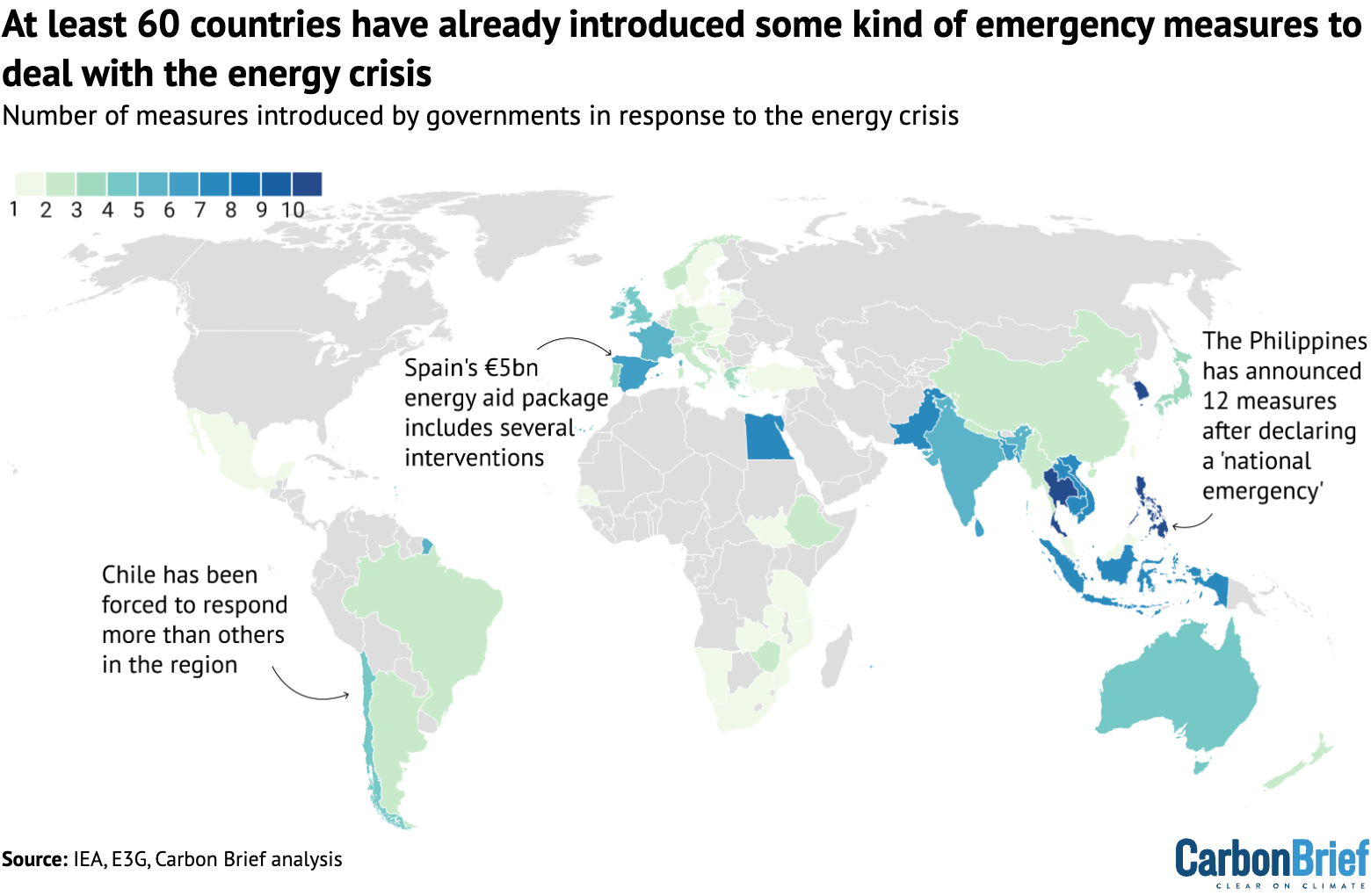
Nations including Indonesia, Japan, South Korea and India are already spending billions of dollars on fuel subsidies to protect people from rising costs.
At least 16 Asian countries are also taking drastic measures to reduce fuel consumption. For example, the Philippines has declared a “state of national emergency”, which includes limiting air conditioning in public buildings and subsidising public transport.
Other examples from the region include the government in Bangladesh asking the public and businesses to avoid unnecessary lighting, Pakistan reducing the speed limit on highways and Laos encouraging people to work from home.
Europe – which was hit hard by the 2022 energy crisis due to its reliance on Russian gas – is less immediately exposed to the current crisis than Asia. However, many nations are still heavily reliant on gas, including supplies from Qatar.
The continent is already feeling the effects of higher global energy prices as countries compete for more limited resources.
At least 18 European nations have introduced measures to help people with rising costs. Spain, which is relatively insulated from the crisis due to the high share of renewables in its electricity supply, nevertheless announced a €5bn aid package, with at least six measures to support consumers.
Many African countries, while also less reliant on direct fossil-fuel supplies via the Strait of Hormuz than Asia, are still facing the strain of higher import bills. Some, including Ethiopia, Kenya and Zambia, are also facing severe fuel shortages.
There have been fewer new policies across the Americas, which have been comparatively insulated from the energy crisis so far. One outlier is Chile, which is among the region’s biggest fuel importers and is, therefore, more exposed to global price increases.
Tax cuts
The most common types of policy response to the energy crisis so far have been efforts to protect people and businesses from the surge in fuel prices.
At least 28 nations, including Italy, Brazil and Australia, have introduced a total of 31 measures to cut taxes – and, therefore, prices – on fuel.
Even across Africa, where state revenues are already stretched, some nations – including Namibia and South Africa – are cutting fuel levies in a bid to stabilise prices.
Another 17 countries, including Mexico and Poland, have directly capped the price of fuel. Others, such as France and the UK, have opted for more targeted fuel subsidies, designed to support specific vulnerable groups and industries.
These measures are all shown in the dark blue “consumer support” bars in the chart below.
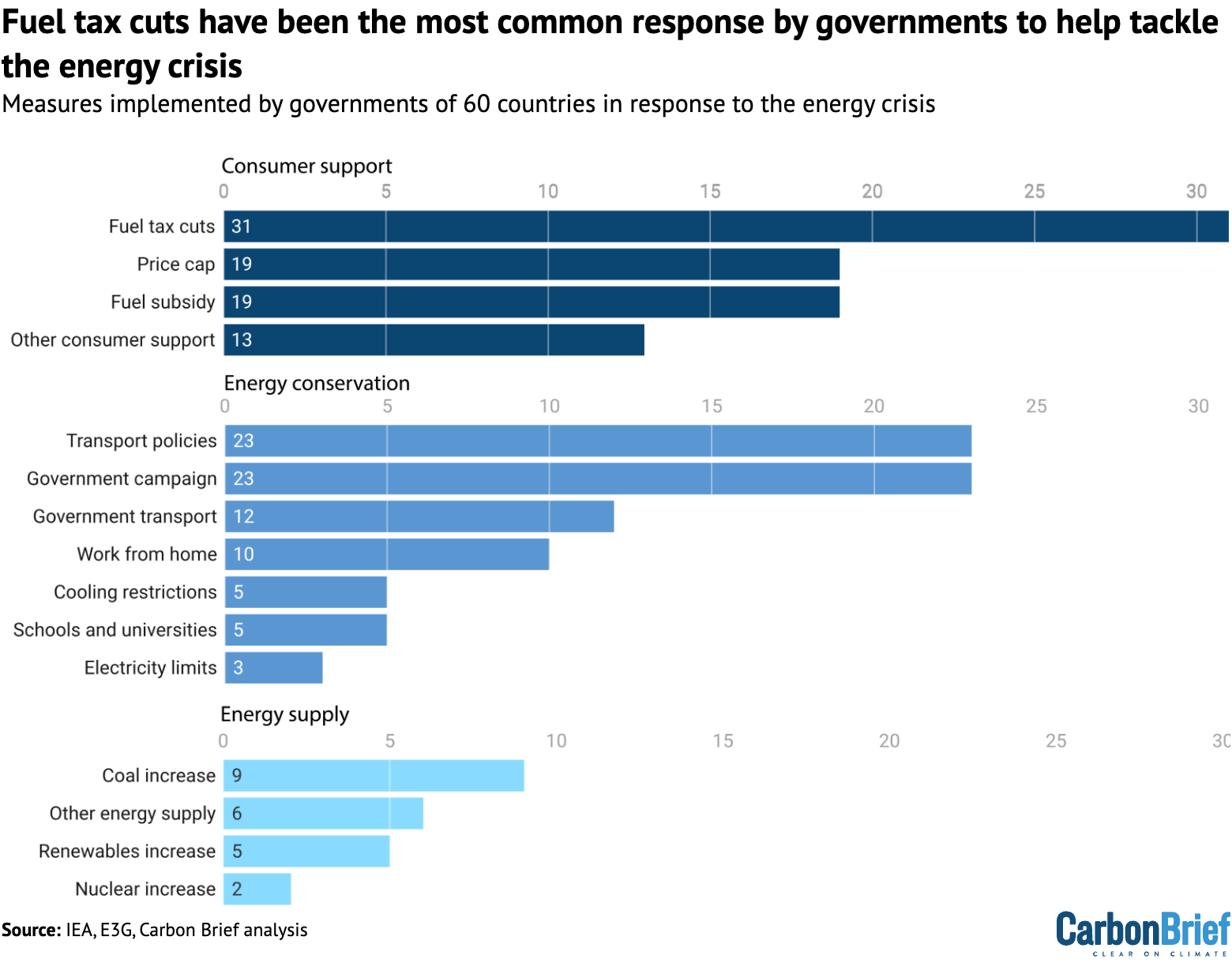
Such measures can directly help consumers, but some leaders, NGOs and financial experts have noted that there is also the risk of them driving inflation and reinforcing reliance on the existing fossil fuel-based system.
Christine Lagarde, president of the European Central Bank, spoke in favour of short-term measures to “smooth the shock”, but noted that “broad-based and open-ended measures may add excessively to demand”.
Measures to conserve energy, of the type that many developing countries in Asia have implemented extensively, have been described by the IEA as “more effective and fiscally sustainable than broad-based subsidies”.
So far, there have been at least 23 such measures introduced to limit the use of transport, particularly private cars.
These include Lithuania cutting train fares, two Australian states making public transport free and Myanmar and South Korea asking people to only drive their cars on certain days.
Clean vs coal
At least eight countries have announced plans to either increase their use of coal or review existing plans to transition away from coal, according to Carbon Brief’s analysis. These include Japan, South Korea, Bangladesh, the Philippines, Thailand, Pakistan, Germany and Italy.
These measures broadly involve delaying coal-plant closure, as in Italy, or allowing older sites to operate at higher rates, as in Japan – rather than building more coal plants.
There has been extensive coverage of how the energy crisis is “driving Asia back to coal”. However, as Bloomberg columnist David Fickling has noted, this shift is relatively small and likely to be offset by a move to cheap solar power in the longer term.
Indeed, some countries have begun to consider changes to the way they use energy going forward, amid a crisis driven by the spiralling costs of fossil-fuel imports.
Leaders in India, Barbados and the UK have explicitly stressed the importance of a structural shift to using clean power. Governments in France and the Philippines are among those linking new renewable-energy announcements with the unfolding crisis.
New renewable-energy capacity will take time to come online, albeit substantially less time than developing new fossil-fuel generation. In the meantime, some nations are also taking short-term measures to make their road transport less reliant on fossil fuels.
For example, the Chilean government has enabled taxi drivers to access preferential credit for purchasing electric vehicles (EVs). Cambodia has cut import taxes on EVs and Laos has lowered excise taxes on them.
Finally, there have been some signs that countries are reconsidering their future exposure to imported fossil fuels, given the current economics of oil and gas.
The New Zealand government has indicated that a plan to build a new LNG terminal by 2027 now faces uncertainty. Reuters reported that Vietnamese conglomerate Vingroup has told the government it wanted to abandon a plan to build a new LNG-fired power plant in Vietnam, in favour of renewables.

The post Iran war analysis: How 60 nations have responded to the global energy crisis appeared first on Carbon Brief.
Iran war analysis: How 60 nations have responded to the global energy crisis



-
Climate Change8 months ago
Guest post: Why China is still building new coal – and when it might stop
-
Greenhouse Gases8 months ago
Guest post: Why China is still building new coal – and when it might stop
-

 Greenhouse Gases2 years ago
嘉宾来稿:满足中国增长的用电需求 光伏加储能“比新建煤电更实惠”
-
Climate Change2 years ago
Bill Discounting Climate Change in Florida’s Energy Policy Awaits DeSantis’ Approval
-

 Climate Change2 years ago
嘉宾来稿:满足中国增长的用电需求 光伏加储能“比新建煤电更实惠”
-
Climate Change Videos2 years ago
The toxic gas flares fuelling Nigeria’s climate change – BBC News
-

 Renewable Energy6 months ago
Sending Progressive Philanthropist George Soros to Prison?
-

 Carbon Footprint2 years ago
US SEC’s Climate Disclosure Rules Spur Renewed Interest in Carbon Credits