
Connect with us

Published

on

copper

In July 2025, the copper market is teetering between booming production and growing political uncertainty. Mining giants such as Rio Tinto and Antofagasta have delivered strong first-half results, indicating that global copper supply is in good shape.

Yet, looming trade disruptions, especially U.S. President Donald Trump’s plan to slap a 50% tariff on copper imports, are stirring fear in the market. While copper demand remains healthy due to clean energy and electrification trends, the tariff shock and rising inventories have shaken investor confidence. Prices, although still up year-on-year, are losing steam fast.

Rio Tinto Delivers a Copper Surge

Rio Tinto’s second-quarter copper production hit 229,000 tonnes—its highest in years. That’s a 15% jump year-on-year and a 9% increase from Q1. The figures include both copper concentrate and refined metal.

  • CuEq production: Up 13% YoY for Q2
  • Half-year growth: 6% YoY
  • Oyu Tolgoi mine: Star performer with 87,000 tonnes, up 65% YoY
  • Escondida (Rio’s share): Production rose 4% despite lower ore grades

Rio Tinto CEO Jakob Stausholm called it a “strong operational quarter,” noting the company’s consistent performance in bauxite and iron ore as well. He emphasized that Oyu Tolgoi remains on track to become the fourth-largest copper mine globally by 2030.

2025 Guidance

The company expects to reach the higher end of its full-year copper production guidance—between 780,000 and 850,000 tonnes. Cost controls remain strong, helping Rio position itself well for the second half.

Meanwhile, expansion efforts are ongoing, with two key projects in the pipeline:

  • Resolution Copper in Arizona
  • Winu Project in Western Australia

Rio’s flagship Oyu Tolgoi mine is expected to scale up to 500,000 tonnes per year between 2028 and 2036, further strengthening its global copper dominance.

Antofagasta’s Copper Surge Meets Market Caution

Chile’s Antofagasta also posted solid growth, producing 314,900 tonnes of copper in H1 2025—a 10.6% increase year-over-year.

Strong output from the Centinela Concentrates and Los Pelambres mines offset a decline in cathode production.

  • However, the company has chosen to keep its annual guidance unchanged at 660,000–700,000 tonnes, similar to its 2024 figures.

That cautious outlook reflects the uncertain pricing environment and potential headwinds from global trade actions.

In general, tighter regulations, environmental rules, and rising production costs are pushing more companies to merge. Experts say that over the next 25 years, the copper industry will need more than $2.1 trillion in investments to keep up with global demand.

At the same time, companies are focusing more on strong ESG practices to boost transparency and improve their sustainability efforts.

Trump’s Tariff Threat Rattles the Copper Market

The copper market’s biggest shock came from Trump’s announcement: a 50% tariff on all copper imports into the U.S., set to take effect August 1, 2025. However, the goal is to boost domestic production and reduce reliance on imports.

The U.S. Geological Survey highlighted key facts about the U.S. copper market

  • U.S. copper production: Covers just over half of domestic demand. In 2024, U.S. mine production of recoverable copper was approximately 1.10 million tonnes, down from ~1.13 Mt in 2023.
  • Arizona’s contribution: Over two-thirds of the U.S. copper supply
  • 2024 imports: Over 90% came from Chile, Canada, and Peru. Refined copper imports reached roughly 0.81 Mt in 2024
  • The U.S. consumes about 1.6 Mt annually but only produces ~1.1 Mt domestically, leading to a net import reliance of nearly 45%.
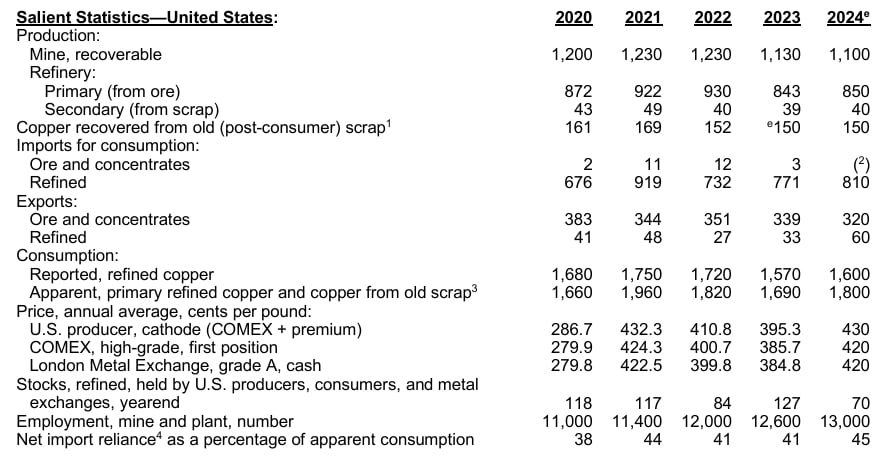
U.S. COPPER
Source: U.S. Geological Survey, Mineral Commodity Summaries, January 2025

Reuters reported that the tariff news sparked a surge in imports as buyers rushed to stockpile ahead of the deadline. Reports say that now, inventories have built up at ports across Texas, New Jersey, and California. Buyers are drawing from these stockpiles instead of placing fresh orders, leading to weaker near-term demand.

Experts warn that if domestic prices rise too quickly, the U.S. might be forced to reverse the tariffs or risk triggering inflation in downstream industries.

Copper Prices Retreat Despite Strong Demand

Despite a solid demand backdrop, copper prices have begun to slip. As per SMM reports, LME copper dipped 0.2% to $9,663 per metric ton, while SHFE copper fell 0.27% to 78,320 yuan per metric ton.

Meanwhile, copper futures dropped below $5.50 per pound.
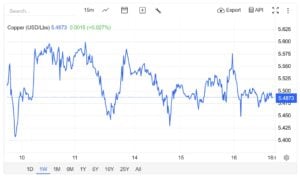
copper prices
Source: Trading Economics

This price retreat reflects softer U.S. demand, swelling inventories, and investor caution ahead of the August tariff deadline. Although the broader copper market has gained 24% year-on-year, it’s up just 2% so far in 2025, signaling fading momentum despite strong underlying fundamentals.

The copper market is facing a rare moment where supply growth and political tension collide. Nonetheless, it is essential for power systems because of its conductivity. This is why it’s significant for numerous low-carbon products and data centers.

Mining leaders like Rio Tinto and Antofagasta are reporting record or near-record output, with new projects coming online and long-term demand drivers intact. But Trump’s tariff bombshell is reshaping global trade flows, spooking investors, and forcing market players to reassess their strategies.

The post Rio Tinto, Antofagasta Lead Copper Surge—But Trump’s Tariff Threat Casts a Shadow appeared first on Carbon Credits.

Continue Reading

Carbon Footprint

Insetting vs Offsetting: Which Actually Counts Toward Your Scope 3 Targets

Published

on

The accounting differences that decide whether your nature investment shows up in inventory, in BVCM, or nowhere at all.

The question reaches a procurement team about three weeks before the next sustainability committee meeting. Someone has read about insetting. Someone else has just signed off on an offset purchase. The CSO wants to know if the two are interchangeable. The answer is no, and the GHG Protocol Land Sector and Removals Standard is the reason why.

This article walks through what each term means at audit-grade specificity, what the standards actually say about how each gets counted, and how to decide which tool fits which target. The insetting vs offsetting question is one of the most-searched in corporate climate strategy, and one of the most poorly answered. By the end of this piece, you should be able to brief a committee on the difference without notes.

The two definitions, in plain English

Offsetting means buying carbon credits generated outside your value chain and retiring them against your residual emissions. The reduction happens somewhere else, financed by you, and the credit is the receipt.

Insetting means investing in emission reductions or removals inside your own value chain, typically with suppliers, where the reduction is directly linked to the products and services you buy. The reduction happens inside the boundary of your Scope 3 inventory, and the accounting treatment is fundamentally different.

The shorthand from the University of Oxford’s Nature-based Insetting Initiative is useful: insetting is what you do with the supply chain you have; offsetting is what you do with the supply chain you do not have.

What the GHG Protocol Land Sector Standard actually says

The GHG Protocol Land Sector and Removals Standard, finalised in 2024 after a multi-year pilot, sets the rules for how land-based emission reductions and removals enter corporate inventories. The Standard distinguishes between inventory accounting (Scope 1, 2, and 3) and project or intervention accounting (a separate methodology for crediting).

For insetting, the practical implication is that supplier-level interventions, when properly measured and attributed, can reduce your Scope 3 category 1 (purchased goods and services) emissions in your inventory. The reduction is not a credit retired against the inventory; it is a lower inventory number, period.

For offsetting, the credit is retired separately. It can be reported as a contribution toward a net-zero claim under the SBTi Beyond Value Chain Mitigation framework or as part of a VCMI Carbon Integrity claim, but it does not lower the inventory number.

A practical consequence: if your Science Based Target requires a 50% absolute reduction in Scope 3 emissions by 2030, insetting moves you toward the target. Offsetting does not. This single point of difference reshapes the procurement decision.

When insetting counts toward Scope 3 (and when it does not)

Insetting counts toward Scope 3 only when several conditions are met:

  • The intervention must occur with an entity in your value chain.
  • The emissions reduction or removal must be measured against a defensible baseline.
  • The reduction must be attributed to your share of that supplier’s output, not double-counted with other buyers.
  • It must follow the inventory accounting rules in the GHG Protocol Land Sector Standard, not the project accounting rules used to generate credits.

The most common failure mode is double counting. If your supplier sells the same reduction as a credit on the voluntary market and also reports it to you as a Scope 3 reduction, the math breaks. The Standard requires you to address this risk, typically by purchasing and retiring the supplier-issued credit as part of your inventory or by contractual provisions that prevent the supplier from selling the reduction twice.

When insetting does not count toward Scope 3: when the intervention sits with a supplier you do not buy from, when the baseline is not defensible, when the attribution is unclear, or when the documentation does not survive audit. Those cases default to Beyond Value Chain Mitigation, which is still useful but operates on a different ledger.

The procurement and supplier engagement question

Insetting is harder than offsetting. That is the unfashionable truth most buyers eventually confront. Offsetting is a transaction; insetting is a relationship.

To run an insetting program, you need supplier mapping precise enough to know which farms or facilities sit at which Scope 3 boundary. You need an engagement model that gets suppliers to participate, which usually requires multi-year commitments and shared economics. You need an MRV architecture that measures the right things and produces audit-ready documentation. And you need a contractual structure that prevents double counting and protects both sides.

The trade-off you receive in return is significant. Reductions count against your inventory rather than your residual. Supplier relationships deepen, which protects sourcing continuity. Yield and quality improvements often follow regenerative interventions, which reduces your input cost over time. And the regulatory file, under CSRD, CSDDD, EUDR, and the SBTi FLAG Guidance, is materially stronger.

Choosing the right tool for the right target

A practical decision rule. If your target is a science-based Scope 3 reduction and you operate in a FLAG sector or source FLAG commodities, insetting is the structurally correct tool. If your target is a net-zero claim that includes neutralising hard-to-abate residual emissions outside your value chain, BVCM via high-integrity offsets is the structurally correct tool. Most companies with material Scope 3 exposure need both, in different proportions, sequenced over time.

The sequencing matters. Insetting takes longer to stand up but produces a permanent reduction in the inventory. Offsetting can be transacted faster but does not change the inventory and now sits under tighter claim restrictions. Treat them as complementary tools with different jobs, not as substitutes. The Accountability Framework Initiative and the IUCN Global Standard for Nature-based Solutions both provide useful guardrails for the insetting side, with biodiversity, human rights, and benefit-sharing requirements that go beyond carbon math.

If you are mapping a Scope 3 reduction roadmap and need to scope which interventions count toward your inventory versus which sit in Beyond Value Chain Mitigation, the carbon and sustainability experts at Carbon Credit Capital can help you structure a nature-based supply chain investment program that fits your FLAG exposure, your target architecture, and your audit horizon. Schedule a consultation.

Continue Reading

Carbon Footprint

Net zero needs nature: a carbon credit guide

Published

on

Net zero is often described as a balancing act: cut what you can, account for the rest, and reach zero on the ledger. That framing is useful, but it leaves something out. It treats every tonne of carbon as interchangeable and every route to zero as equally sound, while the science tells a more specific story.

Continue Reading

Carbon Footprint

Deforestation in Malawi: causes and solutions

Published

on

Malawi has lost a striking share of its forests over the past three decades. Woodlands that once covered well over a third of the country now cover less than a quarter, and the pressure on what remains is increasing. Behind those figures sit two practical questions: what is driving the loss, and what reverses it?

Continue Reading

Trending

Copyright © 2022 BreakingClimateChange.com

