

Claims by wealthy nations that their new emissions reduction targets for 2035 are compatible with limiting global warming to 1.5C have been questioned by experts concerned about fairness.
In Nationally Determined Contribution (NDC) plans submitted to the United Nations in recent months, countries including the UK, Canada and Switzerland have argued that if every nation cut emissions as fast as they aim to, then the Paris Agreement goal of keeping warming to 1.5C above pre-industrial times would be achieved.
But scientists and campaigners – as well as the Canadian government’s official climate advisers – say this view overlooks the fact that historically the people of these rich countries have done, and continue to do, more to cause climate change than those in poorer nations – and so should reduce emissions more sharply than average.
Commenting on the NDC claims of 1.5C compatibility, Imperial College London climate scientist Robin Lamboll noted that “the Paris Agreement requires wealthier countries to lead the way towards net zero much faster than the world as a whole”.
He added that reaching net zero emissions globally by 2050 “should have been enough to keep us below 1.5C if everyone started moving towards it in 2015”. “Unfortunately, global emissions have yet to clearly peak, and every year of rising emissions makes staying below 1.5C harder,” he added.
Most cookstove carbon credits ruled out of quality scheme in integrity push
Most developing countries do not have goals to reach net zero by 2050, citing a lack of funding to invest in the green transition, their low responsibility for climate change, and the need to develop economically. China – today the world’s biggest emitter – aims to reach net zero by 2060, for example, while India targets 2070.
Meanwhile, 2024 marked the first calendar year that global temperature rise topped 1.5C above pre-industrial levels, although scientists said that does not mean the 1.5C Paris goal has been breached because that refers to an average over at least two decades.
Fears of ‘1.5-washing’
At the COP28 climate summit in Dubai in 2023, all countries agreed that their next round of NDC climate plans, due to be issued this year before COP30, would be “aligned with limiting global warming to 1.5C, as informed by the latest science, in the light of different national circumstances”.
Just over a dozen of these NDCS have been published to date, with a mandatory section on how the government considers its plan “fair and ambitious in light of its national circumstances”.
Most developed countries so far have used this section to argue their plans are 1.5C-aligned, based on a 2018 recommendation by scientists working with the Intergovernmental Panel on Climate Change that the world should reach net zero by 2050 to have a good chance of limiting global warming to 1.5C.
The UK, New Zealand, Canada and Switzerland say in their latest NDCs that because they plan to reach net zero by 2050, their plans are therefore 1.5C-compatible.
This argument, however, is based on an assumption that every country should reduce emissions at the same rate, even though relative to the size of their populations, these countries have polluted – and still pollute – more than most other nations.
Avantika Goswami, climate lead at the India-based Centre for Science and Environment, told Climate Home that because of their “higher historical burden of greenhouse gas emissions”, developed nations should cut emissions faster than the average for all countries.
She said a flaw in the 2015 Paris climate accord is that it allows countries to determine their own targets rather than obliging developed nations to do more, as its predecessor did. The 1997 Kyoto Protocol set emissions reduction targets only for developed countries. “A loose voluntary system is likely to lead to creative interpretations by polluters,” Goswami said.
Neither the IPCC’s scientists nor governments have agreed on a methodology to determine what makes a climate plan compatible with 1.5C. Commenting on this last June, Brazilian climate negotiator Liliam Chagas said “it’s up to each [government] to decide”.
The Net-Zero Advisory Body (NZAB), which advises the Canadian government, says in advice included in an annex to Canada’s NDC that Canada is likely to have already used up its 1.5C-compatible carbon budget by the end of 2024 and will burn through its 2C-compatible budget by 2030.
Brazil’s COP30 president: Climate summits must move from words to real action
To do its fair share of limiting global warming to 1.5C, the NZAB says Canada should be carbon-negative – absorbing more greenhouse gas from the atmosphere than it emits – around now. Instead, Canada only aims to reach net zero by 2050.
As a result, the NZAB argues it’s not possible for the Canadian government to use a “science-driven budget approach” for setting emissions reduction targets for the future without assuming “substantial negative emissions or international transfers”.
“Less stringent and hence more realistic and achievable interim targets embed a structural injustice in that they imply Canada is claiming a disproportionate share of the remaining global carbon budget” if the world is to stay below the warming limits in the Paris Agreement, the advice says.
Canada should pay for additional emissions reductions abroad to address this unfairness, it recommends. The Canadian government itself echoed this position in its NDC, saying that climate finance is “essential for Canada to contribute to emission reductions beyond its borders”.
Differentiated responsibilities
Many developing countries do not have a target to reach net zero by 2050. The NDCs of those like Zimbabwe, Zambia and the Maldives stress their disproportionately small contribution to climate change and their vulnerability to its effects.
Zambia’s latest NDC says the plan was developed taking into account the UN climate regime’s agreed principle of “common but differentiated responsibilities and respective capabilities” (CBDR) and, in a nod to carbon budgets, “equitable access to atmospheric space”.
The concept of CBDR is broadly understood to mean that, while all countries should tackle climate change, countries that have put more greenhouse gases into the atmosphere and have greater financial and technical resources should take on a larger share of the action required to tackle climate change.
Despite being a developing country, this year’s COP30 host Brazil aims to reach net zero by 2050. Its recent NDC says that developing countries should try to get to net zero “as close as possible to 2050 while developed countries should move faster – by 2045”.
To back up this 2045 call for richer nations, the Brazilian NDC cites the International Energy Agency and UN Secretary-General Antonio Guterres. Germany is currently the only major nation with a net zero target for 2045.
In 2023, Guterres called for a “quantum leap in global action”, with governments “immediately hitting the fast-forward button on their net zero deadlines to get to global net zero by 2050”. To achieve this, he said developed countries should reach net zero “as close as possible to 2040” – but none have responded to his plea.
The post Rich nations ignore polluting past to claim climate plans are 1.5C-compatible appeared first on Climate Home News.
Rich nations ignore polluting past to claim climate plans are 1.5C-compatible

More than 92,000 people have registered to attend the COP31 climate summit in Antalya, Turkey, potentially making it the largest COP in history.
Carbon Brief analysis of the provisional lists of delegates, published by the United Nations Framework Convention on Climate Change (UNFCCC), reveals that more than 14,000 delegates have been registered as “host country guests”.
For comparison, the provisional list for COP30 in Belém, Brazil, last year included only around 1,000 delegates in this category.
As with COP30, Donald Trump’s US government has not sent a delegation. Other no-shows include Israel and Myanmar.
It was reported ahead of the summit that Taliban officials from Afghanistan had been registered for the event as observers; however, there are no delegates from observer states in the provisional lists.
With more than 3,000 “virtual” delegates signed up to attend the summit online, the total number of people registered for the event surpasses 95,000.
Further analysis of the participant lists will be added to this article in due course.
Party delegates
With 92,934 participants registered, COP31 is provisionally the largest COP in history – topping COP28 in Dubai, which was attended by more than 80,000 people.
This total is based on the delegates that have registered to be at the summit in person. The UNFCCC releases the final figures – based on participants collecting a physical badge at the venue – after the summit has ended.
The chart below shows how the provisional figures for COP31 compare to the final totals in previous COPs – going back to COP1 in Berlin in 1995.
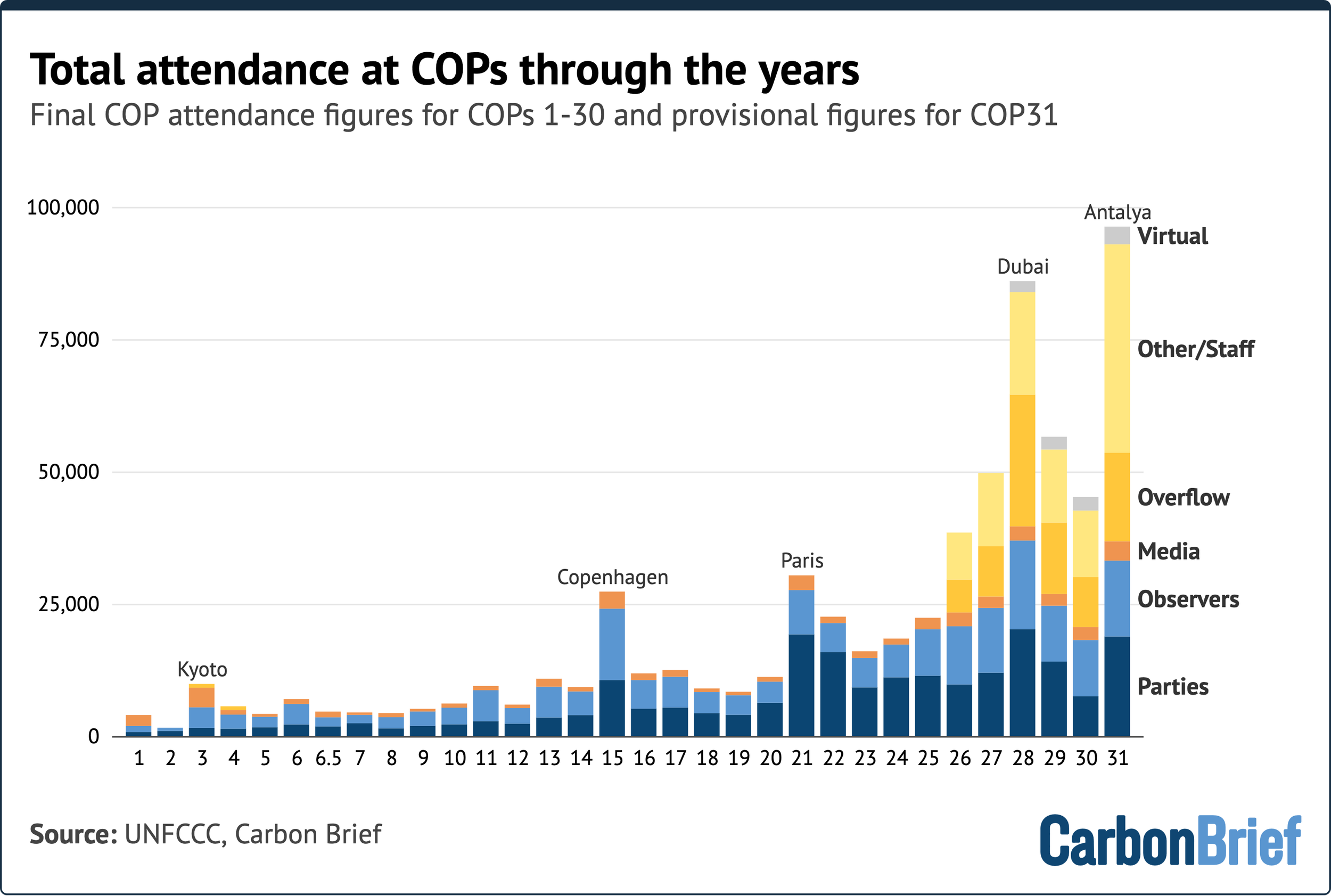
The participant lists provided by the UNFCCC are divided between the different types of groups and organisations attending the summit. The largest group at COP31 is for delegates representing parties. These are nation-states, plus the European Union, that have ratified the convention and play a full part in negotiations.
This group adds up to 18,812 delegates – the second largest after COP28.

Membership
Support award-winning climate journalism
(In keeping with recent COPs, the UNFCCC has published spreadsheets that name every single person that has registered for the summit – excluding support staff. Previously, COPs have typically included thousands of “overflow” participants in which countries and UN agencies could nominate delegates without their names appearing on their official lists.)
For consistency with Carbon Brief’s analysis of previous COPs, the above chart includes overflow delegates as a single group. However, the participant lists do divide the overflow delegates between parties and observer groups. Including the overflow numbers takes the total for party representatives to more than 34,000.
Nations
The map and table below present the delegation size – split between party and overflow badges – for all the countries registered for COP31. The darker the shading, the more delegates that country has signed up. Use the search box to find the data for a specific party.
Unsurprisingly, host nation Turkey has registered the largest delegation for COP31 – with 2,950 people.
Following behind are Brazil (1,994 people), Nigeria (1,506), China (1,021) and Indonesia (978).
The rest of the top 10 is made up of Australia (835), Uganda (627), Italy (607), Japan (588) and Kazakhstan (557).
The UK comes someway down the list with a delegation of 255.
The smallest delegation comes from North Korea (two), followed by Eritrea and Nicaragua (three) and San Marino and Trinidad and Tobago (four).
(It is worth noting that some countries – such as Brazil – allocate some of their party badges to NGOs, which can artificially inflate the size of their official delegation.)
The post Analysis: Which countries have sent the most delegates to COP31? appeared first on Carbon Brief.
Analysis: Which countries have sent the most delegates to COP31?