

ReVision Energy has been selected by Unitil Corporation as the EPC contractor for its 4.9 MW array, to consist of 11,232 panels built on 36 acres of vacant land in Kingston, N.H.
The array is set to be constructed in the vicinity of an electrical substation and fed into Unitil’s distribution system, reducing the amount of energy it receives from the transmission system. The array, which is expected to be completed and brought online next year, is expected to average 8.6 million kWh annually over its projected 40-year lifespan.
“With this array, Unitil will provide substantial savings for ratepayers, generate employment opportunities within the community, and significantly curb carbon emissions,” says ReVision Energy’s Dan Weeks. “As their solar installation partner, we are honored to support them in their charge by powering a more sustainable and resilient future through the transformative technology of solar energy.”
The Kingston project was approved by the New Hampshire Public Utilities Commission last May.
The post ReVision Energy Selected as Contractor for New Hampshire’s First Utility-Owned Solar Array appeared first on Solar Industry.
ReVision Energy Selected as Contractor for New Hampshire’s First Utility-Owned Solar Array

Weather Guard Lightning Tech
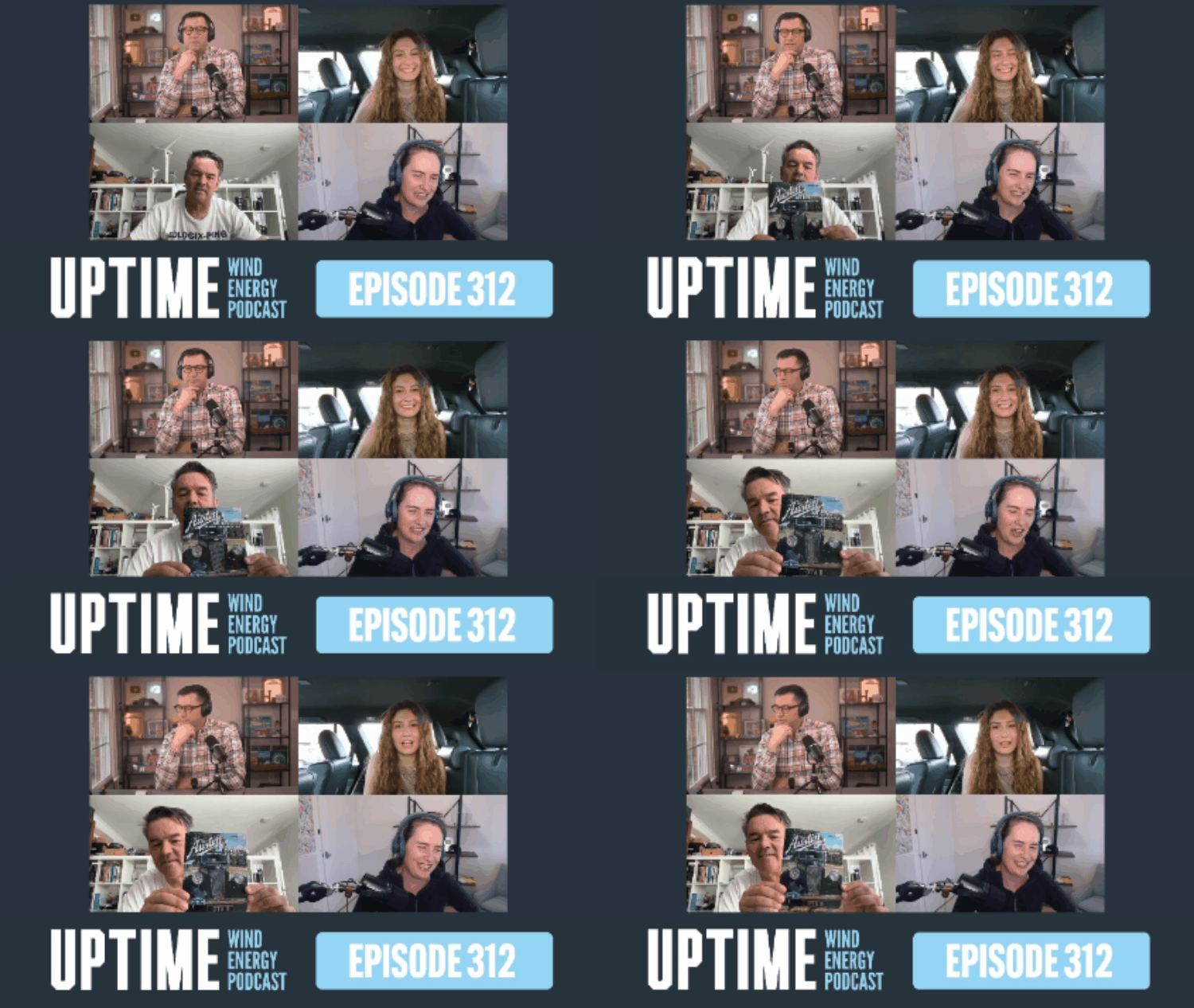
Danish Renewables Push in Australia, Nearthlab Does Defense
Denmark’s royal trade mission brings 54 companies to Australia’s renewables market. Plus the UK opens CFD allocation round eight for up to 18 offshore wind farms, and wind tech startups weigh focus against diversification into defense.
Sign up now for Uptime Tech News, our weekly newsletter on all things wind technology. This episode is sponsored by Weather Guard Lightning Tech. Learn more about Weather Guard’s StrikeTape Wind Turbine LPS retrofit. Follow the show on YouTube, Linkedin and visit Weather Guard on the web. And subscribe to Rosemary’s “Engineering with Rosie” YouTube channel here. Have a question we can answer on the show? Email us!
The Uptime Wind Energy Podcast brought to you by Strike Tape, protecting thousands of wind turbines from lightning damage worldwide. Visit strike tape.com And now your hosts.
Allen Hall: Welcome to the Uptime Wind Energy Podcast. I’m here with Yolanda Padron, Rosemary Barnes at Matthews Stead, and we start off. On the Danish trip to Australia, 54 Danish companies traveled to Australia alongside King Frederick II and Queen Mary. Uh, over the past week, most work in the renewable energy and green construction businesses that traveled along several signed agreements during the trip.
Denmark sees Australia as a growth market, and Rosemary is tied to royalty here. Loosely that Queen Mary is actually from Tasmania, much like Rosemary. [00:01:00] So there is possibly a line to the throne, the Danish throne for Rosemary.
Rosemary Barnes: My dad’s from Tasmania. I, I live in Canberra, but I was, the whole five years I was living in Denmark, I kept waiting for Princess.
She was Princess Mary at that point, but Princess Mary to get in touch with her phone number, catch up. You know, Australians have moved to Denmark. Never happened. And now I see that they’ve come to Australia. And do you think that Mary reached out and got in touch with me? No, she didn’t. So I continue, continue to be disappointed in, in Queen Mary.
Matthew Stead: Maybe she’s waiting for you, Rosie.
Rosemary Barnes: Yeah, she could be waiting for me to reach out. That’s true.
Allen Hall: But I clearly, Australia is a growth market. Denmark sees it. I know there’s been a number of Danish companies in Australia over the last two, three years, or con companies from all over the world have been down to Australia, realizing that the growth of renewables is gonna be big because Australia is targeting 82% renewables by 2030.
Uh, and right now it’s about 50% renewables, which is [00:02:00] remarkable by the way, that connection to Denmark. Is only going to grow, especially with the relationship with Queen Mary to the area. What are some of the growth areas that Denmark can walk into in Australia right now, Matthew?
Matthew Stead: I mean, obviously the proposed offshore wind is a, is a big thing.
So, um, once that gets up and running, obviously the Danish technology will come in there. Um, but, but also, you know, through vest have been here forever. Uh, Siemens, gaa, you know, there’s a strong Danish connection there. Um, so. Yeah, I, I think it’s already, already, already really strong. And, um, obviously having the, the queen, the Danish queen, um, yeah.
Ties in with all of that.
Allen Hall: Is it a reciprocal agreement that Australians can do work in Denmark?
Rosemary Barnes: I don’t think, it’s not any sort of like free trade agreement, is it? It’s just some individual, I dunno how much we’ve, we’ve got to [00:03:00]teach Denmark, although there are some good Australian technologies, like maybe not building wind turbines themselves, but there are some good technologies like here, logic’s Ping, uh, Australian developed the ping part of it anyway.
And then also, you know, I think some, some future manufacturing methods, uh, doing some exciting things here in Australia. Also, it’s not that hard to move to Denmark if you, um, like when I moved there, all I needed to get a Visa was a, a job offer. That was a certain, I, I don’t think it, I don’t, I don’t remember exactly if it was the type of job or if it was the salary, but you know, like you’re not gonna get a job offer.
Like working part-time at a bar isn’t gonna be enough to get you a, a working visa in Denmark. But certainly. Any engineers, um, you can, if you get a good engineering position offered to you in Denmark, it’s not hard for the company to make that happen. So I don’t know that we need, we don’t, we don’t really need it made that much easier for us [00:04:00] to get over there.
Allen Hall: Is it difficult to get a work permit in Australia if you’re from Denmark?
Rosemary Barnes: Yes and no. It’s not like I would so love to be hiring my XLM colleagues to come. I know that I’d moved to Australia too. Some of them, it’s, it’s not super duper easy. Um. It’s not impossible. And uh, if people are young enough, it’s a bit easier.
But, um, it’s, it’s definitely possible, but it’s not, it’s not straightforward. It’s quite expensive and lengthy process.
Matthew Stead: You know, if they can fund a fund, um, themselves with a couple of million dollars, that’ll make it easier.
Rosemary Barnes: It’s definitely beyond my capabilities as a small company of like four, four people to be able to, um, sponsor someone.
But I have had, um, actually. Most, maybe. Yeah. Every single employee actually that I’ve had has been, has non, not an Australian citizen, but they’ve all had visas for other reasons. You know, either because they came over with a partner who, um, was an unskilled working visa or because they did a master’s [00:05:00] here and then got a, um, a, yeah, after that got permanent residency through the, you know, the, there’s a pretty established pathway after studying to be able to get permanent residency.
Definitely appreciate that there is so much, um, international talent that’s willing to come to Australia, but just yeah, unfortunately any, any random skilled person, you, it’s not, it’s not easy for a small company to bring them over.
Matthew Stead: Rosie, would you recommend Australians to go to Denmark to learn about the wind industry and then, and come back again like you did?
Rosemary Barnes: I recommend that they do that in 2016 when I did it. Um, so everyone who’s got a time machine. Hop, hop in, hop in your time machine and go, go do that. I mean, it’s, uh, I was looking back through, um, photos, uh, of my time there recently and was just, uh, like thinking about how much work I did and the amount of time that I spent like in, in production is like I got in my.
Four years that I was working for lm, I had at least 10 years worth of experience. And I mean there were [00:06:00] some long, long weeks, but I’m not sure that Denmark’s the right place now because for LM there’s nearly no engineering left in Denmark and certainly not doing the cool, new, exciting technologies that they were while I was there.
So that’s not the go Vestas is still doing a fair bit. But you know, we talked recently about the Vestas CO wanting to, wanting to move somewhere with more favorable. Taxation of CEOs salaries. So, you know, maybe that’s not continuing. So I definitely recommend moving to another part of the world early on in your career while you’ve still got enough energy to, to, to like really, really hard work.
Um, but I dunno that Denmark is, is the right place anymore. There’s not that much manufacturing left Now.
Based on your experience in both Denmark and Australia, how likely do you think that any of these companies that are coming in. To Australia will do any r and d with data from Australia for all of these wind technologies that they’re bringing.
Rosemary Barnes: I, I think that there’s some interest in that. I haven’t heard [00:07:00] Danish companies specifically. I have heard a few little inklings of US companies who are interested and I think that that makes a lot of sense because the US was a much more attractive environment for wind energy technologies until a couple of years ago.
So there’s a lot of companies that got partway and now are frustrated and I think that Australia seems quite attractive to them. So that’s where I’ve heard people interested, maybe British as well. Um, the Denmark Danish companies would do well. Like any company, um, that’s trying to develop a technology related to wind energy would, um, do really well to come try and develop in Australia because, you know, like, um, we’re so short staffed or like for expert staff.
Things are really spread out. Costs are very high. Um, things wear out faster. Like we just have more operational problems here. So, you know, when you’re putting a business case together, you need to, um, you know, an environment where you are. The alternative of just doing everything manually is [00:08:00]far more expensive here, and it takes far longer so you can get a much more positive business case, um, in Australia, like earlier than you could somewhere else.
So I think that that makes it really. Really like perfect place to develop technologies. Um, yeah, but I don’t think everybody realizes that yet. But I do see some, some people starting to,
Matthew Stead: and I’m adding to what you’re saying, Rosie, when I first started in wind, um, back in 2012, um, I got great reception from Denmark.
Actually, I probably got the most. Positive responses to my outreach from Denmark. So, um, I, at that point in time, you know, it is a little bit before 2016, but, um, um, um, I, you know, I found really positive engagement and willingness to be open to new technologies. So that was my experience
Allen Hall: as Wind energy professionals.
Staying informed is crucial, and let’s face it difficult. That’s why the Uptime podcast recommends PES Wind Magazine. [00:09:00] PES Wind offers a diverse range of in-depth articles and expert insights that dive into the most pressing issues facing our energy future. Whether you’re an industry veteran or new to wind, PES Wind has the high quality content you need.
Don’t miss out. Visit PES wind.com today. The UK government announced contracts for difference allocation round eight, which will open in July of this year. This follows AR seven in January, which secured 8.4 gigawatts of offshore wind. The largest UK CFD procurement ever and renewable UK says up to 18 offshore wind farms could compete for this AR eight round now.
The amount of wind going in offshore in the UK is astonishing. Uh, AR eight. I haven’t seen any numbers yet of what they think the total gigawatts will be, but it has to be somewhere around the eight range just to keep up with the [00:10:00] expected rate, uh, to meet their environmental targets and electricity targets in the uk.
This is changing the way wind is developed in Europe, especially with the UK changing its tariffs and eliminating tariffs on wind turbine parts and components that come into the country. That is going to really improve the economics of wind turbines in the uk. Plus turn out a lot of European countries and companies to to feed the UK energy goals.
Is this the right move in, in terms of the government approach? Because a lot of, uh, other auctions that have happened up in Germany all the way up into Scandinavia have not had such success as this recent UK round. Is their model just a little bit different? And maybe the UK approach is, is the winning method with the the CFDs.
Rosemary Barnes: We have some in Australia too. The A [00:11:00] CT Australian Capital Territory where I live has the same thing and, um, for at least several years. Recently, I think most years recently we’ve had our electricity prices in Canberra have been reduced while in the rest of Australia they’ve gone up. It doesn’t always happen that way.
Um, it depends on, yeah, how expensive. Electricity was compared to normal. But you know, like when the gas, uh, shock was happening and pushing up electricity prices everywhere, it didn’t affect Canberra very much because we already have PPAs for a hundred percent of our electricity from clean sources. So,
Allen Hall: but isn’t that the goal at the end of the day to get.
Some levelized pricing, which is the allocation rounds are doing, is they’re getting levelized pricing over a fixed period, so you know what your electricity is going to cost you. None of this up and down, like with the gas market in the United States and elsewhere.
Rosemary Barnes: My understanding is that it’s the most crucial aspect of that is certainty, so that new projects can get financing.[00:12:00]
It’s not actually about it being a, like, whether it’s a subsidy or a payment is not as important as, like, it’s not that that renewable electricity is too expensive and the government needs to subsidize it. It’s that the bank needs to know how, how much you’re gonna get for the electricity that you generate, um, in order to fuel Okay, to lend it to you.
And I mean, you can understand why, like, think about. As, um, batteries enter the electricity grid, you, you know, the pricing, the market movements throughout a day are really starting to change. We used to have, you know, like big spikes in price every evening as a lot of gas generators came on. ’cause they’re expensive to run.
But now we’re needing less and less of that as we add more batteries. And, you know, people know these. Trends are generally happening, but not exactly. So how can you forecast what your revenue is going to be? Um, if you’re lending billions of dollars to a project, then you want to know that your person you’re lending to is gonna be able to, to pay you back, which they, they can’t if the revenue goes through the floor.
So, yeah, my [00:13:00] understanding is that’s, that’s what it’s really for, is to provide the certainty. It’s, it’s like a bit outdated to refer to it as a subsidy. Um, ’cause it’s not always a subsidy. Sometimes it’s the opposite. But what’s really needed is like knowing how much you’re gonna get for the product that you are delivering.
I think it makes sense. I just think that like if there’s all this, all the changes that are coming down the pipeline for the uk, it’s a little bit difficult to actually pinpoint where that price is gonna be. Like a sweet spot for all parties involved. Um. Which I think is something that we saw on the PPA side a lot in the US a few years ago.
Rosemary Barnes: They had issues in the UK as well, like a couple of auctions ago. Um, they set the price way too low and I mean, they were told leading up to it, no one can deliver a project at this cost and then nobody bid. And it was, it was a real shame because, you know, like it set them back on, you know, that there’s no projects entered the pipeline, um, in that year as a result.
But it’s also what’s interesting to [00:14:00] me is that it’s a different price for different. Types of project. So, you know, onshore wind has a, a different safety price than a, um, offshore wind. And fixed offshore wind has a very different price from floating offshore. Solar’s different. They also have special, uh, price for tidal energy.
And that to me is a really interesting thing because who is looking at the UK’s energy mix and saying, yep, title energy needs to be part of this, and we we’re happy to pay, you know, 2, 3, 4 times whatever it is, more. For that than for offshore wind. It’s, um, that, that’s interesting to me. How, how they’ve come up with, with the Yeah, like how the mix is going to look.
I mean, they don’t control it precisely. It’s not like they say we are gonna have exactly this many gigawatts for offshore wind and exactly this many gigawatts for solar farms. But they do have, um, different prices and different technologies that are targeted.
Matthew Stead: Seems like it really relates really well to the energy [00:15:00]security as well.
You know, an extra eight gigawatt here, extra eight gigawatt there. I mean, that can only help with energy security, which is obviously a massive topic. I’m not sure how the newspapers has been coping in the last week or so in the us but over here it’s all about rationing of fuel. It’s all about queues at the pump.
So energy security is, is definitely a huge topic.
Rosemary Barnes: You wanna know where there isn’t a queue. In my driveway when I plug my car into the, the outlet in my garage. It’s been a really, really fun time to be a smug EV owner. I’ve been, um, reveling in it. Yeah. Really, really, really enjoying, uh. And Joan, but I also do think like it’s gonna last, like we, because we still talk about the oil crisis in the 1970s, right?
Like that, uh, we, uh, people overreacted and then reverted for the most part pretty quickly after that. With Denmark being one exception, they, they went all in on when consistently after that. Um, but [00:16:00] you know, like this, even if it’s only a few weeks long, this little shock is going to. Make people think, okay, oh, I was super worried that I might have to spend 20 minutes refueling on a road trip instead of 10 minutes.
Um, but actually remember that time when I couldn’t even get petrol at all and I had to spend yeah, like half an hour lining up because everyone was freaking out and. Uh, I wasn’t sure if I was even gonna be able to get to work the next week because the Australian government only thinks we need 30 days worth of, um, of oil in reserve.
Uh, I, I think that it’s, it’s got to help EV sales and then. The EV sales is only one part of it because you need then also, you know, security of electricity generation. And I mean, in Australia we’ve got our own coal, so we’re not, um, probably ever going to be able to not generate electricity. But, um, renewables is a, is a huge part of that as well, being able to, you know, have cheap, cheap electricity all the time.
So I, I do think that. It, it’s got to be, you [00:17:00] know, helping some of these technologies move, move ahead a little bit faster now.
Matthew Stead: Yeah, and I also heard that, uh, the UK is sort of patting themselves on the bat for, uh, actually, you know, transitioning and, you know, securing their own, um, energy supply and not being as reliant as some other countries on imports of, of energy.
Rosemary Barnes: Yeah. I mean, we’ve had so many opportunities to learn that lesson over the last few years. Right. So. Anybody that just, um, relaxes after this and says, yep, okay, we’re all good. To go back to relying a hundred percent on, on gas is, you know, like, really. Really going to big lengths to nod to not futureproof themselves from the next one.
I do. Do we could, would anybody believe that this is the last time that we’re gonna see, uh, a shock like this? I mean, it will happen definitely. Again,
Matthew Stead: rather embarrassing, but actually currently I own approximately six EVs.
Allen Hall: It sounds like a lot. Matthew,
Rosemary Barnes: you’ll have people beating down your door. Share.
Share the love around. We need, it
Allen Hall: should give taxi rides. [00:18:00] Ubers
Matthew Stead: in 2026. I wanna sell, I wanna sell three of them. So this is just. I’m just so happy.
Rosemary Barnes: So message ’em on LinkedIn if you need an ev. Now we’re running classified ads in the uptime When new podcast
Allen Hall: are they? BMW electrified? BMWs
Matthew Stead: no one’s. One’s BMW.
Um, another one is, uh, Austin 10. From 1947,
Allen Hall: this is an ad.
Matthew Stead: The other one’s in Nissan Leaf, uh, NISO leaf with about 16,000 Ks on the clock.
Rosemary Barnes: But the first two you converted yourself.
Matthew Stead: Yeah,
Allen Hall: we can reach out to Matthew on LinkedIn and he will sell you an electric vehicle. He’s in Adelaide and there’s plenty of people listening to the podcast in Adelaide and all around Australia.
Honestly, he, he will deliver. If asked, so Matthew Stead, S-T-E-A-D on LinkedIn.
Matthew Stead: The BMW that I converted is a 2 0 2, um, from 19 in the the seventies. And, uh, actually BMW um, converted the same car to an electric vehicle for the Munich [00:19:00] Olympics. So yeah, all I did was, um, recreated what. BMW had done back in 1972.
Allen Hall: Delamination and bottomline. Failures and blades are difficult problems to detect early. These hidden issues can cost you millions in repairs and lost energy production. C-I-C-N-D-T are specialists to detect these critical flaws before they become expensive burdens. Their non-destructive test technology penetrates deep to blade materials to find voids and cracks.
Traditional inspections, completely. Miss C-I-C-N-D-T Maps. Every critical defect delivers actionable reports and provides support to get your blades. Back in service, so visit cic ndt.com because catching blade problems early will save you millions.
Well, south Korean Drone Company Earth Lab built its vision AI [00:20:00]through wind turbine inspections, and I’ve seen hundreds of those in the states. A $10 million defense export deal in 2025 shifted revenue from 80% inspections to. A much larger defense share. Now they have a, a pretty sizable deal, obviously in the Middle East right now, where they’re using their drone technology to be involved in the defense sector.
And North Lab I think got driven to that just because, uh, some of their business in the United States didn’t turn out properly the way they expected it to, although they had. Really great technology. In every conference I would attend with Ner lab, like, uh, and they would explain what they were doing. At one point, they were probably three or four years ahead on the, doing your own drone inspections with the little drone and you just buy their software and it would just, it would go up and take pictures of your wind turbine.
Didn’t need a separate [00:21:00] pilot. It, it made all things a lot simpler, but that did never seem to catch on. But the technology is there and North Lab does have good engineering teams to develop drone technology. One of the things about this article, which I, I saw the other day, is that North Labs is thinking about their technology in a broader sense.
That they’re not just focused on wind turbine inspections. And we see companies that are only tied to wind quite often. The struggle when wind slows down like it’s doing right now, where an Earth Lab is thinking about the problem a little bit differently and saying, I have this technology. It solves a bunch of problems.
Maybe we ought to explore those other problem areas and see if we could generate some revenue. And clearly they have. Is that good advice for the wind industry in terms of technology companies is not to just focus on wind, but to think about solutions for adjacent industries? Does that just broaden the portfolio enough where?
It keeps your, [00:22:00] it keeps your company viable for longer periods of time.
Matthew Stead: This is a huge topic for us because, um, you know, our technologies can be applied to, you know, rail mining defense, you know, so we’ve, we’ve got sensors which can instrument a whole range of things. Like, you know, we can listen for a conveyor belt when it’s failing.
We can measure the ice. On the platform next to a railway line, we can measure ice on an aircraft. Um, you know, with our sensors we can do so much. Um, and um, what we’ve decided is that we need to really conquer. Wind in a nice way, as in, you know, actually help the wind industry first. So we really need to, um, you know, focus there.
But, you know, we, we’ve all always been sort of dragged into other industries. Um, but, you know, I think being a technology startup is all about focus. Um, but, you know, revenue is hard. Um, you know, gaining traction is hard. The industry [00:23:00] is hard. Um, so I can see why it might be attractive to, to look at other, other verticals.
Um, yeah, so it’s, it’s a, it’s, it’s a reality of a technology startup, unfortunately, that you need to look for other applications for your tech. And, and the other thing is, you know, obviously if we can sell our sensors. Into say, mining or, or rail or whatever. Then it can lower the cost and then, you know, that benefits wind as well.
Allen Hall: Well, there’s other technology developments can happen in those other industries you could bring into wind makes both avenues possible. Yeah. A lot of industries are gonna benefit from the technology that has been evolved from wind turbines growth into other industries. But it works both ways and it just adds complexity to the business.
But to me it’s complexity you have to take on.
Rosemary Barnes: Yeah, I’ve worked with a bunch of startups through my career and I’m trying to think of even one that hasn’t had a defense project at some point. It’s very, very common for development, like, um, [00:24:00]technologies that are in development. Is a very appealing avenue to get funds because, you know, defense spends a lot of, a lot of money on developing new technologies.
I’m sure that’s true in every country, not just Australia. Um, and they’re also prepared to, like, if you’ve got a capability that they want, they are like, you don’t, it’s not so commercially cutthroat, you know, like they are prepared to pay a lot for something that, um, has unique capabilities. So I do see that that is incredibly attractive to startups, but I really like what Matt said when he said that as a startup you’ve gotta stay focused because that is what the startups that I have worked with in the past nine, outta 10 of them have done the opposite.
They’re just like trying to grab any grant that they think that they could possibly, you know, um, apply for. Then they win it and then now all of a sudden they’ve got a project in a direction that is not. Taking them to their actual business. It’s, you know, it’s not step on the way towards their bus achieving their business goals.
Um, and it’s like, [00:25:00] what is the startup for? Are you trying to commercialize a technology or find out if, if it’s not possible and stop? Or are you trying to just keep on working on this as long as possible? And I think that, like, honestly, nine outta 10 of the startups that I’ve worked with, it’s the the latter where they just want to keep on doing cool stuff.
Then yeah. Grabbing any, any grant that you can to continue working on that. And a lot of them are defense. Um, makes a lot of sense. But I, I do think that, you know, you’ve got to be goal oriented, keep your eyes on the prize and, um, yeah, like Matt said, say focus if you wanna succeed as a startup,
Allen Hall: you think that’s a difference between grants and actual business?
I agree with you, Rosemary. When you get hooked into a grant that has a particular outcome and you tend to deviate from what the market. Once, because you’re not listening to the market when you’re going through this grant process, but if you’re in a second business area, it may make sense just because you have a customer, you’re learning from that experience.
A lot of things between wind and the other industries are similar in [00:26:00]terms of the way they’re structured, the demands, the expectations, the. It’s, it’s close.
Rosemary Barnes: Grants are amazing when it’s the right grant, and you shouldn’t choose a grant for the sake of getting the money. You should choose it because it helps you achieve something that you wanted to achieve anyway.
Um, I think that that’s what you’ve gotta, gotta consider. Um, and yeah, definitely don’t turn down free money if it’s available to help you, you know, get to where you need to get, but don’t deviate on. A bunch of side quests just because you can get funding for that.
Matthew Stead: I think half the battle is that, uh, half the challenge of commercialization is actually the industry.
So half, half the challenge is the technology and r and d and making stuff, but the other half is actually knowing the industry, knowing how to price it, knowing the people, knowing where to sell it, you know, knowing the return on investment. So every time you go into a new market, you might think, oh yeah, I’ll just reapply what I’ve already learned.
But that’s, that’s. Definitely not true. So your rail is completely different from [00:27:00] wind. Um, in terms of the actual market, the tech, the tech might be the same, the same for, you know, aerospace.
Rosemary Barnes: Yeah. I see that a lot with companies that are trying to take a, a technology that they have from another area and try and bring it into wind.
And people are always shocked at. At how different, um, wind energy is. I mean, in terms of the physical operating environment, that’s a, a shock for most companies to start with. It’s like, like in several aspects, it wouldn’t be a more harsh operating environment than, you know, sticking something in or on a wind turbine blade and expecting it to last without maintenance for 20, 30 years.
Um, but then also just the way that the, the market works. But it’s interesting that you say 50 50, it’s half about the technology. Do you reckon it’s even half? I, I have come to believe that the technology is like, yeah, like really understanding the problem is and, and knowing that there is a need for a solution.
Is the vast majority of the way there, there are so many good engineers in the world that they will find, find the solution if they know exactly what problem they should be solving. [00:28:00] I, I reckon it’s less than 50%. I don’t know about 10%, but, um, certainly I don’t think it’s 50 50.
Matthew Stead: Yeah. Maybe it depends on what, what stage of development it is and, you know, what, what maturity level you’re at, perhaps.
Rosemary Barnes: Yeah. I mean, your company started. From a, um, you, you didn’t just think, Hey, I want, you know, I know a lot about noise. I wonder what technology I can develop with this. You, you started from, Hey, we’ve got a, a, a problem that, uh, I don’t wanna, you know, um, tell your origin story for you, but you started with a, a problem and a potential solution and then, you know, went from there.
Right? So,
Matthew Stead: yeah, Bre, you know, I, I think B would be happy for me to say his name, Bre, basically throughout a challenge saying. But, you know, technicians can hear, um, blade damage. So, you know, it should be really simple and easy to make a machine to do the same as what a human can do.
Rosemary Barnes: And it was simple and easy, right?
Matthew Stead: Ah, yeah. It was so easy. Look, look at all that, all that gray hair.
Allen Hall: Well, I think that’s the trouble, right? Is that [00:29:00] if you want to be tied to an industry, hopefully you hit it during a peak time. Because there are ebbs and flows to every economy about every seven years. There’s always something cataclysmic that happens.
You just don’t wanna be in that down cycle. You want to be in the upcycle and have something ready to go. When the upcycle hits, you’ll see a lot of businesses do that. In the aerospace, you see it quite a bit that they’ll kind of go dormant and then when they feel like the, the economy is going to boom, they’ll ramp up operations real quick and, and try to make their money while the kidding is good.
Then slow it down when it’s not. They have taken a, a more longer term perspective on it. Large businesses can do that. ’cause usually they’re stockpiling cash to, to manage that. Small businesses don’t usually have the cash flow to get over those, uh, lean times. And that’s the trouble. I, I think a lot of companies that I know, in fact.
Rosemary and I are working on a project and a couple of names of companies that were in [00:30:00] Wind two, three years ago popped up and I thought they had such great technology and the business model was right. It just hit a rough patch. That’s all it was, and that if you revive that technology a year from now, it would still be applicable.
You could still sell that product. It’s just trying to manage the cash flow. It’s hard because I, and back to Rosemary’s point. How much of it is the technology? Uh, and I, I say 10%, and I think that’s roughly right from my experience. A lot of it is everything else. Managing the books, managing your risks, people, uh, all that manufacturing, right, all quality, all every, all that’s involved.
And it’s, unless you do it, you don’t realize it. It’s hard to see it unless you’re on the inside. You know, the inside. You think every minute is some other. Major calamity that you have to manage. If you don’t manage it right, you may not make it out the other [00:31:00] side. That’s what small businesses are all about.
But it’s, that’s what makes it so hard.
Rosemary Barnes: Yeah. I know that at Parlo we’re spending a lot more effort on understanding the problems that people need solved, um, rather than developing solutions, which has been a bit of a tough thing for me to. Kind of, uh, stick to because, uh, you know, I’m an engineer. I’ve developed products my whole career and that I, I love tinkering and, you know, like making things work and doing things that haven’t been done before.
But I, I, I do think that there is a real, real need for, um, understanding the problem really well, understanding, um, what solutions are available and, and fitting them together. I think that that is actually a really, um, a, a really needed part of the, you know, the whole wind energy ecosystem.
Allen Hall: We had a listener reach out from Japan, Sini Kajima, who was a city counselor in one of the cities, in obviously in Japan, who was a regular listener and.
He wrote in [00:32:00] about some of the wind turbine installations that are going on in sort of northern western Japan. They’ve installed some eight megawatt turbines about a mile, 1.6 kilometers offshore, and that’s creating a lot of concern for the local residents there. Those are big turbines, and they’re talking about using 15 megawatt turbines to do something similar and.
As, uh, advocate for, uh, the, the city he’s advocating, uh, a 10 kilometer minimum setback in the national diet in Japan. You’re gonna see a lot more of this come up, I think. And the pictures that was sent along with it is pretty, um, eye-opening in that you got this really big turbine, really close to shore.
Are we going to put setbacks [00:33:00] in as, uh, a regulation or law in some of these territories, like especially Northern Japan where there is great wind resources, amazing wind resources, but at the same time, there’s a lot of people who live there that will like to have some view of the ocean, not just turbines in the water right off the coastline.
This is not just a Japanese problem, but it does seem to be a, a big problem ’cause of the, the way the Continental shelf is around Japan, it drops up pretty quick.
Rosemary Barnes: Yeah, exactly. It’s not a specific Japanese problem, and I mean, in most cases there’s development approvals and people have plenty of opportunity to express their displeasure at where turbines are cited.
But for Japan, it wouldn’t be as simple as saying, okay, we just increase the offset dis distance by a little bit because you increase the, I’m assuming these turbines are cited already as far out as they can be while still being fixed bottom. And if you wanted to push them further away, then you move to floating and you double or triple the cost, [00:34:00] which Japan is looking into floating offshore wind a lot.
Um, but Japan. Has no, has no easy options. I mean, Japan likes electricity as much as every other country does. They don’t want to rely on nuclear as much as they have been, which is, you know, probably, at least to a certain extent, understandable. They don’t have great solar resources. I mean, they have some, um, and they could do more.
They don’t have good onshore wind opportunities. They have geothermal potential, but they don’t like that so much because their, um, NAL hot springs are, you know, a very important tourism industry and very important culturally. So they’re worried about doing anything that would mess that up. The offshore wind solution, this particular environment haven’t seen, it doesn’t sound like the best situated project, but take any other option that they’ve got for generating electricity in Japan and it has.
Probably equal disadvantages. I just think that they have a, a hard problem and [00:35:00] have to choose which compromise they wanna make.
Allen Hall: Mr. Kuma brings up a couple of points here that. There’s about 150 residents that are at risk of insomnia from the wind turbine noise, and they’re concerned about the migratory zones for protected wildlife.
In this case, geese about five kilometers offshore.
Rosemary Barnes: Then there might be birds that are affected, and if they are, they can use technologies to spot the birds. Stop the turbines. Like there’s, there’s, you know. Dozens of success stories, um, related to birds and wind turbines. That’s, that’s a solved problem.
The noise, I mean, how far away are they? Matt’s the noise expert. Like how, how far away from a wind turbine do you have to be before you can even hear it over the wind noise?
Matthew Stead: Uh, the wind turbine noise is not gonna be an issue.
Allen Hall: So then it comes down to sight lines. And Japan has some of the most beautiful coastline in the world.
Rosemary Barnes: I mean, I’m not gonna tell someone that they should, like looking at wind turbines, like I would also rather not look at a wind turbine if I could be looking at an ocean view or a mountain view or whatever. But any energy project would [00:36:00] be nicer if it wasn’t there in the first place. Like, you know, there’s not like a beautiful coal power plant to look at.
There’s not a beautiful transmission line to look at. There’s not a beautiful petrol pump, um, to look at. Like, none of none. None of these things are like beautiful technologies that we enjoy interacting with on our daily lives, but we prefer to, you know, have the trade off of having that infrastructure.
And trade off for the, the benefits that it brings. And, um, you know, there’s, in that sense, there’s nothing different about renewable energy technologies. It’s different, different trade offs, but they’re always gonna be there.
Allen Hall: That wraps up another episode of the Uptime Wind Energy Podcast. If today’s discussion sparked any questions or ideas, we’d love to hear from you.
Reach out to us on Linked. And don’t forget to subscribe, so you never miss an episode. And if you’ve found value in today’s conversation, please leave us a review. It really helps other wind energy professionals discover the show for Rosie, Yolanda and Matthew, I’m Alan Hall, and we’ll see you here next week on the Uptime Wind Energy [00:37:00] Podcast.
As we’re all aware, humankind carries around a cognitive bias in the form of seeking out information that confirms what we already believe, and the author of the meme at left has created a textbook example.
Each line conveys a deeply misleading concept about the political left.
Having said this, we live in a time in which disinformation surrounds us at every turn. It’s an industry, just like banking, IT, and manufacturing.
My favorite: “riots and chaos.” lol
If you still think that Trump is sane and an honest servant of the American people, even after all this, you have something profoundly wrong with you.



-
Greenhouse Gases7 months ago
Guest post: Why China is still building new coal – and when it might stop
-
Climate Change7 months ago
Guest post: Why China is still building new coal – and when it might stop
-

 Greenhouse Gases2 years ago
嘉宾来稿:满足中国增长的用电需求 光伏加储能“比新建煤电更实惠”
-
Climate Change2 years ago
Bill Discounting Climate Change in Florida’s Energy Policy Awaits DeSantis’ Approval
-

 Climate Change2 years ago
嘉宾来稿:满足中国增长的用电需求 光伏加储能“比新建煤电更实惠”
-
Climate Change Videos2 years ago
The toxic gas flares fuelling Nigeria’s climate change – BBC News
-

 Carbon Footprint2 years ago
US SEC’s Climate Disclosure Rules Spur Renewed Interest in Carbon Credits
-

 Renewable Energy5 months ago
Sending Progressive Philanthropist George Soros to Prison?