Connect with us

Published

on

Oscar Berglund is a senior lecturer in international public and social policy at the University of Bristol and Tie Franco Brotto is a PhD candidate at the University of Bristol’s School for Policy Studies.

Climate and environmental protest is being criminalised and repressed around the world. The criminalisation of such protest has received a lot of attention in certain countries, including the UK and Australia. But there have not been any attempts to capture the global trend – until now.

We recently published a report, with three University of Bristol colleagues, which shows this repression is indeed a global trend – and that it is becoming more difficult around the world to stand up for climate justice.

This criminalisation and repression spans the global north and south, and includes more and less democratic countries. It does, however, take different forms.

Our report distinguishes between climate and environmental protest. The latter are campaigns against specific environmentally destructive projects – most commonly oil and gas extraction and pipelines, deforestation, dam building and mining. They take place all around the world.

Climate protests are aimed at mitigating climate change by decreasing carbon emissions, and tend to make bigger policy or political demands (“cut global emissions now” rather than “don’t build this power plant”). They often take place in urban areas and are more common in the global north.

Four ways to repress activism

The intensifying criminalisation and repression is taking four main forms.

1. Anti-protest laws are introduced

Anti-protest laws may give the police more powers to stop protest, introduce new criminal offences, increase sentence lengths for existing offences, or give policy impunity when harming protesters. In the 14 countries we looked at, we found 22 such pieces of legislation introduced since 2019.

2. Protest is criminalised through prosecution and courts

This can mean using laws against climate and environmental activists that were designed to be used against terrorism or organised crime. In Germany, members of Letzte Generation (Last Generation), a direct action group in the mould of Just Stop Oil, were charged in May 2024 with “forming a criminal organisation”. This section of the law is typically used against mafia organisations and had never been applied to a non-violent group.

In the Philippines, anti-terrorism laws have been used against environmentalists who have found themselves unable to return to their home islands.

Criminalising protest can also mean lowering the threshold for prosecution, preventing climate activists from mentioning climate change in court, and changing other court processes to make guilty verdicts more likely. Another example is injunctions that can be taken out by corporations against activists who protest against them.

3. Harsher policing

This stretches from stopping and searching to surveillance, arrests, violence, infiltration and threatening activists. The policing of activists is carried out not just by state actors like police and armed forces, but also private actors including private security, organised crime and corporations.

In Germany, regional police have been accused of collaborating with an energy giant (and its private fire brigade) to evict coal mine protesters, while private security was used extensively in policing anti-mining activists in Peru.

4. Killings and disappearances

Lastly, in the most extreme cases, environmental activists are murdered. This is an extension of the trend for harsher policing, as it typically follows threats by the same range of actors. We used data from the NGO Global Witness to show this is increasingly common in countries including Brazil, Philippines, Peru and India. In Brazil, most murders are carried out by organised crime groups while in Peru, it is the police force.

Protests are increasing

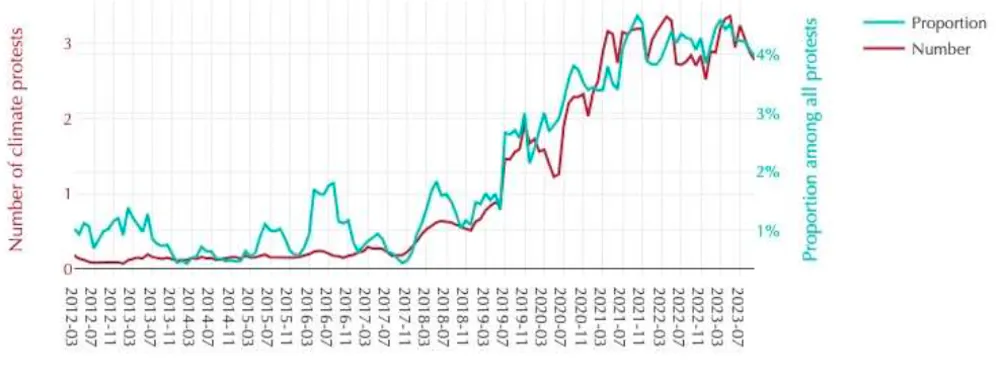
To look more closely at the global picture of climate and environmental protest – and the repression of it – we used the Armed Conflicts Location Event database. This showed us that climate protests increased dramatically in 2018-2019 and have not declined since. They make up on average about 4% of all protest in the 81 countries that had more than 1,000 protests recorded in the 2012-2023 period:
Graph
Climate protests increased sharply in the late 2010s in the 14 countries studied. (Data is smoothed over five months; number of protests is per country per month)
Berglund et al; Data: ACLED, CC BY-SA

This second graph shows that environmental protest has increased more gradually:

Graph
Environmental protests in the same 14 countries
Data: ACLED, CC BY-SA

We used this data to see what kind of repression activists face. By looking for keywords in the reporting of protest events, we found that on average 3% of climate and environmental protests face police violence, and 6.3% involve arrests. But behind these averages are large differences in the nature of protest and its policing.

A combination of the presence of protest groups like Extinction Rebellion, who often actively seek arrests, and police forces that are more likely to make arrests, mean countries such as Australia and the UK have very high levels of arrest. Some 20% of Australian climate and environmental protests involve arrests, against 17% in the UK – with the highest in the world being Canada on 27%.

Meanwhile, police violence is high in countries such as Peru (6.5%) and Uganda (4.4%). France stands out as a European country with relatively high levels of police violence (3.2%) and low levels of arrests (also 3.2%).

In summary, while criminalisation and repression does not look the same across the world, there are remarkable similarities. It is increasing in a lot of countries, it involves both state and corporate actors, and it takes many forms.

This repression is taking place in a context where states are not taking adequate action on climate change. By criminalising activists, states depoliticise them. This conceals the fact these activists are ultimately right about the state of the climate and environment – and the lack of positive government action in these areas.The Conversation

This article is republished from The Conversation under a Creative Commons license. Read the original article.

The post Repression of climate and environmental protest is intensifying across the world appeared first on Climate Home News.

Repression of climate and environmental protest is intensifying across the world

Continue Reading

Climate Change

Big fishing nations secure last-minute seat to write rules on deep sea conservation

Published

on

As a treaty to protect the High Seas entered into force this month with backing from more than 80 countries, major fishing nations China, Japan and Brazil secured a last-minute seat at the table to negotiate the procedural rules, funding and other key issues ahead of the treaty’s first COP.

The Biodiversity Beyond National Jurisdiction (BBNJ) pact – known as the High Seas Treaty – was agreed in 2023. It is seen as key to achieving a global goal to protect at least 30% of the planet’s ecosystems by 2030, as it lays the legal foundation for creating international marine protected areas (MPAs) in the deep ocean. The high seas encompass two-thirds of the world’s ocean.

Last September, the treaty reached the key threshold of 60 national ratifications needed for it to enter into force – a number that has kept growing and currently stands at 83. In total, 145 countries have signed the pact, which indicates their intention to ratify it. The treaty formally took effect on January 17.

    “In a world of accelerating crises – climate change, biodiversity loss and pollution – the agreement fills a critical governance gap to secure a resilient and productive ocean for all,” UN Secretary-General António Guterres said in a statement.

    Julio Cordano, Chile’s director of environment, climate change and oceans, said the treaty is “one of the most important victories of our time”. He added that the Nazca and Salas y Gómez ridge – off the coast of South America in the Pacific – could be one of the first intact biodiversity hotspots to gain protection.

    Scientists have warned the ocean is losing its capacity to act as a carbon sink, as emissions and global temperatures rise. Currently, the ocean traps around 90% of the excess planetary heat building up from global warming. Marine protected areas could become a tool to restore “blue carbon sinks”, by boosting carbon absorption in the seafloor and protecting carbon-trapping organisms such as microalgae.

    Last-minute ratifications

    Countries that have ratified the BBNJ will now be bound by some of its rules, including a key provision requiring countries to carry out environmental impact assessments (EIA) for activities that could have an impact on the deep ocean’s biodiversity, such as fisheries.

    Activities that affect the ocean floor, such as deep-sea mining, will still fall under the jurisdiction of the International Seabed Authority (ISA).

    Nations are still negotiating the rules of the BBNJ’s other provisions, including creating new MPAs and sharing genetic resources from biodiversity in the deep ocean. They will meet in one last negotiating session in late March, ahead of the treaty’s first COP (conference of the parties) set to take place in late 2026 or early 2027.

    China and Japan – which are major fishing nations that operate in deep waters – ratified the BBNJ in December 2025, just as the treaty was about to enter into force. Other top fishing nations on the high seas like South Korea and Spain had already ratified the BBNJ last year.

    Power play: Can a defensive Europe stick with decarbonisation in Davos?

    Tom Pickerell, ocean programme director at the World Resources Institute (WRI), said that while the last-minute ratifications from China, Japan and Brazil were not required for the treaty’s entry into force, they were about high-seas players ensuring they have a “seat at the table”.

    “As major fishing nations and geopolitical powers, these countries recognise that upcoming BBNJ COP negotiations will shape rules affecting critical commercial sectors – from shipping and fisheries to biotechnology – and influence how governments engage with the treaty going forward,” Pickerell told Climate Home News.

    Some major Western countries – including the US, Canada, Germany and the UK – have yet to ratify the treaty and unless they do, they will be left out of drafting its procedural rules. A group of 18 environmental groups urged the UK government to ratify it quickly, saying it would be a “failure of leadership” to miss the BBNJ’s first COP.

    Finalising the rules

    Countries will meet from March 23 to April 2 for the treaty’s last “preparatory commission” (PrepCom) session in New York, which is set to draft a proposal for the treaty’s procedural rules, among them on funding processes and where the secretariat will be hosted – with current offers coming from China in the city of Xiamen, Chile’s Valparaiso and Brussels in Belgium.

    Janine Felson, a diplomat from Belize and co-chair of the “PrepCom”, told journalists in an online briefing “we’re now at a critical stage” because, with the treaty having entered into force, the preparatory commission is “pretty much a definitive moment for the agreement”.

    Felson said countries will meet to “tidy up those rules that are necessary for the conference of the parties to convene” and for states to begin implementation. The first COP will adopt the rules of engagement.

    She noted there are “some contentious issues” on whether the BBNJ should follow the structure of other international treaties such as the Convention on Biological Diversity (CBD), as well as differing opinions on how prescriptive its procedures should be.

    “While there is this tension on how far can we be held to precedent, there is also recognition that this BBNJ agreement has quite a bit to contribute in enhancing global ocean governance,” she added.

    The post Big fishing nations secure last-minute seat to write rules on deep sea conservation appeared first on Climate Home News.

    Big fishing nations secure last-minute seat to write rules on deep sea conservation

    Continue Reading

    Climate Change

    Climate at Davos: Energy security in the geopolitical driving seat 

    Published

    on

    The annual World Economic Forum got underway on Tuesday in the Swiss ski resort of Davos, providing a snowy stage for government and business leaders to opine on international affairs. With attention focused on the latest crisis – a potential US-European trade war over Greenland – climate change has slid down the agenda.

    Despite this, a number of panels are addressing issues like electric vehicles, energy security and climate science. Keep up with top takeaways from those discussions and other climate news from Davos in our bulletin, which we’ll update throughout the day.

    From oil to electrons – energy security enters a new era

    Energy crises spurred by geopolitical tensions are nothing new – remember the 1970s oil shock spurred by the embargo Arab producers slapped on countries that had supported Israel during the Yom Kippur War, leading to rocketing inflation and huge economic pain.

    But, a Davos panel on energy security heard, the situation has since changed. Oil now accounts for less than 30% of the world’s energy supply, down from more than 50% in 1973. This shift, combined with a supply glut, means oil is taking more of a back seat, according to International Energy Agency boss Fatih Birol.

    Instead, in an “age of electricity” driven by transport and technology, energy diplomacy is more focused on key elements of that supply chain, in the form of critical minerals, natural gas and the security buffer renewables can provide. That requires new thinking, Birol added.

    “Energy and geopolitics were always interwoven but I have never ever seen that the energy security risks are so multiplied,” he said. “Energy security, in my view, should be elevated to the level of national security today.”

    In this context, he noted how many countries are now seeking to generate their own energy as far as possible, including from nuclear and renewables, and when doing energy deals, they are considering not only costs but also whether they can rely on partners in the long-term.

      In the case of Europe – which saw energy prices jump after sanctions on Russian gas imports in the wake of Moscow’s invasion of Ukraine – energy security rooted in homegrown supply is a top priority, European Commission President Ursula von der Leyen said in Davos on Tuesday.

      Outlining the bloc’s “affordable energy action plan” in a keynote speech at the World Economic Forum, she emphasised that Europe is “massively investing in our energy security and independence” with interconnectors and grids based on domestically produced sources of power.

      The EU, she said, is trying to promote nuclear and renewables as much as possible “to bring down prices and cut dependencies; to put an end to price volatility, manipulation and supply shocks,” calling for a faster transition to clean energy.

      “Because homegrown, reliable, resilient and cheaper energy will drive our economic growth and deliver for Europeans and secure our independence,” she added.

      Comment – Power play: Can a defensive Europe stick with decarbonisation in Davos?

      AES boss calls for “more technical talk” on supply chains

      Earlier, the energy security panel tackled the risks related to supply chains for clean energy and electrification, which are being partly fuelled by rising demand from data centres and electric vehicles.

      The minerals and metals that are required for batteries, cables and other components are largely under the control of China, which has invested massively in extracting and processing those materials both at home and overseas. Efforts to boost energy security by breaking dependence on China will continue shaping diplomacy now and in the future, the experts noted.

      Copper – a key raw material for the energy transition – is set for a 70% increase in demand over the next 25 years, said Mike Henry, CEO of mining giant BHP, with remaining deposits now harder to exploit. Prices are on an upward trend, and this offers opportunities for Latin America, a region rich in the metal, he added.

      At ‘Davos of mining’, Saudi Arabia shapes new narrative on minerals

      Andrés Gluski, CEO of AES – which describes itself as “the largest US-based global power company”, generating and selling all kinds of energy to companies – said there is a lack of discussion about supply chains compared with ideological positioning on energy sources.

      Instead he called for “more technical talk” about boosting battery storage to smooth out electricity supply and using existing infrastructure “smarter”. While new nuclear technologies such as small modular reactors are promising, it will be at least a decade before they can be deployed effectively, he noted.

      In the meantime, with electricity demand rising rapidly, the politicisation of the debate around renewables as an energy source “makes no sense whatsoever”, he added.

      The post Climate at Davos: Energy security in the geopolitical driving seat  appeared first on Climate Home News.

      Climate at Davos: Energy security in the geopolitical driving seat 

      Continue Reading

      Climate Change

      A Record Wildfire Season Inspires Wyoming to Prepare for an Increasingly Fiery Future

      Published

      on

      As the Cowboy State faces larger and costlier blazes, scientists warn that the flames could make many of its iconic landscapes unrecognizable within decades.

      In six generations, Jake Christian’s family had never seen a fire like the one that blazed toward his ranch near Buffalo, Wyoming, late in the summer of 2024. Its flames towered a dozen feet in the air, consuming grassland at a terrifying speed and jumping a four-lane highway on its race northward.

      A Record Wildfire Season Inspires Wyoming to Prepare for an Increasingly Fiery Future

      Continue Reading

      Trending

      Copyright © 2022 BreakingClimateChange.com