

Deforestation in Australia Summary
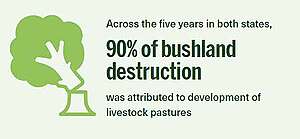
Most deforestation is for beef pasture development and is concentrated in central and south central Queensland and north central NSW in the Brigalow Belt and Mulga Lands bioregions. Mining, infrastructure, and urban development combined account for only 1%.

However, unlike in rural areas, the harm to animals is ongoing particularly in urban and peri-urban environments where past clearing has resulted in native bushland fragments embedded in a landscape with multiple hazards for wildlife. Animals in fragmented landscapes face inadequate shelter, nesting and food resources, exposure to the elements causing dehydration and starvation, as well as increased human wildlife conflict, domestic cat and dog attacks, collisions with powerlines, structures or vehicles on busy roads and stress-induced diseases.

Deforestation in Qld and NSW has resulted in an average of 100 million animals within the clearing footprint. This includes 1.9 to 4.5 million mammals, 7.4 to 9.3 million birds and over 96 million reptiles of all sizes being injured, killed, or displaced every year on average.
This includes approximately 1,200 Koalas a year on average. Koalas were listed as endangered in 2022 after suffering a rapid decline in Qld and NSW in recent decades due to deforestation, habitat fragmentation and the ongoing death and injury that results from fragmentation particularly in urban and peri-urban environments.

In Queensland, on average 24,000 native animals every year are recorded by RSPCA Qld as being rescued or admitted into care, including over 500 koalas. Most admissions fall in the densely populated southeast of the state where wildlife hospitals are concentrated, but which is no longer where most deforestation happens. Numbers injured or killed directly due to deforestation in southeast Queensland are small. The bulk of rescues are the legacy of past deforestation resulting in fragmentation of native bushland in the urban and peri-urban environment.
Little has improved for wild animals since our last report on this crisis in 2017. Despite some reforms to the Vegetation Management Act in Queensland in 2018, laws and policies in both states have not greatly changed and still allow very large areas of bushland habitat for wildlife to be destroyed every year, likely harming, injuring, and killing millions of native animals every year.

Deforestation Legislative changes required
Reducing the toll of suffering and death that results from habitat destruction and fragmentation requires major changes in policy:
- To prohibit or prevent most bushland habitat destruction, especially in areas that remain largely unfragmented;
- To support research to better quantify and understand the impacts of deforestation on forest dependent wildlife, including directly and indirectly impacted individuals;
- To mitigate welfare impacts of any bushland destruction that is allowed through pre-clearing surveys and rehoming of displaced animals;
- To ensure destroyed habitat areas are replaced or offset by restored habitat of the same type and quality;
- To take steps in already developed areas to reduce the ongoing hazards to wildlife from human activities by, for example, establishing wildlife corridors between fragmented areas of previously intact habitat, wildlife bridges over roadways, and stronger controls over human activities within wild habitats;
- To enhance public education about the impacts of deforestation on native animal welfare; and
- To support collaborations between veterinarians, wildlife rescue and conservation organisations, focussing on areas with heavy current deforestation rates or high potential future deforestation risk.
https://www.greenpeace.org.au/greenpeace-reports/deforestation-animal-welfare-crisis/


Consumers remain vulnerable to price spikes despite record domestic oil and gas production. But experts doubt the crisis will boost clean energy, absent strong policy.
In President Donald Trump’s telling, the United States has fuel enough to hover above the chaos that his attack on Iran has triggered in global energy markets.
Iran Energy Shock Tests Limits of Trump’s Vision of US Energy Dominance
A World War II-era policy is stopping old coal plants from closing, despite high costs and the wishes of their owners.
At one time, the U.S. electricity grid ran mostly on coal.
Italy has delayed the permanent closure of its four coal-fired power plants to 2038, after the war in the Middle East caused the cost of producing electricity from gas to spike.
The government inserted the measure into a broader bill aimed at addressing the energy crisis. Parliament approved the legislation on Wednesday after the government tied it to a confidence vote, meaning that losing the vote would see the right-wing coalition government collapse.
The decision marks a climbdown from a pledge first made under centre-left Prime Minister Paolo Gentiloni in 2017 to phase out coal by 2025 on the mainland and by 2028 on the island of Sardinia.
The Mediterranean island’s 1.5 million people remain heavily dependent on coal for electricity due to limited grid connections with the European mainland and a slow rollout of renewable energy.
Riccardo Molinari, a member of Parliament for the governing coalition Lega party, which championed the amendment, said the plants could be kept open as a “strategic reserve”, which can be turned on if needed.
“Unnecessary” decision
But analysts say the practical impact of the move is likely to be limited. Luca Bergamaschi, executive director of Italian climate think tank ECCO, described the extension as “largely symbolic”.
“Keeping them open will not materially affect electricity prices, which are driven by gas – for most hours of the day – and EU market rules,” he told Climate Home News. “The decision sends a negative signal but we don’t expect any meaningful impact on prices or emissions, which shows how unnecessary this is”.
-
Charging worries, high prices put brakes on EV growth in Bangladesh
Sales of e-bikes and rickshaws are up amid queues at fuel stations, but a lack of charging infrastructure and high prices still deter many Bangladeshis from going electric

Coal has already been largely phased out of Italy’s power mix. Generation from coal has fallen over 90% since 2012 and accounted for less than 2% of electricity production last year, almost entirely in Sardinia.
In 2024, Italy got about half of its electricity from gas and half from clean sources like hydropower, solar and wind.
Coal plants on stand-by
Italy has four coal-fired power plants left but only two, both in Sardinia, are still producing electricity.
The other two are run by the country’s largest utility Enel, in Brindisi and Civitavecchia. They were shut down at the end of last year after they became uneconomic.
The company had planned to begin decommissioning them, but the government intervened at the last minute, requiring them to remain on standby in case of an energy crisis.
Gilberto Pichetto Fratin, Italy’s Minister of Environment and Energy Security, said at the end of March that these two power plants could be switched back on “right away, with a government decree”.
“If the price of gas exceeds 70 euros per megawatt hour, producing with coal would be convenient,” he told Italian newspaper Il Corriere della Sera.
European gas prices spiked to just below that level in mid-March as the Iran war escalated, but have since come down to around 50 euros per megawatt hour.
Coal surge in Asia
Italy’s move comes amid a broader, though limited, shift back towards coal in some parts of the world as countries respond to restricted gas supply. Germany slightly increased coal-fired generation in March and has considered reactivating idle plants as a precaution.
Outside Europe, the trend has been more pronounced. Several Asian countries heavily exposed to disruptions in Gulf gas supplies have increased coal use.
Nepal’s EV revolution pays off as oil crisis causes pain at the pumps
Japan has allowed its coal power plants to operate at a higher rate to reduce the need for liquified natural gas (LNG). Bangladesh, Thailand and the Philippines have also increased electricity generation from coal since the start of the conflict in the Middle East.
But analysis from Zero Carbon Analytics suggested that producing electricity from solar is cheaper than coal in most south-east Asian countries.
“Energy security in Southeast Asia will not come from switching between fossil fuels,” Amy Kong added. “It will come from reducing dependence on them altogether.”
The post Italy pushes coal exit back after gas prices rise appeared first on Climate Home News.

Japan Unveils First Hydrogen Engine for Large Ships
Solar Plus Batteries Can Meet 90% of India’s Electricity Needs, Says Ember
Bioleaching Breakthrough in Canada: How MIRARCO’s Pilot Facility Turns Mine Waste into Critical Minerals
-
Climate Change8 months ago
Guest post: Why China is still building new coal – and when it might stop
-
Greenhouse Gases8 months ago
Guest post: Why China is still building new coal – and when it might stop
-

 Greenhouse Gases2 years ago
嘉宾来稿:满足中国增长的用电需求 光伏加储能“比新建煤电更实惠”
-
Climate Change2 years ago
Bill Discounting Climate Change in Florida’s Energy Policy Awaits DeSantis’ Approval
-

 Climate Change2 years ago
嘉宾来稿:满足中国增长的用电需求 光伏加储能“比新建煤电更实惠”
-
Climate Change Videos2 years ago
The toxic gas flares fuelling Nigeria’s climate change – BBC News
-

 Renewable Energy6 months ago
Sending Progressive Philanthropist George Soros to Prison?
-

 Carbon Footprint2 years ago
US SEC’s Climate Disclosure Rules Spur Renewed Interest in Carbon Credits