

Weather Guard Lightning Tech

R&D Test Systems: Digital Twins for Wind Turbine Testing
Allen Hall and Joel Saxum interview Dr. Elif Ecem Bas, a PhD project engineer at R&D Test Systems in Denmark. Dr. Bas discusses how R&D Test Systems is leveraging digital twin technologies and hybrid testing to improve the efficiency and effectiveness of testing wind turbine components, particularly pitch bearings.
Sign up now for Uptime Tech News, our weekly email update on all things wind technology. This episode is sponsored by Weather Guard Lightning Tech. Learn more about Weather Guard’s StrikeTape Wind Turbine LPS retrofit. Follow the show on Facebook, YouTube, Twitter, Linkedin and visit Weather Guard on the web. And subscribe to Rosemary Barnes’ YouTube channel here. Have a question we can answer on the show? Email us!
Pardalote Consulting – https://www.pardaloteconsulting.com
Weather Guard Lightning Tech – www.weatherguardwind.com
Intelstor – https://www.intelstor.com
Allen Hall: Welcome to the Uptime Wind Energy Podcast. I’m your host, Allen Hall, along with my co host, Joel Saxum. As wind turbines grow in size and complexity, testing these components has become increasingly expensive and time consuming. To address these challenges, R&D Test Systems is leveraging digital twin technologies to improve the efficiency of their test bed.
Benches, ultimately reducing testing time and costs. And if you don’t already know, R&D Test Systems is a leading company in the wind energy industry, providing testing solutions for wind turbine components on a massive scale. Today we have the pleasure of speaking with Ecem Bas, a PhD project engineer.
At R&D Test Systems in Denmark, Dr. Bas earned her PhD in structural engineering from the University of Nevada, Reno, and is currently focusing on digital twin technologies at R&D Test Systems. In this interview, we will delve into the applications of digital twin technology and wind turbine component testing and learn more about Dr.
Bas’s work in this cutting edge field. Ecem, Welcome to the program.
Elif Ecem Bas: Thank you. And thanks a lot for the introduction.
Allen Hall: So there’s a lot to learn here because Joel and I have been following the digital twin saga over the last several years because you see a lot of of news articles and information about digital twins and OEMs or have been looking at it and a lot of smaller companies have been trying to prove out digital twins.
But we haven’t seen a lot of it being applied in a place where I think it’s important, which is in the testing phase. And R&D Test Systems if you haven’t worked with R&D Test Systems, build some of the largest pieces of test equipment in the world to test generators up to 25 megawatts and all kind of blades, just insanely big things.
So what is the benefit of using Digital Twin on such large test equipment?
Elif Ecem Bas: Let’s come one step back. As you mentioned in your introduction. Testing is necessity for all the wind turbine components and their subcomponents as well. This is required by the standards and this is required by the design and also the manufacturing.
So we will not get rid of testing. Testing is very important. But as the wind turbines are getting bigger and bigger, this time to test these components takes also a lot of time. And for as an example for a blade to test the Fatigue test to make a fatigue test for a blade. It takes one year or more than a year to do the saw
Joel Saxum: Constant movement.
Elif Ecem Bas: Yeah, exactly to see all the damages through the blade. You have to do that and also for a highly accelerated lifetime testing of an assault. This also takes six and eight months and also testing this. These are large facilities, right? And testing this will also cost money. tens of million euros bought to establish and run this.
And this leads, of course, longer time to market. For new and more powerful wind turbines. In detail systems, we are trying to develop digital tools to overcome these challenges and to have these turbines to roll onto the market. So and also yeah, cut cost on it. And what we are using digital twins in the testing, it is very necessary because we would like to reduce the cost of the down time in the testing itself, in the test execution itself.
Allen Hall: So there are portions of testing, from my understanding, and I’m an electrical engineer and I’m a mechanical engineer, but I’ve spent about a lot of structural testing. Those tests take a long time, they’re very expensive, but sometimes the result we get out of those tests isn’t very useful in the real world.
On the other side of this, you’ve got two problems. One is that, does the test match what’s happening in service? That’s a really great question. The second half is, how much do you know about this product before you start testing it? Or are you testing the way? You’re touching the engineering aspects properly to evaluate that for the real world.
And I think you, you run into two problems here and I want to understand this part first, which is you model the component, but you don’t model all aspects of it. And I want to, I Can you walk through that a little bit, like what you’re trying to do with a device, a blade, or a gearbox, or anything else, a pitch bearing?
Elif Ecem Bas: As you mentioned, there are two aspects. So in the component test, we just take one component and test it, right? And with our, Digital twin technologies, we focus on both simulating the complete system, whereas we only test one component and model the remaining parts. So this is one thing, and we call this hybrid testing because one part is tested experimentally, whereas the remaining components are modeled numerically.
And we do this in In a closed loop system where we share at every time step, we share the commands and feedbacks with the test bench. So this is one aspect where we test. Only one component, let’s say it is the pitch bearing, and model the remaining part, which is the blade and the hub and the other parts, the other blades.
Allen Hall: Alright, so that’s interesting. That’s a complicated model though, right? When you try to do that.
Elif Ecem Bas: Exactly.
Allen Hall: So you have to simplify it so you can model it. How are you finding those sort of the key characteristics so you can model it on a test bench properly?
Elif Ecem Bas: Why we do hybrid testing? Hybrid testing is to get the both advantages from the experimental world and from the analytical world.
So we do hybrid testing for the components that we cannot model properly. In this case, it is, we choose that it is the pitch bearing because it’s very hard to model.
Joel Saxum: Makes sense. Yeah. Yeah.
Elif Ecem Bas: Yeah. And also the pitch bearing itself. So bearings are designed to roll, right? But the pitch bearing is rolling a little bit and then exposed to the bending moments for their lifetime.
So it’s against to its own nature. So this is why also predicting the failure mechanisms of the pitch bearing is a bit hard. Another thing is, when it is failed, it is very hard to backtrace what was the cause of this failure, because you cannot model it properly. So what we are doing is, since this part is hard to model, we put it in an experimental setup.
And the blade and the remaining part, the other kinematics are relatively easier to model.
Joel Saxum: That’s a good word. Relatively. Yeah.
Elif Ecem Bas: And so it took that part and we use that simplified models to apply more realistic loading scenarios to the pitch bearing. In order to get its behavior.
Joel Saxum: A question here like Allen said earlier pitch bearings is a headache for, man, what would you say, 90 percent of the people we talk to, Allen? Oh, easily, yes. When we’re thinking about you guys advancing the testing mechanism for us, because it’s, it is, just, if you picture it in your head, It is, a bearing is designed for that rolling surface, however, this not only is exposed to the root bending moment of the blades, basically, on a fulcrum, pulling and pushing on it, but it’s also having gravitational loads at the exact same time, going up, sideways, down so you have this really complex load scenario.
You guys coming forth with something that could hopefully accelerate lifetime testing,
Elif Ecem Bas: Yeah. Also, we are looking into testing extreme cases in this scenario. So picking up extreme wind load event and test this and hopefully see the development of a failure with the test.
Joel Saxum: That with everybody with pitch bearings.
If you talk to anybody in the manufacturing sector, it’s it’s really hard to do an accelerate at any kind of lifetime testing. For that pitch, because it isn’t when you look at it in the crate, right? That is a robust piece of metal. That’s a big, bad thing, right? If anybody’s ever seen one of these it’s impressive how big it is and how heavy it is and how much steel there is.
But to test that you can’t you can’t do a life cycle test in six months on that thing. It’s just not possible.
Elif Ecem Bas: Exactly. And also what. We hear from the test centers that they cannot see the failures with this highly accelerated lifetime test on it. So what we are looking into, okay, we have this extreme load case scenario.
Can we apply this with hybrid testing and can we see the development of the failure of this component?
Allen Hall: Let me ask you about the complexities of pitch bearing, because I think Joel brought it up at a really high level, but I want to focus in, drill down to how complex this is. So you have this massively long blade, right?
The blades are getting longer, so the center of gravity is moving further and further out, the center of lift on them is moving also, the blades are flexing, right? Then you got the gravitational pull. piece. But on top of that, now you’ve added a control system in the turbine, which is pitching the blades as they rotate around the 360.
So you have this, and you’re not necessarily sure what the OEM is doing with their pitch control system. That’s not widely disclosed as to say it that way. So when you’re looking for failure modes on a, particularly a new blade with a new control system, On mostly an existing bearing structure, you have a lot of unknowns there.
And we have, as we have, Joel has pointed out, we have a lot of operators around the world that are complaining about pitch for each breaking and yet they passed all the required tests for to get type certification. So now we’re going back and this is where I think the brain powered R&D Test Systems really matters here.
Now you’re able to apply some knowledge because now we see these failures. And then can you model those failures? Are you able to digital twin the failure mode and then place that back into the new testing regime?
Elif Ecem Bas: Yeah, first of all, we have to see that if we can track these failures with the hybrid testing while applying these extreme load scenarios.
And as you mentioned, in our, now in our test configuration, we have two actuators, to apply the bending moment of the blade. And we also have the third actuator to model the pitch angle, to control the pitch angle. So we are also making it yeah, rotate to pitch, and then to apply the bending moments. We are But these cal these are all coming from the simulation world, so all these bending moment calculations are coming from the simulation world of this blade.
So we calculate a bending moment at the blade, which will be applied to the pitch. And we apply this in the test bench itself.
Allen Hall: So let me ask, let me go down this rabbit hole a little bit further. Because it’s a very complicated mechanical problem, right? It’s probably one of the most difficult mechanical problems out there today because of the quantities of product and the cost involved.
You have this, you have a fixed hub diameter for the most part as the blades get longer. So the load paths in that are are unique. There’s not they’re not simple, right? So when you’re creating a piece of test equipment to go evaluate and in this hybrid condition, I’m trying to go through the thought process of what R&D Test Systems is trying to do here because you have so many variables you have this I’ll call it a black box of control system like there’s inputs and there’s outputs and so you’re looking at the outputs into the bearing How do you then when you go to create that piece of test equipment to test it?
determine how these failures are occurring. Do you just, do you design the equipment based upon that control system, that digital twin?
Elif Ecem Bas: So for this specific case, it is slightly different. We have this research and development project with the university, Aarhus University and FORCE Technology, and Together with this team, we developed this hybrid testing framework for pitch pairings.
All of us together are, is designed this let’s say test setup. But this is not the similar ones that we develop here. We usually develop large scale test benches. This is considerably small, and we would like to get yeah, apply the know how and see the results of hybrid testing.
And what we are also helping with our customers here, as you said, there are so many people are involved. So the the control system of the, uh, OEM is their own IP protected and the blade is maybe the blade model is that they don’t want to share.
Allen Hall: Definitely IP.
Elif Ecem Bas: Exactly. It’s also even the wind load could be an IP issue.
So what we are also trying to to give our customers as a service is how to combine these pieces together.
Allen Hall: Okay, that’s brilliant. All right, so then that drives the cost down because you’re applying so much knowledge ahead of time. So when you get to the test scenario, you know what you’re looking for already.
These are the features. These are the failure modes because of the way the control system is designed and operating. This is how we’re going to test these bearings in a real world scenario. How much cost reduction and time shortening does that does that, does occur because of your digital twin?
Elif Ecem Bas: Another aspect of digital twin, as I just mentioned, we are trying to provide a platform for our customers to put their models into. Together. So it’s not that high, only the hybrid testing that we are focusing on, but we are also focusing on combining different simulation models. So it could be if it is a test bench, it is the test bench and analytical models that are combined, but it could be also test bench models combined with OEMs device under test.
So we are also looking into that. Yeah. So we are yeah, as also as you mentioned, this is extremely IP secured way and we are trying to solve this problem. In terms of time constant, like How much time can we reduce? Cannot give an exact number, but this will improve the collaboration between the partners.
As an example, this is apart from hybrid testing to prepare for a test. This can take several months. So how does how the people test is they design a component in a digital world. And then they create some load sequences and they contact contact to the test operators. They say they want to test this test sequences in their test bench.
So there are so many back and forth, even for the planning of this large tests. So what we are trying to do with these digital tools is to give our customers and also the test bench operators a platform where they can. Plug in their models and then execute these test scenarios beforehand before the test execution so that they can save time.
in both planning and they can also reduce time in the test campaigns that wouldn’t make sense.
Joel Saxum: Ecem, when we talked off air, we talked about a little bit about this, right? This kind of, this concept of the functional mock up interface and the function, yeah, and the functional mock up unit where it’s basically like you guys took the concept from the automotive world, from their advanced testing processes, right?
Elif Ecem Bas: The FMI standard was developed Yeah. Yeah. By an automate by automated industry. So this was and this standard is out there for several years, and it is quite mature in that industry. And what we are trying to do in the wind industry or also in the testing, we are trying to adapt This technology to our models in our system as well.
Joel Saxum: Yeah. The cool thing about that was you said basically, because it is a standard that’s been used for it, this is the black box stuff, right? This is how an OEM can protect it, protect their IP come to you guys. It goes through the functional mockup interface, that black box there, where they.
And then everything comes into your side, you’re able to test. But the cool thing about that is, is since it is an automotive standard, it’s the practices out there. People have knowledge of it. There’s multiple. I think you said over 200 different tools are available to work through with this as well.
So there’s a lot of stuff that’s. That’s there. It’s just getting the, basically the wind industry or the, that industrial testing that you guys do up to speed with the, what the rest of the world is doing and, or not the rest of the world, but different industries are doing.
Elif Ecem Bas: Exactly. There are many commercial and also open source tools that are available to use this Functional lockup interface standard.
Allen Hall: Can I walk through a test case? And I want to get a jams input on this because we see the, see this a lot. And Joel and I have been around a lot of wind turbines over the last couple of months. And as Joel has pointed out, pitch bearings is the main problem. You see a lot of cranes replacing pitch bearings.
Okay. So the question we get asked all the time is, Hey, the OEM has offered us an upgrade to these pitch bearings to prevent this problem. I want you to describe the problem and say it’s a problem. In the meantime, I have other pitch bearing manufacturers saying they have a replacement that doesn’t require the fix.
Now, both of those may be right, both of them may be wrong, but I think what’s happening now is that the operators are thinking about doing testing on their own. And if they do that, the, your hybrid digital twin approach makes a lot of sense for them because it’s going to, it takes the OEM and the other manufacturers of these devices out of the picture and lets them focus on what’s really happening.
Now How would they I’m thinking of a couple large OEMs in the United States and in Europe that have this problem, how would they connect with you to do that testing? Would they just say, Hey, Ajam, this is the turbine we have, this is the bearing we have. We need you to look at this fix or solution and just let you go with it.
Or how does that interaction work?
Elif Ecem Bas: First of all, we define which part. So which. What component are we testing? Then we design the test setup accordingly for this test for this hybrid testing scenario. Because as I mentioned, we need to have the pitch actuator, we need to have the other actuators to apply this to that.
And then, Once we want to involve the models, we have to walk through with them how to define these black boxes. Then we define, once we define the interface, because we will tell them what to share in between the test bench and the model. So we will not help with that. So they will have We can help them to put this in a black box.
And also we tell them, okay, you need these five signals that are coming to this test bench, and you will get these five to your model. So we define these interfaces. together with them and then help them to put this in this black box, let’s say, and then help them execute this test campaign.
Joel Saxum: Allen, what you’re saying here right now in my mind starts screaming joint industry project between the asset owners. Get a bunch of them together that have the same machines and go test them themselves. Try to find a fix. It could work.
Allen Hall: R&D Test Systems is the place to test it because they test large items and they’ve been doing it for years and they have all the technical know how and the equipment to go test it.
So R&D Test Systems is the right place to do it. I think you’re right Joel, connecting operators together to work with a job to create the control system, the black box, the hybrid, is the real link. that we’re missing at the moment. And that needs to be done.
Elif Ecem Bas: Just to give a comment, we don’t have, we don’t own the test.
We are not a test bench operator. We are test bench developers. So we know a lot about developing the test systems to test these equipments. So yeah, we don’t have our own test bench facility, but we help we know that side. And we can help our customers to develop these.
Joel Saxum: Yes. All of the things that we’ve been talking about, this is your baby at R&D Test Systems.
You’ve been your PhD is in it and the hybrid testing and everything like you are the expert in it. But my, where I’m falling down a little bit is that this is not this way of testing and this methodology and these idea of digital twins and hybrid testing, this isn’t standard yet.
So this is not in the IEC standard. This isn’t. A rule that they have to, anybody has to follow right now. It’s still in that R&D phase. We you’re sitting in this chat, this should be how we do it. And I believe that this is definitely the future, but how do you feel about, like, where do you see it going?
Do you see this being adopted as mainstream? This is how we’re going to test stuff, or is it still going to be an R&D thing for a while?
Elif Ecem Bas: Yeah, very good question. I think the industry needs Kind of this collaborative platform, both for hybrid testing and also digital twins, because we can see that this is Requirements because everyone wants to improve their both modeling and testing, and we for sure need to collaborate more to do you’re right for hybrid testing itself for components. Hybrid testing. There is no standards, but there is hardware in the loop testing, which is in IEC standards, which is not exactly. hybrid testing, but it is also hybrid testing. So I can see that it would also come at some point for component testing as well.
Yeah, I don’t know when, but it will come because this kind of there are so many challenges and we have solutions to these challenges. So I think it will come at some point. Yes.
Joel Saxum: Yeah. You’ve got two great partners in the University of Aarhus and force technology bringing in the issues and helping you develop those things.
But what you, I think what you are sitting on and your department, your team, what you guys are working on could be a fix for some of the large problems that our industry is seeing. You. Everybody’s complaining about OEM quality or OEM this, nah, I don’t want to bash on the OEMs, but like they’re getting components that are failing.
The answer could be, advanced better testing to develop better products before they go out into the field because now we have Platforms with 000 machines out in the world where they have a component that keeps failing on them. While that’s good for the aftermarket companies and the people selling the extra bearings.
That’s not good for the general grid and the energy transition, right? So you guys have that piece there that could be the link between making the wind turbines that are in the field more effective at staying, guaranteeing uptime. That’s what we want. That’s why you’re, that’s why we’re all here.
Allen Hall: And Joel, That’s a good segue because I think we wanted to highlight Ajam’s and R&D test systems technology and make sure everybody understood that there is an alternative out there rather than just taking the component from the manufacturer and saying, yeah, trust me there is another way to do this, which is to actually look at it from a systems perspective and that’s what Ajam is doing here.
Ajam, how do they, how do people get ahold of you and how to. How do people contact R&D Test Systems?
Elif Ecem Bas: Yeah, you can find me on LinkedIn, it’s Elif Ecem Bas. You can also find us in our website, rdtestsystems.com
Allen Hall: Ecem, thank you so much for being on the podcast. I’ve learned a tremendous amount. I know Joel has.
And thank you for addressing one of the big problems of wind energy today. I’m glad you’re working on this. Thank you so much for being on the podcast.
Elif Ecem Bas: Thank you.
https://weatherguardwind.com/rd-test-systems-digital-twins-for-wind-turbine-testing/

 Ayn Rand was a “thing” in the mid-20th Century. Libertarians point out, correctly, that governments tend to be bloated and corrupt. And still today, many people advocate for small government.
What most of us have realized in the last 70 years, however, is that unbridled capitalism results in the centralization of power into the hands of a few billionaires who essentially own our lawmaking apparatus. It leaves the rest to struggle with poverty, inflation, war, racism, sexism, pollution, climate change, poor education, and limited/no access to healthcare.
With a few exceptions, the super-rich really don’t care about the wellbeing of anyone but themselves, and this is resulting in the implosion of our civilization and the slow destruction of our planet.
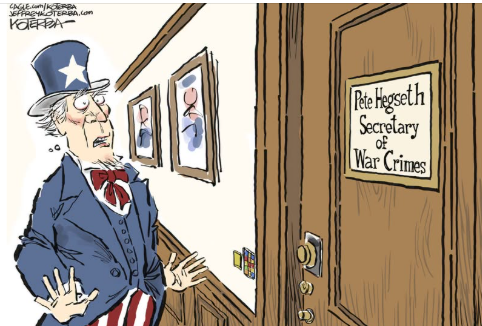 In a better world, the International Criminal Court would have much greater power to prosecute war crimes.
Today, winding up at The Hague requires terrible luck, and it’s virtually impossible to happen to a Donald Trump or a Pete Hegseth, given the enormous military might that the United States possesses.
Contrast this to what happened to Slobodan Milošević, who was arrested when his countries, Yugoslavia and Serbia, were overthrown.
 The prediction made here is nearly certain to come true.
The question is what happens at the point. E.g., how long does it take to rebuild trade deals and relationships with allies?
Keep in mind that regardless of the manner in which Trump loses power, there will always be “news” outlets like Fox and Newsmax, trying their best to convince the idiots that Trump was hounded and persecuted by the communists who hate America.



-
Climate Change1 year ago
Guest post: Why China is still building new coal – and when it might stop
-

 Greenhouse Gases2 years ago
嘉宾来稿:满足中国增长的用电需求 光伏加储能“比新建煤电更实惠”
-
Greenhouse Gases1 year ago
Guest post: Why China is still building new coal – and when it might stop
-

 Climate Change2 years ago
嘉宾来稿:满足中国增长的用电需求 光伏加储能“比新建煤电更实惠”
-

 Renewable Energy12 months ago
Sending Progressive Philanthropist George Soros to Prison?
-
Climate Change2 years ago<