Connect with us

Published

on

President Joe Biden has announced a US target to cut greenhouse gas emissions by 61-66% below 2005 levels by 2035, with White House officials saying the new goal can be achieved even if climate-change sceptic Donald Trump tries to roll back the country’s climate-action agenda.

With just a month to go until President-elect Trump takes office, the outgoing administration called its updated Nationally Determined Contribution (NDC) under the Paris Agreement “ambitious and achievable” thanks to federal investments made in the last four years under Biden, including through the Inflation Reduction Act, and policies introduced at state level.

Donald Trump has indicated he may pull the US out of the Paris Agreement again – something he did during his previous term in the White House – and is likely to undo many green policies and encourage more fossil fuel production.

But John Podesta, senior advisor to Biden for international climate policy, told journalists that the “investments under this administration are durable and will continue to pay dividends for our economy and our climate for years to come”.

That is because the strategy has been led by the private sector, which has announced over $450 billion in clean energy investments, he added on a call before the new target was unveiled on Thursday.

“While the United States federal government under President Trump may put climate action on the back burner, the work to contain climate change is going to continue in the United States with commitment and passion and belief,” he said.

The United Nations has asked all countries to submit more ambitious national climate plans by February next year, including 2035 emissions-cutting targets, in an effort to put the world on track to limit global warming to 1.5 degrees Celsius as governments agreed to do under the 2015 Paris pact.

State leaders step up

Podesta urged local government officials – including governors and mayors – as well as business leaders to carry climate action forward and “show how many Americans still care about the future of our planet”.

The US is not currently on track to meet its existing goal of slashing greenhouse gas emissions by between 50% and 52% by 2030, according to several independent assessments.

Tell us your top three climate issues for 2025! We’ll share the results in the New Year

Announcing the new NDC, White House climate policy official Ali Zaidi said the 2035 target puts the US on a trajectory to reach net zero by 2050, meaning that the country “will do its part to keep [the Paris Agreement goal of] 1.5 degrees alive”.

Rachel Cleetus, policy director and lead economist for the climate and energy programme at the Union of Concerned Scientists (UCS), said that “while falling short of what the science requires”, the 2035 goal and plan to get there provides “an important benchmark to propel further climate action by cities, states, Tribal nations, and businesses”.

Manish Bapna, president of the Natural Resources Defense Council (NRDC), a US think-tank, said the new emissions-reduction target can “serve as a North Star” for all those actors that are “ready to accelerate progress outside of Washington”.

Twenty-four state governors united under the “US Climate Alliance” pledged on Thursday to work together to achieve the NDC. Lujan Grisham, the Democratic governor of New Mexico and co-chair of the alliance, said “the only thing clearer than the science and impacts of climate change is the benefit of taking action – and we’re not slowing down”.

A recent study by the University of Maryland’s Center for Global Sustainability indicated that the US could reduce emissions by 54-62% by 2035, relying only on “strong” climate action from non-federal actors.

Senior US administration officials said their own analysis of the potential for clean energy technologies to achieve cost-effective emissions cuts backed this up. But one noted “the higher ends of this [2035] range require the federal government to do what a responsible federal government would do in the face of an existential risk and the biggest economic opportunity the world has ever seen to invest in America”.

‘Drill, baby, drill’

The wider NDC document filed with the UN climate change body on Thursday does not contain any concrete plans to reduce fossil fuel production, while only name-checking the global agreement to “transition away from fossil fuels in energy systems” reached at COP28 in Dubai last year.

In 2023, the US was the world’s largest producer of crude oil and the biggest exporter of liquefied natural gas (LNG).
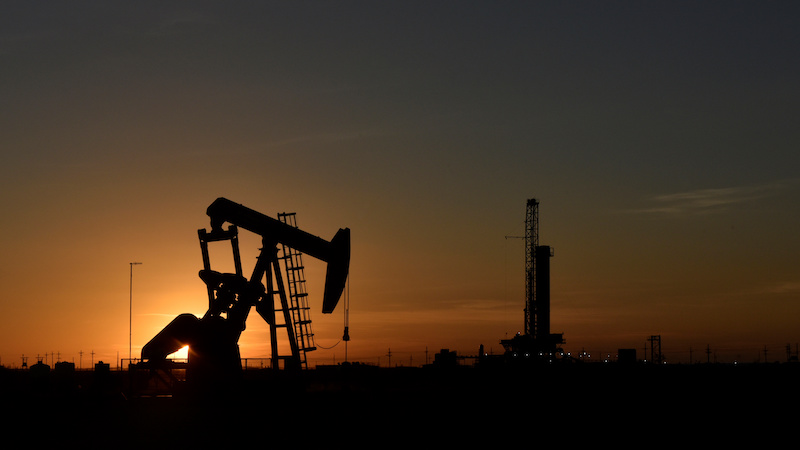
Oil extraction at sunset in an oil field in Midland, Texas. REUTERS/Nick Oxford. Climate leaders, oil bosses pitch alternate energy-transition realities

Oil extraction at sunset in an oil field in Midland, Texas. REUTERS/Nick Oxford

After taking office, Donald Trump is expected to spur more oil and gas development.

Karoline Leavitt, a spokeswoman for the Trump transition team, told Fox News this week that Trump would issue executive orders “to drill, baby, drill,” and “to expedite permits for drilling and for fracking all over this country” immediately after his inauguration.

The United Arab Emirates and Brazil – among the handful of countries that have announced new NDCs this year – also left out any commitment to cut their oil and gas output, while the UK has set a 2035 target but not yet outlined its plans to reach the goal. The Labour government, which took power in July, has ruled out issuing new oil and gas licences for the North Sea.

After Baku setback, activists call for ‘just transition’ to be front and centre at COP30

Ashfaq Khalfan, climate justice director at Oxfam America, said the new US NDC “ignores critical targets for phasing out fossil fuel production and fails to commit funds to help disadvantaged communities in the Global South”.

It “represents the bare minimum floor for climate action”, he added.

(Reporting by Matteo Civillini; editing by Megan Rowling)

The post President Biden sets US emissions goal for 2035 in the shadow of Trump appeared first on Climate Home News.

President Biden sets US emissions goal for 2035 in the shadow of Trump

Continue Reading

Climate Change

World leaders invited to see Pacific climate destruction before COP31

Published

on

The leaders and climate ministers of governments around the world will be invited to meetings on the Pacific islands of Fiji, Palau and Tuvalu in the months leading up to the COP31 climate summit in November.

Under a deal struck between Pacific nations, Fiji will host the official annual pre-COP meeting, at which climate ministers and negotiators discuss contentious issues with the COP Presidency to help make the climate summit smoother.

This pre-COP, expected to be held in early October, will include a “special leaders’ component” hosted in neighbouring Tuvalu – 2.5-hour flight north – according to a statement issued by the Australian COP31 President of Negotiations Chris Bowen on LinkedIn on Thursday.

Bowen said this “will bring a global focus to the most pressing challenges facing our region and support investment in solutions which are fit for purpose for our region.” Australia will provide operational and logistical support for the event, he said.

    Like many Pacific island nations, Tuvalu, which is home to around 10,000 people, is threatened by rising sea levels, as salt water and waves damage homes, water supplies, farms and infrastructure.

    Dozens of heads of state and government usually attend COP summits, but only a handful take part in pre-COP meetings. COP31 will be held in the Turkish city of Antalya in November, after an unusual compromise deal struck between Australia and Türkiye.

    In addition, Pacific country Palau will host a climate event as part of the annual Pacific Islands Forum (PIF) – which convenes 18 Pacific nations – in August.

    Palau’s President Surangel Whipps Jr told the Australian Broadcasting Corporation (ABC) that this meeting would be a “launching board” to build momentum for COP31 and would draw new commitments from other countries to help Pacific nations cut emissions and adapt to climate change.

    “At the PIF our priorities are going to be 100 per cent renewables, the ocean-climate nexus and … accelerating investments that build resilience from climate change,” he told ABC.

    The post World leaders invited to see Pacific climate destruction before COP31 appeared first on Climate Home News.

    World leaders invited to see Pacific climate destruction before COP31

    Continue Reading

    Climate Change

    There is hope for Venezuela’s future – and it isn’t based on oil

    Published

    on

    Alejandro Álvarez Iragorry is a Venezuelan ecologist and coordinator of Clima 21, an environmental NGO. Cat Rainsford is a transition minerals investigator for Global Witness and former Venezuela analyst for a Latin American think tank.

    In 1975, former Venezuelan oil minister Juan Pablo Pérez Alfonzo gave a now infamous warning.

    “Oil will bring us ruin,” he declared. “It is the devil’s excrement. We are drowning in the devil’s excrement.”

    At the time, his words seemed excessively gloomy to many Venezuelans. The country was in a period of rapid modernisation, fuelled by its booming oil economy. Caracas was a thriving cultural hotspot. Everything seemed good. But history proved Pérez right.

    Over the following decades, Venezuela’s oil dependence came to seem like a curse. After the 1980s oil price crash, political turmoil paved the way for the election of populist Hugo Chávez, who built a socialist state on oil money, only for falling prices and corruption to drive it into ruin.

      By 2025, poverty and growing repression under Chávez’s successor Nicolás Maduro had forced nearly 8 million Venezuelans to leave the country.

      Venezuela is now at a crossroads. Since the US abducted Maduro on January 3 and seized control of the country’s oil revenues in a nakedly imperial act, all attention has been on getting the country’s dilapidated oil infrastructure pumping again.

      But Venezuelans deserve more than plunder and fighting over a planet-wrecking resource that has fostered chronic instability and dispossession. Right now, 80% of Venezuelans live below the poverty line. Venezuelans are desperate for jobs, income and change. 

      Real change, though, won’t come through more oil dependency or profiteering by foreign elites. Instead, it is renewable energy that offers a pathway forward, towards sovereignty, stability and peace.

      Guri Dam and Venezuela’s hydropower decline

      Venezuela boasts some of the strongest potential for renewable energy generation in the region. Two-thirds of the country’s own electricity comes from hydropower, mostly from the massive Guri Dam in the southern state of Bolívar. This is one of the largest dams in Latin America with a capacity of over 10 gigawatts, even providing power to parts of Colombia and Brazil.

      Guri has become another symbol of Venezuela’s mismanagement. Lack of diversification caused over-reliance on Guri for domestic power, making the system vulnerable to droughts. Poor maintenance reduced Guri’s capacity and planned supporting projects such as the Tocoma Dam were bled dry by corruption. The country was left plagued by blackouts and increasingly turned to dirty thermoelectric plants and petrol generators for power.

      Today, industry analysis suggests that Venezuela is producing at about 30% of its hydropower capacity. Rehabilitating this neglected infrastructure could re-establish clean power as the backbone of domestic industry, while the country’s abundant river system offers numerous opportunities for smaller, sustainable hydro projects that promote rural electrification.

      A fisherman walks down the coast from the Paraguana Refining Center (CRP) following a crude spill in September from a pipeline that connects production areas with the state-run PDVSA’s largest refinery, in Punta Cardon, Venezuela October 2, 2021. Picture taken October 2, 2021. REUTERS/Leonardo Fernandez Viloria

      A fisherman walks down the coast from the Paraguana Refining Center (CRP) following a crude spill in September from a pipeline that connects production areas with the state-run PDVSA’s largest refinery, in Punta Cardon, Venezuela October 2, 2021. Picture taken October 2, 2021. REUTERS/Leonardo Fernandez Viloria

      Venezuela also has huge, untapped promise in wind power that could provide vital diversification from hydropower. The coastal states of Zulia and Falcón boast wind speeds in the ideal range for electricity generation, with potential to add up to 12 gigawatts to the grid. Yet planned projects in both states have stalled, leaving abandoned turbines rusting in fields and millions of dollars unaccounted for.

      Solar power is more neglected. One announced solar plant on the island of Los Roques remains non-functional a decade later, and a Chávez-era programme to supply solar panels to rural households ground to a halt when oil prices fell. Yet nearly a fifth of the country receives levels of solar radiation that rival leading regions such as northern Chile.

      Developing Venezuela’s renewables potential would be a massive undertaking. Investment would be needed, local concerns around a just and equitable transition would have to be navigated and infrastructure development carefully managed.

      Rebuilding Venezuela with a climate-driven energy transition 

      A shift in political vision would be needed to ensure that Venezuela’s renewable energy was not used to simply free up more oil for export, as in the past, but to power a diversified domestic economy free from oil-driven cycles of boom and bust.

      Ultimately, these decisions must be taken by democratically elected leaders. But to date, no timeline for elections has been set, and Venezuela’s future hangs in the balance. Supporting the country to make this shift is in all of our interests.

      What’s clear is that Venezuela’s energy future should not lie in oil. Fossil fuel majors have not leapt to commit the estimated $100 billion needed to revitalise the sector, with ExxonMobil declaring Venezuela “uninvestable”. The issues are not only political. Venezuela’s heavy, sour crude is expensive to refine, making it dubious whether many projects would reach break-even margins.

      Behind it all looms the spectre of climate change. The world must urgently move away from fossil fuels. Beyond environmental concerns, it’s simply good economics.

      People line up as others charge their phones with a solar panel at a public square in Caracas, Venezuela March 10, 2019. REUTERS/Carlos Garcia Rawlins

      People line up as others charge their phones with a solar panel at a public square in Caracas, Venezuela March 10, 2019. REUTERS/Carlos Garcia Rawlins

      Recent analysis by the International Renewable Energy Agency finds that 91% of new renewable energy projects are now cheaper than their fossil fuel alternatives. China, the world’s leading oil buyer, is among the most rapid adopters.

      Tethering Venezuela’s future to an outdated commodity leaves the country in a lose-lose situation. Either oil demand drops and Venezuela is left with nothing. Or climate change runs rampant, devastating vulnerable communities with coastal loss, flooding, fires and heatwaves. Meanwhile, Venezuela remains locked in the same destructive economic swings that once led to dictatorship and mass emigration. There is another way.

      Venezuelans rightfully demand a political transition, with their own chosen leaders. But to ensure this transition is lasting and stable, Venezuela needs more – it needs an energy transition.

      The post There is hope for Venezuela’s future – and it isn’t based on oil appeared first on Climate Home News.

      There is hope for Venezuela’s future – and it isn’t based on oil

      Continue Reading

      Climate Change

      UN’s new carbon market delivers first credits through Myanmar cookstove project

      Published

      on

      A cleaner cooking initiative in Myanmar is set to generate the first-ever batch of carbon credits under the new UN carbon market, more than a decade after the mechanism was first envisioned in the Paris Agreement.

      The Article 6.4 Supervisory Body has approved the issuance of 60,000 credits, which correspond to tonnes of carbon dioxide equivalent reduced by distributing more efficient cookstoves that need less firewood and, therefore, ease pressure on carbon-storing forests, the project developers say. The approval of the credit issuance will become effective after a 28‑day appeal and grievance period.

      The programme started in 2019 under the previous UN-run carbon offsetting scheme – the Clean Development Mechanism (CDM) – and is being implemented by a South Korean NGO with investment from private South Korean firms.

      The credits are expected to be used primarily by major South Korean polluters to meet obligations under the country’s emissions trading system – a move that will also enable the government to count those units toward emissions reduction targets in its nationally determined contribution (NDC), the UN climate body told Climate Home News.

      Myanmar will use the remaining credits to achieve in part the goals of its national climate plan.

      Making ‘a big difference’

      The approval of the credits issuance represents a major milestone for the UN carbon market established under article 6.4 of the Paris Agreement. By generating carbon credits that both governments and private firms can use, the mechanism aims to accelerate global climate action and channel additional finance to developing nations.

        UNFCCC chief Simon Stiell said the approval of the first credits from a clean cooking project shows “how this mechanism can support solutions that make a big difference in people’s daily lives, as well as channeling finance to where it delivers real-life benefits on the ground”.

        “Over two billion people globally are without access to clean cooking, which kills millions every year. Clean cooking protects health, saves forests, cuts emissions and helps empower women and girls, who are typically hardest hit by household air pollution,” he added in a statement.

        Concerns over clean cookstove credits

        Carbon markets are seen as an important channel to raise money to help low-income communities in developing countries switch to less polluting cooking methods. Proceeds from the sale of carbon credits made up 35% of the revenue generated by for-profit clean cooking companies in 2023, according to a report by the Clean Cooking Initiative.

        But many cookstove offsetting projects have faced significant criticism from researchers and campaigners who argue that climate benefits are often exaggerated and weak monitoring can undermine claims of real emission reductions. Their main criticism is that the rules allow project developers to overestimate the impact of fuel collection on deforestation, while relying on surveys to track stove usage that are prone to bias and can further inflate reported impacts.

        As Louisiana bets big on ‘blue ammonia’, communities brace for air pollution

        The project in Myanmar follows a contested methodology developed under the Kyoto Protocol that was rejected last year by The Integrity Council for the Voluntary Carbon Market (ICVCM), a watchdog that issues quality labels to carbon credit types, because it is “insufficiently rigorous”.

        An analysis conducted last year by Brussels-based NGO Carbon Market Watch claimed that the project would generate 26 times more credits than it should, when comparing its calculations with values from peer-reviewed scientific literature.

        ‘Conservative’ values cut credit volume

        But, after transitioning from the CDM to the new mechanism, the project applied updated values and “more conservative” assumptions to calculate emission reductions, according to the UNFCCC, which added that this resulted in 40% fewer credits being issued than would have been the case in the CDM.

        “The result is consistent with environmental integrity requirements and ensures that each credited tonne genuinely represents a tonne reduced and contributes to the goals of the Paris Agreement,” said Mkhuthazi Steleki, the South African chair of article 6.4 Supervisory Body, which oversees the mechanism.

        Over 1,500 projects originally developed under the CDM requested the transition to the new mechanism, including controversial schemes subsidising fossil gas-powered plants in China and India. But, so far, the transfer of only 165 of all those projects has been approved by their respective host nations, which have until the end of June to make a final decision.

        The UN climate body said this means that “a wide variety of real-world climate projects are already in line to follow” in sectors such as renewable energy, waste management and agriculture. But the transfer of old programmes from the CDM has long been contested with critics arguing that weak and discredited rules allow projects to overestimate emission reductions.

        Genuinely new projects unrelated to the CDM are expected to start operating under the Paris Agreement mechanism once the Supervisory Body approves the first custom-made methodologies.

        The post UN’s new carbon market delivers first credits through Myanmar cookstove project appeared first on Climate Home News.

        UN’s new carbon market delivers first credits through Myanmar cookstove project

        Continue Reading

        Trending

        Copyright © 2022 BreakingClimateChange.com

