


As reported by Bloomberg, Russia’s largest mining company, Nornickel is negotiating to establish a major copper smelting facility in Fangchenggang, a port city in China’s Guangxi region. The proposed plant will use raw copper concentrate transported from Russia and will have the capacity to refine up to 500,000 tons of copper annually. This project aims to bring the final processing a step closer to China’s vast metal market.
Nornickel’s Push for Joint Ventures in China Amid Western Sanctions
Nornickel is Russia’s leading metals and mining company and the world’s largest high-grade nickel and palladium producer. President, Vladimir Potanin said that the company has been exploring options in copper for joint projects in China since earlier this year.
Strategic ambitions for 2030+ metal production
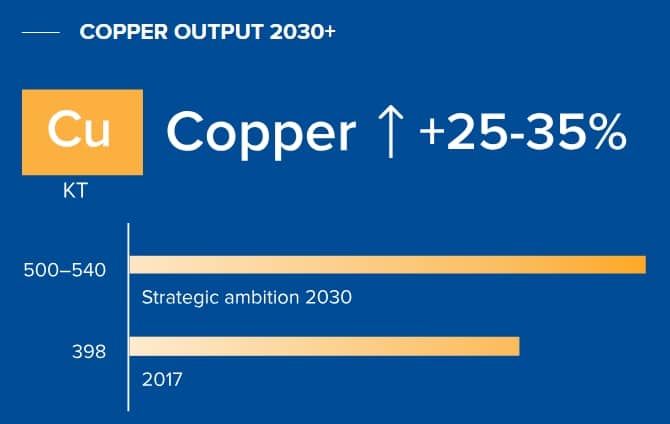
Source: Nornickel
Lately, Western sanctions on Russian commodities have made global trade more difficult. These restrictions limit where and how Russian goods, like metals (aluminum, copper, and nickel) and energy resources, can be sold. As a result, Nornickel has been seeking joint ventures in China since earlier this year even though it is not directly sanctioned by the West.
The mining giant has not disclosed the name of the Chinese partner they are in talks with but they hint at constructing a greenfield plant at the mentioned location.
The smelter project represents a strategic shift for Nornickel, which previously explored partnerships with established Chinese smelters to process Russian concentrate. However, those plans were abandoned in favor of a new, purpose-built facility.
China’s Copper Dominance: Too Much of a Good Thing?
Demand for copper is going high due to renewables, electric vehicles, and grid infrastructure. According to Bloomberg, China’s refined copper output rose by over 5% in 2024 despite certain production curbs. Furthermore, in recent years, the country has rapidly constructed smelters which has led to an increase in its global share for copper.
This burst in capacity is certainly not favorable for the Chinese copper market. Rather it has put tremendous pressure on domestic smelters to slow expansion. This is the outcome of the fierce competition and limited raw materials which have shrunk the profits of the copper industry.
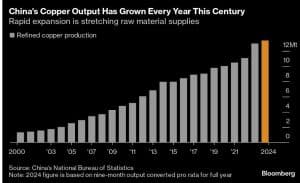
Source: Bloomberg
Grant Sporre, head of metals and mining research at Bloomberg Intelligence had cautioned that China’s excesses threaten the future of copper refining beyond its borders and operations from Chile to Europe and India could be at risk.
The above analysis is based on the fact that ore supply has intensified as new smelters open in India and Indonesia. India is rapidly building plants to cut down on copper imports and strengthen domestic production. Meanwhile, Indonesia has taken steps to keep its ore resources within the country by curbing exports on which many smelters in Asia rely. This shift forces copper smelters in Asia to secure new sources or risk production slowdowns, further straining the already tight market.
However, interestingly some analysts suggested that state-owned Chinese smelters may handle the market downturn better than global competitors. This is simply because of the cost advantages and more modern facilities the country is equipped with.
Is Nornickel’s Entry A Threat to China’s Copper Giants?
Fangchenggang, where the plant would be built, already has a large smelter with a 600,000-ton capacity and is operated by China’s state-owned Jinchuan Group. On top, this project comes at a time when the country is dealing with an oversupply of copper refining capacity.
As a consequence, Nornickel’s project has met substantial resistance from Chinese copper producers, who feel the extra capacity could harm their domestic output.
China’s refined copper imports from Russia have declined by over one-third year-on-year, totaling about 165,000 tons in the first nine months of 2024. The new smelter, if finalized, would help stabilize the flow of Russian copper into China and offer Nornickel an opportunity to circumvent Western trade restrictions while accessing the world’s largest copper market.
Operational performance
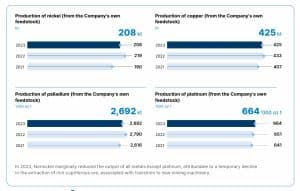
Source: Nornickel Sustainability Report
Thus, it’s too early to comment on whether Nornickel’s entry will be a boon or a bane for China’s copper market. The study is speculative and the picture will be clear eventually as the mining company reveals more details of their expansion plans.
Expanding on Critical Resources: Alaska’s Role in U.S. Energy Independence
The challenges Nornickel faces in China underscore the broader global race to secure critical mineral resources, especially as countries like the U.S. strive for energy independence. Alaska, a state rich in mineral deposits, is at the center of efforts to boost domestic production of essential metals. Canadian mining company Alaska Energy Metals Corporation (AEMC) is one such player making strides by exploring Alaska’s underground deposits of nickel, a metal critical for energy transition technologies, particularly electric vehicle batteries.
AEMC President Greg Beischer has highlighted the importance of building a sustainable, domestic supply chain for nickel and other key minerals. With AEMC’s flagship project, the 23,000-acre Nikolai deposit, the company aims to help reduce the U.S.’s reliance on imports and support a shift towards a low-carbon economy. The Nikolai deposit holds substantial nickel reserves and also contains copper, cobalt, platinum, and palladium—metals deemed critical by the U.S. Department of Energy.
AEMC’s activities in Alaska mirror Nornickel’s efforts in Fangchenggang. Both companies recognize the growing need to secure a stable supply of strategic minerals, given geopolitical pressures and the global focus on energy security. For AEMC, overcoming challenges posed by fluctuating nickel prices and securing project funding are priorities to advance the Nikolai project, which they aim to assess economically by 2025. This project also aligns with U.S. initiatives to establish local sources for critical minerals, a strategy that could mitigate reliance on overseas production.
Data and Content Sources:
- Russian Miner Moves Closer to Deal for New Copper Plant in China – Bloomberg
- China’s Copper Production Boom Threatens to Crowd Out the Rest of The World – Bloomberg
- FURTHER READING: Will AI Drive A Global Copper Shortage? BHP Rings the Alarm
Disclosure: Owners, members, directors, and employees of carboncredits.com have/may have stock or option positions in any of the companies mentioned: AEMC.
Carboncredits.com receives compensation for this publication and has a business relationship with any company whose stock(s) is/are mentioned in this article.
Additional disclosure: This communication serves the sole purpose of adding value to the research process and is for information only. Please do your own due diligence. Every investment in securities mentioned in publications of carboncredits.com involves risks that could lead to a total loss of the invested capital.
Please read our Full RISKS and DISCLOSURE here.
The post Nornickel’s Big Copper Bet: Will It Disrupt China’s Smelting Power? appeared first on Carbon Credits.

Carbon credit providers vs marketplaces is the first comparison many buyers try to make. In this comparison, a carbon credit provider is the project developer: the company that originates credits from its own projects and sells them directly. A carbon credit marketplace is a platform that lists credits from many projects at published prices.

Carbon Footprint
Democrats who call climate change an emergency should not defend a permitting system too slow to build the clean energy that would address it.”
Democrats, Take The Deal. New York Times editorial, Nov. 12.
Insetting program design starts with your supplier map. The carbon claim comes much later.
Consider a coffee procurement team that funds a farm intervention before checking its sourcing data. The supplier aggregates coffee lots from several regions. The buyer lacks farm-level traceability. Another purchaser expects to report the same outcome. A more attractive project brochure solves none of these problems.
If the distinction between a value-chain intervention and a purchased credit is still open, read CCC’s Insetting vs Offsetting guide before you set the brief.
Insetting program design begins with the purchasing relationship and works outward. You need to decide 1) where an intervention belongs, 2) what business problem it addresses, 3) who pays for it, 4) how results will be measured, and 5) what the evidence will let you say about them. This five-step playbook turns that sequence into a procurement plan.
Step 1: Insetting program design starts with supplier mapping
Start with the commodities that matter most to your Scope 3 inventory and sourcing continuity. Ask finance for spend by supplier, sustainability for the emissions baseline, and category managers for origin and volume records. Then identify which suppliers can trace material to a jurisdiction, sourcing region, producer group, or individual land-management unit.
The level of traceability affects what you can account for. Under the GHG Protocol Land Sector and Removals Standard, the spatial boundary for purchased land-based products depends on the traceability associated with each volume. Farm-specific factors or removals require physical traceability through an acceptable chain-of-custody model. A contract with a tier-one trader, by itself, does not establish a link to the farms behind its deliveries.[1]
Build a first-pass table with five columns: commodity and annual volume; supplier and origin; current traceability level; land-use and production risks; and the business owner who can change the purchasing terms. Mark missing data plainly. A blank cell is cheaper to fix before a program starts than after a claim is drafted.
If your company sets an SBTi Forest, Land and Agriculture target (FLAG), keep its land-related target boundary separate from energy and industry emissions. The current FLAG guidance also requires relevant companies to assess primary deforestation-linked commodities in their value chains.[2]
Step 2: Choose a commodity and jurisdiction for a pilot
Select one supply corridor where the sourcing connection can be established and procurement has a reason to stay. A useful pilot has repeat purchases, suppliers willing to share records, an intervention matched to a diagnosed problem, and a defined plan to measure the result. Carbon potential alone is a poor selection rule if the supplier cannot deliver the crop your business needs.
Compare candidate regions on land-use risk, supplier concentration, local rights and tenure, the availability of baseline data, and exposure to drought, erosion, or forest conversion. Check the relevant legal requirements separately. A nature project does not satisfy a due-diligence obligation merely because it has a carbon method attached.
Consider a coffee buyer sourcing from two districts. In the first, producer-group records identify the farms, while recent dry seasons have increased rejected green coffee lots. In the second, deliveries pass through several intermediaries and farm origins are unknown. Pilot shade management in the first district, with local agronomic advice and quality checks built into the plan. The buyer can trace purchases there and test the intervention against a defined sourcing problem.
Use a short decision memo to record why the selected corridor beats the alternatives, what remains uncertain, and what would stop the pilot. That memo is the first control against a project drifting toward whatever happens to photograph well.
Step 3: Design the supplier engagement and commercial model
The intervention needs an owner on each side of the contract. Decide who supplies planting material or training, who maintains the practice, who bears the cost if a harvest disappoints, and how long the buyer expects to purchase from participating suppliers. Where smallholders participate, budget cash flow and technical support for practices that offer a later return.
Put these terms in a supplier agreement or pilot addendum. It should cover eligible farms and volumes, consent to data collection, access for monitoring, any land or carbon rights that matter, benefit sharing, and what happens if the purchasing relationship ends. Ask local counsel and producer representatives to review the arrangement. The Accountability Framework is a useful reference for supply-chain work involving forests, ecosystems, and human rights.[3]
Avoid assigning an automatic carbon benefit to the buyer. The contract should say which party has the right to report each outcome, how overlapping claims will be checked, and how any issued credits will be handled. A reduction reported in a buyer’s inventory cannot simply be sold for someone else’s offset claim without an accounting review. SBTi FLAG guidance excludes purchased credits used as offsets from near-term FLAG target achievement.[2]
Set commercial measures beside environmental ones: delivered volume, rejection rate, supplier retention, and procurement cost. They tell you whether the program works as a supply-chain investment, even if carbon accounting takes longer to resolve.
Step 4: Build monitoring, reporting, and verification before rollout
Agree on the baseline and data flow before paying for a full rollout. Identify the land units or sourcing regions in scope, the practices that change, the records suppliers already keep, and the additional measurements the program requires. Decide which data can come from field visits, transaction records, or remote sensing, and who checks each source.
For carbon, separate three questions. Did the practice happen? Did emissions or removals change under an applicable method? Can the buyer attribute a defensible share to its purchased goods without double counting? The GHG Protocol’s 2026 guidance includes dedicated chapters on spatial boundaries, data and methods, evaluating actions, credited outcomes, and assurance.[1] These are distinct jobs. A photograph of a planted tree answers only part of the first.
CCC’s MRV and Additionality article explains the separate evidence questions a project reviewer will ask.
Create an evidence file for every reporting period: dated supplier and farm records, purchase volumes, methods and emission factors, uncertainty, quality checks, and changes from the baseline. Specify who can challenge the data and how corrections are recorded. If a project also seeks credit certification, keep project accounting and corporate inventory accounting separate. The GHG Protocol says its land standard focuses on entity-level inventories and does not set the rules for credit certification.[4]
Start with the minimum viable measurement design that can survive review. Add complexity when the pilot tells you which data actually changes a decision.
Step 5: Decide what can be reported and claimed
Insetting program design needs reporting rules before the marketing copy. Procurement, sustainability, finance, and legal should agree on four distinct outputs: operational performance; observed land or nature outcomes; inventory effects, if the accounting criteria are met; and any separately issued credits. One dashboard can display them, but they should not share a single unqualified headline.
SBTi FLAG guidance allows certain land-based removals within a company’s operations or supply chain to contribute to FLAG pathways, subject to criteria including permanence, traceability, data quality, and allocation. It does not allow purchased offsets to meet near-term FLAG targets.[2] Eligibility therefore depends on evidence and the applicable target rules, not on calling an activity “insetting.”
Draft a claims register. For each proposed sentence, record the period, boundary, data owner, calculation method, reviewer, and whether the result is measured, estimated, or still a goal. If the evidence supports only “we funded a pilot with 200 farms,” say that. Do not turn a funding fact into a verified emissions reduction.
What good looks like by year three
Treat year three as a review point, not a promised payback date. A mature pilot should have mapped participating supply volumes, a stable supplier agreement, a repeatable data collection process, and a comparison of commercial and environmental results against the baseline. It should also have a documented answer for outcomes that cannot be included in the buyer’s inventory.
Scale only where the pilot improves a sourcing decision and the evidence can follow the product. If neither condition holds, redesign the intervention or change the corridor. A disciplined program can conclude that a site is unsuitable. That is useful procurement intelligence.
Discuss your insetting program with CCC
Carbon Credit Capital designs nature-based supply chain investments around sourcing needs and measurable sustainability outcomes. Schedule a consultation with our carbon and sustainability experts to map your tier-one supplier network, FLAG exposure, and first pilot decision.
Sources
[1] GHG Protocol, Land Sector and Removals Standard, version 1.1, and companion Guidance, June 2026: https://ghgprotocol.org/land-sector-and-removals-standard ; https://ghgprotocol.org/land-sector-and-removals-guidance
[2] Science Based Targets initiative, Forest, Land and Agriculture Science-Based Target-Setting Guidance, version 1.2, March 2026, especially pp. 16–17, 37, and 41: https://sciencebasedtargets.org/resources/files/SBTiFLAGGuidance.pdf
[3] Accountability Framework initiative, Accountability Framework and guidance for companies: https://accountability-framework.org/
[4] GHG Protocol, Frequently Asked Questions: Land Sector and Removals Standard, questions 10 and 18: https://ghgprotocol.org/blog/frequently-asked-questions-land-sector-and-removals-lsr-standard

‘COP-out’: COP31 fails to deliver the ambition needed to phase out fossil fuels and address climate breakdown
COP31 Bulletin Day 13: New draft retains electrification goal but delays adaptation finance and science decisions

How “Marie Antoinnete” Can We Get?

-
Climate Change1 year ago
Guest post: Why China is still building new coal – and when it might stop
-
Greenhouse Gases1 year ago
Guest post: Why China is still building new coal – and when it might stop
-

 Renewable Energy1 year ago
Sending Progressive Philanthropist George Soros to Prison?
-
Greenhouse Gases1 year ago
嘉宾来稿:探究火山喷发如何影响气候预测
-

 Climate Change2 years ago
Analysis: China’s CO2 falls 1% in Q2 2024 in first quarterly drop since Covid-19
-

 Climate Change1 year ago
嘉宾来稿:探究火山喷发如何影响气候预测
-

 Renewable Energy5 months ago
Send a Bible to a Starving Child
-