Connect with us

Published

on

At Climate Home News, we found this year a pretty depressing one to cover, shaped as it was by Donald Trump’s attacks on climate science and action at home and abroad – and rounded off by the UN declaring global warming will break through the key 1.5C limit the world set itself in 2015.

But it wasn’t all bad. Nobody had decided to follow the US out of the Paris Agreement by the time it turned 10 this month. Anti-climate candidates in Canada and Australia, backed by Trump, lost elections convincingly. And 2025 may also have been the year carbon dioxide emissions fell for the first time.

What’s more, our reporting this year saw results in the real world. After we revealed that Chilean doctors believe pollution from copper mines in the northern hub of Calama is causing autism, campaigners sued state-owned mining company Codelco. The case is ongoing.

One of the lawyers representing the campaigners said “when [Climate Home News] revealed our silent suffering and our fight, we felt we had finally been heard and had entered the national conversation thanks to international media coverage. That was the final push to file the lawsuit.”

If you want to fund more impactful reporting like this in 2026, please subscribe and unlock all of our content for just the price of a coffee per week. Or to keep up with our latest coverage, you can sign up for our free newsletter and follow us on LinkedIn, Instagram, BlueSky and Facebook.

Below are nine of our best stories this year and, if that’s not enough, here’s nine more from 2024.

1. Solar squeeze: US tariffs threaten panel production and jobs in Thailand

In the year of trade wars, Trump extended Biden-era tariffs on solar panels from China to neighbouring countries. Nicha Wachpanich spoke to some of those workers who subsequently lost their jobs making panels at Chinese-run factories in Thailand and found that the US levies and bad behaviour by bosses had combined to crush their dreams of a better life.

Solar Thailand
Bunyuen Sukmai, a labour lawyer and former auto-factory worker, goes through files of dismissal dispute cases (Photo: Peerapon Boonyakiat)

2. Business-as-usual: Donors pour climate adaptation finance into big infrastructure, neglecting local needs

Trump being Trump, and axing US climate finance, is no reason to let other wealthy donor nations off the hook. We examined the latest spreadsheets for annual adaptation aid and found Japan is counting support for massive infrastructure projects in its figures, despite them having only a dubious role in helping people adapt to climate change.

Our reporter Tanbirul Miraj Ripon visited one such project – the Matarbari port in Bangladesh. He found that the port handles coal and gas imports and has destroyed locals’ homes and livelihoods. Despite this, on paper it represents $363 million in Japanese climate adaptation finance, the biggest single climate resilience project being funded by a wealthy country in 2023.

3. Ethiopia’s bold EV ambitions hit bumps in rural areas

Other nations are trying hard to go green but finding it tricky. This year, Ethiopia hosted the Africa Climate Summit, was selected as the host of COP32 and opened the continent’s biggest hydropower dam.

It plans to use some of this clean power to charge electric vehicles, after banning imports of cars with internal combustion engines (even as the European Union is softening its own 2035 ban on ICEs). While that will reduce Ethiopia’s already tiny emissions and its fossil fuel import bills, it won’t be easy in a nation where only half the population has electricity access, as Solomon Yimer and Vivian Chime reported.

In Ethiopia, EV ambitions are hitting bumps in rural areas
A newly inaugurated EV charging station installed by Ethio Telecom in Addis Ababa. (Photo: Solomon Yimer)

4. Ending poverty and gangs: How Zambia seeks to cash in on the global drive for EVs

Other African governments are trying to cash in on their minerals, which big players like China, the US and increasingly Saudi Arabia want for green technologies and/or making equipment for wars.

Pamela Kapekele went to look at the situation in Zambia’s Copperbelt province – where you can probably guess what they produce! She found that good tax regulations and working conditions will be needed if locals are to see the benefits of surging demand for the metal.

Later in the year, an acid spill from a copper-mine tailings dam that contaminated the country’s main river showed the value of environmental regulation too. Reporting from Nigeria’s lithium and South Africa’s platinum mines also highlighted the challenges of making minerals mining and processing cleaner and fairer for communities.

Zambia copper mining
Illegal miner Mulenga Chishala climbs out of a mining tunnel

5. Is the world’s big idea for greener air travel a flight of fancy?

Some sectors – like international aviation and shipping – tend to fall outside the scope of national media, and it’s a gap we’ve aimed to fill. Together with Singapore’s Straits Times, we tracked the supply chain for what the airline industry calls “Sustainable Aviation Fuel” (SAF) and found that virgin and barely used palm oil – which threatens rainforests – is being passed off as waste cooking oil and used to power planes in Europe.

Malaysia is a particular hotspot for this fraud, as government subsidies there make virgin palm oil cheap in the shops – and it can be sold for a higher price as “used” cooking oil, providing a profit motive for flipping it. Our investigation was picked up by the Financial Times, Bloomberg and the Malaysian authorities, who have since launched a crackdown on this kind of fraud. 

But with verification of the materials used for SAF relying on just a handful of commercial auditors conducting mainly paper-based checks, airlines currently cannot know for sure if their green jet fuel is actually sustainable. Their advertising to passengers should – but often doesn’t – reflect this uncertainty.
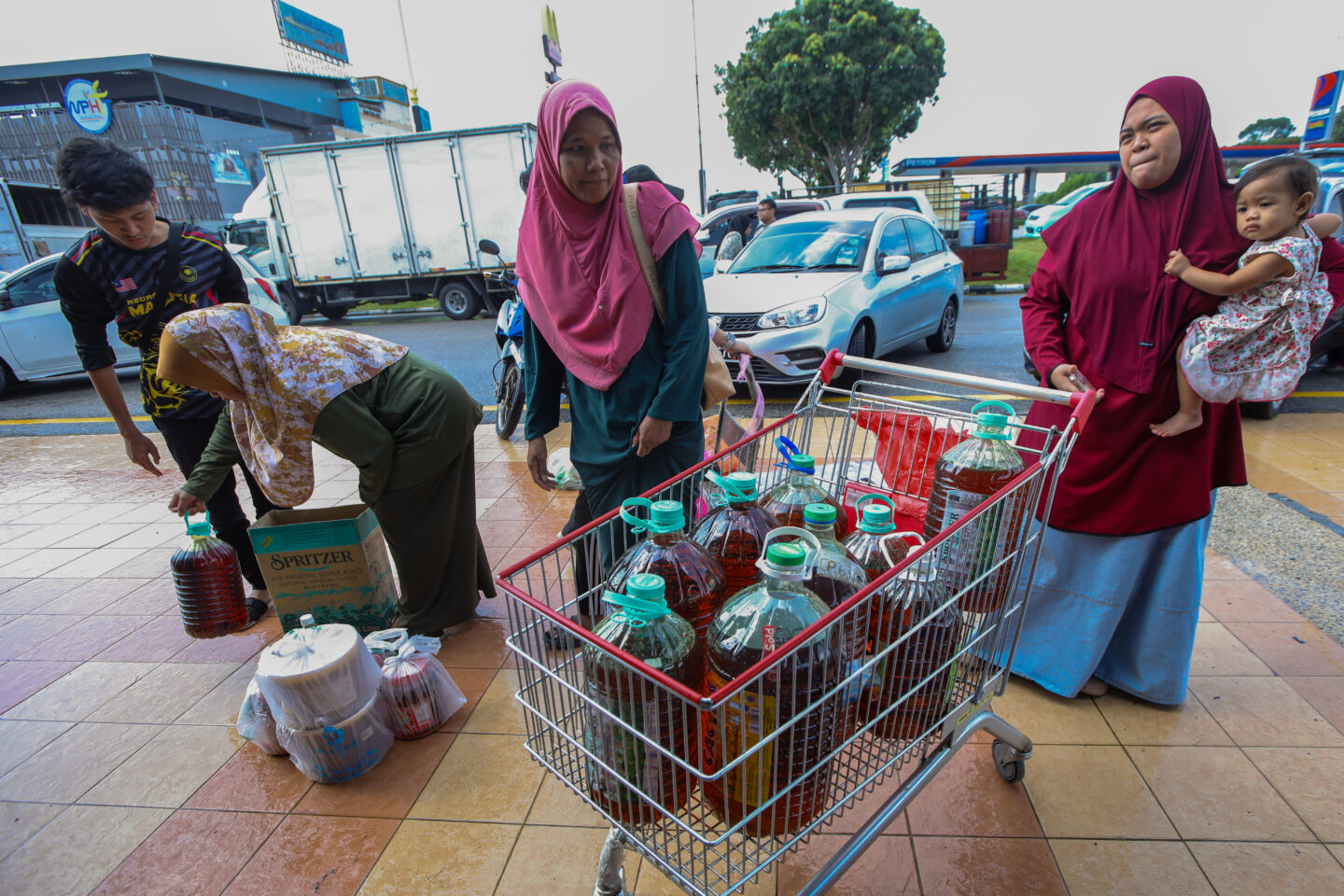
Members of the public delivering their used cooking oil (UCO) to Evergreen Oil & Feed’s joint collection drive with the Melaka City Council in May 2025. (Photo: Sairien Nafis/Climate Home News/The Straits Times)

6. Brazil’s environment minister suggests roadmap to end fossil fuels at COP30

Our reporting was often prescient this year. We called it correctly that the US would leave the Paris Agreement but not the UNFCCC, that Argentina would not follow America out of Paris, that Ethiopia rather than Nigeria would be chosen as COP32 host and that petrostates would try to kill a new green shipping framework at the International Maritime Organization.

We are also pretty sure we were the first – at least in English – to pick up on Brazilian Environment Minister Marina Silva’s proposal for COP30 to agree on a roadmap away from fossil fuels, which she aired back in June at London Climate Week. That proposal was pushed by President Lula at the start of COP30, dominated much of the conversation at the summit and will continue to be discussed throughout 2026.

Brazil's environment minister Marina Silva at a press conference in London. (Photo: Credit: Isabela Castilho / COP30 presidency)
Brazil’s environment minister Marina Silva at a press conference in London. (Photo: Credit: Isabela Castilho/COP30 presidency)

8. PR firm working for Shell wins COP30 media contract

In the summer of 2025, our crack investigative reporter Matteo Civillini got the scoop on how the Brazilian government, via a contract tendered by the UN, was working with Edelman on international media relations for the COP30 climate summit while the global PR giant was simultaneously engaged in promoting Shell’s fossil fuel interests in Brazil.

This story was picked up by a range of other media, and amplified calls for agencies whose clients include fossil fuel firms to be excluded from the climate negotiations. Advocacy group Clean Creatives was inspired by Matteo’s reporting to launch a campaign against Edelman’s COP involvement. That culminated in an open letter from influencers and creators with a combined audience of over 24 million calling for Edelman to be dropped. The drumbeat on this theme is likely to get louder in 2026.

COP30 President André Aranha Corrêa do Lago speaks to journalists at COP30 (Photo: Flickr/COP30)

8. “House of cards”: Verra used junk carbon credits to fix Shell’s offsetting scandal

And talking of smoke and mirrors, just when we thought the murky web of carbon offsetting linking oil and gas major Shell to sham rice-farming projects in China couldn’t get any more convoluted, it did exactly that.

By combing through the records of carbon-credit registry Verra – the world’s biggest – Matteo confirmed that nearly a million bogus offsets from 10 disqualified methane reduction projects had been compensated for with the same number of junk credits from another four such projects that were also axed by Verra.

“It’s frankly unbelievable that Verra considers it appropriate to compensate for hot air credits with other hot air credits,” Jonathan Crook, policy lead at Carbon Market Watch, told us. “To pretend this is a satisfactory resolution is both absurd and deeply alarming.”

Verra insists the replacement credits were technically available to plug the gap left by the first batch – even though the second set, too, now need to be swapped out. Shell is keeping its distance, saying it does not manage or operate “the projects in question” despite being earlier involved in the Chinese rice-farming programmes as their “authorised representative”. Mind-boggling indeed!

Farmers transplant rice seedlings in the fields in Lianyungang City, Jiangsu Province, China, on June 17, 2025. (Photo: Costfoto/NurPhoto)

9. Self-taught mechanics give second life to Jordan’s glut of spent EV batteries

In what was on balance a bad year, we brought you some hope too. A landmark advisory opinion on climate change and human rights from the International Court of Justice in The Hague was stronger than anyone imagined and may open the door to lawsuits against polluting countries and companies in 2026.

Other good news stories included analysts suggesting China’s fossil fuel use could peak this year, the UN’s loss and damage fund launching its first call for proposals, South Korea and Morocco moving to phase out coal and a boom in imports of solar panels to Africa.

Hope came too from ordinary people and their ingenuity – like the untrained Jordanians interviewed by Yamuna Matheswaran, hooking up solar panels to old Tesla batteries, lowering both their electricity bills and their carbon emissions into the bargain.

Man leans over large depleted EV battery in a workshop in Amman
Shadi Jameel at work in his repair shop in Amman’s al Bayader industrial area (Photo: Shadi Jameel)

The post Nine of our best climate stories from 2025 appeared first on Climate Home News.

Nine of our best climate stories from 2025

Continue Reading

Climate Change

Battery passport plan aims to clean up the industry powering clean energy

Published

on

For millions of consumers, the sustainability scheme stickers found on everything from bananas to chocolate bars and wooden furniture are a way to choose products that are greener and more ethical than some of the alternatives.

Inga Petersen, executive director of the Global Battery Alliance (GBA), is on a mission to create a similar scheme for one of the building blocks of the transition from fossil fuels to clean energy systems: batteries.

“Right now, it’s a race to the bottom for whoever makes the cheapest battery,” Petersen told Climate Home News in an interview.

The GBA is working with industry, international organisations, NGOs and governments to establish a sustainable and transparent battery value chain by 2030.

“One of the things we’re trying to do is to create a marketplace where products can compete on elements other than price,” Petersen said.

Under the GBA’s plan, digital product passports and traceability would be used to issue product-level sustainability certifications, similar to those commonplace in other sectors such as forestry, Petersen said.

Managing battery boom’s risks

Over the past decade, battery deployment has increased 20-fold, driven by record-breaking electric vehicle (EV) sales and a booming market for batteries to store intermittent renewable energy.

Falling prices have been instrumental to the rapid expansion of the battery market. But the breakneck pace of growth has exposed the potential environmental and social harms associated with unregulated battery production.

From South America to Zimbabwe and Indonesia, mineral extraction and refining has led to social conflict, environmental damage, human rights violations and deforestation. In Indonesia, the nickel industry is powered by coal while in Europe, production plants have been met with strong local opposition over pollution concerns.

“We cannot manage these risks if we don’t have transparency,” Petersen said.

    The GBA was established in 2017 in response to concerns about the battery industry’s impact as demand was forecast to boom and reports of child labour in the cobalt mines of the Democratic Republic of the Congo made headlines.

    The alliance’s initial 19 members recognised that the industry needed to scale rapidly but with “social, environmental and governance guardrails”, said Petersen, who previously worked with the UN Environment Programme to develop guiding principles to minimise the environmental impact of mining.

    A blonde woman wearing a head set sits with her legged crossed during an event at the World Economic Forum
    Inga Petersen, executive director of the Global Battery Alliance, speaking at a conference in Dalian, China, in June 2024 (Photo: World Economic Forum/Ciaran McCrickard) 

    Digital battery passport

    Today, the alliance is working to develop a global certification scheme that will recognise batteries that meet minimum thresholds across a set of environmental, social and governance benchmarks it has defined along the entire value chain.

    Participating mines, manufacturing plants and recycling facilities will have to provide data for their greenhouse gas emissions as well as how they perform against benchmarks for assessing biodiversity loss, pollution, child and forced labour, community impacts and respect for the rights of Indigenous peoples, for example.

    The data will be independently verified, scored, aggregated and recorded on a battery passport – a digital record of the battery’s composition, which will include the origin of its raw materials and its performance against the GBA’s sustainability benchmarks

    The scheme is due to launch in 2027.

    A carrot and a stick

    Since the start of the year, some of the world’s largest battery companies have been voluntarily participating in the biggest pilot of the scheme to date.

    More than 30 companies across the EV battery and stationary storage supply chains are involved, among them Chinese battery giants CATL and BYD subsidiary FinDreams Battery, miner Rio Tinto, battery producers Samsung SDI and Siemens, automotive supplier Denso and Tesla.

    Petersen said she was “thrilled” about support for the scheme. Amid a growing pushback against sustainability rules and standards, “these companies are stepping up to send a public signal that they are still committed to a sustainable and responsible battery value chain,” she said.

    A slide deck of the consortia and companies involved in the Global Battery Alliance pilot scheme
    The companies taking part in the Global Battery Alliance’s latest battery passport pilot scheme (Credit: Global Battery Alliance)

    There are other motivations for battery producers to know where components in their batteries have come from and whether they have been produced responsibly.

    In 2023, the EU adopted a law regulating the batteries sold on its market.

    From 2027, it mandates all batteries to meet environmental and safety criteria and to have a digital passport accessed via a QR code that contains information about the battery’s composition, its carbon footprint and its recycling content.

    The GBA certification is not intended as a compliance instrument for the EU law but it will “add a carrot” by recognising manufacturers that go beyond meeting the bloc’s rules on nature and human rights, Petersen said.

    Raising standards in complex supply chain

    But challenges remain, in part due to the complexity of battery supply chains.

    In the case of timber, “you have a single input material but then you have a very complex range of end products. For batteries, it’s almost the reverse,” Petersen said.

    The GBA wants its certification scheme to cover all critical minerals present in batteries, covering dozens of different mining, processing and manufacturing processes and hundreds of facilities.

    “One of the biggest impacts will be rewarding the leading performers through preferential access to capital, for example, with investors choosing companies that are managing their risk responsibly and transparently,” Petersen said.

      It could help influence public procurement and how companies, such as EV makers, choose their suppliers, she added. End consumers will also be able to access a summary of the GBA’s scores when deciding which product to buy.

      US, Europe rush to build battery supply chain

      Today, the GBA has more than 150 members across the battery value chain, including more than 50 companies, of which over a dozen are Chinese firms.

      China produces over three-quarters of batteries sold globally and it dominates the world’s battery recycling capacity, leaving the US and Europe scrambling to reduce their dependence on Beijing by building their own battery supply chains.

      Petersen hopes the alliance’s work can help build trust in the sector amid heightened geopolitical tensions. “People want to know where the materials are coming from and which actors are involved,” she said.

      At the same time, companies increasingly recognise that failing to manage sustainability risks can threaten their operations. Protests over environmental concerns have shut down mines and battery factories across the world.

       “Most companies know that and that’s why they’re making these efforts,” Petersen added.

      The post Battery passport plan aims to clean up the industry powering clean energy appeared first on Climate Home News.

      Battery passport plan aims to clean up the industry powering clean energy

      Continue Reading

      Climate Change

      Reheating plastic food containers: what science says about microplastics and chemicals in ready meals

      Published

      on

      How often do you eat takeaway food? What about pre-prepared ready meals? Or maybe just microwaving some leftovers you had in the fridge? In any of these cases, there’s a pretty good chance the container was made out of plastic. Considering that they can be an extremely affordable option, are there any potential downsides we need to be aware of? We decided to investigate.

      Scientific research increasingly shows that heating food in plastic packaging can release microplastics and plastic chemicals into the food we eat. A new Greenpeace International review of peer-reviewed studies finds that microwaving plastic food containers significantly increases this release, raising concerns about long-term human health impacts. This article summarises what the science says, what remains uncertain, and what needs to change.

      There’s no shortage of research showing how microplastics and nanoplastics have made their way throughout the environment, from snowy mountaintops and Arctic ice, into the beetles, slugs, snails and earthworms at the bottom of the food chain. It’s a similar story with humans, with microplastics found in blood, placenta, lungs, liver and plenty of other places. On top of this, there’s some 16,000 chemicals known to be either present or used in plastic, with a bit over a quarter of those chemicals already identified as being of concern. And there are already just under 1,400 chemicals that have been found in people.

      Not just food packaging, but plenty of household items either contain or are made from plastic, meaning they potentially could be a source of exposure as well. So if microplastics and chemicals are everywhere (including inside us), how are they getting there? Should we be concerned that a lot of our food is packaged in plastic?

      Ready meals, takeaway containers and plastic packaging can release microplastics and toxic chemicals into our food.

      Greenpeace analysis of 24 articles in peer-reviewed scientific journals found that the plastics we use to package our food are directly risking our health.

      Heating food in plastic packaging dramatically increases the levels of microplastics and chemicals that leach into our food.

      © Jack Taylor Gotch / Greenpeac

      Plastic food packaging: the good, the bad, and the ugly

      The growing trend towards ready meals, online shopping and restaurant delivery, and away from home-prepared meals and individual grocery shopping, is happening in every region of the world. Since the first microwaveable TV dinners were introduced in the US in the 1950s to sell off excess stock of turkey meat after Thanksgiving holidays, pre-packaged ready meals have grown hugely in sales. The global market is worth $190bn in 2025, and is expected to reach a total volume of 71.5 million tonnes by 2030. It’s also predicted that the top five global markets for convenience food (China, USA, Japan, Mexico and Russia) will remain relatively unchanged up to 2030, with the most revenue in 2019 generated by the North America region.

      A new report from Greenpeace International set out to analyse articles in peer-reviewed, scientific journals to look at what exactly the research has to say about plastic food packaging and food contact plastics.

      Here’s what we found.

      Our review of 24 recent articles highlights a consistent picture that regulators, businesses and

      consumers should be concerned about: when food is packaged in plastic and then microwaved, this significantly increases the risk of both microplastic and chemical release, and that these microplastics and chemicals will leach into the food inside the packaging.

      And not just some, but a lot of microplastics and chemicals.

      When polystyrene and polypropylene containers filled with water were microwaved after being stored in the fridge or freezer, one study found they released anywhere between 100,000-260,000 microplastic particles, and another found that five minutes of microwave heating could release between 326,000-534,000 particles into food.

      Similarly there are a wide range of chemicals that can be and are released when plastic is heated. Across different plastic types, there are estimated to be around 16,000 different chemicals that can either be used or present in plastics, and of these around 4,200 are identified as being hazardous, whilst many others lack any form of identification (hazardous or otherwise) at all.

      The research also showed that 1,396 food contact plastic chemicals have been found in humans, several of which are known to be hazardous to human health. At the same time, there are many chemicals for which no research into the long-term effects on human health exists.

      Ultimately, we are left with evidence pointing towards increased release of microplastics and plastic chemicals into food from heating, the regular migration of microplastics and chemicals into food, and concerns around what long-term impacts these substances have on human health, which range from uncertain to identified harm.

      Illustrated diagram showing how heating food in plastic containers releases microplastics, nanoplastics and chemicals into food. The graphic lists common plastic types used in food containers, including PET, HDPE, PVC, LDPE, PP, PS and other plastics. It shows food being heated in ovens and microwaves in containers labelled “oven safe” and “microwave safe”. Arrows lead from heated food to a cutaway of a plastic container filled with coloured particles, representing microplastics, nanoplastics and chemical additives migrating from the plastic into food.
      Heating food in plastic containers, even those labelled “microwave safe” or “oven safe”, can release microplastics, nanoplastics and toxic chemicals into our meals. From ready meals to leftovers, common plastics like PET, PP and PS break down under heat, contaminating food we eat every day. This visual explains how plastic packaging turns heat into hidden exposure. © William Morris-Julien / Greenpeace 

      The known unknowns of plastic chemicals and microplastics

      The problem here (aside from the fact that plastic chemicals are routinely migrating into our food), is that often we don’t have any clear research or information on what long-term impacts these chemicals have on human health. This is true of both the chemicals deliberately used in plastic production (some of which are absolutely toxic, like antimony which is used to make PET plastic), as well as in what’s called non-intentionally added substances (NIAS).

      NIAS refers to chemicals which have been found in plastic, and typically originate as impurities, reaction by-products, or can even form later when meals are heated. One study found that a UV stabiliser plastic additive reacted with potato starch when microwaved to create a previously unknown chemical compound.

      We’ve been here before: lessons from tobacco, asbestos and lead

      Although none of this sounds particularly great, this is not without precedence. Between what we do and don’t know, waiting for perfect evidence is costly both economically and in terms of human health. With tobacco, asbestos, and lead, a similar story to what we’re seeing now has played out before. After initial evidence suggesting problems and toxicity, lobbyists from these industries pushed back to sow doubt about the scientific validity of the findings, delaying meaningful action. And all the while, between 1950-2000, tobacco alone led to the deaths of around 60 million people. Whilst distinguishing between correlation and causation, and finding proper evidence is certainly important, it’s also important to take preventative action early, rather than wait for more people to be hurt in order to definitively prove the point.

      Where to from here?

      This is where adopting the precautionary principle comes in. This means shifting the burden of proof away from consumers and everyone else to prove that a product is definitely harmful (e.g. it’s definitely this particular plastic that caused this particular problem), and onto the manufacturer to prove that their product is definitely safe. This is not a new idea, and plenty of examples of this exist already, such as the EU’s REACH regulation, which is centred around the idea of “no data, no market” – manufacturers are obligated to provide data demonstrating the safety of their product in order to be sold.

      Ready meals, takeaway containers and plastic packaging can release microplastics and toxic chemicals into our food.

      Greenpeace analysis of 24 articles in peer-reviewed scientific journals found that the plastics we use to package our food are directly risking our health.

      Heating food in plastic packaging dramatically increases the levels of microplastics and chemicals that leach into our food.

      © Jack Taylor Gotch / Greenpeac

      But as it stands currently, the precautionary principle isn’t applied to plastics. For REACH in particular, plastics are assessed on a risk-based approach, which means that, as the plastic industry itself has pointed out, something can be identified as being extremely hazardous, but is still allowed to be used in production if the leached chemical stays below “safe” levels, despite that for some chemicals a “safe” low dose is either undefined, unknown, or doesn’t exist.

      A better path forward

      Governments aren’t acting fast enough to reduce our exposure and protect our health. There’s no shortage of things we can do to improve this situation. The most critical one is to make and consume less plastic. This is a global problem that requires a strong Global Plastics Treaty that reduces global plastic production by at least 75% by 2040 and eliminates harmful plastics and chemicals. And it’s time that corporations take this growing threat to their customers’ health seriously, starting with their food packaging and food contact products. Here are a number of specific actions policymakers and companies can take, and helpful hints for consumers.

      Policymakers & companies

      • Implement the precautionary principle:
        • For policymakers – Stop the use of hazardous plastics and chemicals, on the basis of their intrinsic risk, rather than an assessment of “safe” levels of exposure.
        • For companies – Commit to ensure that there is a “zero release” of microplastics and hazardous chemicals from packaging into food, alongside an Action Plan with milestones to achieve this by 2035
      • Stop giving false assurances to consumers about “microwave safe” containers
      • Stop the use of single-use and plastic packaging, and implement policies and incentives to foster the uptake of reuse systems and non-toxic packaging alternatives.

      Consumers

      • Encourage your local supermarkets and shops to shift away from plastic where possible
      • Avoid using plastic containers when heating/reheating food
      • Use non-plastic refill containers

      Trying to dodge plastic can be exhausting. If you’re feeling overwhelmed, you’re not alone. We can only do so much in this broken plastic-obsessed system. Plastic producers and polluters need to be held accountable, and governments need to act faster to protect the health of people and the planet. We urgently need global governments to accelerate a justice-centred transition to a healthier, reuse-based, zero-waste future. Ensure your government doesn’t waste this once-in-a-generation opportunity to end the age of plastic.

      Reheating plastic food containers: what science says about microplastics and chemicals in ready meals

      Continue Reading

      Climate Change

      REPORT: Are We Cooked?

      Published

      on

      The hidden health risks of plastic-packaged ready meals

      Ready meals and takeaways promise convenience – hot food, fast. The labels on the plastic trays reassure us that they are ‘safe’ to heat in a microwave or oven. But are we exposed to potentially dangerous microplastics and chemical additives along with our food? 

      Greenpeace decided to check

      Greenpeace International’s analysis of 24 research papers in peer-reviewed scientific journals found that the plastics we use to package our food are exposing us to health risks – and none more so than heated ready meals and takeaways. Specifically:

      • Plastic containers can release microplastics and toxic chemicals into our food.
      • Leaching into food dramatically increases when the food is heated in the plastic packaging.

      Regulators and the industry are failing to act on the plastics problem, which is already causing a global waste crisis, yet the production of plastic is set to more than double by 2050 from current levels. The fossil fuel and petrochemical industry is banking on this for its future growth – and relying on the growing trend for plastic packaged ready meals.

      Past experience shows that the costs to society multiply when action is delayed by the denial of convincing scientific evidence. This has led to health and environmental disasters, from tobacco, to asbestos, to hazardous chemicals. When it comes to plastics, we already know that their global health impacts are costing trillions, and have more than enough evidence to act.

      • At least 1,396 plastic food contact chemicals have been found in human bodies, including several which are a known threat to human health, linked to conditions such as cancers, infertility, neurodevelopmental disorders, and cardiovascular and metabolic diseases like obesity and type 2 diabetes. 

      Current regulation is clearly insufficient to protect public health. We need to act now and apply the precautionary principle to the way that we package food and stop this uncontrolled chemistry experiment that nobody signed up for
      As negotiations on the UN Plastics Treaty advance, we cannot ignore the potential impacts on human health.

      Key Findings:

      • Microwaving plastic containers can release hundreds of thousands of micro- and nanoplastics in minutes. One study found 326,000 to 534,000 particles leaching into food simulants after just five minutes of microwave heating, up to seven times more than oven heating.
      • Heating dramatically increases chemical contamination. Across multiple studies, every microwave test sample of common plastics such as polypropylene and polystyrene leached chemical additives into food or food simulants, including plasticisers and antioxidants.
      • More than 4,200 hazardous chemicals are known to be used in or present in plastics, most are not regulated in food packaging. Some, like bisphenols, phthalates, PFAS “forever chemicals” and even toxic metals such as antimony, are linked to cancer, infertility, hormone disruption and metabolic disease.
      • Plastic chemicals are already in our bodies. At least 1,396 plastic-related chemicals have been detected in human bodies, with growing evidence linking exposure to neurodevelopmental disorders, cardiovascular disease, obesity and type 2 diabetes.
      • Old, scratched or reused containers are worse. Worn plastic releases nearly double the number of microplastic particles compared to new packaging.

      Reducing reliance on plastic packaging is not just an environmental issue – it is a public health imperative. And a global one. That’s why we urgently need governments to agree on a strong and effective Global Plastics Treaty.

      REPORT: Are We Cooked?

      Continue Reading

      Trending

      Copyright © 2022 BreakingClimateChange.com

