


Microsoft has taken a significant step in the global renewable energy transition by partnering with Acadia Infrastructure Capital to launch the Climate and Communities Investment Coalition (CCIC). This ambitious $9 billion initiative aims to develop 5 gigawatts (GW) of renewable energy projects across the United States over the next five years.
The move underscores Microsoft’s commitment to sustainability and highlights corporations’ growing role in accelerating clean energy development.
Sparking a Green Revolution: How Microsoft and Acadia are Powering Up the Future
Acadia Infrastructure Capital specializes in driving investments into North America’s proven energy transition infrastructure. The company strategically deploys tax credits and structured/common equity into mid-market, real asset-based opportunities. By focusing on bespoke product structuring, Acadia goes beyond conventional investment approaches to adapt seamlessly to the dynamic energy market landscape.
The CCIC is designed to address the dual challenges of:
- Expanding clean energy capacity, and
- Ensuring that communities benefit from the renewable energy transition.
The coalition’s projects are expected to generate enough power for nearly 1 million homes. It can also prevent about 15 billion pounds of carbon emissions annually.
These efforts align with Microsoft’s long-standing commitment to reducing its carbon footprint and achieving sustainability goals.
The coalition’s first project is a 210-megawatt (MW) solar farm in Texas. It is financed in collaboration with Matrix Renewables and supported by the Sustain Our Future Foundation. The project serves as a model for how corporate investment can drive the renewable energy sector forward while providing tangible benefits to local communities.
Corporate-Led Climate Action
Dr. Brian O’Callaghan, Vice President at Acadia Infrastructure Capital, emphasized the coalition’s mission to fast-track corporate-led renewable energy financing. He stated that:
“The CCIC’s reason for being is to accelerate corporate-led renewable energy financing with real tangible benefits to local communities.”
This approach not only aids in achieving environmental goals but also delivers economic and social benefits.
The CCIC initiative is strategically designed to assist businesses in accessing Renewable Energy Certificates (RECs). Also known as renewable energy credits, RECs are essential for offsetting carbon emissions and greening supply chains. These certificates will enable participating corporations to meet sustainability targets while supporting the U.S. energy transition.
Just a few days ago, Meta also announced a similar move of purchasing green credits from 4 big solar energy projects in the U.S. The deal will produce 760 megawatts of solar power that the big tech can use to negate its carbon emissions.
Tech Meets Climate: Microsoft’s Role in a Global Green Shift
Microsoft’s role as an anchor member of the CCIC reflects its broader sustainability vision. The tech giant has been a leader in climate action, with initiatives ranging from reducing its carbon emissions to designing zero-water data centers.
Unlike other recent renewable energy announcements, Microsoft has not tied the CCIC projects to specific data centers. Instead, the RECs generated are expected to flow into Microsoft’s general sustainability efforts, supporting its commitment to becoming carbon-negative by 2030, which means removing more carbon than it emits.
Microsoft’s Path to Carbon Negativity by 2030
The tech giant aims to remove all emissions since 1975 by 2050. However, achieving this ambitious goal involves tackling complex challenges, particularly the reduction of Scope 3 emissions, comprising over 96% of its carbon footprint. These emissions largely stem from purchased goods, capital goods, and the use of sold products.
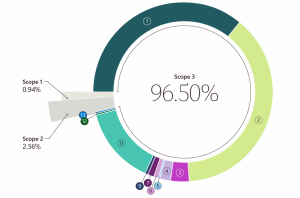
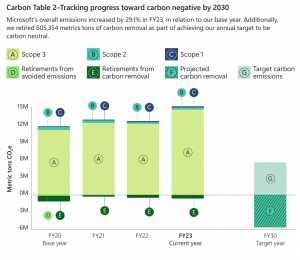
Despite progress, Microsoft’s total emissions rose by 29.1% in FY23 compared to 2020, driven by infrastructure investments. Still, the company has reduced Scope 1 and 2 emissions by 6% through clean energy procurement and efficiency initiatives.
- To scale clean energy, Microsoft expanded its renewable energy portfolio to 19.8 GW across 21 countries by 2023.
It signed power purchase agreements in countries like Brazil, Poland, and New Zealand. The tech company became the first major entity to use 24×7 clean energy services for its Washington data center.
Microsoft also focuses on data center efficiency, achieving a PUE of 1.12 and reducing hardware needs for Azure by 1.5%, cutting embodied carbon. The company is electrifying its fleet, with plans to achieve a 100% electric fleet by 2030.
To address unavoidable emissions, Microsoft is investing in carbon dioxide removal (CDR) projects, contracting over 5 million metric tons annually starting in 2030. In 2023, it secured landmark deals, including reforestation in the Amazon and bioenergy with carbon capture. These efforts highlight Microsoft’s commitment to driving sustainability and global decarbonization.
The CCIC further strengthens Microsoft’s renewable energy portfolio, which includes diverse projects across the globe. Danielle Decatur, Director of Environmental Justice at Microsoft, highlighted the coalition’s significance:
“The CCIC program provides us opportunities to meet our goals through high-quality renewable energy procurement.”
A Triple Win for Corporate Climate Leaders
The CCIC’s success relies on its ability to attract additional corporate members. With Microsoft’s leadership and Acadia’s expertise, the coalition is actively recruiting other companies to amplify its impact.
Tim Short, Managing Partner at Acadia, described the coalition as offering a “triple win” for corporations with these aspects:
- clean energy,
- improved earnings, and
- meaningful community impact.
One of the standout features of the CCIC is its focus on community benefits. The coalition aims to:
- Expand access to affordable clean energy for low-income households.
- Create local jobs and promote economic inclusion.
- Support diverse contractors and suppliers, ensuring equitable growth.
With these goals, the CCIC emphasizes environmental justice, ensuring that renewable energy projects contribute positively to underserved communities. By involving more corporations, the CCIC aims to scale its impact significantly, accelerating the transition to a sustainable energy future.
Microsoft and Acadia’s partnership set a benchmark for how businesses can lead in the renewable energy space while delivering tangible benefits to local communities. By combining financial resources, technological innovation, and a commitment to social equity, the coalition can help shape the U.S. clean energy landscape over the next five years.
The post Microsoft’s $9 Billion Power Move: Revolutionizing U.S. Clean Energy and Communities appeared first on Carbon Credits.

Carbon credit providers vs marketplaces is the first comparison many buyers try to make. In this comparison, a carbon credit provider is the project developer: the company that originates credits from its own projects and sells them directly. A carbon credit marketplace is a platform that lists credits from many projects at published prices.

Carbon Footprint
Democrats who call climate change an emergency should not defend a permitting system too slow to build the clean energy that would address it.”
Democrats, Take The Deal. New York Times editorial, Nov. 12.
Insetting program design starts with your supplier map. The carbon claim comes much later.
Consider a coffee procurement team that funds a farm intervention before checking its sourcing data. The supplier aggregates coffee lots from several regions. The buyer lacks farm-level traceability. Another purchaser expects to report the same outcome. A more attractive project brochure solves none of these problems.
If the distinction between a value-chain intervention and a purchased credit is still open, read CCC’s Insetting vs Offsetting guide before you set the brief.
Insetting program design begins with the purchasing relationship and works outward. You need to decide 1) where an intervention belongs, 2) what business problem it addresses, 3) who pays for it, 4) how results will be measured, and 5) what the evidence will let you say about them. This five-step playbook turns that sequence into a procurement plan.
Step 1: Insetting program design starts with supplier mapping
Start with the commodities that matter most to your Scope 3 inventory and sourcing continuity. Ask finance for spend by supplier, sustainability for the emissions baseline, and category managers for origin and volume records. Then identify which suppliers can trace material to a jurisdiction, sourcing region, producer group, or individual land-management unit.
The level of traceability affects what you can account for. Under the GHG Protocol Land Sector and Removals Standard, the spatial boundary for purchased land-based products depends on the traceability associated with each volume. Farm-specific factors or removals require physical traceability through an acceptable chain-of-custody model. A contract with a tier-one trader, by itself, does not establish a link to the farms behind its deliveries.[1]
Build a first-pass table with five columns: commodity and annual volume; supplier and origin; current traceability level; land-use and production risks; and the business owner who can change the purchasing terms. Mark missing data plainly. A blank cell is cheaper to fix before a program starts than after a claim is drafted.
If your company sets an SBTi Forest, Land and Agriculture target (FLAG), keep its land-related target boundary separate from energy and industry emissions. The current FLAG guidance also requires relevant companies to assess primary deforestation-linked commodities in their value chains.[2]
Step 2: Choose a commodity and jurisdiction for a pilot
Select one supply corridor where the sourcing connection can be established and procurement has a reason to stay. A useful pilot has repeat purchases, suppliers willing to share records, an intervention matched to a diagnosed problem, and a defined plan to measure the result. Carbon potential alone is a poor selection rule if the supplier cannot deliver the crop your business needs.
Compare candidate regions on land-use risk, supplier concentration, local rights and tenure, the availability of baseline data, and exposure to drought, erosion, or forest conversion. Check the relevant legal requirements separately. A nature project does not satisfy a due-diligence obligation merely because it has a carbon method attached.
Consider a coffee buyer sourcing from two districts. In the first, producer-group records identify the farms, while recent dry seasons have increased rejected green coffee lots. In the second, deliveries pass through several intermediaries and farm origins are unknown. Pilot shade management in the first district, with local agronomic advice and quality checks built into the plan. The buyer can trace purchases there and test the intervention against a defined sourcing problem.
Use a short decision memo to record why the selected corridor beats the alternatives, what remains uncertain, and what would stop the pilot. That memo is the first control against a project drifting toward whatever happens to photograph well.
Step 3: Design the supplier engagement and commercial model
The intervention needs an owner on each side of the contract. Decide who supplies planting material or training, who maintains the practice, who bears the cost if a harvest disappoints, and how long the buyer expects to purchase from participating suppliers. Where smallholders participate, budget cash flow and technical support for practices that offer a later return.
Put these terms in a supplier agreement or pilot addendum. It should cover eligible farms and volumes, consent to data collection, access for monitoring, any land or carbon rights that matter, benefit sharing, and what happens if the purchasing relationship ends. Ask local counsel and producer representatives to review the arrangement. The Accountability Framework is a useful reference for supply-chain work involving forests, ecosystems, and human rights.[3]
Avoid assigning an automatic carbon benefit to the buyer. The contract should say which party has the right to report each outcome, how overlapping claims will be checked, and how any issued credits will be handled. A reduction reported in a buyer’s inventory cannot simply be sold for someone else’s offset claim without an accounting review. SBTi FLAG guidance excludes purchased credits used as offsets from near-term FLAG target achievement.[2]
Set commercial measures beside environmental ones: delivered volume, rejection rate, supplier retention, and procurement cost. They tell you whether the program works as a supply-chain investment, even if carbon accounting takes longer to resolve.
Step 4: Build monitoring, reporting, and verification before rollout
Agree on the baseline and data flow before paying for a full rollout. Identify the land units or sourcing regions in scope, the practices that change, the records suppliers already keep, and the additional measurements the program requires. Decide which data can come from field visits, transaction records, or remote sensing, and who checks each source.
For carbon, separate three questions. Did the practice happen? Did emissions or removals change under an applicable method? Can the buyer attribute a defensible share to its purchased goods without double counting? The GHG Protocol’s 2026 guidance includes dedicated chapters on spatial boundaries, data and methods, evaluating actions, credited outcomes, and assurance.[1] These are distinct jobs. A photograph of a planted tree answers only part of the first.
CCC’s MRV and Additionality article explains the separate evidence questions a project reviewer will ask.
Create an evidence file for every reporting period: dated supplier and farm records, purchase volumes, methods and emission factors, uncertainty, quality checks, and changes from the baseline. Specify who can challenge the data and how corrections are recorded. If a project also seeks credit certification, keep project accounting and corporate inventory accounting separate. The GHG Protocol says its land standard focuses on entity-level inventories and does not set the rules for credit certification.[4]
Start with the minimum viable measurement design that can survive review. Add complexity when the pilot tells you which data actually changes a decision.
Step 5: Decide what can be reported and claimed
Insetting program design needs reporting rules before the marketing copy. Procurement, sustainability, finance, and legal should agree on four distinct outputs: operational performance; observed land or nature outcomes; inventory effects, if the accounting criteria are met; and any separately issued credits. One dashboard can display them, but they should not share a single unqualified headline.
SBTi FLAG guidance allows certain land-based removals within a company’s operations or supply chain to contribute to FLAG pathways, subject to criteria including permanence, traceability, data quality, and allocation. It does not allow purchased offsets to meet near-term FLAG targets.[2] Eligibility therefore depends on evidence and the applicable target rules, not on calling an activity “insetting.”
Draft a claims register. For each proposed sentence, record the period, boundary, data owner, calculation method, reviewer, and whether the result is measured, estimated, or still a goal. If the evidence supports only “we funded a pilot with 200 farms,” say that. Do not turn a funding fact into a verified emissions reduction.
What good looks like by year three
Treat year three as a review point, not a promised payback date. A mature pilot should have mapped participating supply volumes, a stable supplier agreement, a repeatable data collection process, and a comparison of commercial and environmental results against the baseline. It should also have a documented answer for outcomes that cannot be included in the buyer’s inventory.
Scale only where the pilot improves a sourcing decision and the evidence can follow the product. If neither condition holds, redesign the intervention or change the corridor. A disciplined program can conclude that a site is unsuitable. That is useful procurement intelligence.
Discuss your insetting program with CCC
Carbon Credit Capital designs nature-based supply chain investments around sourcing needs and measurable sustainability outcomes. Schedule a consultation with our carbon and sustainability experts to map your tier-one supplier network, FLAG exposure, and first pilot decision.
Sources
[1] GHG Protocol, Land Sector and Removals Standard, version 1.1, and companion Guidance, June 2026: https://ghgprotocol.org/land-sector-and-removals-standard ; https://ghgprotocol.org/land-sector-and-removals-guidance
[2] Science Based Targets initiative, Forest, Land and Agriculture Science-Based Target-Setting Guidance, version 1.2, March 2026, especially pp. 16–17, 37, and 41: https://sciencebasedtargets.org/resources/files/SBTiFLAGGuidance.pdf
[3] Accountability Framework initiative, Accountability Framework and guidance for companies: https://accountability-framework.org/
[4] GHG Protocol, Frequently Asked Questions: Land Sector and Removals Standard, questions 10 and 18: https://ghgprotocol.org/blog/frequently-asked-questions-land-sector-and-removals-lsr-standard

‘COP-out’: COP31 fails to deliver the ambition needed to phase out fossil fuels and address climate breakdown
COP31 Bulletin Day 13: New draft retains electrification goal but delays adaptation finance and science decisions

How “Marie Antoinnete” Can We Get?

-
Climate Change1 year ago
Guest post: Why China is still building new coal – and when it might stop
-
Greenhouse Gases1 year ago
Guest post: Why China is still building new coal – and when it might stop
-

 Renewable Energy1 year ago
Sending Progressive Philanthropist George Soros to Prison?
-
Greenhouse Gases1 year ago
嘉宾来稿:探究火山喷发如何影响气候预测
-

 Climate Change2 years ago
Analysis: China’s CO2 falls 1% in Q2 2024 in first quarterly drop since Covid-19
-

 Climate Change1 year ago
嘉宾来稿:探究火山喷发如何影响气候预测
-

 Renewable Energy5 months ago
Send a Bible to a Starving Child
-

 Green Living2 years ago
Our Picks for the Top 2024 Black Friday and Cyber Week Sales From Sustainable Brands