


Microsoft (NASDAQ: MSFT) has taken another major step toward its 2030 carbon-negative goal by expanding its partnership with carbon removal company UNDO. The tech giant has agreed to purchase 28,900 tonnes of permanent CO₂ removals, backed by an innovative financing structure from Inlandsis, a Canadian climate fund managed by Fondaction Asset Management.
The deal—estimated to be worth over $5 million based on current Enhanced Rock Weathering (ERW) credit prices—marks Microsoft’s third and largest purchase from UNDO to date.
It follows earlier commitments in 2023 and 2024, bringing the company’s total removals with UNDO to nearly 49,000 tonnes.
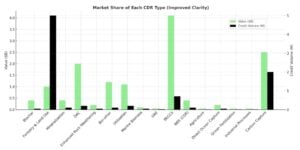
Financing the Next Frontier of Carbon Removal
To keep global warming below 1.5°C, the world must remove billions of tonnes of CO₂ from the atmosphere by mid-century. But achieving that scale requires more than promising technology. It demands financing structures that can fund large-scale deployment and reward verified results.
That’s where Inlandsis plays a crucial role. The fund has developed a first-of-its-kind debt financing model to fully support UNDO’s latest ERW project. The structure ensures that capital is deployed in sync with verified progress, effectively tying funding to real-world delivery.
UNDO’s CEO Jim Mann described the model as a turning point for the industry:
“Innovative financing is the catalyst for unlocking gigatonne-scale carbon removal. The support of Inlandsis shows how financial backers can help transform carbon removal into a genuine asset class, one that is scalable, tradable, and investable. By combining financial innovation, strategic partnerships and bleeding-edge science, UNDO is accelerating deployment and delivering both climate and agricultural benefits in Ontario and beyond.”
By blending financial innovation, strategic partnerships, and rigorous science, UNDO is proving that enhanced rock weathering can be both a credible carbon removal method and an investable business model.
Additionally, the company’s focus on transparent MRV (measurement, reporting, and verification) ensures that every credit sold is backed by evidence and durability.
Microsoft’s Evidence-Backed Commitment
Microsoft’s partnership with UNDO has evolved gradually but strategically—each stage built on verified outcomes and increasing scientific confidence.
- 2023: Microsoft made its first-ever ERW purchase with a 5,000-tonne agreement.
- 2024: The company followed up with 15,000 tonnes and additional funding to strengthen scientific measurement and monitoring.
- 2025: This latest deal for 28,900 tonnes represents the company’s largest ERW investment yet.
The steady growth signals Microsoft’s confidence in the integrity and scalability of enhanced rock weathering. It also reflects a shift in the carbon removal market, where buyers are moving from pilot projects to multi-year, performance-based partnerships.
Phillip Goodman, Director of Microsoft’s Carbon Removal Portfolio, underscored the importance of science-led delivery,
“Enhanced rock weathering is a promising pathway to gigatonne-scale carbon removal. UNDO’s commitment to scientific rigour gives us confidence in both the durability of these credits and their role in helping Microsoft achieve its goal of being carbon negative by 2030.”
For Microsoft, this approach ensures that every tonne purchased represents verified, durable removal—not speculative offsets. The company’s portfolio strategy emphasizes transparency, permanence, and continuous improvement.
READ MORE:
- Microsoft and UNDO Partner for 15,000 Tons of Carbon Removal Using Enhanced Rock Weathering
- Microsoft (MSFT Stock) Tops Q2 2025 Record-Breaking Surge in Durable Carbon Removal Credit Purchases
Backing UNDO: Insurance-Enabled, Bankable Carbon Solutions
For Inlandsis, the UNDO deal marks two significant milestones: it is the fund’s first ERW investment and its first Canadian project under its second climate fund. These achievements underscore how carbon finance is evolving—shifting from traditional offset models to evidence-backed removal financing.
David Moffat, Managing Director at Inlandsis, said the project highlights a new direction for climate investment:
“This strategic and innovative deal strengthens the growing relationship between Microsoft and UNDO while advancing the critical fight against climate change. It also reflects our commitment to financing credible, scalable carbon solutions in Canada and beyond.”
Adding another layer of security, the deal is underwritten by CFC, a specialized insurance provider for the carbon markets. CFC’s involvement de-risks the transaction by ensuring compensation if project milestones aren’t met—an emerging best practice in carbon finance.
Such insurance-backed financing is becoming a cornerstone for scaling carbon removal. It gives both investors and lenders the confidence to fund long-term projects, accelerating deployment and making climate solutions bankable.
A Replicable Model for the Carbon Market
This financing structure is designed to meet the needs of all players in the carbon ecosystem:
- Buyers like Microsoft get verified, durable credits with transparent evidence.
- Lenders gain confidence through milestone-based repayment tied to credit issuance.
- Farmers benefit from predictable, low-disruption operations that align with agricultural cycles.
By ensuring that capital flows only after verified results, the model turns projected tonnes into measured, issued removals. It’s a practical, transparent framework that can be replicated across regions and scales.
UNDO’s growing list of partners—Microsoft, Barclays, British Airways, and McLaren—illustrates strong corporate demand for high-integrity removals. Each new deal builds capacity for UNDO’s operations, allowing it to scale faster while maintaining scientific rigor.
Ground-Level Action: Every Rock, Every Acre, Every Record
Under the new agreement, UNDO will deploy 90,000 tonnes of crushed wollastonite, a calcium silicate rock, across 30,000 acres of Canadian farmland. The operation is designed to fit seamlessly within normal farming practices, using existing machinery and scheduled around planting and harvest.
The delivery process is transparent and data-rich:
- Equipment is calibrated and GPS-tracked.
- Every load of rock is logged and verified.
- Soil and porewater samples are collected at multiple intervals and analyzed in accredited labs.
- Each sample follows a strict chain of custody from field to lab to final data report.
These steps ensure that every credit issued represents real, measured carbon removal. UNDO’s system links field operations with verified outcomes, providing partners with full traceability from quarry to credit.
UNDO’s ERW process
Science-Led, Evidence-Based Removals
Enhanced rock weathering accelerates a natural process where CO₂ reacts with silicate minerals in rock, forming stable carbonates that lock away carbon for thousands of years.
UNDO’s science-first approach ensures that every aspect—from sampling design to lab analysis—is statistically sound and auditable. Sampling plans are written in advance for accuracy, include control plots, and specify precise locations and timing for collection.
Once samples are analyzed, results go through multiple quality control checks, and data are tied to GPS coordinates and timestamps. Life-cycle emissions from quarrying, transportation, and spreading are subtracted, and uncertainty margins are conservatively applied before credits are issued.
Issuance happens only after independent verification, meaning each credit represents net carbon removed, not just projected outcomes. This evidence-led methodology helps ensure transparency and credibility, both essential for scaling trust in the carbon market.
A Blueprint for Scalable Carbon Removal
This partnership between Microsoft, UNDO, and Inlandsis represents a powerful new model for how the carbon removal sector can grow. It combines long-term purchasing commitments, performance-linked finance, scientific validation, and insurance-backed assurance into one scalable framework.
The collaboration also offers a clear path for other companies and investors: pair proven carbon removal science with structured, delivery-based finance to accelerate real climate impact.
As UNDO expands operations, its combination of practical field deployment, scientific transparency, and financial accountability will serve as a blueprint for scaling carbon removal across geographies.
The next phase is focused on steady execution—planning rock supply, coordinating farm deployments, and sharing verified progress through public reporting. Each season adds data, strengthens methodologies, and builds confidence in the durability of ERW as a global climate tool.
The Surge in Verified Removals Signals Market Maturity
Microsoft’s (MSFT stock) $5 million partnership with UNDO is a signal of market maturity. It shows how science-based removal, innovative finance, and transparent delivery can work together to build a credible, investable carbon market.
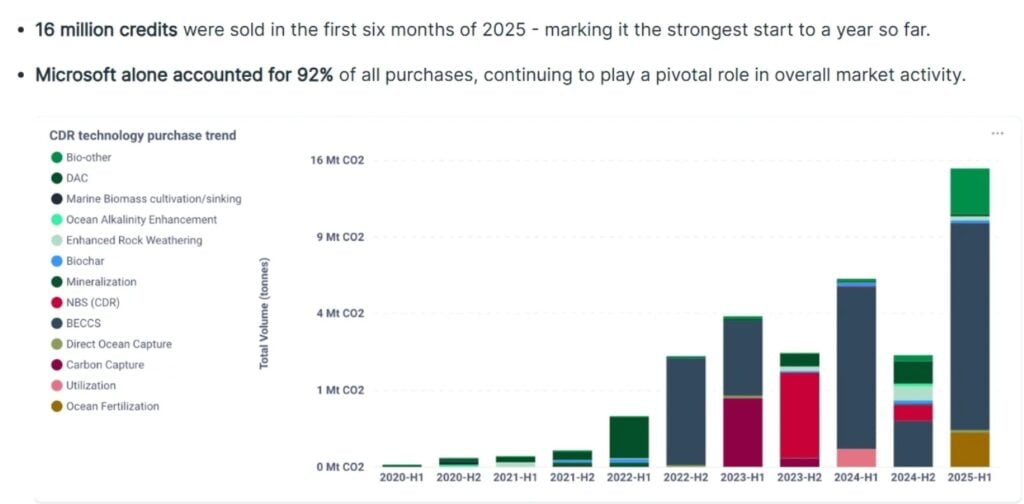
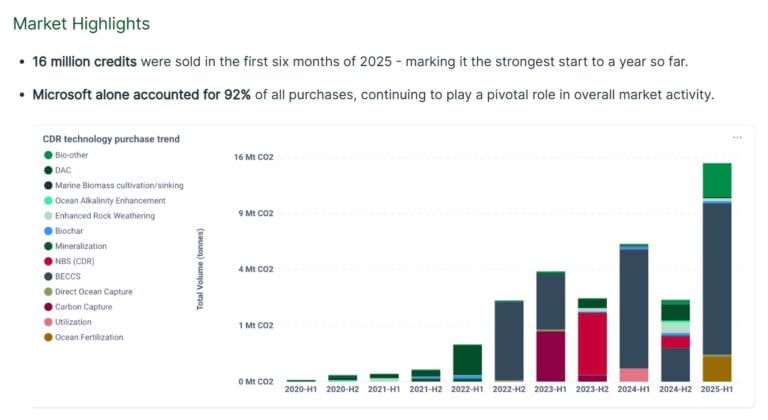
Allied Offsets data showed that in the first quarter of 2025, around 780,000 CDR credits were contracted — a surge of 122% compared to the same period in 2024.
Additionally, 16 million credits were sold in the first six months of 2025 – marking it the strongest start to a year so far. The momentum is fueled by major buyers like Microsoft, aiming to be carbon negative by 2030. Also rise in biomass-based removal methods that are reshaping corporate offset strategies is contributing to the growth.
Market Highlights
As the world races to reach net zero, this deal stands out as a real-world example of progress: a partnership that delivers measured, permanent carbon removal, financed and verified with integrity.
ALSO READ:
- Microsoft (MSFT) Signs $2.6 Million Soil Carbon Credit Deal with Agoro Carbon to Meet its Net-Zero Goals
- Microsoft Signs Groundbreaking 7MT Carbon Credits Deal with U.S.-Based Chestnut Carbon
The post Microsoft (MSFT) Buys 28,900 Tonnes of CO₂ Removal from UNDO in Landmark Multi-Million-Dollar Deal appeared first on Carbon Credits.


Google, Meta, and McKinsey & Company have made a major move in corporate climate action. They signed a long-term deal to remove carbon from the air in Appalachia. The project is run by Living Carbon and focuses on restoring forests on degraded lands. Under this deal, the companies will remove 131,240 tonnes of CO₂ over the next ten years.
A New Deal for Climate
The effort targets a much larger problem. Across the United States, about 1.6 million acres of abandoned mine land remain damaged by past mining. These lands often have poor soil, erosion, toxic metals, and invasive species that block natural regrowth.
In addition, around 30 million acres of degraded agricultural land could be restored through reforestation. Appalachia is one of the hardest-hit regions due to decades of coal mining.
The deal is backed by the Symbiosis Coalition, a group of buyers that funds high-quality carbon removal projects. The coalition is an advance market commitment (AMC) launched in 2024 by Google, Meta, Microsoft, and Salesforce.
The group has pledged to contract up to 20 million tonnes of carbon removal credits by 2030. This commitment aims to create strong market demand and support the growth of high-impact, science-based restoration projects that can help advance global climate goals.
The agreements they have give developers a steady demand. They also help unlock financing and allow projects to scale.
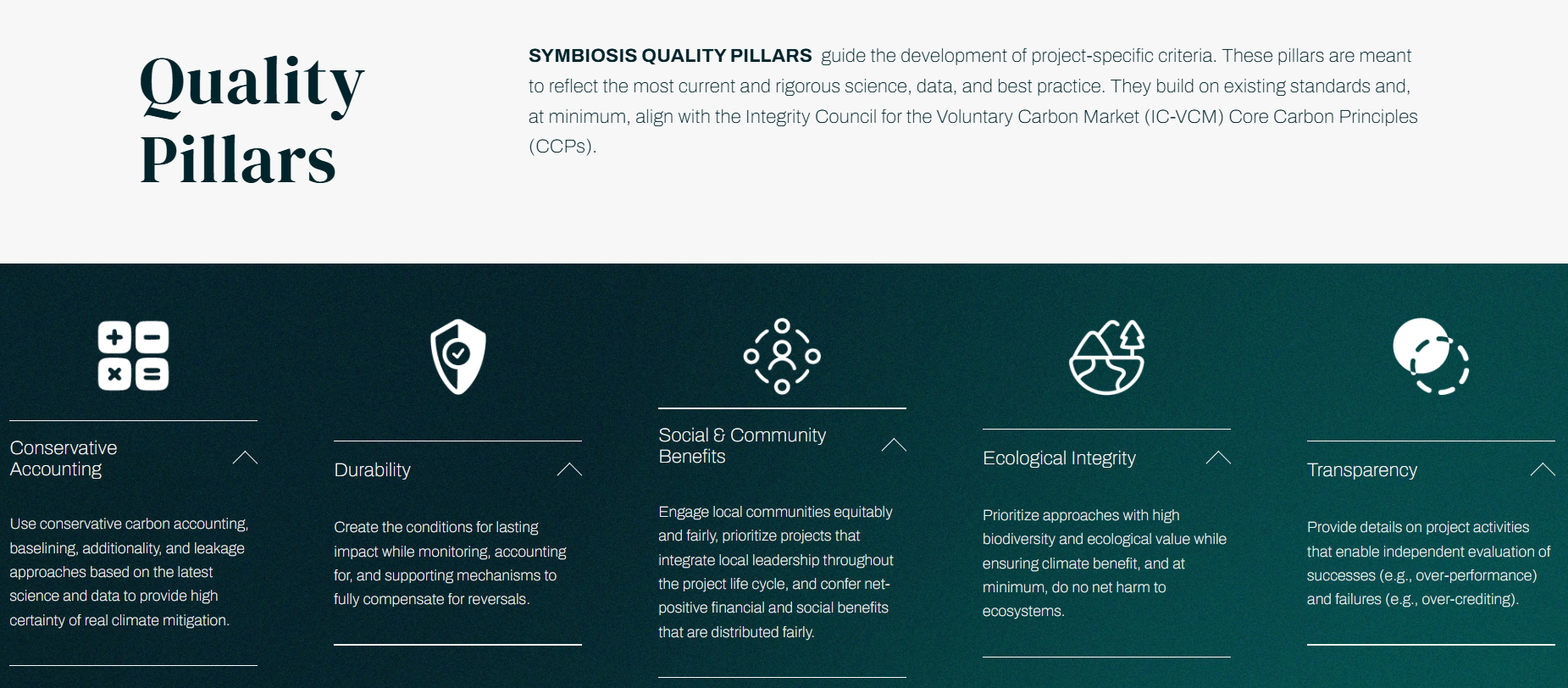
Symbiosis selected the Appalachian project after a strict review process. It looked at data, field conditions, and long-term risks. The group follows key standards such as durability, transparency, ecological integrity, and community impact. This helps ensure that every credit represents real and measurable carbon removal.
Julia Strong, Executive Director of the Symbiosis Coalition, remarked:
“Our support of Living Carbon reflects our belief that effective nature-based carbon removal requires both strong science and solid execution. Their project stands out for its rigor and for its thoughtful and scalable approach shaped around the needs of local communities, ecosystems, and economies in Appalachia.”
Why Appalachia Matters: From Coal Hubs to Carbon Heroes
The Appalachia region, in the eastern United States, was once a center of coal mining. Today, many of these lands remain unused and degraded. Living Carbon is working to restore them by planting native hardwood and pine trees on former mine sites and damaged farmland.
The project uses a mix of careful site preparation, invasive species control, and strategic planting. This helps trees grow in areas where nature cannot easily recover on its own. The goal is not just to plant trees, but to rebuild entire ecosystems and support long-term carbon storage.
The benefits go beyond carbon removal. Restoring forests improves soil health, water quality, and biodiversity. Native trees help rebuild habitats for local plants and wildlife. These changes can also reduce erosion and improve land stability over time.
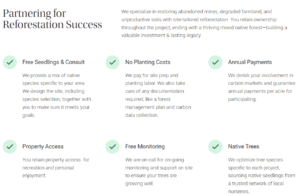
The project also creates real economic value. Landowners earn lease payments from land that was once unproductive. Local workers are hired for planting and land restoration.
-
In some cases, old mining equipment is reused to support ecological recovery. This helps turn former industrial sites into productive carbon sinks.
Community engagement is a key part of the project. Living Carbon works closely with landowners, local groups, and government agencies. This helps build long-term support and ensures the project fits local needs. Strong local partnerships also improve the chances that the forests will be maintained over time.
The project stands out for its strong science and clear execution plan. It uses careful monitoring and conservative estimates to ensure carbon removal is real. It also applies new methods for tracking results, including advanced baselines and lifecycle analysis.
This type of approach shows that high-quality nature-based carbon removal can deliver more than climate impact. It can restore ecosystems, support local economies, and scale across similar regions. In places like Appalachia, it offers a way to turn damaged land into a long-term climate solution.
Big Business Bets on Carbon Credits
More corporations are now buying carbon removal credits to meet climate goals. For example, Microsoft bought 45 million tonnes of carbon removal in fiscal year 2025. This is nearly double the amount from 2024 and nine times what they bought in 2023.
These purchases are part of a broader climate strategy. Companies are combining emissions reductions with long-term removal commitments. Durable carbon removal credits, which permanently store CO₂, are becoming more important. Businesses feel pressure to deal with emissions that they cannot completely eliminate.
A major supporter of these deals is Frontier, launched in 2022 by Stripe, Alphabet (Google’s parent company), Meta, Shopify, and McKinsey Sustainability. Frontier wants to boost early demand and funding for promising carbon removal technologies.
The company does this through long-term purchase agreements. Its initial goal was $1 billion in purchases by 2030, sending a strong signal to the market about future demand.
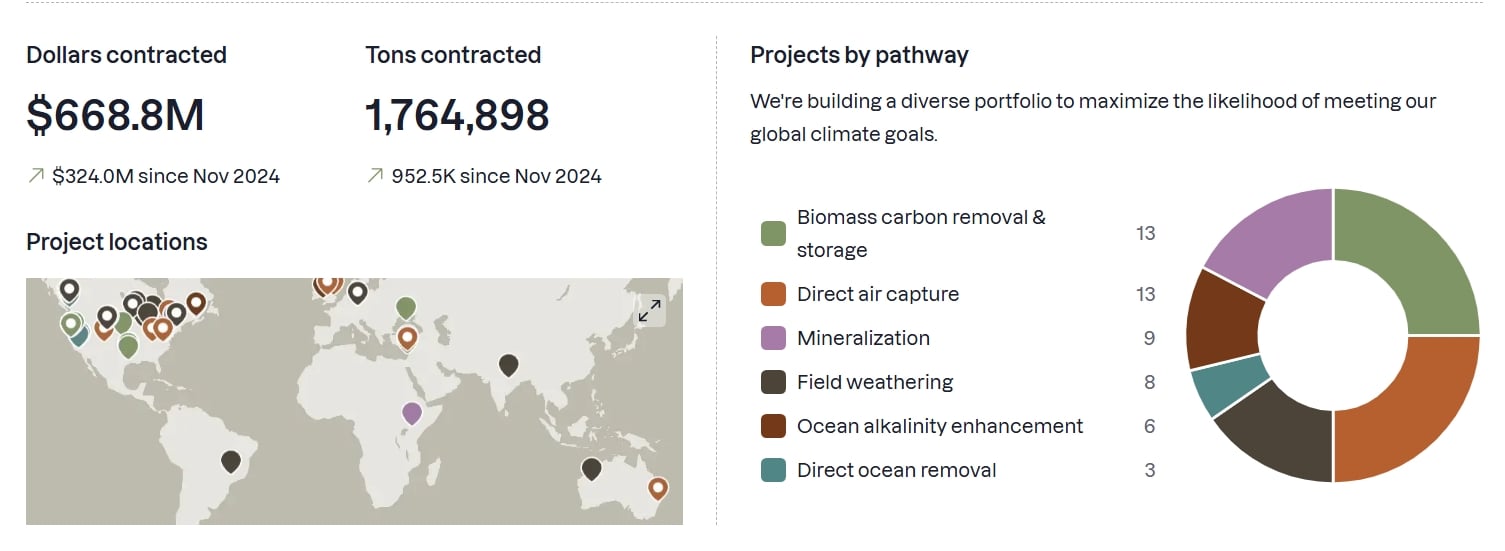
By 2025, Frontier signed contracts for various technologies. These include bioenergy with carbon capture and storage (BECCS), direct air capture (DAC), and enhanced weathering. Several contracts are worth tens of millions of dollars. These agreements help developers survive the early “valley of death,” when financing is hardest to secure.
Market Trends: From Niche to Necessity
The carbon removal market is still small compared with global climate goals, but it is evolving quickly. Industry forecasts say that demand for durable carbon removal credits might hit 100 million tonnes of CO₂ each year by 2030.
This growth is fueled by corporate commitments and government purchases. This is roughly double the supply currently announced, showing a large gap between demand and delivery.
Globally, carbon removal is still a tiny fraction of what is needed. Scientific assessments show that to meet the Paris Agreement, carbon removal needs to increase. By 2050, it should reach 7–9 billion tonnes of CO₂ each year. This is about 4,000 times more than what we do now.
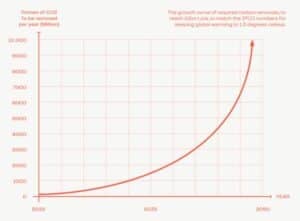
Market projections show strong growth in the next decade. A report by Oliver Wyman and the UK Carbon Markets Forum estimates that the global carbon removal market could grow from $2.7 billion in 2023 to $100 billion per year by 2030–2035, provided policies and standards evolve to support it.
Local and Global Wins
The Appalachia project highlights how carbon removal can benefit both the climate and communities. Restoring degraded lands improves water filtration, soil health, and wildlife habitats. Communities also gain jobs and income through forest management.
Nature-based projects, including reforestation and forest management, currently dominate removal activity. However, they do not offer the same permanence as engineered removals like BECCS or DAC, which store carbon for centuries or longer. Still, both approaches are necessary to scale the carbon removal market.
From Milestones to Market Momentum
The Google, Meta, and McKinsey deal is a milestone for corporate climate action. Long-term agreements help projects secure funding and expand. They also send strong signals to developers and investors. These deals can shift the market from short-term offsets to long-term, permanent carbon removal solutions.
The industry must grow significantly to meet global climate targets. Expanding beyond early adopter companies is essential. Continued policy support, strong standards, and wider sector participation will help scale removals.
In the next decade, how fast carbon removal technologies grow and the amount of credits produced will be key to achieving net-zero goals. Deals like the Appalachia reforestation project are early steps in building a foundational, long-term carbon removal industry.
The post Google, Meta and McKinsey Lead Carbon Removal Boom and Turn Appalachia Green appeared first on Carbon Credits.
The sustainability landscape is increasingly complex. More and more carbon-capture solutions are entering the market, and innovation is a constant thread running through the carbon market. With more possibilities, buyers are faced with more considerations than simply offsetting carbon. In this sphere, two main directions are taking shape—nature-centred or tech-focused.

Nasdaq has backed one of the first carbon removal credit deals licensed under European Union rules. The project is based in Stockholm and is designed to generate high-quality carbon removal credits under a formal EU framework.
This marks a key shift. For years, carbon markets have relied on voluntary standards with mixed credibility. Now, the European Union has developed a regulated system to define what counts as a valid carbon removal. This move aims to build trust and attract large investors into a market that is still in its early stages.
The deal shows growing interest from major companies. It also reflects rising demand for reliable ways to remove carbon from the atmosphere.
Inside the Stockholm Carbon Removal Project
The removal project is run by Stockholm Exergi. It uses a process called BECCS, or bioenergy with carbon capture and storage. This method burns biomass, such as wood waste and agricultural residues, to produce heat and electricity. At the same time, it captures the carbon dioxide released and stores it underground.
The captured CO₂ will be transported and stored deep beneath the North Sea in rock formations. Over time, it will turn into solid minerals. This makes the carbon removal long-lasting and more secure than many nature-based solutions.
The facility is expected to start operating in 2028. Once active, it will generate carbon removal credits that companies can buy to balance their remaining emissions.
Beccs Stockholm is one of the world’s largest carbon removal projects. In its first ten years, the project could remove about 7.83 million tonnes of CO₂ equivalent. This makes it a key tool for helping the European Union reach climate neutrality by 2050.
The project also aims to scale carbon removal by building a full CCS value chain in Northern Europe and supporting a growing market for negative emissions credits.
This project is important because it is one of the first to follow the EU’s new carbon removal certification rules. These rules define how carbon removal should be measured, verified, and reported. They also aim to reduce risks like double-counting and weak accounting.
EU Certification: Building Trust in a Fragile Market
The European Commission has introduced a framework, also called Carbon Removals and Carbon Farming (CRCF) Regulation, to certify carbon removal activities. This includes technologies like BECCS, direct air capture with carbon storage, and biochar.
The goal is to create a trusted system that investors and companies can rely on. It also established the first EU-wide certification framework for carbon farming and carbon storage in products, not just removals.
Until now, the voluntary carbon market (VCM) has faced criticism. Concerns about transparency and “greenwashing” have made some companies cautious. Many buyers want stronger proof that credits represent real and permanent carbon removal.
The EU framework tries to solve this problem. It sets clear rules for:
- Measuring how much carbon is removed.
- Verifying results through independent checks.
- Ensuring long-term storage of CO₂.
This structure may help standardize the market. It could also make carbon removal credits easier to compare and trade across borders. The Commission states that the goal of having the framework is:
“to build trust in carbon removals and carbon farming while creating a competitive, sustainable, and circular economy.”
Corporate Demand Is Growing—but Still Limited
Large companies are starting to invest in carbon removal. However, the market remains small compared to what is needed.
One major buyer is Microsoft. It currently holds about 35% of all global carbon removal credits, making it a dominant player in the market. In fact, it is responsible for 92% of purchased removal credits in the first half of 2025.
Other companies, including Adyen, a Dutch payments provider, have also joined the Stockholm project. These early buyers aim to secure a future supply of high-quality carbon credits as demand grows.
Ella Douglas, Adyen’s global sustainability lead, said in an interview with the Wall Street Journal:
“This project does exactly that [“catalytic impact” to the VMC] while also building key market infrastructure in collaboration with the European Commission.”
Still, many firms remain cautious. Carbon removal technologies are often expensive and not yet proven at a large scale. Some companies also worry about reputational risks if projects fail to deliver real climate benefits.
This creates a gap. Demand is rising, but the supply of trusted credits is still limited.
- SEE event: Carbon Removal Investment Summit 2026
A Market Set for Rapid Growth
Despite these challenges, the long-term outlook for carbon removal is strong. Estimates suggest the market could reach $250 billion by mid-century, according to MSCI Carbon Markets.
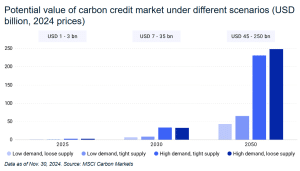
Several factors drive this growth:
- First, global climate targets require large-scale carbon removal. The Intergovernmental Panel on Climate Change estimates that the world may need to remove around 10 billion metric tons of CO₂ per year by 2050 to limit warming.
- Second, many companies have set net-zero goals. These targets often include removing emissions that cannot be avoided, especially in sectors like aviation, shipping, and heavy industry.
- Third, new regulations are pushing companies to disclose and manage emissions more clearly. This increases demand for credible carbon solutions.
However, the current supply falls far short of what is needed. Only a small share of the required carbon removal credits has been developed or sold so far.
Balancing Removal and Emissions Cuts
While carbon removal is gaining attention, experts stress that it cannot replace emissions reductions. Removing carbon from the atmosphere is often more expensive and complex than avoiding emissions in the first place.
Groups like the European Environmental Bureau warn that over-reliance on credits could delay real climate action. They argue that companies should set separate targets for reducing emissions and for removing carbon.
The EU framework reflects this concern. It treats carbon removal as a tool for addressing residual emissions, not as a substitute for cutting pollution at the source. This distinction is important. It helps ensure that carbon markets support, rather than weaken, overall climate goals.
From Concept to Market Infrastructure
The Stockholm project marks a turning point for carbon removal. It shows how rules, strong verification, and corporate backing can bring structure to a fragmented market.
With support from players like Nasdaq, carbon removal is moving closer to becoming a mainstream financial asset. At the same time, the European Union’s certification system is setting the foundation for a more credible and scalable market.
The path ahead remains complex. Technologies must scale. Costs must fall. Trust must grow. But the direction is clear.
Carbon removal is no longer a niche idea. It is becoming a key part of the global climate economy, with the potential to shape investment flows for decades to come.
The post Nasdaq Invests in First EU-Certified Carbon Removal Credits from Stockholm Exergi appeared first on Carbon Credits.



-
Greenhouse Gases8 months ago
Guest post: Why China is still building new coal – and when it might stop
-
Climate Change8 months ago
Guest post: Why China is still building new coal – and when it might stop
-

 Greenhouse Gases2 years ago
嘉宾来稿:满足中国增长的用电需求 光伏加储能“比新建煤电更实惠”
-
Climate Change2 years ago
Bill Discounting Climate Change in Florida’s Energy Policy Awaits DeSantis’ Approval
-

 Climate Change2 years ago
嘉宾来稿:满足中国增长的用电需求 光伏加储能“比新建煤电更实惠”
-
Climate Change Videos2 years ago
The toxic gas flares fuelling Nigeria’s climate change – BBC News
-

 Renewable Energy5 months ago
Sending Progressive Philanthropist George Soros to Prison?
-

 Carbon Footprint2 years ago
US SEC’s Climate Disclosure Rules Spur Renewed Interest in Carbon Credits