


L’Oréal, the global beauty giant, has unveiled its first cohort of startups participating in its new sustainable innovation program, L’AcceleratOR. The program chose 13 startups focused on climate, nature, and circularity. They were selected from nearly 1,000 applicants across 101 countries. It aims to find, pilot, and scale solutions that address key environmental challenges in the beauty industry and beyond.
The initiative is part of L’Oréal’s larger sustainability plan, called “L’Oréal for the Future.” This plan includes bold goals for climate action, resource use, and a shift to a circular economy by 2030 and beyond.
Inside L’AcceleratOR: Funding, Pilots, and Scale
L’AcceleratOR is a €100 million (about US$116 million) sustainable innovation program. The funding will be provided over a five-year period. The program helps startups and small to medium-sized enterprises (SMEs) that create sustainable solutions for L’Oréal and the beauty industry.
L’AcceleratOR is in partnership with the University of Cambridge Institute for Sustainability Leadership (CISL). Selected startups will enter an intensive support phase led by CISL. They will receive funding, expert guidance, and access to L’Oréal’s research and testing capabilities. The aim is to help these companies become pilot-ready and scale their solutions for broader use.
The accelerator focuses on key strategic themes tied to L’Oréal’s sustainability goals:
- Next-generation packaging and materials
- Nature-sourced ingredients
- Circular solutions
- Data intelligence tools to measure and reduce environmental impacts
Startups may run six- to nine-month pilots with L’Oréal and its partners. Successful pilots may be scaled across global operations if they show measurable benefits.
Ezgi Barcenas, Chief Corporate Responsibility Officer, remarked:
“To accelerate sustainable solutions to market, we are being even more intentional and inclusive in our pursuit of partnerships through “L’AcceleratOR”. We are really energized to be co-designing the future of beauty with the University of Cambridge Institute for Sustainability Leadership, and these 13 change makers.”
The 13 Startups and Their Focus Areas
The selected startups and SMEs represent a range of sustainable innovations across climate, nature, and circularity. They fall into four main categories:
- Packaging and materials
- Nature-sourced ingredients
- Circular solutions
- Data intelligence

These 13 startups use different ways to cut environmental impact. They focus on product design, supply chain management, and manufacturing to promote circularity.
How L’AcceleratOR Fits L’Oréal’s 2030 Strategy
L’AcceleratOR is part of L’Oréal’s broad 10-year sustainability roadmap, “L’Oréal for the Future.” The roadmap covers four main areas: climate, nature, materials circularity, and communities. It includes the 2030 goals that aim to transform operations while driving innovation in sustainable solutions.

Some of L’Oréal’s key targets under the roadmap include:
- 100% renewable energy for all operations.
- Sustainable sourcing of at least 90% bio-based materials in formula and packaging.
- 100% recycled or reused water for industrial purposes.
- Reducing virgin plastic use by 50%.
- Sourcing 50% of packaging from recycled or bio-based materials.
- Cutting Scope 1 and 2 emissions by 57% and some Scope 3 emissions by 28% against a baseline year.

The L’AcceleratOR program expands these efforts by tapping external innovation. L’Oréal supports startups to speed up solutions that can cut environmental impacts throughout its value chain.
L’Oréal’s Scope 3 emissions are by far the largest part of its footprint, as seen below. This reflects impacts from sourcing, production inputs, logistics, product use, and end-of-life. In 2024, Scope 1 and 2 fell further to about 227,051 tCO₂e, showing continued reductions in direct and energy-related emissions. Total emissions, though, remained roughly stable at 7.41 million tCO₂e, increased with Scope 3 again the largest component.

L’Oréal also has other sustainability initiatives. For example, its Fund for Nature Regeneration has invested more than €25 million (about US$29.1 million) in projects like forest, mangrove, and marine ecosystem restoration. This reflects L’Oréal’s commitment to nature and biodiversity alongside climate action.
Water stewardship is another strategic focus. In 2024, 53% of the water used in L’Oréal’s industrial processes came from reused and recycled sources. This was supported through water recycling systems in areas facing water stress.
Implications for the Beauty and Consumer Goods Sector
L’Oréal’s accelerator initiative reflects a larger industry trend. Many global companies are increasingly investing in sustainable technologies through partnerships, incubators, and venture funds. These partnerships aim to speed up climate, nature, and circular solutions. They combine corporate scale with startup agility.
The L’AcceleratOR program connects L’Oréal with companies that use innovation and partnerships to achieve their environmental goals. It also shows that sustainability strategies can go beyond internal changes. They can support the larger ecosystem, too. Helping startups scale can benefit whole industries, not just single companies.
This trend is important in areas like packaging, materials science, green chemistry, and digital climate tools. Packaging waste and carbon emissions from supply chains are major problems for consumer goods. This is especially true in beauty and personal care.
The beauty industry accounts for about 0.5% to 1.5% of global greenhouse gas emissions. Most of these emissions come from the value chain, not from company factories. For many beauty companies, around 90% of total emissions are Scope 3, such as raw materials, packaging, transport, and product use.
Raw material sourcing, including agricultural inputs and plastics, can make up 30% to 50% of industry emissions. Consumer use also adds a large share, especially for products that require water and heat.

The industry produces about 120 billion beauty packaging units each year worldwide. Much of this packaging is single-use and hard to recycle. A typical beauty product can generate several kilograms of CO₂-equivalent over its life cycle, from production to disposal.
Notably, most emissions are in the value chain. So, new solutions in packaging, materials, and data tools are key to cutting the beauty sector’s climate impact. This is what L’Oréal seeks to address. By supporting solutions in these areas, it hopes to change old industry practices.
Early Expectations and Next Steps
The 13 selected startups will now enter the pilot readiness phase of the L’AcceleratOR program. During this phase, the startups will refine their technologies with CISL guidance and L’Oréal support. The goal is to ensure their solutions are ready for real-world testing in commercial environments.
If pilot outcomes are successful, solutions may be scaled beyond initial tests. Some could fit into L’Oréal’s global operations or be used by industry partners. This would speed up sustainable progress.
L’Oréal and CISL plan future cohorts for the L’AcceleratOR program. Future rounds will create chances for more companies. They will also expand the pipeline of sustainable solutions.
By partnering with the University of Cambridge Institute for Sustainability Leadership and supporting startups across packaging, materials, ingredients, circular systems, and data tools, L’Oréal aims to fast-track real solutions that reduce environmental impacts.
The initiative boosts L’Oréal’s sustainability plan, “L’Oréal for the Future.” This plan sets bold goals for 2030, focusing on renewable energy, resource use, cutting emissions, and promoting circularity.
The pilot and scaling opportunities in the program can help new technologies join global supply chains. This support will aid L’Oréal and its partners in tackling climate, nature, and circular economy challenges towards its net-zero goals.
The post L’Oréal Taps 13 Global Startups to Boost Climate, Nature, and Circular Innovation appeared first on Carbon Credits.

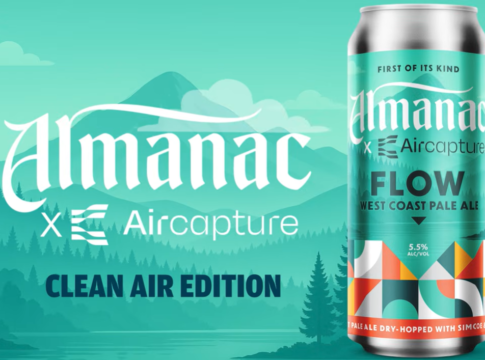
A new beer is turning carbon removal into a real-world product. U.S.-based Aircapture and Almanac Beer have launched what they call the world’s first commercial beer carbonated using (carbon dioxide) CO₂ captured directly from the atmosphere.
The system uses direct air capture (DAC) technology. It pulls carbon dioxide from ambient air and delivers it on-site for use in brewing. The captured CO₂ replaces conventional industrial CO₂, which is usually sourced from fossil fuel processes.
The DAC unit is installed at Almanac’s brewery in California. It captures CO₂ from the air and feeds it directly into the beer carbonation process. This removes the need to transport CO₂ from external suppliers and reduces the carbon footprint of production.
While the volume of CO₂ used in beer is small, the concept is significant. It shows how captured carbon can move beyond storage and into everyday consumer products.
How Direct Air Capture Works in Practice
Direct air capture is a technology that removes CO₂ directly from the atmosphere. Unlike traditional carbon capture, which targets emissions at industrial sources, DAC works anywhere.
The process uses chemical materials to bind CO₂ from the air. The captured gas is then purified and either stored or reused. In this case, it is reused in beverage production.
Globally, DAC is still at an early stage. According to the International Energy Agency, only 27 DAC plants are operating worldwide, capturing about 0.01 million tonnes of CO₂ per year.
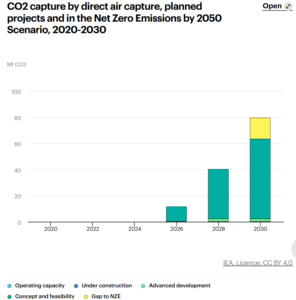
However, the pipeline is growing. More than 130 DAC facilities are in development, including large-scale plants that could capture over 1,000 tonnes of CO₂ per year each.
Aircapture’s model is different from many large DAC projects. Instead of building centralized plants, it installs modular units directly at industrial sites. This allows companies to use captured CO₂ on-site, reducing transport costs and emissions.
This approach fits well with industries like food and beverage, where CO₂ is already used as an input.
Why CO₂ Matters in Beer Production
Carbon dioxide plays a key role in brewing. It creates the bubbles in beer and affects taste, texture, and shelf life. Most breweries rely on industrial CO₂ supplies, often sourced from fossil fuel processes or as a byproduct of fertilizer production.
This supply chain has faced disruptions in recent years. CO₂ shortages have affected breweries across the U.S. and Europe, highlighting the risks of relying on centralized supply.
Using DAC changes this model. Breweries can produce CO₂ on-site, reducing supply risks and emissions. It also provides a way to use carbon that would otherwise remain in the atmosphere.
Damian Fagan, CEO of Almanac Beer Co., stated:
“Brewing is both science and craft. By integrating direct air capture into our production floor, we’re rethinking one of our essential ingredients and contributing to carbon-removal efforts. Instead of relying on distant industrial supply, we’re sourcing CO₂ from the air right here in Alameda. It’s local, circular, and a glimpse of what the future will look like.”
This does not make beer carbon-negative on its own. But it reduces reliance on fossil-derived CO₂ and shows how carbon can be reused in circular systems.
Almanac’s DAC unit captures 50-100 tCO₂/year, small volume, massive market signal. On-site generation cuts fossil CO₂ emissions from trucking by 20-30% in the supply chain. It also creates premium utilization credits for beverage Scope 3 or supply chain emissions.
DAC Market Set for Explosive Growth
The launch comes as interest in carbon removal technologies is rising. Governments and companies are investing in solutions that remove CO₂ from the atmosphere, not just reduce emissions.
The DAC market is still small but growing fast. One estimate values the market at about $160 million in 2025, with projections reaching nearly $18.7 billion by 2035, growing at a 61% annual rate.
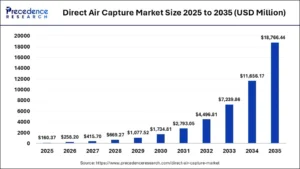
Other forecasts show similar trends. The market could reach over $9 billion by 2033, driven by corporate climate targets and government incentives.
This growth is supported by key factors, including:
- Net-zero commitments from major companies,
- Carbon pricing systems and policy support,
- Demand for high-quality carbon removal credits, and
- Advances in carbon capture technology.
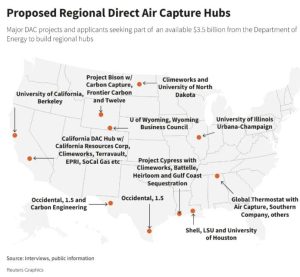
North America currently leads the DAC market, accounting for a large share of global deployment. However, scaling remains a challenge. DAC systems require energy and infrastructure, and costs are still high compared to other climate solutions.
- SEE MORE: Deep Sky and Skyrenu Launch North America’s First Direct Air Capture (DAC) Storage Facility
From Storage to Utilization: A New Carbon Economy
Most DAC projects focus on storing CO₂ underground. This is known as carbon dioxide removal (CDR). It is essential for reaching global climate targets, especially for hard-to-abate sectors.
But there is growing interest in carbon utilization. This means using captured CO₂ as a resource rather than storing it. Common applications include:
- Synthetic fuels
- Building materials
- Chemicals
- Food and beverages
The beer project shows a simple but visible example of this shift. It turns captured carbon into a product that consumers can see and use.
While the scale is small, it helps build awareness and demand for carbon removal technologies. It also shows that DAC can integrate into existing industries without major changes to production systems.
Corporate Climate Strategies Drive Innovation
Projects like this are also linked to corporate climate goals. Many companies are looking for ways to reduce emissions across their operations and supply chains. Carbon removal is becoming part of these strategies.
Using captured CO₂ in products supports these goals. It reduces reliance on fossil inputs and creates new pathways for decarbonization.
More notably, in sectors like food and beverage, where emissions are harder to eliminate completely, these solutions can play a supporting role.
Carbon Markets Expand Beyond Offsets
The launch of a DAC-based beer highlights a broader shift in carbon markets. The focus is expanding from reducing emissions to actively removing and reusing carbon.
Carbon markets are expected to grow as demand for high-quality carbon credits increases. Many experts see carbon removal as essential for meeting global climate targets.
At the same time, new use cases for CO₂ could create additional value streams. Instead of treating carbon only as a cost, companies can use it as an input for products.
However, scale remains the key challenge. Current DAC capacity is far below what is needed. The IEA notes that global DAC deployment must reach around 65 million tonnes of CO₂ per year by 2030 to align with net-zero pathways. This will require major investment, policy support, and technological progress.
A Small Beer with a Big Climate Message
The beer itself is a niche product, but the idea behind it is larger. It shows how carbon removal can move into everyday life and consumer markets.
By turning captured CO₂ into a usable product, companies can demonstrate the value of climate technologies in simple terms. This can help build public support and encourage further investment.
The project also highlights a key trend. Climate solutions are becoming more integrated into business operations, not just separate offset programs.
For now, a single beer will not change global emissions. But it offers a glimpse of how carbon could be managed differently in the future, not just emitted or stored, but reused in practical ways.
The post From Air to Ale: Introducing the First-of-its-Kind Beer Made with Captured Carbon appeared first on Carbon Credits.
Carbon Footprint
IEA Sounds Alarm as War Disrupts Energy Markets, Boosting Australia’s Uranium Demand

The global energy system is under pressure again. This time, the shock is not just about oil and gas. It is also about minerals that power clean energy and nuclear technologies. Media reports revealed that, according to International Energy Agency chief Fatih Birol, the current crisis could soon look small compared to what lies ahead in critical minerals.
Speaking at a major industry event in Canberra, Birol warned that supply risks in minerals like uranium, copper, and battery metals could reshape global energy security. His message was clear: countries must diversify supply chains now or face deeper disruptions later.
A New Energy Shock Unfolds
The world is already dealing with a massive energy disruption. The ongoing conflict involving the United States, Israel, and Iran has removed the equivalent of around 10 million barrels of oil per day from global markets, according to the IEA. This supply gap has pushed countries to rethink energy security. Oil prices remain volatile, and supply routes are under strain. However, Birol stressed that the bigger challenge may not be oil at all.
Instead, the future risk lies in critical minerals. These materials are essential for clean energy systems, electric vehicles (EVs), and nuclear power. Without stable access to them, the global energy transition could slow down sharply.
The problem is concentration. Today, one country dominates the refining and processing of many key minerals. China controls more than 80% of global refining capacity for several critical materials, according to IEA estimates. This creates a major bottleneck in supply chains.
To sum up, without urgent diversification, countries could face even greater risks than today’s energy shock.
Amid these concerns, Australia is emerging as a key player. The country holds vast reserves of critical minerals and energy resources. This includes uranium, lithium, copper, and natural gas.
Australia has the world’s largest uranium reserves. It accounts for roughly one-third of the known global resources, according to data from the Minerals Council of Australia. At the same time, it ranks among the top global uranium producers, alongside Kazakhstan, Canada, and Namibia.

This puts the nation in a strong position as nuclear energy gains traction again worldwide. IEA highlighted that Australia is a reliable supplier that does not use energy exports as a geopolitical tool. This reliability is becoming more valuable as global tensions rise.
At the same time, Australia is also rich in battery minerals. It is the world’s largest producer of lithium and a major supplier of nickel and cobalt. These materials are critical for EV batteries and renewable energy storage.
The IEA expects global nuclear capacity to grow strongly through 2035. In its latest outlook, nuclear generation could rise by nearly 50% by 2040 under net-zero scenarios. This shift will significantly increase demand for uranium. According to the World Nuclear Association, uranium demand could double by 2040 if new reactors and SMRs scale up as expected.
For Australia, this presents a major export opportunity. Even though the country does not use nuclear power domestically, it plays a crucial role in supplying fuel to the global market.
One of the biggest shifts expected from this crisis is the revival of nuclear energy. Governments are now looking for stable, low-carbon energy sources that can reduce reliance on volatile fossil fuel markets.
As per WNA, in 2022, Australia produced 4087 tU of uranium, 8% of global production. Uranium comprises about 17% of the country’s energy exports in thermal terms.
Contracted Imports of Australian Uranium Oxide Concentrate – U3O8

LNG Demand Set to Rise
The current crisis is also boosting demand for liquefied natural gas (LNG). Damage to energy infrastructure in the Middle East has disrupted supply flows, forcing countries to seek alternatives.
Australia is already one of the world’s largest LNG exporters. Projects in Western Australia and Queensland supply key markets across Asia, including Japan, South Korea, and China.
Birol said demand for Australian LNG is expected to grow further as countries look for stable suppliers. This could strengthen Australia’s role in global gas markets in the short to medium term. Similarly, Wood Mac had also projected earlier that the nation’s exports would remain steady throughout this year,
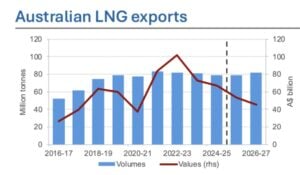
According to the International Energy Agency, global LNG demand is projected to rise by around 3–4% annually through 2030, driven by Asia’s energy needs and coal-to-gas switching.
- READ MORE: War Could Boost Carbon Credit Demand: How Middle East Energy Crisis May Reshape Climate Markets
EV Growth Drives Copper and Battery Metals
Beyond nuclear and gas, electrification is another major trend shaping demand. The global shift to EVs and renewable energy systems is accelerating the need for metals like copper, lithium, and nickel.
Copper is especially important. It is used in power grids, EV motors, and renewable energy systems. Birol emphasized that expanding electricity grids worldwide will require massive amounts of copper.
The IEA estimates that clean energy technologies could double global copper demand by 2040. Similarly, lithium demand could grow more than 40 times under aggressive climate scenarios.
As said before, Australia is well-positioned here too. It leads global lithium production and has large untapped reserves of other key minerals. This gives it a strategic advantage as countries race to secure supply chains.
Investment Trends Show Growing Interest
Recent data shows rising investment in Australia’s resource sector. Uranium exploration spending has picked up after years of decline. According to the Australian Bureau of Statistics, uranium exploration spending reached about $55 million in 2023. This marked the highest level in over a decade.
This increase reflects renewed interest in nuclear energy and long-term expectations of higher uranium demand. At the same time, mining companies are investing more in critical minerals projects. Governments are also stepping in with policies to support domestic processing and reduce reliance on foreign supply chains.
While the current energy crisis is serious, Birol’s warning points to a deeper challenge. The world is entering a new phase where minerals, not just fuels, will define energy security. If supply chains remain concentrated, disruptions could become more frequent and more severe. This could slow down clean energy deployment and push up costs.
Diversification is key. Countries need to invest in new mining projects, expand refining capacity, and build resilient supply networks. And Australia is likely to play a central role in this shift. Its vast resources, stable political environment, and strong export infrastructure make it a critical partner for many nations.
The global energy landscape is changing fast. Oil shocks are no longer the only concern. Critical minerals are becoming the new backbone of energy systems. As nuclear power returns, EV adoption rises, and clean energy expands, demand for these materials will surge. This creates both risks and opportunities.
The challenge now is to scale supply, diversify processing, and ensure these materials remain accessible. If not, today’s energy crisis could soon be overshadowed by a much larger minerals crunch.
The post IEA Sounds Alarm as War Disrupts Energy Markets, Boosting Australia’s Uranium Demand appeared first on Carbon Credits.

A new agreement between Microsoft and Liferaft highlights the rapid growth of carbon removal markets. The deal covers 1 million carbon removal units or credits over 10 years, making it one of the latest long-term offtake agreements in the sector.
These agreements are important. They give developers guaranteed future demand while helping them raise capital, build projects, and scale operations. For buyers like Microsoft, they secure access to high-quality carbon removal credits in a tight market.
Phillip Goodman, Director, Carbon Removal at Microsoft, commented:
“At Microsoft, we’re pleased about the Liferaft project’s potential to pair high-quality, durable carbon removal with meaningful local benefits. Liferaft has strong plans for putting locally available biomass waste to productive use, generating local jobs, and supporting farmers and land managers. This demonstrates how carbon removal can strengthen agricultural communities, improve land outcomes, and deliver durable climate impact.”
The deal also reflects a broader shift. Companies are moving from short-term carbon offsets to long-term carbon removal contracts. These focus on physically removing carbon dioxide from the atmosphere and storing it for long periods.
Microsoft Expands Its Carbon Removal Playbook
Microsoft is the largest corporate buyer of carbon removal credits today. The company has rapidly scaled its purchases in recent years.

In 2025 alone, Microsoft signed agreements covering about 45 million tonnes of carbon removal. This was more than double its 2024 volume and a major jump from about 5 million tonnes in 2023.
- The company also dominates the broader market. In 2024, Microsoft accounted for about 63% of all durable carbon removal purchases, securing over 5.1 million tonnes.
Recent deals show how fast this is growing:
- 2.85 million tonnes of soil carbon removal credits with Indigo Ag over 12 years
- 2 million tonnes from afforestation projects in Africa
- 1.24 million biochar credits in one of the largest deals of its kind
- 3.6 million tonnes from a bioenergy carbon capture project in the U.S.
These numbers show a clear trend. Microsoft is using long-term contracts to build supply across multiple carbon removal pathways.
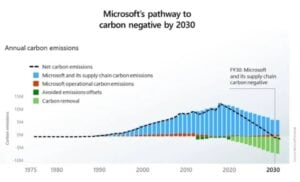
The company’s goal is ambitious. It aims to become carbon-negative by 2030 and to remove all its historical emissions by 2050. Carbon removal plays a key role in achieving this target.
- SEE MORE:
Why Biochar Is Dominating Early Carbon Markets
Biochar is produced by heating organic materials like agricultural waste in low-oxygen conditions. This process locks carbon into a stable solid form that can be stored in soil for hundreds to thousands of years.
It is considered one of the most practical carbon removal methods available today. Moreover, it is relatively low-cost compared to technologies like direct air capture. It can also scale faster because it uses existing biomass waste.
Biochar already plays a major role in the market. In 2024–2025, it accounted for about 86% of global carbon removal purchases and deliveries.

Demand is strong, but supply is limited. In 2024, biochar made up a large share of purchases, but actual issued credits remained below demand levels.
The long-term potential is also huge. Estimates suggest biochar could remove between 0.3 and 4.9 billion tonnes of CO₂ per year globally, with some studies pointing to around 3 billion tonnes annually using available biomass waste.
This makes biochar one of the most scalable carbon removal options available today.
How Offtake Deals Help Scale Carbon Removal
The Liferaft–Microsoft agreement follows a model that is becoming standard in carbon removal markets: long-term offtake contracts.
These deals serve several purposes:
- They provide price certainty for developers.
- They reduce investment risk for new projects.
- They help scale technologies that are still early-stage.
Microsoft has emphasized that early demand is critical. By committing to future purchases, companies help suppliers secure financing and expand capacity. This model is similar to how renewable energy markets grew. Long-term power purchase agreements helped scale solar and wind by guaranteeing revenue.
Now, the same model is being applied to carbon removal.
From Offsets to Permanent Carbon Removal
The carbon removal market is still small but growing fast. Demand is driven by corporate climate targets and stricter net-zero standards. Global purchases of carbon removal credits reached about 8 million tonnes in 2024, up nearly 78% from 2023.
By 2025, demand had already surged further, with tens of millions of tonnes under contract. Looking ahead, forecasts show strong growth:
- The market could reach $40 billion to $80 billion per year by 2030.
- By 2050, it could expand from $300 billion to $1.2 trillion annually.
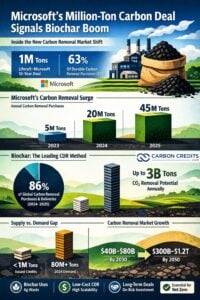
However, supply remains a key constraint. Less than 1 million tonnes of durable carbon removal credits have been issued globally, far below demand.
This gap is pushing companies to secure long-term contracts early. It also supports higher prices for high-quality credits, especially those with long-term storage like biochar.
Carbon Removal Becomes Essential for Net Zero
Carbon removal is now seen as essential for climate goals. Reducing emissions alone is not enough. Some emissions are hard to eliminate, especially in sectors like agriculture, aviation, and heavy industry.
Carbon removal helps address these residual emissions. It removes CO₂ directly from the atmosphere and stores it in a durable way.
Experts note that carbon removal is what makes “net-zero” possible. Without it, many climate targets would be difficult to achieve at scale. This is why companies like Microsoft are investing heavily in the sector. They are building portfolios that include:
- Nature-based solutions like forests and soil,
- Engineered solutions like DAC and BECCS, and
- Hybrid approaches like biochar.
This diversified strategy reduces risk and supports multiple technologies at once.
A New Phase for Carbon Markets Emerges
The Liferaft agreement may seem small compared to Microsoft’s larger deals. But it reflects an important shift in the market.
First, it shows that demand is spreading across more suppliers. This helps build a broader and more competitive market.
Second, it highlights the growing role of biochar. As one of the most mature carbon removal methods, it is likely to remain a key part of early market growth.
Third, it reinforces the importance of long-term contracts. These agreements are becoming the main way to scale carbon removal globally.
With all these, the broader trend is clear. Carbon removal is moving from pilot projects to large-scale deployment. Companies are no longer testing the market. They are actively building it.
For now, Microsoft remains the dominant buyer. But its strategy is also creating space for others to follow. By securing supply early, the tech giant is helping to unlock a new phase of growth in climate technology.
The post Microsoft Inks Biggest-Ever U.S. Biochar Deal with Liferaft appeared first on Carbon Credits.


-
Greenhouse Gases8 months ago
Guest post: Why China is still building new coal – and when it might stop
-
Climate Change8 months ago
Guest post: Why China is still building new coal – and when it might stop
-

 Greenhouse Gases2 years ago
嘉宾来稿:满足中国增长的用电需求 光伏加储能“比新建煤电更实惠”
-
Climate Change2 years ago
Bill Discounting Climate Change in Florida’s Energy Policy Awaits DeSantis’ Approval
-

 Climate Change2 years ago
嘉宾来稿:满足中国增长的用电需求 光伏加储能“比新建煤电更实惠”
-
Climate Change Videos2 years ago
The toxic gas flares fuelling Nigeria’s climate change – BBC News
-

 Carbon Footprint2 years ago
US SEC’s Climate Disclosure Rules Spur Renewed Interest in Carbon Credits
-

 Renewable Energy5 months ago
Sending Progressive Philanthropist George Soros to Prison?