

Rudecindo Espíndola’s family has been growing corn, figs and other crops for generations in the Soncor Valley in northern Chile, an oasis of green orchards in one of the driest places on Earth – the Atacama desert.
Perched nearly 2,500 metres above sea level, his village, Toconao, means “lost corner” in the Kunza language of the Indigenous people who have lived and farmed the land in this remote spot for millennia.
“Our deep connection to this place is based on what we have inherited from our ancestors: our culture, our language,” said Espíndola, a member of a local research team that found evidence that people have inhabited the desert for more than 12,000 years.
This distant outpost is at the heart of the global rush for lithium, a silvery-white metal used to make batteries for electric vehicles (EV) and renewable energy storage that are vital to the world’s clean energy transition. The Atacama salt flat is home to about 25% of the world’s known lithium reserves, turning Chile into the world’s second-largest lithium producer after Australia.
For decades, the Atacama’s Indigenous Lickanantay people have protested against the expansion of the lithium industry, warning that the large evaporation ponds used to extract lithium from the brine beneath the salt flats are depleting scarce and sacred water supplies and destroying fragile desert ecosystems.
Espíndola joined the protests, fearing that competition for water could pose an existential threat to his community.
But last year, he was among dozens of Indigenous representatives who sat across the table from executives representing two Chilean mining giants to hammer out a governance model that gives Indigenous communities living close to lithium sites a bigger say over operations, and a greater share of the economic benefits.

A pioneering deal
The agreement is part of a landmark deal between state-owned copper miner Codelco and lithium producer the Sociedad Química y Minera de Chile (SQM) to extract lithium from the salt flats until 2060 through a joint venture called NovaAndino Litio.
The governance model that promises people living in Toconao and other villages around the salt flats millions of dollars in benefits and greater environmental oversight is the first of its kind in mineral-rich Chile, and has been hailed by industry experts as the start of a potential model for more responsible mining for energy transition metals.
NovaAndino told Climate Home News the negotiations with local communities represented an “unprecedented process that has allowed us to incorporate the territory’s vision early in the project’s design” and creates “a system of permanent engagement” with local communities.
The company added it will contribute to sustainable development in the area and help “the safeguarding of [the Lickanantay people’s] culture and environmental values”.
-
West Africa’s first lithium mine awaits go-ahead as Ghana seeks better deal
Ghana wants to benefit from the scramble for lithium but its reliance on mining firms for revenue and expertise weakens its ability to negotiate preferential terms, experts say -
Campaigners sue Chilean government over copper mining pollution
The case comes after Climate Home News revealed that uncontrolled air pollution has put people’s health at risk in Chile’s copper mining heartland -
Argentina’s pioneering glacier law on the line as Milei bets on copper rush
President Javier Milei wants Congress to relax groundbreaking glacier protection legislation to boost mining, but opponents say the environmental risks are too great


For mining companies, such agreements could help reduce social conflicts and protests, which have delayed and stalled extraction in other parts of South America’s lithium-rich region, known as the lithium triangle.
“Argentina and Bolivia could learn a lot from what we’re doing [here],” said Rodrigo Guerrero, a researcher at the Santiago-based Espacio Público think-tank, adding that adopting participatory frameworks early on could prevent them from “going through the entire cycle of disputes” that Chile has experienced.
Justice at last?
As part of the governance deal, NovaAndino has pledged to adopt technologies that will reduce water use and mitigate the environmental impacts of lithium extraction.
It has also committed to hold more than 100 annual meetings with community representatives to build a “good faith” relationship, and an Indigenous Advisory Council will meet twice a year with the company’s sustainability committee to discuss its environmental strategy, company sources said. The meetings are due to begin next month.
To oversee the agreement’s implementation, an assembly – composed of representatives from all 25 signatory communities – will track the project’s progress. In addition, NovaAndino will hold one-on-one meetings with each community to address issues such as the hiring of local people and the protection of Indigenous employees.

Espíndola said the deal, while far from perfect, was an important step forward.
“Previously, Indigenous participation was ambiguous. Now we talk about participation at [every] hierarchical level of this process, a very strong empowerment for Indigenous communities,” said Espíndola, adding that it did not give local communities everything they had asked for. For instance, they will not hold veto power over NovaAndino’s decisions or have a formal shareholder role.
But after years of conflict with mining companies, a form of “participatory justice is being done”, he said.
Not everyone is convinced that the accord, pushed by Chile’s former leftist government, marks progress, however.
“Not in our name”
The negotiations have caused deep divisions among the Lickanantay, some of whom say greater engagement with mining companies will not stop irreparable damage to the salt flats on which their traditional way of life depends. Others fear the promise of more money will further erode community bonds.
In January 2024, Indigenous communities from five villages closest to the mining operations, including Toconao, blocked the main access roads to the lithium extraction sites. They said the Council of Atacameño Peoples, which represents 18 Lickanantay communities and was leading discussions with the company, no longer spoke for them.
Official transcripts of consultations on the extension of the lithium contracts and how to share the promised benefits reveal deep divisions. Tensions peaked when communities around the mining operations clashed over how to distribute the multimillion-dollar windfall, with villages closest to the mining sites demanding the largest share.
Eventually, separate deals establishing a new governance framework over mining activities were reached between Codelco and SQM with 25 local communities, including a specific agreement for the five villages closest to the extraction sites.

The division caused by the separate deal for the five villages “will cause historic damage” to the unity of the Atacama desert’s Indigenous peoples, said Hugo Flores, president of the Council of Atacameño Associations, a separate group representing farmers, herders and local workers who oppose the mining expansion.
Sonia Ramos, 83, a renowned Lickanantay healer and well-known anti-mining activist, lamented the fracturing of social bonds over money, and for the sake of meeting government objectives.
“There is fragmentation among the communities themselves. Everything has transformed into disequilibrium,” said the 83-year-old.
“[NovaAndino] supposedly has economic significance for the country, but for us, it is the opposite,” she said.
The company told Climate Home News it has “acted consistently” to promote “transparent, voluntary, and good-faith dialogue with the communities in the territory, recognising their diversity and autonomy, and always respecting their timelines and forms of participation”.
A one-off deal or a model for others?
The NovaAndino joint venture is a pillar of Chile’s strategy to double lithium production by 2031 and consolidate the copper-producing nation’s role in the clean energy transition as demand for battery minerals accelerates.
Chile’s new far-right president, José Antonio Kast, who was sworn in last week, promised to respect the lithium contracts signed by his predecessor’s administration – including the governance model.
Still, some experts say the splits over the new model highlight the need for legislation that mandates direct engagement and minimum community benefits for all large mining projects.
“In the past, this has lent itself to clientelism, communities who negotiate best or arrive first get the better deal,” said Pedro Zapata, a programme officer in Chile for the Natural Resource Governance Institute.
“This can be to the detriment of other communities with less strength. We cannot have first- and second-class citizens subject to the same industry,” he added.
The government is already negotiating two more public-private partnerships to extract lithium with mining giant Rio Tinto, which it said would include a framework to engage with Indigenous communities and share some of the revenues. The details will need to be negotiated between local people, the government and the company.
Sharing the benefits of mining
Under the deal in the Atacama, NovaAndino will run SQM’s current lithium concessions until they expire in 2030 before seeking new permits to expand mining in the region under a vast project known as “Salar Futuro” – a process which will require further mandatory consultations with communities.
Besides the participatory mechanism, the new agreement promises more money than ever before for salt flat communities.

Depending on the global price of lithium and their proximity to the mining operations, Indigenous communities could collectively receive roughly $30 million annually in funding – about double what SQM currently disburses under existing contracts.
When taking into account the company’s payments to local and regional authorities, contributions could reach $150 million annually, according to the government.
To access these resources, each community will need to submit a pipeline of projects they would like funding for under a complex arrangement that includes five separate financial streams:
- A general investment fund will distribute funding based on each village’s size and proximity to the mining sites
- A development fund will support projects specifically in the five communities closest to the extraction sites
- Contributions to farmers and livestock associations
- Contributions to local governments
- A groundbreaking “intergenerational fund” held in trust for the Lickanantay until 2060
For many isolated communities in the Atacama desert, financial contributions from mining firms have funded essential public services, such as healthcare and facilities like football pitches and swimming pools.
In the past, communities have used some of the benefits they received from mining to build their own environmental monitoring units, hiring teams of hydrogeologists and lawyers to scrutinise miners’ activities.
Espíndola said the new model could pave the way for more ambitious development projects such as water treatment plants and community solar energy projects.

Competition for water
The depletion of water resources is one of local people’s biggest environmental concerns.
To extract lithium from the salt flats, miners pump lithium-rich brine accumulated over millions of years in underground reservoirs into gigantic pools, where the water is left to evaporate under the sun and leaves behind lithium carbonate.
One study has shown that the practice is causing the salt flat to sink by up to two centimetres a year. SQM recently said its current operations consume approximately 11,500 to 12,500 litres of industrial freshwater for every metric ton of lithium produced.
NovaAndino has committed to significantly reduce the company’s water use by returning at least 30% of the water it extracts from the brine and eliminating the use of all freshwater in its operations within five years of obtaining an environmental permit.
-
Bolivia’s shift to the right renews ambition to mine vast lithium reserves
The election of a centre-right president after 20 years of socialist rule could open up the nation’s lithium reserves to foreign investment – the US is paying attention -
‘The state doesn’t want to know’: Doctors raise alarm on children’s health crisis in Chile’s copper heartland
Autism and cancer cases are soaring in Chile linked to pollution from copper mining critical for the energy transition, doctors say -
Lithium tug of war: the US-China rivalry for Argentina’s white gold
As global competition hots up to secure lithium supplies for batteries, China is boosting its investments in Argentina while the US courts President Javier Milei


Cristina Dorador, a microbiologist at the University of Antofagasta, told Climate Home News that reinjecting the water underground is untested at a large scale and could impact the chemical composition of the salt flats.
Continuing to extract lithium from the flats until 2060 could be the “final blow” for this fragile ecosystem, she said.
Asked to comment on such concerns, NovaAndino said any new technology will be “subject to the highest regulatory standards”, and pledged to ensure transparency through “an updated monitoring system with the participation of Indigenous communities”.
High price for hard-won gains
For the five communities living on the doorstep of the lithium pools, one of the biggest gains is being granted physical access to the mining sites to monitor the lithium extraction and its impact on the salt flats.
That is a first and will strengthen communities’ ability to call out environmental harms, said Sergio Cubillos, the community president of Peine, the village closest to the evaporation ponds. It could also give them the means to seek remediation through the courts if necessary, Espíndola said.
Gaining such rights represents long-overdue progress, Cubillos said, but it has come at a high price for the Lickanantay people.
“Communities receiving money today is what has ultimately led to this division, because we haven’t been able to figure out what we want, how we want it, and how we envision our future as a people,” he said.
Main image: A truck loads concentrated brine at SQM’s lithium mine at the Atacama salt flat in Chile (Photo: REUTERS/Ivan Alvarado)
The post Landmark deal to share Chile’s lithium windfall fractures Indigenous communities appeared first on Climate Home News.
Landmark deal to share Chile’s lithium windfall fractures Indigenous communities

Casting doubt on the determination that greenhouse gas emissions endanger public health and welfare, he said, “we’re not accepting all of the narrative of the left without any question or pushback.”
WASHINGTON—Addressing a conference of scientists and other experts skeptical of climate change, Environmental Protection Agency Administrator Lee Zeldin on Wednesday celebrated his decision to repeal what is known as the “endangerment finding,” which provided the backbone for federal regulation of greenhouse gas emissions.
Zeldin Celebrates Endangerment Finding Repeal With Climate Skeptics
With the U.S. bombing Iran and the Strait of Hormuz closed, energy experts say countries transitioning to renewables will be more resilient in the “face of the shock.”
The United States’ war on Iran could fundamentally alter how countries consume and generate energy and hamper international progress in combating climate change, a panel of energy experts said today.
The Global Energy Supply in a Decade ‘Is Not a World We’re Going to Recognize’
One month into the US and Israel’s war on Iran, at least 60 countries have taken emergency measures in response to the subsequent global energy crisis, according to analysis by Carbon Brief.
So far, these countries have announced nearly 200 policies to save fuel, support consumers and boost domestic energy supplies.
Carbon Brief has drawn on tracking by the International Energy Agency (IEA) and other sources to assess the global policy response, just as a temporary ceasefire is declared.
Since the start of the war in late February, both sides have bombed vital energy infrastructure across the region as Iran has blocked the Strait of Hormuz – a key waterway through which around a fifth of global oil and liquified natural gas (LNG) trade passes.
This has made it impossible to export the usual volumes of fossil fuels from the region and, as a result, sent prices soaring.
Around 30 nations, from Norway to Zambia, have cut fuel taxes to help people struggling with rising costs, making this by far the most common domestic policy response to the crisis.
Some countries have stressed the need to boost domestic renewable-energy construction, while others – including Japan, Italy and South Korea – have opted to lean more on coal, at least in the short term.
The most wide-ranging responses have been in Asia, where countries that rely heavily on fossil fuels from the Middle East have implemented driving bans, fuel rationing and school closures in order to reduce demand.
‘Largest disruption’
On 28 February, the US and Israel launched a surprise attack on Iran, triggering conflict across the Middle East and sending shockwaves around the world.
There have been numerous assaults on energy infrastructure, including an Iranian attack on the world’s largest LNG facility in Qatar and an Israeli bombing of Iran’s gas sites.
Iran’s blockade of the Strait of Hormuz, a chokepoint in the Persian Gulf, is causing what the IEA has called the “largest supply disruption in the history of the global oil market”.
A fifth of the world’s oil and LNG is normally shipped through this region, with 90% of those supplies going to destinations in Asia. Without these supplies, fuel prices have surged.
Governments around the world have taken emergency actions in response to this new energy crisis, shielding their citizens from price spikes, conserving energy where possible and considering longer-term energy policies.
Even with a two-week ceasefire announced, the energy crisis is expected to continue, given the extensive damage to infrastructure and continuing uncertainties.
Asian crunch
Carbon Brief has used tracking by the IEA, news reports, government announcements and internal monitoring by the thinktank E3G to assess the range of national responses to the energy crisis roughly one month into the Iran war.
In total, Carbon Brief has identified 185 relevant policies, announcements and campaigns from 60 national governments.
As the map below shows, these measures are concentrated in east and south Asia. These regions are facing the most extreme disruption, largely due to their reliance on oil and gas supplies from the Middle East.
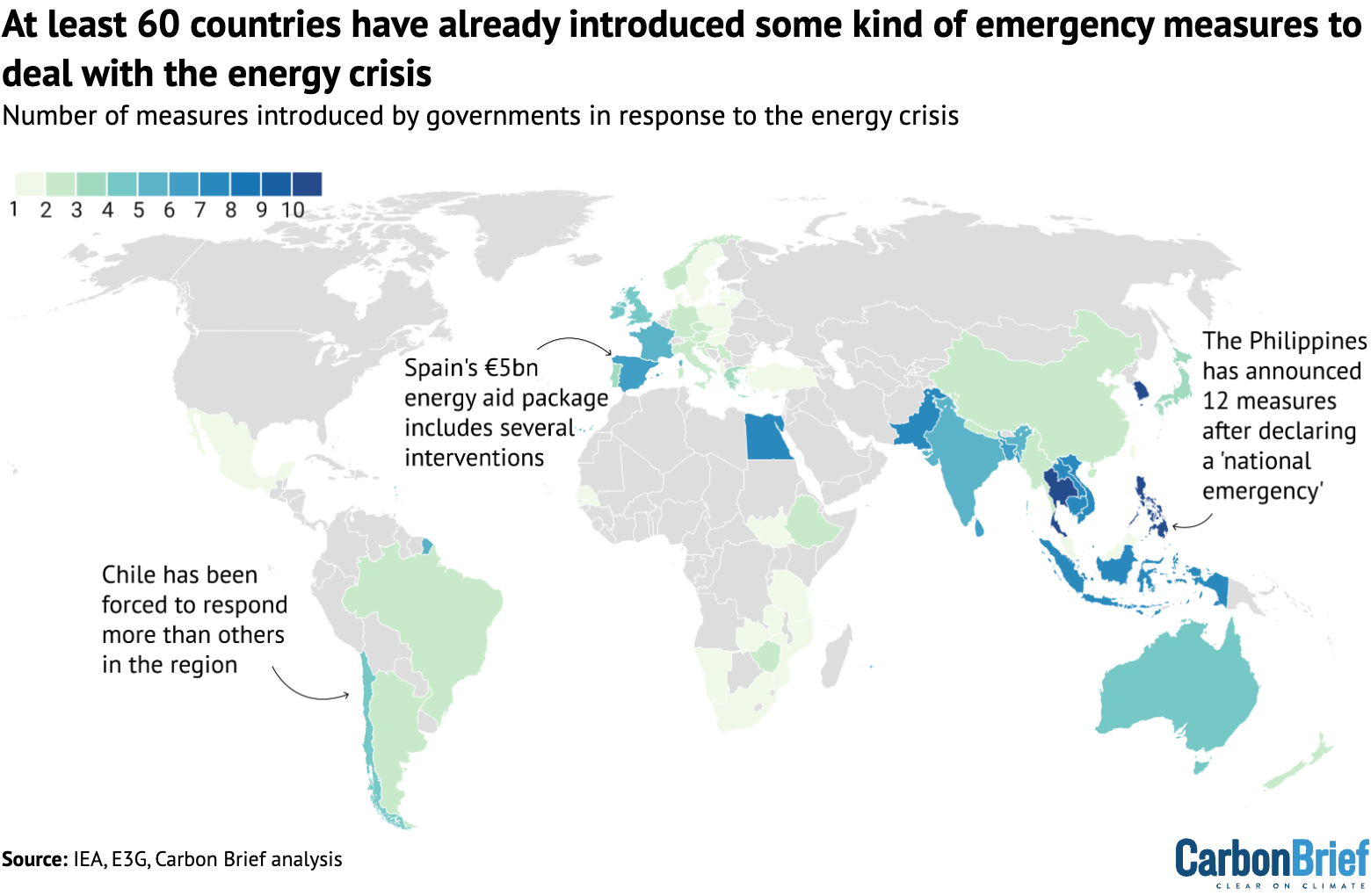
Nations including Indonesia, Japan, South Korea and India are already spending billions of dollars on fuel subsidies to protect people from rising costs.
At least 16 Asian countries are also taking drastic measures to reduce fuel consumption. For example, the Philippines has declared a “state of national emergency”, which includes limiting air conditioning in public buildings and subsidising public transport.
Other examples from the region include the government in Bangladesh asking the public and businesses to avoid unnecessary lighting, Pakistan reducing the speed limit on highways and Laos encouraging people to work from home.
Europe – which was hit hard by the 2022 energy crisis due to its reliance on Russian gas – is less immediately exposed to the current crisis than Asia. However, many nations are still heavily reliant on gas, including supplies from Qatar.
The continent is already feeling the effects of higher global energy prices as countries compete for more limited resources.
At least 18 European nations have introduced measures to help people with rising costs. Spain, which is relatively insulated from the crisis due to the high share of renewables in its electricity supply, nevertheless announced a €5bn aid package, with at least six measures to support consumers.
Many African countries, while also less reliant on direct fossil-fuel supplies via the Strait of Hormuz than Asia, are still facing the strain of higher import bills. Some, including Ethiopia, Kenya and Zambia, are also facing severe fuel shortages.
There have been fewer new policies across the Americas, which have been comparatively insulated from the energy crisis so far. One outlier is Chile, which is among the region’s biggest fuel importers and is, therefore, more exposed to global price increases.
Tax cuts
The most common types of policy response to the energy crisis so far have been efforts to protect people and businesses from the surge in fuel prices.
At least 28 nations, including Italy, Brazil and Australia, have introduced a total of 31 measures to cut taxes – and, therefore, prices – on fuel.
Even across Africa, where state revenues are already stretched, some nations – including Namibia and South Africa – are cutting fuel levies in a bid to stabilise prices.
Another 17 countries, including Mexico and Poland, have directly capped the price of fuel. Others, such as France and the UK, have opted for more targeted fuel subsidies, designed to support specific vulnerable groups and industries.
These measures are all shown in the dark blue “consumer support” bars in the chart below.
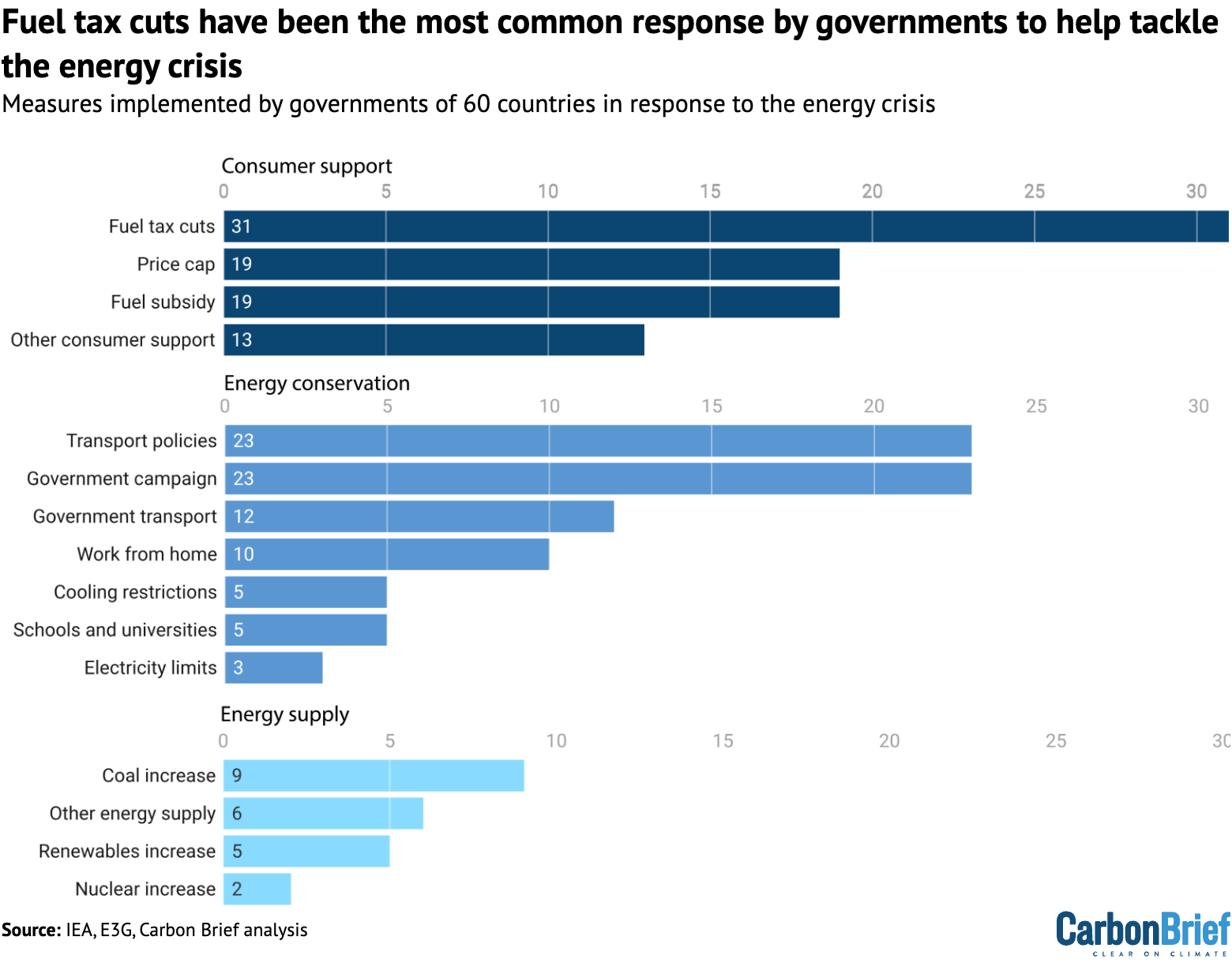
Such measures can directly help consumers, but some leaders, NGOs and financial experts have noted that there is also the risk of them driving inflation and reinforcing reliance on the existing fossil fuel-based system.
Christine Lagarde, president of the European Central Bank, spoke in favour of short-term measures to “smooth the shock”, but noted that “broad-based and open-ended measures may add excessively to demand”.
Measures to conserve energy, of the type that many developing countries in Asia have implemented extensively, have been described by the IEA as “more effective and fiscally sustainable than broad-based subsidies”.
So far, there have been at least 23 such measures introduced to limit the use of transport, particularly private cars.
These include Lithuania cutting train fares, two Australian states making public transport free and Myanmar and South Korea asking people to only drive their cars on certain days.
Clean vs coal
At least eight countries have announced plans to either increase their use of coal or review existing plans to transition away from coal, according to Carbon Brief’s analysis. These include Japan, South Korea, Bangladesh, the Philippines, Thailand, Pakistan, Germany and Italy.
These measures broadly involve delaying coal-plant closure, as in Italy, or allowing older sites to operate at higher rates, as in Japan – rather than building more coal plants.
There has been extensive coverage of how the energy crisis is “driving Asia back to coal”. However, as Bloomberg columnist David Fickling has noted, this shift is relatively small and likely to be offset by a move to cheap solar power in the longer term.
Indeed, some countries have begun to consider changes to the way they use energy going forward, amid a crisis driven by the spiralling costs of fossil-fuel imports.
Leaders in India, Barbados and the UK have explicitly stressed the importance of a structural shift to using clean power. Governments in France and the Philippines are among those linking new renewable-energy announcements with the unfolding crisis.
New renewable-energy capacity will take time to come online, albeit substantially less time than developing new fossil-fuel generation. In the meantime, some nations are also taking short-term measures to make their road transport less reliant on fossil fuels.
For example, the Chilean government has enabled taxi drivers to access preferential credit for purchasing electric vehicles (EVs). Cambodia has cut import taxes on EVs and Laos has lowered excise taxes on them.
Finally, there have been some signs that countries are reconsidering their future exposure to imported fossil fuels, given the current economics of oil and gas.
The New Zealand government has indicated that a plan to build a new LNG terminal by 2027 now faces uncertainty. Reuters reported that Vietnamese conglomerate Vingroup has told the government it wanted to abandon a plan to build a new LNG-fired power plant in Vietnam, in favour of renewables.

The post Iran war analysis: How 60 nations have responded to the global energy crisis appeared first on Carbon Brief.
Iran war analysis: How 60 nations have responded to the global energy crisis



-
Climate Change8 months ago
Guest post: Why China is still building new coal – and when it might stop
-
Greenhouse Gases8 months ago
Guest post: Why China is still building new coal – and when it might stop
-

 Greenhouse Gases2 years ago
嘉宾来稿:满足中国增长的用电需求 光伏加储能“比新建煤电更实惠”
-
Climate Change2 years ago
Bill Discounting Climate Change in Florida’s Energy Policy Awaits DeSantis’ Approval
-

 Climate Change2 years ago
嘉宾来稿:满足中国增长的用电需求 光伏加储能“比新建煤电更实惠”
-
Climate Change Videos2 years ago
The toxic gas flares fuelling Nigeria’s climate change – BBC News
-

 Renewable Energy6 months ago
Sending Progressive Philanthropist George Soros to Prison?
-

 Carbon Footprint2 years ago
US SEC’s Climate Disclosure Rules Spur Renewed Interest in Carbon Credits