



- Formal negotiations
- Finance
- Global review
- Global report
- Digital sequence information
- Harmful subsidies
- Marine biodiversity
- Planning, monitoring, reporting and review
- Article 8(j) implementation
- Biodiversity and climate change
- Links with other bodies
- Around the COP
- Armenian presidency
- Protests
- Lobbying and influence
- Carbon and biodiversity markets

At COP28 in Dubai last November, countries agreed specific global targets on adaptation for the first time.
This marked a significant step forward for the “global goal on adaptation” (GGA) work programme, which was established in 2015, but has seen little progress over the subsequent years.
The GGA framework agreed last year sets out targets that will act as a guide for nations in their efforts to protect their people and ecosystems from the impacts of climate change.
The agreement also saw the launch of the two-year UAE-Belém work programme, which will produce a set of indicators to track progress towards these targets by COP30 next year.
Recently, more than 5,000 potential indicators were submitted to the UN Framework Convention on Climate Change (UNFCCC) secretariat by parties and non-party stakeholders, including UN bodies, specialised agencies and other relevant organisations.
This created a daunting challenge: how to select adaptation indicators that are meaningful, feasible and that do not cause undue reporting burden?
In this article, we look at a series of key considerations for developing effective indicators that track progress on adaptation.
What is the ‘global goal on adaptation’?
The GGA in the Paris Agreement aims to enhance adaptive capacity, strengthen resilience and reduce vulnerability to climate change, in the context of the goal to limit global average temperature increase to “well-below 2C”.
Until recently, progress towards the GGA becoming operational has been slow. But COP28 saw a significant step forwards, with countries agreeing a global framework known as the “United Arab Emirates framework for global climate resilience”.
The GGA framework includes 11 global targets to be achieved by 2030. Seven are targets for adaptation action in specific themes: water; health; biodiversity; food; infrastructure; poverty; and heritage. And the other four targets are for the adaptation cycle: climate risk and vulnerability assessments; planning; implementation and monitoring; and evaluation and learning.
Tracking progress towards these targets needs a set of indicators to measure against. Many are already available and used in other contexts, but this work involves identifying a set that can be applied globally under the GGA.
In June 2024 at the UN’s Bonn climate negotiations, countries agreed to begin this process by mapping existing indicators and identifying gaps. The graphic below shows the timeline for developing the indicators, which will culminate at COP30 in Belém, Brazil next year.

Timeline to develop indicators for the GGA framework, across the next two UN climate conferences – COP29 and COP30 – and the 60th (SB60) and 62nd (SB62) sessions of the subsidiary bodies to the UNFCCC under the Bonn Climate Change Conference. Source: Updated from Leiter (2024a), timeline by Carbon Brief.
Developing indicators is challenging because adaptation is context-specific, influenced by framing and value judgements, and is closely interlinked with sustainable development.
There is, therefore, no universal metric for adaptation akin to reductions of greenhouse gas emissions.
Developing adaptation indicators that apply to a broad range of actions across diverse contexts is particularly difficult. The compilation of indicators by the UNFCCC secretariat shows that there is a lack of indicators that can be aggregated to the global level.
Developing suitable indicators to track progress of the GGA targets requires time, expertise and resources – and a targeted process that combines technically sound inputs with political consultations.
Robust GGA indicators
Before forming the indicators themselves, it is critical to establish how the GGA targets can be tracked. We have identified nine key considerations that the UAE-Belem work programme will need to address.
First, each GGA target consists of multiple elements, so the first step towards developing suitable indicators must be to unpack each target, to identify the key elements and then guide development of the indicators based on these elements.
For example, the table below lists the key elements of the GGA’s water target and impact, vulnerability and risk assessment target.
The presence of multiple elements within each target means that each target requires multiple indicators if its scope is to be fully covered. Hence, at a minimum, several dozen indicators will be needed to measure progress towards the 11 targets.
(A breakdown of the key elements of each of the seven thematic targets and for the four targets around the iterative adaptation cycle are provided in recent UNFCCC submissions by LSE and the AGN.)
The second key consideration is how to secure ambitious interpretations of the targets.
Many elements of the targets require further clarification, as seen in the table above. This is especially important for the development of appropriate indicators that are to be used at the global level, as opposed to national or local level.
The way target elements are interpreted will influence the ambition level of the targets and how they are tracked through the indicators.
For example, the 2023 adaptation gap report found that 85% of countries already have a national adaptation plan or an equivalent planning document. Accordingly, further specifications – such as having the plan be informed by risk assessments or be regularly updated – will increase ambition.
It is important for the indicator work programme to consider the influence of the indicators and the associated calculation methods on the ambition of the targets.
Countries could also agree to additional specifications that are not mentioned in the targets that would further increase ambition. For example, in addition to policies and plans, countries could be tracked for the establishment of legal instruments that foster adaptation.
Adaptation-relevant indicators
The third key consideration is ensuring that indicators are relevant to adaptation.
Given the thousands of existing indicators developed for different purposes, defining what counts as adaptation-relevant is key for mapping and for the development of suitable GGA indicators.
However, many existing indicators were not developed to directly track climate adaptation actions as described in the GGA targets. If they are to be adopted under the GGA, it needs to be demonstrated how these indicators measure adaptation specifically – distinguishing them from other general development indicators – and how they will track GGA targets.
For example, indicators should at least be able to measure one of the key elements that define climate adaptation: changes in vulnerability; exposure; adaptive capacity; resilience; risks; and impacts from climate change. Additionally, outcome-based targets should be tracked with outcome-based indicators.
The fourth key consideration is understanding which elements in the GGA targets can be tracked with existing adaptation-relevant indicators – with or without modification – and where new indicators are required.
We completed a rapid assessment of the indicators available from existing global frameworks and UN climate funding mechanisms. As the table below shows, many existing indicators are insufficient for tracking GGA targets.
For example, the Sendai Framework for Disaster Risk Reduction has a series of indicators, including those covering the number of countries that have multi-hazard early warning systems and the number of countries that have multi-hazard monitoring and forecasting systems (see G1-4 here).
While these could be adopted for the early warning systems element under the impacts, vulnerability and risk target, the majority of the Sendai indicators cannot be adopted without significant modification.
Table 2: Mapping and gap analysis showing sufficiency of existing indicators in multilateral frameworks for GGA targets: Sustainable Development Goals (SDGs), Sendai Framework (SF), and Convention on Biological Diversity Kunming-Montreal Global Biodiversity Framework (CBD); the UN climate funding mechanism: Green Climate Fund (GCF) and Adaptation Fund (AF); and Adaptation Gap Report (AGR). Sufficiency was assessed based on adaptation relevance of the indicators to effectively track the key element of the target.
Best-available science and data
The fifth key consideration is that the indicators will need to cover the support of adaptation, not just the actions themselves. This means tracking the means of implementation – that is, adaptation finance, technology transfer and capacity building – to enhance adaptation action and support.
Sixth is ensuring that indicators are robust and based on best-available science. This requires them to be accompanied by clear calculation methods and definitions.
For example, tracking progress towards the GGA infrastructure target requires determining how to measure “climate-related impacts on infrastructure”. Without clear guidance for countries, the indicator values would not be comparable and could not be used for global aggregation.
The seventh key consideration is exploring innovative data sources and methods. Ideally, this would involve indicators using multiple data sources, with technology offering the potential to fill data gaps and support high-quality data.
For example, remote sensing, artificial intelligence and digital tools – such as mobile phones – can offer cost-effective alternatives to traditional data gathering at the national level.
The eighth key consideration is including technical experts. Due to the technical complexity of the indicator work programme, it is crucial that technical experts receive clear guidelines and detailed procedures. This includes work organisation, timelines, inputs and outputs, with balanced regional representation to ensure contextual relevance.
Finally, the last consideration is agreeing on the remaining UAE-Belem work programme details in 2024.
The COP29 summit in Baku, Azerbaijan is pivotal for achieving consensus on the GGA indicator work programme regarding any outstanding issues. Parties are expected to conclude at the talks with consensus on the programme's implementation, including clarifying processes, scope of work, roles and deliverables for 2025.
Given the limited time to complete the work before COP30 in Belém, such consensus could be crucial.
The post Guest post: How to track progress towards the ‘global goal on adaptation’? appeared first on Carbon Brief.
Guest post: How to track progress towards the ‘global goal on adaptation’?
Continue Reading
Countries have completed the first “global review” of their progress towards reversing nature loss by 2030 at the COP17 biodiversity talks in Yerevan, Armenia.
The review “notes with deep concern” that, unless action is “rapidly accelerated”, the goal to reverse nature loss and meet a set of 23 targets by 2030 “will not be achieved”.
It “urges” countries to accelerate action, including by “increased ambition in addressing the gaps”.
Much of the discussions in Yerevan focused on how to raise the necessary funds to help developing countries protect nature.
Some major economies pushed to expand the range of nations that are expected to provide finance, with countries agreeing at the end of the two weeks of talks that non-donors that want to contribute can “signal interest” before COP18.
This came after developed countries failed to meet a target to significantly ramp up nature finance over the last few years.
It also came as a landmark fund agreed at COP16 in Colombia to pay communities for the genetic resources derived from nature stands nearly empty two years on.
The Yerevan talks marked the halfway point of the “Kunming-Montreal Global Biodiversity Framework” (GBF), the “Paris Agreement for nature” first made in 2022 and due to be achieved by 2030.
During the nearly 12-hour-long final plenary, countries voted for Quito, Ecuador, to host the COP18 nature talks, which will be held in 2028.
Countries managed to sign off on all the major negotiation texts, marking a stark contrast to COP16, which ran so far over time that the Colombian presidency lost “quorum”, forcing talks to resume in Rome months later.
Below, Carbon Brief has detailed analysis of all of the key outcomes from COP17.
Formal negotiations
Finance
Finance, predictably, was at the heart of the discord and deadlock at the Yerevan talks.
At COP17, discussions on finance had to achieve several outcomes.
The first part – to take stock of biodiversity finance mobilised so far to meet the nature deal’s goals – fell under the global review.
As the global report noted, developed countries failed to meet their commitments to raise “at least $20bn a year by 2025” for nature. Delegates pointed to falling aid levels and a sharp 27% decline in environmental funding for the 2026-30 period.
The second part was to agree on how to mobilise resources for the next four years, to meet the GBF’s goals and targets.
Calls to “broaden the contributor base” of who pays to protect nature – and whether that should include emerging economies – became the most fraught element of the talks.
Eventually, countries agreed on what Switzerland described as a “super, mega-delicate” text. It hinged on major “political compromises”, with “no major winner or loser”, according to Kenya.
Per the decision, countries that want to be included on a list of developed country donors can “signal interest” through bilateral, confidential consultations before COP18 and every alternate COP after.
Finally, countries also agreed on criteria to shape and resource a new, permanent financial mechanism to protect nature after 2030.
However, this did not immediately take the form of a new fund under the COP that biodiverse countries have demanded since 2022, deferring the mechanism’s institutional structure to COP18.
Resource mobilisation discussions at the GBF’s halfway mark were supposed to agree on how to close the “biodiversity finance gap” and to “increase resources from all sources” to “at least” $200bn per year by 2030, as set out in target 19 of the GBF.
The talks were largely dominated by a push, led by the JUSCANZ bloc of developed countries, to “broaden the contributor base”. This could see emerging economies, such as Qatar, China, Saudi Arabia and India, being added to the list of countries that pay to protect nature.
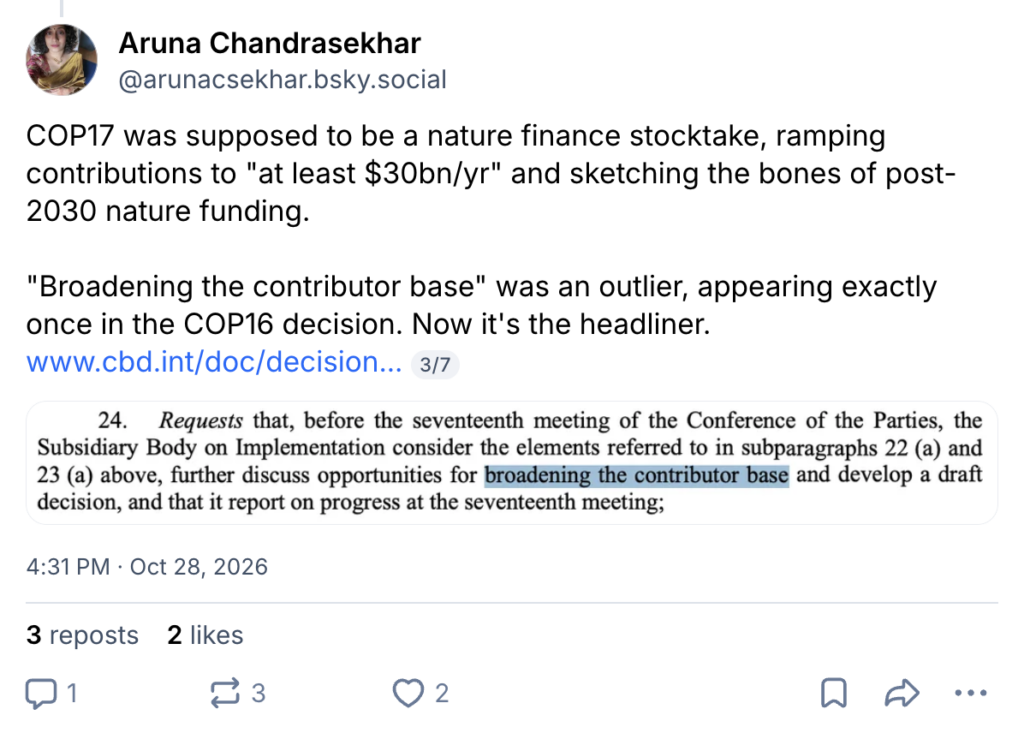
Article 20 of the UN Convention on Biological Diversity (CBD) states that developed countries “shall provide new and additional financial resources” to developing countries to meet the costs of implementing measures to protect nature.
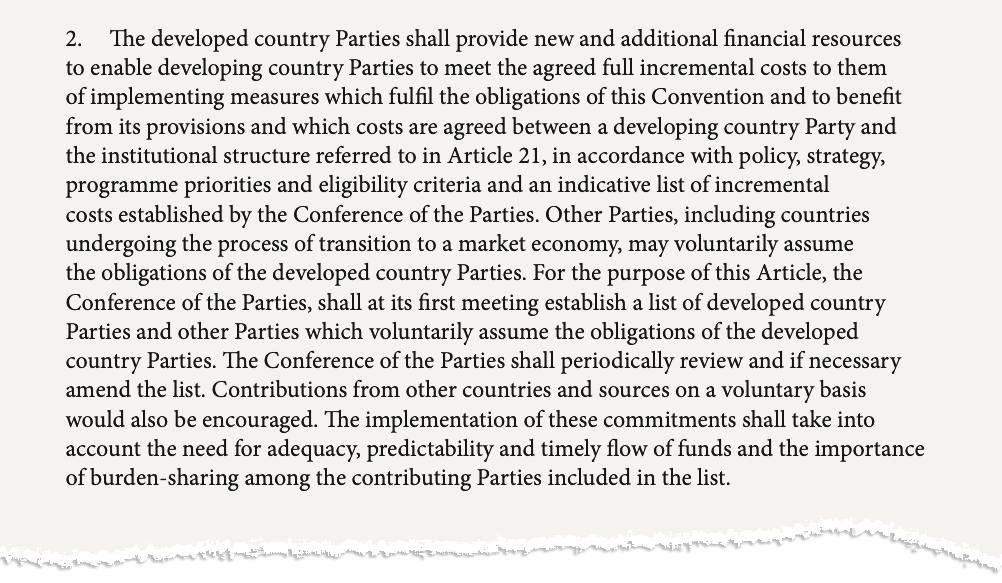
The text states that other countries – including emerging economies – may “voluntarily assume” these obligations to pay. However, it adds that this list of developed countries “shall” be reviewed periodically and amended “if necessary”.
The list was last amended in 2006.
(See this “jargon buster” which explains the specific meaning and legal weight of various terms and verbs used in UN formal documents.)
Discussions around this fraught subject had reached a dead end at intersessional talks this year, but resurfaced in Yerevan.
The first “non-paper” had four different options for expanding the contributor base. These ranged from using the World Bank’s country inco