

The ocean plays a vital role in regulating the climate, storing roughly 50 times more carbon dioxide (CO2) than the atmosphere.
Marine life plays a significant part in this process, as organisms transfer carbon from the ocean surface to the deep sea upon death or as they migrate.
Our new research, published in Nature Communications, suggests the contribution of ocean biology to climate regulation is more complex than previously thought.
To explore how ocean biology shapes the past, present and future climate, we explore an extreme scenario where all marine life has been wiped out.
We find that – in a pre-industrial climate – CO2 levels would rise by 50% without marine life, leading to 1.6C of global warming.
In a separate study in Nature Climate Change, we estimate that ocean biology sequesters the equivalent of 10bn tonnes of CO2 each year.
This is more than one quarter of annual fossil-fuel emissions from human activity.
We also calculate that the contribution of marine life to carbon storage is worth hundreds of billions of dollars each year.
Biological carbon pump
The ocean takes up and stores vast amounts of CO2 every year through two mechanisms known as “carbon pumps”.
The first is the “solubility pump”. This is the process by which dissolved CO2 in seawater is transported from the ocean’s surface to its depth through the sinking and upwelling of water mass.
The second is the “biological carbon pump”. This is the process where carbon is converted into organic materials by plankton and other marine organisms at the ocean’s surface and then transported to the deep sea when they die or migrate.
Scientists have long known that the biological carbon pump played an essential role in maintaining low atmospheric CO2 levels before the industrial revolution.
However, the conventional view is that the solubility pump has been responsible for the ocean’s steady absorption of rising CO2 emissions caused by human activity.
Our findings challenge this view, by showing the biological carbon pump plays a crucial role in the modern ocean’s sequestration of atmospheric CO2.
We find that, without marine life, the ocean’s capacity to capture CO2 emissions would be significantly diminished.
Two scenarios
To get an estimate of the contribution of the marine carbon pump in a stable pre-industrial climate, we simulate the planet’s climate as it was before the industrial era using a complex Earth system model.
(This is the second generation of the Norwegian Earth system model, which contributed to the sixth Coupled Model Intercomparison Project.)
We then explore what would happen to the Earth’s climate system under two scenarios:
- A reference, “healthy ocean” scenario where ocean biology conditions were as realistic as possible.
- An “abiotic” scenario where all marine life is removed.
In a pre-industrial scenario with no marine life, we find that atmospheric CO2 levels would rise to 445 parts per million (ppm). This is an increase of more than 50% on the “healthy ocean” scenario, where CO2 levels are 282ppm.
(This suggests that the influence of marine life on global CO2 levels is greater than the sum of all human activity, which has – so far – raised atmospheric CO2 concentrations to around 425ppm).
The rise in CO2 levels caused by the absence of marine life would result in about 1.64C of global warming at the surface and a 1.15C increase in global sea surface temperature.
This warming would have considerable impacts on the wider world, including declines in sea ice area at the Arctic and Antarctic of close to 25% and an Atlantic Meridional Overturning Circulation that was around 9% weaker.
The value of exploring such an extreme scenario is to investigate the role biological processes in the ocean play in carbon storage, as well as the implications of damage to marine life.
The role of terrestrial ecosystems
Our estimation that pre-industrial atmospheric CO2 would rise by 163ppm without ocean biology is on the lower end of the 150-240ppm range approximated by some previous studies.
However, previous estimates of the contribution of the biological carbon pump in a pre-industrial climate neglect the interactions between oceanic and terrestrial biospheres.
Our research reveals that terrestrial ecosystems – such as tropical forests and grasslands – play a crucial role in compensating for the increase in CO2 concentrations when ocean life declines. (This is due to the CO2 fertilisation effect, when higher CO2 concentrations speed up photosynthesis).
We find that in the extreme pre-industrial scenario, approximately half the carbon lost from the ocean is absorbed by the land.
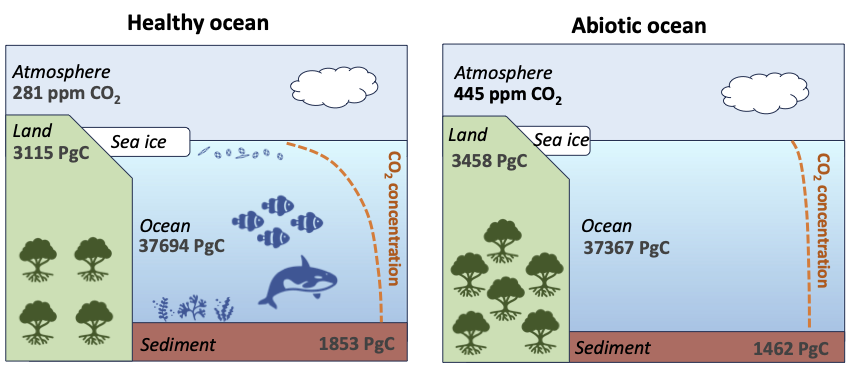
The figure below illustrates the Earth’s carbon reservoirs in a pre-industrial climate with (left) and without (right) marine life. It shows how, if marine life is wiped out, carbon content decreases in the ocean and marine sediment, whereas more carbon accumulates in the atmosphere and on land.
Ramifications for the future
Today, the ocean captures approximately 25% of human-caused CO2 emissions – which allows it to play a crucial role in slowing global warming.
In order to estimate the overall importance of marine life to carbon sequestration in the ocean, we also conduct experiments for various future emission pathways – both with, and without, marine life.
In all cases, we find that more CO2 emitted by human activities remains in the atmosphere when there is no marine life.
One might think that the ocean’s lower concentrations of carbon in the pre-industrial climate, relative to the atmosphere, might mean it would be able to absorb more additional carbon.
However, we find the absence of marine life fundamentally alters the vertical distribution of carbon in the ocean. Although the total amount of carbon stored is lower, there is more carbon at the surface due to an absence of organisms. This, in turn, hinders additional CO2 from entering the ocean.
Another surprising finding of the simulations was that the terrestrial biosphere’s capacity to absorb excess CO2 by increasing its vegetation mass diminishes over time, potentially due to limited nutrients.
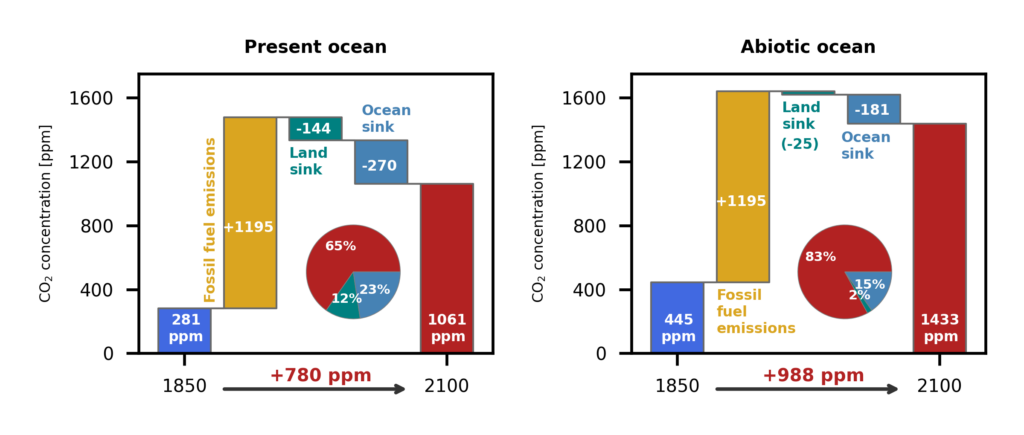
The figure below shows the distribution of human-caused CO2 in the Earth’s carbon reservoirs under two 2100 scenarios. The chart on the left shows a scenario with ocean life, and the chart on the right shows one without ocean biology.
It illustrates how, without marine life, more CO2 stays in the atmosphere and less goes into the land and the ocean.
The study shows that in the absence of marine life, future warming would occur faster and more intensely.
This acceleration in warming would potentially trigger other processes that could further amplify warming, such as greater ocean stratification, longer sea-ice free Arctic summers and greater loss of permafrost.
Economic benefits
Damaging marine life is economically costly given the many and various benefits – or “ecosystem services” – provided by carbon sequestration.
We estimate that the sinking of organic matter sequesters approximately 2.8bn tonnes of carbon annually, locking it away from the atmosphere for at least 50 years.
This carbon sequestration capacity is equivalent to 10bn tonnes of atmospheric CO2 – or roughly 27% of emissions generated by fossil fuels in 2024.
We estimate – based on a carbon price of $90 per tonne of CO2 – that the carbon storage provided by the marine carbon pump is worth $545bn per year in international waters and $383bn per year within national waters. Its total value is projected to exceed $2.2tn by 2030.
Carbon storage is valuable because it helps avoid climate impacts.
This economic value is important for developing countries, particularly small island developing states whose national waters are collectively responsible for 11% of biological carbon pump sequestration activity, in terms of carbon stored.
The top eight countries where the biological carbon pump value is highest in proportion to gross domestic product (GDP) are small island states. These are the Cook Islands, Kiribati, the Marshall Islands, Micronesia, Nauru, Niue, Palau and Tuvalu. Of these nations, just one – the Cook Islands – is classified by the World Bank as high income.
These climate-impacted nations’ key role in preserving ocean health should be considered in discussions of international climate finance.
The figure below shows the economic value of carbon sequestration of the biological carbon pump for each of these eight small island states, calculated on the basis of a carbon price of $90 per tonne of CO2.
For example, it illustrates how Micronesia and Kiribati have an estimated biological carbon pump value of $4,620m and $8,525m each year, respectively.

A healthy ocean buys the world time in the battle against global warming, but the window to protect it is closing rapidly.
Marine ecosystems remain vulnerable to a raft of human activities, including industrial fishing, pollution, shipping and deep-sea mining. Stronger conservation policies, enhanced financial incentives for lower income countries and increased international cooperation are essential to protect the services provided by ecosystems.
These are important steps towards not only protecting 30% of the global ocean as agreed under the new Global Biodiversity Framework – but it will help to reach the Paris Agreement’s climate target.
There are a number of tools at governments disposal to protect the valuable services provided by marine ecosystems. This includes promoting sustainable fishing and ecotourism, establishing marine protected areas and undertaking robust environmental impact assessments.
Nations can also support protection of the biological heat pump within international waters by ratifying the High Seas Treaty, which recognises the importance of protecting biogeochemical cycles.


The post Guest post: How marine life provides climate benefits worth billions of dollars appeared first on Carbon Brief.
Guest post: How marine life provides climate benefits worth billions of dollars

Climate Change
“Sink or swim”: WA Gov hugely underestimating decline in regional gas demand while sleeping on green exports, new report finds
PERTH, Tuesday 13 October 2026 — A new report from Greenpeace Australia Pacific and Springmount Advisory reveals green commodity exports are an untapped economic opportunity for Western Australia in a declining Asian gas market, while offering a genuine solution for decarbonising Asia.
From Gas to Green: Building Western Australia’s Future State is a comprehensive analysis of the declining gas market in Asia, and the untapped economic opportunity for WA to become a global leader in green commodity exports while driving the regional shift away from fossil fuels.
The report offers key recommendations for the WA Government to support regional decarbonisation through an orderly phase out of gas exports in favour of green iron and other green exports. It comes as global climate leaders from across business, politics and advocacy prepare to meet for the Global Citizen Now: Perth event focused on decarbonising WA.
Key findings:
- Gas demand is falling across WA’s core markets in Asia: Gas demand fell in 2025 and is projected to continue to decline, driven by a combination of global geopolitical factors and domestic concerns.
- Policy shifts in key markets since the war on Iran now prioritise renewables and nuclear over gas: Japan, South Korea and China have legislated energy plans that prioritise renewables and nuclear over gas.
- New WA gas would arrive in a saturated, uncertain Asian market filled with cheaper gas: The US is now the world’s largest liquefied gas producer and plans to double its capacity as it also targets Asian markets.
- Green commodities offer a real solution to sustain WA’s economy: WA can lead Australia’s green commodity exports, which by 2060 could be worth almost a trillion dollars.
- Exporting more WA gas is likely to delay or impede Asia decarbonisation: Despite claims by the gas industry, there is no evidence that WA gas is displacing coal in Asia, and in fact diverts resources from genuine decarbonisation options.
Geoff Bice, WA Campaign Lead at Greenpeace Australia Pacific said: “As our export partners in Asia shift away from expensive and polluting gas, the WA Government has a golden opportunity to pivot our economy to green exports, like green iron, which is the most effective way to help our region to decarbonise.
“The writing is on the wall: gas is in decline, renewables are our future. In this context, it makes zero sense for the government to encourage high risk projects like Woodside’s reckless Browse gas proposal at Scott Reef.
“This report clearly shows that the WA Government faces a choice: sink or swim. They can either allow the gas industry to keep ripping off West Australians and continue propping up its decline, or choose the path that will deliver enormous benefits to the state and the world by becoming a leader in the rapidly expanding green economy.”
Tom Quinn, Managing Director of Springmount Advisory: “Western Australia prospers when it looks to the future and builds for future demand. Twenty years from now, what the world needs is green commodities made using WAs abundant renewable resources. Just like it did with iron ore in the 1950s and gas in the 1970s, WA should look to the future and build what the world will need, not sunsetting industries like gas that are already past their peak.”
-ENDS-
Media contact
Kate O’Callaghan on 0406 231 892 or kate.ocallaghan@greenpeace.org
Lucy Keller on 0491 135 308 or lucy.keller@greenpeace.org
A report from Greenpeace Australia Pacific and Springmount Advisory reveals the untapped green economic opportunity for Western Australia in a declining Asian gas market, which also offers a genuine solution for decarbonisation in Asia.
Is Western Australia clinging to a fading gas industry while a thriving green future passes it by? As major Asian trading partners rapidly pivot away from volatile gas imports toward cheap solar and battery storage, this report exposes a high-stakes choice: risk becoming stranded in an oversupplied fossil fuel market, or harness WA’s unmatched sun and wind to lead the global clean energy transition.
Summary
From Gas to Green: Building Western Australia’s Future State reveals that Western Australia (WA) faces a critical juncture as falling Asian gas demand, geopolitical gas supply volatility and accelerating renewable energy deployment undermine the long-term economic viability of gas exports. By harnessing its world-class wind and solar resources, the report demonstrates that WA can execute an orderly phase-out of gas and pioneer a green commodity export economy that could generate $987 billion in economic value by 2060, create 24,000 ongoing jobs, and drive a 9.6% reduction in global greenhouse gas emissions.
Key Findings
- Gas demand is falling in Asia – WA can no longer rely on gas exports: Gas demand in core Asian markets fell in 2025 and is projected to continue to decline in 2026. Legislated energy plans in Japan, South Korea, and China now prioritise renewables and nuclear over gas.
- Asia is increasing renewables, importing gas just gets in the way: Evidence from markets like Thailand suggests that gas imports are increasingly crowding out cheaper renewable energy investments and battery storage rather than displacing coal, locking in more emissions over time.
- Green commodities offer a real solution to decarbonise Asia – this is a major win for WA: With world-class renewables, WA can lead Australia’s green commodity exports, which by 2060 could be worth almost a trillion dollars ($987 billion) and support a genuine 9.6% reduction in global emissions.
Recommendations to WA government
Recommendation 1: Plan an orderly gas phase-out aligned with a trading partner pivot plan
Implement a managed, orderly phase-out of gas exports aligned with trading partners’ decarbonisation pathways, rather than waiting for demand to collapse, by:
- Developing and implementing a staged phase-out of gas facilities aligned with feedstock supply expiry or typical end of facility lifespans.
- Committing to no new gas development for gas expansion, including Browse and Kimberley fields.
- Developing new, reciprocal trade relationships with existing gas trade partners, structured to progressively replace gas exports with green commodities – integrated with recommendation 2.
Recommendation 2: Develop an integrated green commodity export strategy, positioning WA as a global green iron manufacturing hub
Establish an integrated green commodity export strategy that immediately prioritises green iron development, positioning WA as a global green iron manufacturing hub, by:
- Committing to green commodity export targets to give industry and investors a clear demand signal.
- Prioritising green iron as the lead sector within the broader green commodity strategy, given WA’s iron ore endowment and first-mover potential.
Recommendation 3: Reject false solutions such as carbon dumping (CCS) and blue hydrogen
Reject carbon dumping (also described as carbon capture and storage, or CCS) and blue hydrogen as viable decarbonisation technologies, and prioritise green hydrogen and proven renewables for clean energy and fuel production by:
- Excluding blue hydrogen projects (and CCS-dependent projects) from all government support programs.
- Requiring existing hydrogen-based production (including ammonia, methanol, synthetic fuels) to have clear, near-term transition timelines to switch to green hydrogen production.

What you can do
Together, we can push for a prosperous green future.
You can help by:
- Sending an email to Environment Minister Murray Watt and Prime Minister Anthony Albanese, calling on them to reject Browse.
- Sharing this story to help more Australians understand what’s at stake.
- Encouraging your friends and family to take action.
REPORT: “From Gas to Green” Building Western Australia’s Future State
Cleaner cooking projects in the UN carbon market will have to set aside a share of their credits to insure against the risk that the trees they save are lost to fire, drought or logging, after the market’s regulator rejected calls to exempt the sector.
The requirement is part of a new rulebook that the Paris Agreement carbon market regulator – the Article 6.4 Supervisory Body – approved last Friday for programmes that aim to cut emissions by distributing new and cleaner cookstoves in regions that still burn wood or charcoal for cooking.
These are the UN mechanism’s first rulebooks for cookstoves, one of the carbon market’s most popular credit types and also one of its most criticised for overstating climate benefits.
They consist of two methodologies: one for programmes that aim to cut greenhouse gas emissions by distributing more efficient cookstoves that burn less wood or charcoal, and a separate methodology for projects shifting households to lower-emissions cookers running on electricity or liquid petroleum gas (LPG).
Mkhuthazi Steleki, the South African chair of the Supervisory Body, said “this decision gives cleaner cooking projects a new pathway under the UN carbon market, with clear rules to ensure that each credit represents a real and credible emission reduction”.