

Last Updated on October 17, 2024
By now, you’ve probably seen Forest Stewardship Council (FSC) certifications on some of your products. But what exactly does it mean? And how does it correlate with sustainability?
Paper products are one of the most common FSC certified items. But many other items can be FSC certified, such as wooden furniture, decking, and packaging.
Several of the links in the blog post below are affiliate links. For more information, please see my disclosure policy.
The FSC certification essentially means the product certified came from responsibly managed forests. This is important, considering the alarming scale of deforestation happening on our planet.
Deforestation and forest degradation is the second leading cause of carbon pollution, causing 20% of total greenhouse gas emissions.
A staggering 13.4 million acres of Brazil’s Amazon have burned through August 2024 alone, an area larger than Costa Rica.
And it’s not just the Amazon being affected: Forests right here in the US are feeling the effects of climate change too.
Maine’s forests are a vital part of the state’s identity and economy. But as the climate changes, and pressures on natural resources increase, how we manage these forests will become even more critical.
Climate change is already affecting Maine’s forests with shifting temperatures, changing perception patterns, new pest pressures and invasive species. Sustainable forestry practices are essential for adapting to these changes, while preserving the forest’s ecological and economic value.
That’s why it’s vital to protect forests. There are several ways we can do this, like choosing to eat less beef (cattle ranching is the number one cause of deforestation in the Amazon), recycling paper properly, supporting native tree planting efforts, and buying FSC certified materials.
Here’s everything you need to know about FSC certifications and why they matter.

what is fsc certified?
FSC certified stands for Forest Stewardship Council, which is one the most recognized certifications globally. The FSC certifies forests to ensure their environments are managed in a way that protects biodiversity, water resources, and the rights of indigenous people.
FSC certified forests must meet the highest environmental and social standards. But what exactly are FSC standards?
As listed on their website, FSC requires any managers of certified forests to:
- Comply with all applicable laws
- Maintain or improve the social and economic well-being of workers
- Uphold the rights of Indigenous Peoples
- Maintain or improve the social and economic well-being of local communities
- Manage their products and services in a way that maintains or improves their long-term economic viability, social benefits, and environmental benefits
- Maintain, conserve, and/or restore the ecosystem services and environmental values of managed forests; and also avoid, repair, or mitigate negative environmental impacts
- Establish a management plan that outlines their economic, environmental, and social policies and objectives
- Demonstrate progress toward meeting these objectives
- Maintain or improve high conservation values;
- Ensure that all management activities comply with FSC principles and criteria.
Complete descriptions of these principles and the criteria that determine whether the principles are being followed can be found here.
However, it’s important to note that for FSC, it’s not just about meeting standards: It’s about doing what’s right for the forest, and the community.
what are the different fsc certificates?
There are three different FSC certifications available: Forest Management, Chain of Custody, and Controlled Wood. In all types of certifications, independent FSC-Accredited Certification Bodies verify that all FSC-certified forests conform to the requirements contained within the FSC forest management standard. This third-party verification is crucial to the integrity of the FSC system.
Here’s a little more about each certification.
forest management certification
Think of this as the “good forestry practice” stamp. It means that forests are managed in a way that’s environmentally responsible, socially beneficial, and economically viable.
chain of custody certification
This one’s all about the journey. It tracks the wood from the certified forest, through every step of the supply chain, to the final product, ensuring that the product really comes from a responsibly managed forest.
controlled wood
This is for those who want to mix certified and non-certified wood, but still want to ensure that the non-certified wood is from low-risk sources. It’s like a quality control measure to keep out the bad stuff like illegally harvested wood.
what do fsc labels mean?
If you’re a consumer, chances are you’ve noticed a little FSC label on your products before. But there are three different kinds. Here’s what each of them mean.
FSC 100%: This means all the materials used come from responsibly managed, FSC-certified forests.
FSC recycled: The means the product is made from 100% recycled materials, which reduces the pressure to harvest more trees and conserves precious forest resources.
FSC mixed: This means the product is made from a mix of materials from FSC-certified forests, recycled materials, and/or FSC-controlled wood. While controlled wood doesn’t come from FSC-certified forests, it mitigates the risk of the material originating from unacceptable sources.

What are fsc requirements?
There are varying requirements to earn FSC certification, depending on which kind of certification you’re aiming for. Here’s a snapshot of what each certification requires.
Forest Management Certification: Forest operations must adhere to ten principles that cover a broad range of issues, including maintaining high conservation values, community relations, workers’ rights, and monitoring environmental and social impacts.
Chain of Custody Certification: This certification tracks the wood from the certified forest through every step of the supply chain to the final product. It ensures that the product really comes from a responsibly managed forest.
Controlled Wood: This certification ensures that non-certified wood comes from low-risk sources and is free from illegal harvesting, genetically modified organisms, and violation of traditional and human rights.
Each certification type has its own set of detailed standards and criteria that must be met, and certification is conducted by independent, third-party certifying bodies.

what products are fsc certified?
Thankfully, there are several products that have the FSC certification.
Some types of products that can be FSC certified include:
- Paper products, packaging, tissue, and coffee cups
- Tyres
- Sports equipment like skis and wetsuits
- Clothing and shoes
- Furniture and home décor
- Books and art supplies
- Timber
Here is a full list of FSC certified products from companies small and large in all kinds of categories, such as fashion, furniture, beauty, and stationary.
gzw approved fsc certified products
There are thousands of FSC certified products to choose from, but here are a few from my favorite brands. These brands go above and beyond being just FSC certified, but also utilize sustainable materials, mindful packaging, and give back.
I’ve made sure to highlight which products in their supply chain are FSC certified, or if just their packaging is. I’ve gone ahead and highlighted some key features of each brand, but it isn’t an exhaustive list. Be sure to check out their websites for more information.

1. allbirds
- Tree material used in shoes + apparel is FSC certified
- Rerun collection offers slightly imperfect and gently used products
- Offer premium replacement insoles + replacement lace kits
- B Corp certified
- Recycled, natural, and renewable materials
- Carbon neutral footwear

2. ecoblvd
- FSC certified packaging
- 100% Compostable phone cases
- 6FT Drop Protection
- Plastic-Free & FSC Certified Packaging
- Roundabout Recycling Program: Send back old cases/chargers for a discount
- 1% for the Planet Member

3. o my bag
- FSC-certified recycled cardboard + paper packaging
- Bags made from leather, apple leather, + recycled cotton
- Second chances collection allows you to shop pre-loved + imperfect bags at a discount
- Kenzie bag’s leather is hand-woven in Kolkata
4. caraway
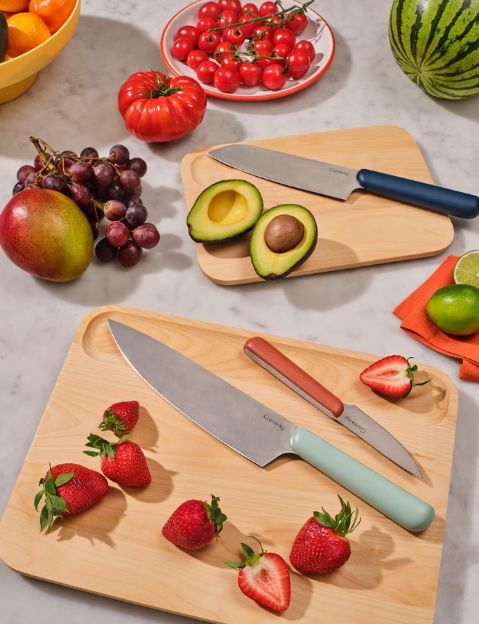
- FSC certified birch wood cutting board
- 4-piece board set (small, medium, large)
- Storage organizer included
- Mineral oil + wax finish
- Sustainable packaging

5. bambu
- FSC certified bamboo cutting board
- Medium + large size options
- Constructed using a water-based, food-grade adhesive imported from Europe that contains no formaldehyde
- Hand finished with food-safe wood oil
- USDA Certified Biobased
- No lacquer coating
- B corporation

6. brentwood home
- FSC Certified GOLS organic latex
- Sustainable mattresses + yoga mats
- 100% GOTS certified organic cotton and wool from New Zealand
- 25 year warranty on mattresses
- Responsibly made in Los Angeles
- Greenguard Gold certified
- Gives back to social and environmental initiatives

7. pukka herbs
- Tea boxes are made from FSC certified card, printed using vegetable-based inks
- Organic herbal teas and supplements
- 100% compostable teabags with organic cotton string
- Supports regenerative organic agriculture
- 1% For The Planet
- Fair for Life certified

8. avocado mattress
- FSC certified Dunlop latex in their latex mattresses
- 100% GOTS organic certified cotton and wool
- 100% natural latex
- Handmade in California
- Vegan options
- Carbon negative
- Upcycles material byproducts
- 25 year warranty
- 1% for the Planet
So, what are your thoughts on FSC certifications? Which FSC certified brands are your favorite? Let me know in the comments below!
The post FSC Certifications: What Are They + Are They Sustainable? appeared first on Going Zero Waste.

As a longtime book lover, I may be biased, but I think a full bookshelf is one of the most beautiful additions to a space. There’s nothing better than seeing a showcase of your favorite reads alongside a TBR list.
A bookcase, though, can of course be used for all sorts of purposes from placing your favorite photos of family and friends to showcasing treasured vintage finds.
Whatever the case, this guide will help you find the right sustainable bookshelf for your living room, office, or wherever you like to cozy up with a good read!
So what make a bookcase more sustainable? What makes a bookshelf non-toxic?
First of all: sustainable and non-toxic are two overlapping — but distinct — criteria. And both of those terms can come with a lot of opinions and varying definitions.
When it comes to sustainable bookcases, I look for:
- Responsibly Sourced Materials: most bookshelves are made primarily with wood. While natural, unsustainable wood sourcing can be a cause of deforestation, so we want to see that the wood was from responsibly managed forests or made from reclaimed or repurposed wood. Some bookshelves may feature metal, in which case recycled materials here are important.
- High Quality Construction: sustainability includes longevity — how long will you be able to use that furniture piece before it goes to the landfill and gets replaced? Look for transparency around craftsmanship and woodworking processes. Another sign of quality is the length of warranty a company has for its products.
- Ethically Made: this one is straightforward in theory — were the people making it paid fairly and working in safe conditions? — but is unfortunately not always easy to find information. In this category, I look for transparency in practices, what relationship the brand has with the manufacturer (some produce in-house which is the best case scenario for transparency!), where it was made, and how well the makers were paid.
Ideally a sustainable bookshelf would also be non-toxic — as toxic chemical fumes aren’t exactly sustainable! But this isn’t always the case. For example, if a company prioritizes upcycled materials, they don’t necessarily have control over what inputs were part of the original materials. And sometimes a company focuses more on ethical artisan partnerships and sustainable wood sourcing, more than, say, using non-toxic finishes.
But when it comes to non-toxic bookshelves, this is what I look for. (Note that non-toxic doesn’t necessarily mean safe for all chemical sensitivities. Nor does it mean zero potentially irritating chemicals.)
- Solid Wood (where possible): MDF or pressed wood contains glue to stick the various wood pieces together, which can contain added formaldehyde. I prefer solid wood, or if it is engineered wood, I’d make sure the company is transparent around the type of glue used and/or they at least have a product certification like GREENGUARD. (More on that in a second.)
- Low or Zero VOC Finishes: most wood furniture is completed with some sort of finish to provide a protection against scratches or moisture. Many of these finishes are synthetic, and some can contain high levels of toxic chemicals. Look for a natural finish like linseed oil or beeswax or a low VOC synthetic finish.
Relevant Certifications
You’ll see a few certifications referenced throughout this guide. Here’s what each one covers:
- FSC Certified = the wood sourcing was responsibly managed; this is not a finish, foam, or textile guarantee.
- GREENGUARD / GREENGUARD Gold Certified = the finished product was tested for low chemical emissions, including VOCs, with Gold representing the stricter tier.
- Fair Trade Certified
 = verifies that a factory meets standards for fair wages, safe working conditions, and ethical labor practices.
 - Cradle to Cradle Certified (Gold) = evaluates a product or material across material health, circularity, clean air/climate, water/soil stewardship, and social fairness.
Where to Find Sustainable Bookcases and Shelving
I’m always a secondhand first proponent, and that goes for furniture, too. While your local thrift store might not have used bookshelves, check for dedicated furniture resale shops near you or estate sales. (I use EstateSales.net to find ones near me.) You can also find gently used pieces on online marketplaces like Facebook Marketplace, OfferUp or AptDeco.
If you can’t find something you love secondhand, and you don’t want to DIY your own bookshelf, then the next best choice is to shop from one of the sustainable furniture companies below. (If you’re simply looking for a bookstand, I’d suggest browsing Etsy for a collection of solid wood, bamboo, and reclaimed wood book stands and cookbook stands!)
Note that this guide includes affiliate links, which means we may earn a small commission if you purchase through these links which helps us continue to run this website and create resources like these. As always all brands meet strict sustainability criteria and are brands we love — and that we think you’ll love too!
1. Medley
Best for: low VOC wood bookcases
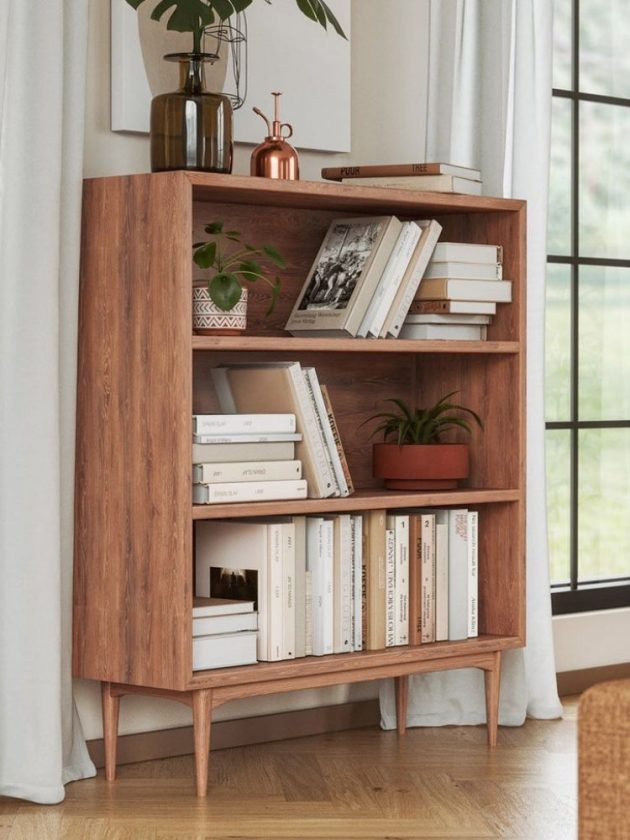
Medley’s bookshelves are elegant and elevated, perfect for a living room. Each piece is made with 100% solid FSC-certified hardwood for the tops and sides, though low-VOC CARB 2 compliant plywood is used for the shelves.
Every eco-friendly bookcase is handcrafted in the US (California or North Carolina) and completed with a low-VOC wood finish.
Price: $2,395 – $2,995
Materials: White Maple, American Walnut Wood
Conscious Qualities: Made-to-Order, US-Made, FSC-Certified Wood, Natural Finish
2. Thuma
Best for: non-toxic modular bookshelf
Thuma’s eco-friendly bookshelf is made from upcycled wood sourced from rubberwood trees no longer being used to source rubber. The brand’s bookshelf is also GREENGUARD Gold certified.
What makes Thuma’s bookshelf stand out to me, though, is its modularity — their Pillar Bookshelf can be set in 10 different configurations. And if you start with just a few shelves but later decide you want a larger bookshelf, you can simply buy an additional shelf or two to add on to it!
Price Range: $550 – $3,300
Materials: Upcylced Rubber Wood
Conscious Qualities: GREENGUARD Gold Certified, Repurposed Materials, Adaptable

3. West Elm GREENGUARD Certified
Best for: low-tox bookcases and bookracks for kids
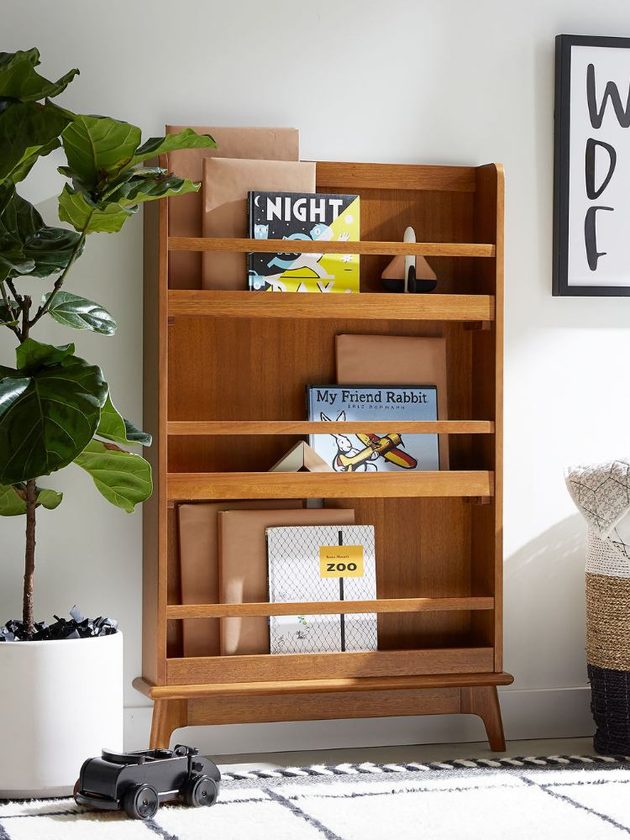
This furniture retailer has plenty of adorable, but functional, bookshelves for a playroom or kids’ bedroom. From cubby bookcases to mid-century bookracks, you’ll find plenty of options that are not only GREENGUARD certified, but made in Fair Trade Certifiedfactories, and/or with FSC-certified wood. Note that the company’s bookshelves are made with engineered wood, though.
West Elm also has GREENGUARD certified bookcases large enough for the adults too!
Price: $399 – $2,897
Materials: Solid Wood, Reclaimed Wood
Conscious Qualities: Fair Trade, FSC Certified, and GREENGUARD Certified Options
4. Urban Natural
Best for: a variety of eco-friendly bookshelves
This natural home retailer has sustainable bookcases in all shapes and sizes. From traditional bookcases to open-back asymmetrical shelving units, Urban Natural has options for any interior aesthetic. Each brand they carry values quality craftsmanship, responsible production, and sustainable sourcing.
Price: $1,099 – $5549
Materials: Solid Teak, Maple, Cherry, Walnut, Birch (varies by brand)
Conscious Qualities: FSC-Certified Options, USA-Made Options, Low VOC Finish Options (varies by brand)