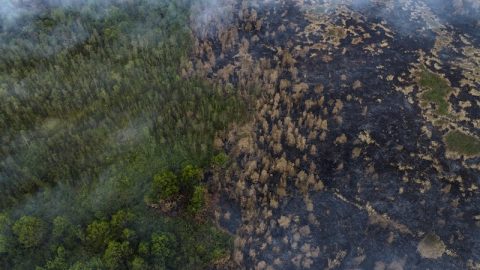
It was water that stripped nearly everything from Tambudzai Chikweya’s life on the night of March 15, 2019.
As Cyclone Idai tore through Chimanimani, her hometown in Zimbabwe’s eastern highlands, it unleashed floods that swept away her house and claimed the life of her eldest daughter. Chikweya was rescued only after spending the night pinned between a wardrobe and a bed, unable to free herself from the mud.
More than five years later, water again stands in the way of Chikweya’s attempts to build a new life for herself and her family. But this time, the problem is that there isn’t enough of it.
The mother-of-three has been resettled in Runyararo, a vast expanse of sun-baked semi-arid land where the Zimbabwe government has been building brick homes for hundreds of people displaced by the cyclone, on the site of a former colonial farm more than 60 kilometres away from Chimanimani.
High temperatures of up to 34 degrees Celsius and erratic rainfall make access to water in Runyararo “inadequate”, according to government documents. The situation has been made worse this year by a severe drought – dubbed “historic” by the UN – which has affected much of Southern Africa and was sparked by the El Niño weather pattern.
“Not having enough water and drought-induced hunger are challenges here,” Chikweya said, speaking through a translator when Climate Home visited her home in Runyararo last September on a trip organised by Danish humanitarian NGO DanChurchAid.
“It was a very difficult decision for us [to move here],” she added, “It weighed on us for a long time.”

Tambudzai Chikweya walks past some of the land she was allocated by the government as part of the resettlement project. Photo: Matteo Civillini
The reality has also proved tough. Standing in front of a small vegetable patch where she grows tomatoes and kale, Chikweya described the struggle she faces in getting enough food to feed herself and her children at least once a day.
She tried to grow potatoes on a large plot of land donated by the government – but the crops failed in the bone-dry soil as a result of the stifling heat and a shortage of water.
Climate Home asked Zimbabwe’s government why storm-hit communities were resettled in a known drought-prone area, but had not received a response by the time of the publication.
Multiple climate threats
Chikweya’s situation underscores the wide range of climate-related threats affecting vulnerable communities in a country like Zimbabwe where the frequency and intensity of both storms and droughts are projected to increase as the planet heats up.
The situation in Runyararo also highlights the complexities of the critical decisions facing cash-strapped governments that need to ensure their efforts to help people recover from one disaster also make them better able to withstand future hazards.
Mattias Söderberg, global climate lead at DanChurchAid, said adapting to multiple climate stresses “is not just a tick-box exercise”, but must be grounded in a “thorough assessment of the expected climate effects”.
Development organisations and government authorities leading adaptation projects need enough expertise to take into account expected climate impacts in the future as well as what is happening now. “Otherwise adaptation investment may be lost, and people will live in a false sense of safety,” Söderberg said.
Emerging economies set up COP29 agenda fight over trade measures
Doing that in practice, however, can add to the upfront costs of adaptation measures. To tackle the lack of water in Runyararo, for example, the national government has sketched out plans to build a dam on a nearby river and bring a stable water supply into the area. But a lack of funding has put the dam project beyond reach for now.
It is a familiar dilemma for developing nations struggling to bridge the widening gulf between the impacts of climate change and the shortfall of money available to address them.
International public funding to protect communities in poorer, vulnerable countries from worsening extreme weather and rising seas is only a fraction – between 7% and 13% – of what is needed, according to the latest Adaptation Gap Report published on Thursday by the UN Environment Programme (UNEP).
UNEP said governments have an important opportunity to “alter this trajectory” at the upcoming COP29 summit, starting next week in Baku, Azerbaijan. The talks are expected to agree on a new post-2025 global climate finance goal to help developing countries tackle climate change – but deep divisions remain on what it should consist of, how large it should be, and who should contribute to it.
For Zimbabwe, the money could make all the difference when dealing with another climate disaster.
‘Surrounded by floodwater’
Back in 2019, Joseph Maphosa was fast asleep when the water brought by Cyclone Idai burst through the front door of his home late at night with such force that it lifted up his bed.
Idai was then passing through Kopa, a settlement lying on a plain at the confluence of three rivers. Conditions making it particularly prone to flooding and landslides would turn Kopa into the epicentre of the disaster.
After fleeing his house by hanging onto the roof trusses, Maphosa eventually climbed up into a tree with three of his neighbours. They spent the next 48 hours there alone.
“The rain was coming down all around us, there was nothing we could do,” he recounted more than five years later. “No one could help us because we were just surrounded by floodwater.”
By the time rescuers arrived and took the four people to safety, the water had started receding and the devastation caused by the cyclone was laid bare.
It was Zimbabwe’s most devastating natural disaster on record.
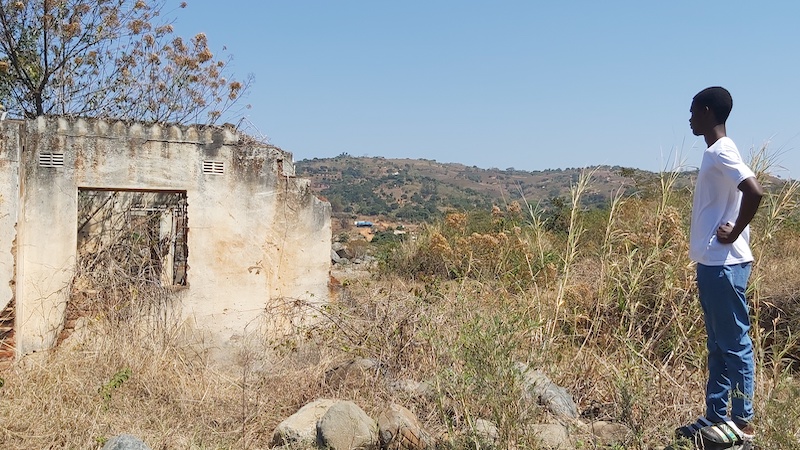
Travail Ngorima looks at the remnants of his family home in Kopa that was destroyed by Cyclone Idai. (Photo: Matteo Civillini)
More than 70 households were swept away in Kopa alone. Across the country, 344 people died, with over 250 reported missing and 60,000 displaced by the disaster. The cost of damage to property and infrastructure ranged between $542 million and $616 million according to a rapid impact assessment by the World Bank which funded a wide-ranging recovery programme.
As the government and development agencies set about rebuilding homes, roads and bridges and restoring local people’s livelihoods, they promised that similar cyclones would never have the same calamitous consequences.
‘Building back better’
“We said, ‘we don’t need to build back better anymore – we want to build back better first time’,” John Misi, acting director for local government services in Manicaland Province, told reporters visiting the area in September.
“We challenged our local authorities that no one was going to build a structure, a home, a shelter, without getting technical support from the council so that we build more resilient infrastructure,” he added.
Businesses may be investing more in climate adaptation than we think
On a three-day trip across the province, Climate Home saw a mixed picture of how the recovery efforts have unfolded five years on from the dramatic events caused by Idai.
Key infrastructure – including many roads and bridges – was repaired, restoring access to remote communities.
Still, a large swathe of the floodplain in Kopa remains littered with giant boulders that came rolling down from the mountains as a result of the cyclone, destroying everything in their way.
Even so, a dozen metres away, the local business centre is a hive of activity. New buildings are being erected, helping locals to earn a living but also fuelling concerns over what would happen if a fresh climate disaster struck.
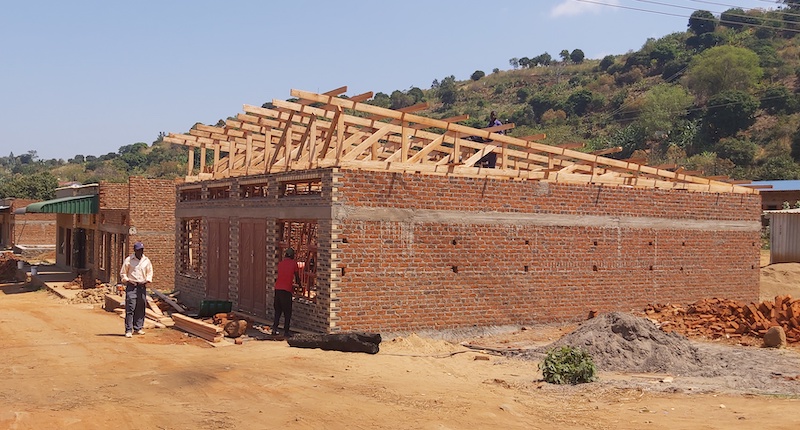
New commercial buildings are springing up in Kopa, a flood-prone area. (Photo: Matteo Civillini)
“There is no order – these businesses are just coming up,” said Maphosa, who now works in Chimanimani’s civil registry office. “It is a great risk to build there. [With Cyclone Idai] water got into the shops there but people are still building them there anyways.”
While commercial buildings are being constructed in Kopa, an official told Climate Home that the local council denied permission to rebuild residential houses there.
Most people made homeless by the disaster found shelter with families or host communities, but hundreds of households ended up in temporary camps waiting to be given a new permanent home elsewhere.
Settling in the ‘land of peace’
The centrepiece of the Zimbabwe government’s resettlement plans lies in Runyararo, which means “land of peace” in the local Shona language. The settlement lies at the end of a long dirt road nearly two-hours’ drive away from Chimanimani.
Here, on a largely empty piece of barren land traditionally used for cattle-grazing, the government built 159 new homes for displaced people – with close to a hundred more in the pipeline – as well as a primary school and a small hospital.
In addition to a four-room house, new residents are allocated 2.5 hectares of land that they can use to grow crops or keep animals.
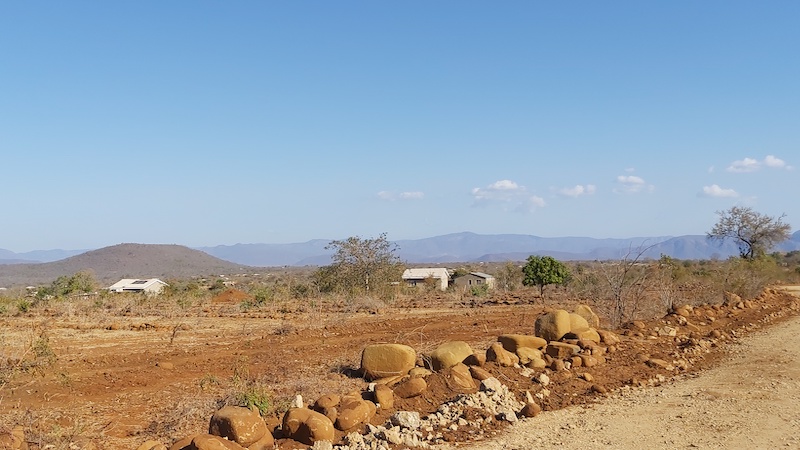
Hundreds of households displaced by Cyclone Idai have been resettled in Runyararo, more than 60 km away from their previous hometown. (Photo: Matteo Civillini)
Chikweya moved to Runyararo in 2022 after spending three years in a tent camp. She said she was grateful to the government for her new house, but she has been struggling to adjust to a life full of fresh challenges.
“It is more isolated here,” she said. “In Chimanimani, I used to sell things and there was always someone who would buy from you, which helped me get by.”
Chikweya now keeps goats and chickens and tends her vegetable patch – but her ambition to put the rest of her land to productive use to grow food has failed because she cannot irrigate it regularly.
The shortage of water afflicts everyone in the area – and it’s becoming more acute as the government has resettled cyclone survivors there.
“It’s always been like this here,” lamented another resident during a community meeting. “But because there are a lot of people now, the little water that was here is now being used by too many people. It’s getting to a point where the water just dries up.”
Struggle to boost water access
Boreholes to tap underground water were drilled in the area, but a lack of rain during the ongoing drought means the water table has been getting lower and some of the boreholes have dried up, a local official said.
German charity Welthungerhilfe (WHH) stepped in to help, with funding from the US government’s development agency USAID. It drilled two more boreholes and installed solar panels to pump water into a large storage tank and from there to a network of taps situated closer to the homes.
Yet, while the scheme has offered a welcome reprieve for the community, water stress persists – and the struggle for a sufficient supply could get worse as the number of residents grows.
Matthias Späth, WHH’s country director in Zimbabwe, told Climate Home it was “saddening to see how quickly the water level is shrinking” when he visited Runyararo recently.
“We did the best we could with the available resources,” he said. “We ensured that no IDP [internally displaced person’s] household was more than 100 metres from a water point.”
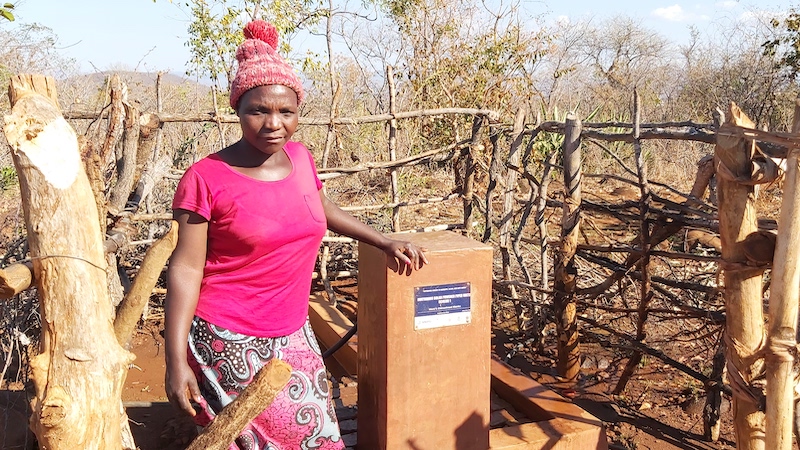
Tambudzai Chikweya stands by one of the water points installed by WHH. Photo: Matteo Civillini
Späth added that, given water shortages across the wider area, the system designed for the new residents “has likely been overloaded” because people living there before the resettlement project have also been using it. “A larger budget would have enabled us to extend the water system to the host community,” he said.
A lack of funding is also putting the brakes on a project the government believes could offer a long-term solution. Under the plans, a dam would be built on a river up in the nearby hills and a 30-km pipeline would channel the water from there to the community in Runyararo.
But, for now, there is no money to put the costly project into practice, local officials told Climate Home.
Späth said he was concerned that current global geopolitics and national economic hardship would make it hard to mobilise the funds needed to build a dam. He also said water quality in the river would need to be assessed to ensure it is suitable for filling the dam, partly because livestock also use it for their needs.
Legal experts say Trump could quit Paris pact – but leaving UNFCCC much harder
Misi of Manicaland province said the administration has been doing its best in Runyararo but acknowledged that “it is a work-in-progress” and challenges remain.
“We want to make that settlement as good as the area that they [the displaced people] stayed in before the cyclone,” he said.
For Chikweya, that day cannot come soon enough as she reflects on her life before Cyclone Idai.
“Chimanimani was basically an oasis. We’d never run out of water – we could always access fresh food,” she said. “Here it’s more difficult.”
(Reporting by Matteo Civillini; editing by Megan Rowling)
Danish NGO DanChurchAid organised and sponsored Climate Home’s trip to Zimbabwe.
The post From cyclone to drought, Zimbabwe’s climate victims struggle to adapt appeared first on Climate Home News.
From cyclone to drought, Zimbabwe’s climate victims struggle to adapt

Climate Change
“Sink or swim”: WA Gov hugely underestimating decline in regional gas demand while sleeping on green exports, new report finds
PERTH, Tuesday 13 October 2026 — A new report from Greenpeace Australia Pacific and Springmount Advisory reveals green commodity exports are an untapped economic opportunity for Western Australia in a declining Asian gas market, while offering a genuine solution for decarbonising Asia.
From Gas to Green: Building Western Australia’s Future State is a comprehensive analysis of the declining gas market in Asia, and the untapped economic opportunity for WA to become a global leader in green commodity exports while driving the regional shift away from fossil fuels.
The report offers key recommendations for the WA Government to support regional decarbonisation through an orderly phase out of gas exports in favour of green iron and other green exports. It comes as global climate leaders from across business, politics and advocacy prepare to meet for the Global Citizen Now: Perth event focused on decarbonising WA.
Key findings:
- Gas demand is falling across WA’s core markets in Asia: Gas demand fell in 2025 and is projected to continue to decline, driven by a combination of global geopolitical factors and domestic concerns.
- Policy shifts in key markets since the war on Iran now prioritise renewables and nuclear over gas: Japan, South Korea and China have legislated energy plans that prioritise renewables and nuclear over gas.
- New WA gas would arrive in a saturated, uncertain Asian market filled with cheaper gas: The US is now the world’s largest liquefied gas producer and plans to double its capacity as it also targets Asian markets.
- Green commodities offer a real solution to sustain WA’s economy: WA can lead Australia’s green commodity exports, which by 2060 could be worth almost a trillion dollars.
- Exporting more WA gas is likely to delay or impede Asia decarbonisation: Despite claims by the gas industry, there is no evidence that WA gas is displacing coal in Asia, and in fact diverts resources from genuine decarbonisation options.
Geoff Bice, WA Campaign Lead at Greenpeace Australia Pacific said: “As our export partners in Asia shift away from expensive and polluting gas, the WA Government has a golden opportunity to pivot our economy to green exports, like green iron, which is the most effective way to help our region to decarbonise.
“The writing is on the wall: gas is in decline, renewables are our future. In this context, it makes zero sense for the government to encourage high risk projects like Woodside’s reckless Browse gas proposal at Scott Reef.
“This report clearly shows that the WA Government faces a choice: sink or swim. They can either allow the gas industry to keep ripping off West Australians and continue propping up its decline, or choose the path that will deliver enormous benefits to the state and the world by becoming a leader in the rapidly expanding green economy.”
Tom Quinn, Managing Director of Springmount Advisory: “Western Australia prospers when it looks to the future and builds for future demand. Twenty years from now, what the world needs is green commodities made using WAs abundant renewable resources. Just like it did with iron ore in the 1950s and gas in the 1970s, WA should look to the future and build what the world will need, not sunsetting industries like gas that are already past their peak.”
-ENDS-
Media contact
Kate O’Callaghan on 0406 231 892 or kate.ocallaghan@greenpeace.org
Lucy Keller on 0491 135 308 or lucy.keller@greenpeace.org
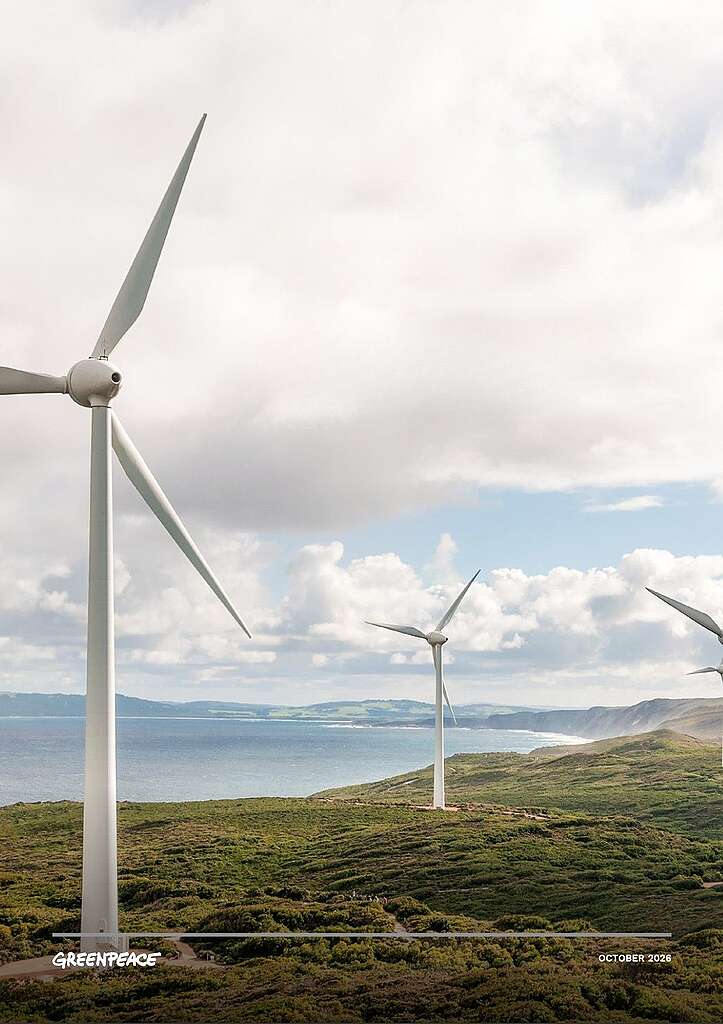
A report from Greenpeace Australia Pacific and Springmount Advisory reveals the untapped green economic opportunity for Western Australia in a declining Asian gas market, which also offers a genuine solution for decarbonisation in Asia.
Is Western Australia clinging to a fading gas industry while a thriving green future passes it by? As major Asian trading partners rapidly pivot away from volatile gas imports toward cheap solar and battery storage, this report exposes a high-stakes choice: risk becoming stranded in an oversupplied fossil fuel market, or harness WA’s unmatched sun and wind to lead the global clean energy transition.
Summary
From Gas to Green: Building Western Australia’s Future State reveals that Western Australia (WA) faces a critical juncture as falling Asian gas demand, geopolitical gas supply volatility and accelerating renewable energy deployment undermine the long-term economic viability of gas exports. By harnessing its world-class wind and solar resources, the report demonstrates that WA can execute an orderly phase-out of gas and pioneer a green commodity export economy that could generate $987 billion in economic value by 2060, create 24,000 ongoing jobs, and drive a 9.6% reduction in global greenhouse gas emissions.
Key Findings
- Gas demand is falling in Asia – WA can no longer rely on gas exports: Gas demand in core Asian markets fell in 2025 and is projected to continue to decline in 2026. Legislated energy plans in Japan, South Korea, and China now prioritise renewables and nuclear over gas.
- Asia is increasing renewables, importing gas just gets in the way: Evidence from markets like Thailand suggests that gas imports are increasingly crowding out cheaper renewable energy investments and battery storage rather than displacing coal, locking in more emissions over time.
- Green commodities offer a real solution to decarbonise Asia – this is a major win for WA: With world-class renewables, WA can lead Australia’s green commodity exports, which by 2060 could be worth almost a trillion dollars ($987 billion) and support a genuine 9.6% reduction in global emissions.
Recommendations to WA government
Recommendation 1: Plan an orderly gas phase-out aligned with a trading partner pivot plan
Implement a managed, orderly phase-out of gas exports aligned with trading partners’ decarbonisation pathways, rather than waiting for demand to collapse, by:
- Developing and implementing a staged phase-out of gas facilities aligned with feedstock supply expiry or typical end of facility lifespans.
- Committing to no new gas development for gas expansion, including Browse and Kimberley fields.
- Developing new, reciprocal trade relationships with existing gas trade partners, structured to progressively replace gas exports with green commodities – integrated with recommendation 2.
Recommendation 2: Develop an integrated green commodity export strategy, positioning WA as a global green iron manufacturing hub
Establish an integrated green commodity export strategy that immediately prioritises green iron development, positioning WA as a global green iron manufacturing hub, by:
- Committing to green commodity export targets to give industry and investors a clear demand signal.
- Prioritising green iron as the lead sector within the broader green commodity strategy, given WA’s iron ore endowment and first-mover potential.
Recommendation 3: Reject false solutions such as carbon dumping (CCS) and blue hydrogen
Reject carbon dumping (also described as carbon capture and storage, or CCS) and blue hydrogen as viable decarbonisation technologies, and prioritise green hydrogen and proven renewables for clean energy and fuel production by:
- Excluding blue hydrogen projects (and CCS-dependent projects) from all government support programs.
- Requiring existing hydrogen-based production (including ammonia, methanol, synthetic fuels) to have clear, near-term transition timelines to switch to green hydrogen production.

What you can do
Together, we can push for a prosperous green future.
You can help by:
- Sending an email to Environment Minister Murray Watt and Prime Minister Anthony Albanese, calling on them to reject Browse.
- Sharing this story to help more Australians understand what’s at stake.
- Encouraging your friends and family to take action.
REPORT: “From Gas to Green” Building Western Australia’s Future State
Cleaner cooking projects in the UN carbon market will have to set aside a share of their credits to insure against the risk that the trees they save are lost to fire, drought or logging, after the market’s regulator rejected calls to exempt the sector.
The requirement is part of a new rulebook that the Paris Agreement carbon market regulator – the Article 6.4 Supervisory Body – approved last Friday for programmes that aim to cut emissions by distributing new and cleaner cookstoves in regions that still burn wood or charcoal for cooking.
These are the UN mechanism’s first rulebooks for cookstoves, one of the carbon market’s most popular credit types and also one of its most criticised for overstating climate benefits.
They consist of two methodologies: one for programmes that aim to cut greenhouse gas emissions by distributing more efficient cookstoves that burn less wood or charcoal, and a separate methodology for projects shifting households to lower-emissions cookers running on electricity or liquid petroleum gas (LPG).
Mkhuthazi Steleki, the South African chair of the Supervisory Body, said “this decision gives cleaner cooking projects a new pathway under the UN carbon market, with clear rules to ensure that each credit represents a real and credible emission reduction”.