


- What are the benefits and challenges of using AI in weather and climate forecasting?
- What are some other current uses of AI in climate science research?
- How is AI being used to advance climate policy and action?
- How could AI be used in climate research over the coming years?
- Are there any misconceptions about the use of AI in climate science?
- Could AI improve or exacerbate inequalities in climate research?
- What are some other risks and challenges of AI in climate change research?

In the wake of the recent flash flood that swept down from the Himalayas, Nepal is seeking immediate aid from a UN fund for climate loss and damage to help vulnerable families displaced by the disaster and rebuild destroyed schools and hospitals, the country’s foreign minister told Climate Home News.
“This is exactly the kind of climate-driven catastrophe the Fund was created to address,” Shisir Khanal said in an interview. He added that “stronger global solidarity and meaningful international support” are needed for countries like Nepal, which are facing increasingly severe climate-related disasters.
The floods were caused by a glacier collapsing and triggering a landslide that forced a torrent of water and debris to rush down the Bhote Koshi River valley, causing catastrophic impacts downstream. More than 1,300 people died and over 5,300 are still missing in the area.
Khanal described the disaster as a “Himalayan tsunami”, telling Climate Home News that early assessments suggest the roads, bridges, hydropower stations, highways and settlements it wiped out could require billions of dollars to rebuild. Reconstruction estimates by the government range between $2.5 billion and $5 billion.
The minister of foreign affairs said Nepal would not be asking the UN’s new Fund for Responding to Loss and Damage (FRLD) “to write a single check for this total amount”, explaining that the government is finalising a post-disaster assessment “to guide our broader international donor appeals”.
Nepal disaster seen as test case for fledgling fund
In reality, if Nepal does receive rapid support from the FRLD, it is likely to be a fraction of the total bill because the fund has a cap of $20 million per project and has little more than $350 million available to hand out in its initial phase.
So far its board has not approved any projects as it is still working out how to allocate its scarce resources, nor does it have a process in place to respond to sudden climate disasters such as glacial lake outburst floods or powerful storms.
On August 31, Nepal’s government sent a direct appeal for emergency grant funding to the FRLD, emphasising that “a prompt response would… demonstrate that the fund can translate international solidarity into timely support for vulnerable countries and communities when it is most urgently needed”.
A couple of days later, eight developing-country board members – later joined by those from small island states – signed a letter, seen by Climate Home News, asking the fund’s board to hold an extraordinary meeting to respond to Nepal’s request.
The FRLD said in a statement that the devastating impacts on the ground “underscore both the urgency and scale of need and reaffirm the fundamental purpose for which the FRLD was established”.
It added that it is “committed to approaching Nepal’s request with the urgency, compassion, and careful consideration that these difficult circumstances require, while respecting the Fund’s governing instrument and established decision-making processes”. As of Wednesday, Climate Home News understands that discussions were still ongoing.
Designing infrastructure for extreme shocks
Khanal pointed to “the unprecedented scale” of the huge flood which occurred within a matter of minutes and swept away river gauges meant to provide early warning in Rasuwa and Nuwakot, near the border with Tibet.
“You cannot easily ‘plan’ against a mountain collapsing,” he said. But the lesson, he added in written responses in English, is that “our historical baseline for infrastructure engineering is no longer sufficient”.
Building resilient infrastructure means that “hydropower projects, roads and early warning systems must be designed for extreme, unpredictable climate shocks”, he said. Another key element will be plans to better understand and protect ecosystems, he added.
-
As science comes under attack at UN talks, climate movement splits over how to respond
A rift over how IPCC messages are produced and turned into policy is creating tensions in the world’s most influential coalition of climate NGOs -
At regional summit, Pacific islands ask for COP31 support for clean energy and finance
Pacific nations want the annual climate conference to deliver funding for renewables and ocean protection, as the UN warns of devastating sea level rise
The minister noted that Nepal, India and China share a common, interconnected Himalayan ecosystem and all three countries are affected by the impacts of climate change in the Himalayan mountain chain.
“Therefore, our call is for the three countries to work together to strengthen preparedness, resilience and regional cooperation,” he said.
New research from consultancy Systemiq, released on Wednesday, finds that Himalayan glaciers are losing mass 65% faster than a decade ago, and that only around 20 of the Himalaya’s estimated 40,000 glaciers are currently monitored. India alone has 56 glacial lakes rated very high risk, it warns.

Early cross-border efforts on information-sharing
Since the same region of Nepal was hit by smaller-scale but still highly destructive flooding in 2024 and 2025, China and Nepal have stepped up efforts to cooperate in tackling glacier-related risks in the region.
In August 2025, Climate Home News reported that authorities in both countries had agreed to share cross-border information about the risks of glacial lake outburst floods across the Tibetan region, in a first step that could be expanded to the national level in an effort to reduce deaths and damage.
This May, a delegation from China’s Ministry of Water Resources and the Water Resources Department of the Xinjiang Autonomous Region held talks with Nepalese officials in charge of water and disaster management about establishing a joint disaster information mechanism.
Then in August, a team from the Institute of Mountain Hazards and Environment under the Chinese Academy of Sciences also visited Nepal for scientific research and exchange, sharing China’s experience in monitoring glacial lakes.
Nepal and China agree to cooperate on glacial lake flooding, as warming hikes threat
However, experts told Climate Home News that progress on putting in place concrete measures has been slow. Narendra Khanal, a professor in the department of geography at Tribhuvan University, blamed that partly on Nepal’s traditional administrative system and bureaucratic delays.
“We have to share information with them, and they have to share information with us,” he said. “In my understanding, the Chinese side is also facing difficulties in making this cooperation work.”
Mohan Bahadur Chand, a Himalayan glaciologist and assistant professor at Kathmandu University, said China has the technology and human resources to provide significant information to its neighbour downstream.
But, to make that work, “we have to build trust between the two countries”, which is currently lacking but could be developed, he said. “As scientists, we are already working with them personally. If we create a trusted environment, cooperation should not be difficult.”
Nepal lacks monitoring and warning technology
Experts said Nepal – one of the world’s least-developed countries – does not have the technology or resources to install the sophisticated monitoring and warning systems needed to protect its population from growing threats linked to accelerating glacier melt in the Himalayas.
A senior meteorologist at the Department of Hydrology and Meteorology, who did not want to be named, told Climate Home News that the government had not invested enough in rainfall and weather monitoring stations, especially above 3,500 metres, and therefore lacks reliable data about what is happening at high altitudes.
“The stations we have are operated by different organisations, but many of them are not functioning properly,” the official added.
Comment: The loss and damage fund needs far more finance to deliver climate justice
This year, the UN’s Green Climate Fund released initial funding for a $50-million project to address the risks from four glacial lakes in other parts of Nepal, but has come under criticism for taking seven years to approve the proposal. The fund said this was due to efforts needed to strengthen and consult on the project, as well as administrative, institutional and COVID-related delays.
Foreign minister Khanal said Nepal was calling on the international community for support to tackle global warming impacts into the future.
“This disaster should not be viewed simply as a one-time event requiring one-time assistance,” he emphasised. “We need to recognise the longer-term consequences of rising temperatures and climate change, particularly for vulnerable communities and developing countries.”
The post Foreign minister: Nepal needs “meaningful” international support to face climate threats appeared first on Climate Home News.
Foreign minister: Nepal needs “meaningful” international support to face climate threats
Continue Reading
Climate Change
Loss and damage fund agrees $20m for Nepal but rich nations warn it should not set precedent
The board of the UN’s Fund for Responding to Loss and Damage agreed on Thursday to set aside $20 million to help Nepal recover from the devastating climate-driven flood it suffered in August.
At an extraordinary online meeting, board members unanimously invited Nepal’s government to submit a proposal for how to use the money, which will be considered at a future board meeting.
The board’s co-chair Camila Minerva Rodriguez described the decision as “truly historic” as it is the first time the new fund has allocated any money since it was set up three years ago. It is expected to approve its first set of projects at its next board meeting in December.
Maheshwar Dhakal, a senior official at Nepal’s climate ministry, told the meeting the decision was “a powerful expression of humanity, compassion, solidarity and hope” and, for the flood victims, a “recognition of their suffering, respect for their dignity and hope that they are not alone in their darkest hour”.
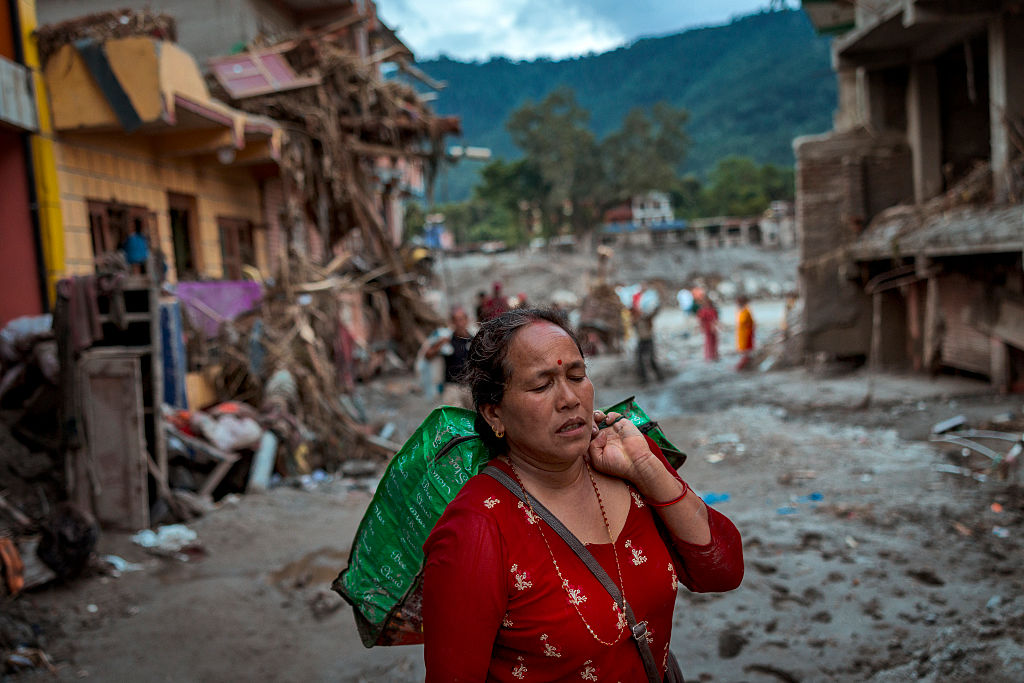
While board members were united in approving the $20 million, plus $1.6 million of administrative costs, representatives of developed and developed countries were divided over the extent to which the decision should set a precedent for the fund’s long-term way of operating.
Germany and Czechia’s board members said it should not set a “precedent” while Japan’s representative said the decision is “truly exceptional” and that the fund’s support must be “in accordance with established rule and procedure”.
Learning the lessons?
Responding, Pakistan’s Ali Sheikh said the lessons from the Nepal case should “feed the long-term model and its work on rapid disbursement” of funds.
He added that he had heard Jan Dusik, Czechia’s board member saying that “we are open for learning but not in setting precedent”. “Please do not define the boundaries for learning,” he emphasised.
Sheikh complained that the decision approved by the board – the result of negotiations between a group of four developed and four developing-country representatives – was narrower than developing countries had hoped for.
“We are saying it is a one-time and Nepal-only window, a sentiment against which many developed countries have raised their voice,” he said, adding there had been no time to review the decision.
Walter Schuldt from Ecuador echoed Sheikh, saying “we should not put limits on lesson learning”. He said the decision, which he was involved in negotiating through “intense exchanges”, tells the fund’s staff to assess the lessons learned.
The fund is currently in a start-up phase and the board will debate its long-term model – including whether and how to rapidly disburse funds in response to climate-driven disasters – at its next board meeting in the Philippines in December.
At Thursday’s meeting, several developing-country board members called for wealthy nations to put more money into the fund. Recovery and reconstruction from Nepal’s flood alone is estimated to cost $4.8 billion – in comparison, the fund has only around $350 million to allocate, with a current cap of $20 million per project.
The post Loss and damage fund agrees $20m for Nepal but rich nations warn it should not set precedent appeared first on Climate Home News.
Loss and damage fund agrees $20m for Nepal but rich nations warn it should not set precedent
Artificial intelligence (AI) is developing at a rapid pace and is increasingly being used by scientists to better understand climate change.
AI is perhaps best-known for its use in “large language models”, such as ChatGPT, Claude and Gemini.
However, the field is vast.
From weather forecasting to analysing satellite images, climate scientists are using various types of AI to develop faster and more efficient ways to study the warming planet.
However, the technology comes with no shortage of risks and challenges, including overreliance on unverified results, intensive energy use and exacerbating existing inequalities in climate science.
Carbon Brief spoke to 10 experts working across a range of climate-related fields – from developing climate forecasts to analysing changes in the energy grid – about how AI is being used.
Their answers are set out below, grouped by theme.
- What are the benefits and challenges of using AI in weather and climate forecasting?
- What are some other current uses of AI in climate science research?
- How is AI being used to advance climate policy and action?
- How could AI be used in climate research over the coming years?
- Are there any misconceptions about the use of AI in climate science?
- Could AI improve or exacerbate inequalities in climate research?
- What are some other risks and challenges of AI in climate change research?
What are the benefits and challenges of using AI in weather and climate forecasting?
Dr Doug McNeall, science lead in data-driven climate modelling at the UK Met Office:
One of the most significant recent developments has been the success of AI weather-prediction models, which learn from large volumes of weather data to predict the next few hours ahead and then repeatedly feed those predictions back into themselves to generate forecasts up to two weeks into the future.
These models have demonstrated that AI can provide accurate predictions while requiring far less computing power than existing numerical models [which rely on mathematical equations to simulate the climate].
One of the main challenges is that AI weather-prediction models have been developed for relatively short timescales, where large amounts of observational data [for example, temperature, rainfall or sea ice extent data] is available and model performance can be evaluated quickly and rigorously.
Climate prediction is fundamentally different. To provide useful climate information, we need to make projections for future climates that lie outside the observational record.
One promising route forward is, therefore, to use AI to emulate or accelerate these existing models, rather than relying solely on purely data-driven approaches. This blended approach could make climate risk information far more accessible and affordable to produce, while retaining the physical understanding [based on mathematical and scientific principles] that underpins confidence in climate projections.
Prof William Collins, professor of AI for climate science at the University of East Anglia:
We’re seeing a really exciting renaissance in both weather and climate science…Machine learning [a subset of AI that uses algorithms to let computers learn from data and make predictions without being explicitly programmed] has had an enormous impact on numerical weather prediction.
So, for example, the European Center for Mid-Range Weather Forecasts is now deploying an AI forecast system as part of their official communication of weather predictions to the European community, alongside the traditional forecast system. AI systems have become good enough that they’re absolutely competitive with the world’s leading numerical weather prediction…So that’s been quite remarkable.
Much of machine learning and AI involves learning from data and climate represents a future for which we do not have data. We’re literally trying to predict the future. We don’t have observations of it. So, where does the data come from to inform the models? That is, at the moment, the central challenge that the climate community is attempting to overcome.
Dr Amirpasha Mozaffari, researcher in Earth artificial intelligence at the Barcelona Supercomputing Centre:
AI forecast models do well on typical weather, but underperform physics-based models on record-breaking and unprecedented extremes – precisely the events that matter most for adaptation [to climate change].
Solving that – whether through hybrid models [which combine AI with traditional models], physical constraints [in which rules are implemented based on the laws of physics to help the models make realistic forecasts] or new ways of evaluating models on what they have not seen – is the central open problem for the field.