

Following a “landslide” Labour win in the UK general election, attention is turning to the new government’s next steps.
Climate and energy were key parts of Labour’s election campaign and manifesto, with a range of policies it will now look to enact. This ranges from zero-carbon power by 2030 and reforming the planning system, through to decarbonising heat and developing adaptation policy.
Carbon Brief has asked a range of policy experts, academics and campaigners what they think is the incoming government’s top priority for meeting UK climate targets.
These are their responses, first as sample quotes, then, below, in full (some entries have been edited for length and clarity):
- Charles Oglivie: “To tackle the myriad of…challenges facing the UK, No 10 will have to make some quick, difficult choices about how to manage Whitehall.”
- Adam Bell: “Delivering at the pace required involves spending the kind of political capital that only a landslide win can offer.”
- Jan Rosenow: “We now need to tackle the other 80% of our energy use and focus on decarbonising heating and transport.”
- Juliet Phillips: “Labour will need to hit the ground running to fulfil its clean power mission.”
- Federica Genovese: “The top political priority in the first six months is to credibly form the coalitions of supporters willing to shift gears on the energy transition.”
- Rachel Solomon Williams: “There is very little time in which to transform the economy.”
- Bethan Laughlin: “Adaptation must be integrated into all government policy decision-making processes.”
- Dr Nina Skorupska CBE: “We need delivery forces not more task forces.”
- Jenny Bird: “Deliver an adaptation programme that is fit for purpose.”
- Andrew Sissons: “The UK is a long way behind where it needs to be on heating and it will be very hard to meet future carbon budgets without a rapid turnaround.”
- Caterina Brandmayr: “The UK should help raise ambition globally by submitting an ambitious and credible 2035 NDC.”
- Tessa Khan: The government “needs to stop locking in our dependency on fossil fuels by rejecting any new oil and gas projects”.
- Rebecca Williams: “The priority should be unblocking investment in offshore wind.”
- Linda Kalcher: “The clean power by 2030 goal is ambitious, but a smart economic and security choice.”
- Sam Hall: “Crucially, the new government must urgently rebalance levies from electricity to gas.”
- Ben Nelmes: “The UK needs a motoring taxation that is fit for the day when 100% of the cars on the roads are fully electric.”
 Charles Ogilvie
Former strategy director of COP26 and senior strategic counsel to COP28; former Conservative special advisor on energy and climate policy
To tackle the myriad of linked domestic and international challenges facing the UK, No 10 will have to make some quick, difficult choices about how to manage Whitehall.
Their top priority on day one should be establishing an integrated, programmatic approach to delivering on the climate mission; to ensure that DESNZ (the Department of Energy Security and Net-Zero) is not held up by cross Whitehall logjams – especially around domestic planning, land use, and industrial strategy; and that the Treasury and FCDO (Foreign, Commonwealth and Development Office) are integrated into a strategic approach that leverages UK domestic leadership and investments to effectively shift the world faster, whilst generating co-benefits in trade, development and influence.
Time is of the essence as many of the manifesto promises will be tough to deliver in a single parliament. No 10 will have to think hard about what to prioritise early on, in order to prove to the country that the inevitable compromises needed in the short term will deliver the promised wins.
 Adam Bell
Director of policy, Stonehaven
Labour’s first priority must be getting the structures they need to deliver their 2030 power decarbonisation ambition in place before anything else. Delivering at the pace required involves spending the kind of political capital that only a landslide win can offer.
Carving out exemptions from the planning system for energy infrastructure – which their target will require – must be a key first step.
Setting up a cross-government committee to deliver, chaired by the prime minister, should happen within the first few weeks. And getting the necessary outline of legislation into the king’s speech before parliament rises is essential.
 Jan Rosenow
Director at Regulatory Assistance Project
The UK has made great strides with decarbonising its electricity. We now need to tackle the other 80% of our energy use and focus on decarbonising heating and transport.
The new government can do this by rebalancing energy prices making electrification an attractive proposition to people and industry. We also need clarity on the role of hydrogen and an ambitious plan for rolling out heat pumps.
 Juliet Phillips
Programme lead, UK energy team, E3G
Labour will need to hit the ground running to fulfil its clean power mission – quickly making decisions on the scale of the next renewables auction round, taking actions to unclog the planning system and setting up GB Energy.
They mustn’t forget the less sexy, but equally important, cleantech solutions that will be needed to get the UK off fossil gas, including demand side flexibility, long-duration energy storage and green hydrogen.
Labour will also need to quickly get to grips with how they can turn around the sluggish delivery of retrofit schemes. The locally-led retrofit schemes are currently massively under-delivering, returning vast sums of unspent money back to the Treasury. Labour will need to listen to installers and local authorities to understand where the current pinch-points are and how these can be quickly addressed.
 Federica Genovese
Professor of political science at University of Oxford
In my opinion – and recall that I am a political scientist – the top priority is not focusing on single climate targets. The top political priority in the first six months is to credibly form the coalitions of supporters willing to shift gears on the energy transition, which of course will come with adjustment costs.
Bad news: there are *many* actors that need to be brought into this coalition, most of which have already suffered from unjust energy transitions of the past (eg polluting industry workers) or that fear the costs of any adjustment (fossil fuel companies). Convincing these actors will require building trust and, simply put, money.
Good news: we will have a new government with both a broad initial support and more technocratic takes (less populism at the top). The new government needs to capitalise on these circumstances and make climate targets an embedded product or the new economic growth model it wishes to forge.
 Rachel Solomon Williams
Executive director, Aldersgate Group
Focus on delivery and stability – there is very little time in which to transform the economy.
It’s vital that the new government focuses on delivery, rather than on crafting new policies. Policy work is well advanced on a range of important climate issues, such as green finance, emissions trading and power market reform. In these areas (and others), what’s needed now is clear prioritisation, decision-making and resourcing rather than extensive further consultation.
This should all be supported by a clear governance structure, which combines central leadership with mature collaboration with businesses, regional and local government and civil society.
 Bethan Laughlin
Senior policy specialist, Zoological Society of London
Urgent action is required to prioritise climate adaptation and resilience to protect citizens, property, food systems, health and the environment from growing climate shocks. Adaptation must be integrated into all government policy decision-making processes with effective, ambitious, implementable and well-funded strategies.
Appointing a climate adaptation and resilience minister to sit across Defra (Department for Environment, Food & Rural Affairs) and DESNZ is crucial for ensuring political attention, budget allocation and civil service resources.
Investment in nature-based adaptation approaches also offers cost-effective, high-impact action, providing adaptation and mitigation benefits alongside a wide range of societal and economic co-benefits.
 Dr Nina Skorupska CBE
Managing director of the Renewable Energy Association
Unblock the infrastructure and planning requirements for the renewable energy national, regional and local developments by establishing the NESO (National Energy Systems Operator) as quickly as possible and bang the energy and environmental regulators heads together to make sure their purposes and responsibilities are aligned and resources to regulate properly; we need delivery forces, not more task forces.
There are enough “recommendations” out there that make good common energy and net-zero sense, including accelerating the REMA (review of electricity market arrangements) solutions. All done by mid 2025 to have a fighting chance for net-zero by 2030.
 Jenny Bird
Campaign manager, Grantham Institute, Imperial College London
Deliver an adaptation programme that is fit for purpose.
Climate change is already making UK extreme weather events more likely and more intense; the 2022 heatwave and winter storms earlier this year being two examples.
The third National Adaptation Programme (NAP3) “falls far short of what is needed” according to the Climate Change Committee. Strengthening adaptation action should be a top priority for a government that is seeking to deliver security and stability for people, communities and the economy.
We need to see a greater level of ambition, combined with a more strategic approach to managing complex climate risks, interdependencies between different sectors and our exposure to impacts elsewhere in the world (through global supply chains and other means).
 Andrew Sissons
Deputy director, Nesta
A lot of attention will be focused on decarbonising electricity, but the real challenge will be on buildings. The UK is a long way behind where it needs to be on heating and it will be very hard to meet future carbon budgets without a rapid turnaround.
The government needs a new approach. It needs to quickly rule out hydrogen for heat and clarify its plans on phase-out dates. It must make heat pumps more affordable, aiming for lifetime cost parity with boilers and rebalancing electricity levies. And it needs to build new state delivery capacity, with a new national heating agency and stronger local institutions.
 Caterina Brandmayr
Director of policy and translation, Grantham Institute
With countries due to submit new nationally determined contributions (NDCs) ahead of COP30, it is vital to scale up action to put the world on track to deliver on the Paris Agreement’s goals.
The UK should help raise ambition globally by submitting an ambitious and credible 2035 NDC, alongside a strengthened 2030 NDC – setting out clear policies to deliver on the COP28 commitment of “transitioning away from fossil fuels”, stronger plans on adaptation, aligned with the new framework for the Global Goal on Adaptation and an ambitious climate finance contribution.
The UK should also champion ambitious, evidence-based climate policy at fora such as the G7, G20, the UN general assembly and the Intergovernmental Panel on Climate Change (IPCC), and it should be at the forefront of global efforts to scale up finance for climate action.
 Tessa Khan
Executive director, Uplift
The UK government must ensure that we accelerate our transition away from fossil fuels and that the transition is fundamentally fair, including through more affordable energy and good jobs.
As a first step, it needs to stop locking in our dependency on fossil fuels by rejecting any new oil and gas projects, building on its commitment to reject new licensing. Further, it needs to introduce processes, policies and investment so that the workforce and communities that have strong ties to the oil and gas sector benefit from the transition away from oil and gas production.
Lowering bills will take time, but short-term steps can be taken to help struggling households. This includes protecting vulnerable households by extending the warm homes discount, reducing energy debt and reforming standing charges.
 Rebecca Williams
Chief strategy officer, Offshore Wind, Global Wind Energy Council
It’s exciting to see the Labour party elected with a clear mandate to accelerate climate action and renewable energy. The priority should be unblocking investment in offshore wind.
Sending this strong signal on renewables will help the UK regain its position on international climate leadership, which is now focused on how to deliver the global tripling of renewables by 2030. The UK has been underperforming against its peers in this arena for quite some time, failing to make the most of its huge advantage when it comes to offshore wind.
The Global Wind Energy Council is looking forward to working with Keir Starmer and Ed Miliband to see the UK retake its climate leadership crown.
 Linda Kalcher
Executive director, Strategic Perspectives
The UK can reinforce its international leadership on power decarbonisation again and return as “best in the class” among the G7. The clean power by 2030 goal is ambitious, but a smart economic and security choice. It can lower the energy bills for households and businesses, as well as reduce the UK’s import dependence.
Electrification has untapped potential – in the transport, heating and industry sectors. Only fossil-free power can enable these sectors to actually decarbonise. Renewables are the cheapest and fastest clean power source to build domestically. There is untapped potential ranging from community energy to offshore wind parks.
With the G7 struggling to wean itself off fossil fuels, the time is right for the UK to step up and show how a clean power sector can be achieved by 2030.
 Sam Hall
Director, Conservative Environment Network
Labour’s stated top priority is power sector decarbonisation by 2030 through accelerated planning decisions. But the biggest climate policy gap in Labour’s manifesto was on how to decarbonise home heating. If we’re going to get on track to meeting our climate goals, wean ourselves off imported gas and deliver permanently lower energy bills, this arguably should be the top priority.
The previous government’s enhanced boiler upgrade scheme (BUS) has helped to drive the uptake of heat pumps in recent months and is an essential part of the policy mix. But confirmation of the clean heat market mechanism, extensions to permitted development rights for heat pumps, an extension of BUS funding in the spending review, and new mechanisms to unlock more private investment in retrofit and reforms to the retail energy market will also be needed.
Crucially, the new government must urgently rebalance levies from electricity to gas, to end the penalty on lower-carbon electricity and to encourage electrification, while protecting lower-income households reliant on gas boilers.
 Ben Nelmes
Chief executive, New AutoMotive
The top climate priority for this government to maintain momentum on UK emissions reductions will be to start seeing reductions from road transport emissions. Carbon emissions from road transport have been stubbornly flat in recent years, but significant reductions are required to meet the fourth and fifth carbon budgets, 2023-27 and 2028-32 respectively.
Labour went into the election promising to restore the 2030 phase-out date for petrol and diesel vehicles, which had been the last government’s approach until September 2023. Between 2030 and 2035, new cars and vans can be sold if they have significant zero emission capability, which was envisaged to permit the sale of some plug-in and full hybrids during that time. Clarifying exactly what hybrids may be sold during this time is necessary to provide the car industry with clarity around the government’s plans.
Restoring certainty about cross-channel trade in electric vehicles is vital to the automotive industry transition in the UK, and must be an urgent priority for the UK government.
The government should take the experience with EU exports as a salutary lesson in the risk of having our EV exports hit by tariffs, and be very cautious about following Brussels and introducing tariffs on Chinese EVs.
The UK needs a motoring taxation that is fit for the day when 100% of the cars on the roads are fully electric, and the best time to act is now while there is a relatively small number of BEV cars around. Rather than seeking to find ways to simply replace revenue, the government should start by deciding what its transport strategy is for the UK, the role of vehicles in our economy and society, and a weighing exercise taking into account private and public costs and benefits.
The new Labour government has inherited a commitment without a plan: the UK needs to find a way to phase-out sales of fossil fuelled HGVs by 2035, yet there is no emissions standard or ZEV mandate to make this ambition a reality. The UK risks falling behind the EU, which has a new scheme for HGVs.
Misinformation and myths about electric vehicles are still deterring some consumers from considering the technology, despite the growing number of electric cars and vans on UK roads. The last government closed down the Go UltraLow campaign, which was supported by the automotive industry, and which sought to give consumers information about electric and low-emission cars on offer. The government should consider steps to make more factual and impartial information available to consumers about making the switch to electric vehicles.


The post Experts: What is the Labour government’s top priority for meeting UK climate targets? appeared first on Carbon Brief.
Experts: What is the Labour government’s top priority for meeting UK climate targets?

With the U.S. bombing Iran and the Strait of Hormuz closed, energy experts say countries transitioning to renewables will be more resilient in the “face of the shock.”
The United States’ war on Iran could fundamentally alter how countries consume and generate energy and hamper international progress in combating climate change, a panel of energy experts said today.
The Global Energy Supply in a Decade ‘Is Not a World We’re Going to Recognize’
One month into the US and Israel’s war on Iran, at least 60 countries have taken emergency measures in response to the subsequent global energy crisis, according to analysis by Carbon Brief.
So far, these countries have announced nearly 200 policies to save fuel, support consumers and boost domestic energy supplies.
Carbon Brief has drawn on tracking by the International Energy Agency (IEA) and other sources to assess the global policy response, just as a temporary ceasefire is declared.
Since the start of the war in late February, both sides have bombed vital energy infrastructure across the region as Iran has blocked the Strait of Hormuz – a key waterway through which around a fifth of global oil and liquified natural gas (LNG) trade passes.
This has made it impossible to export the usual volumes of fossil fuels from the region and, as a result, sent prices soaring.
Around 30 nations, from Norway to Zambia, have cut fuel taxes to help people struggling with rising costs, making this by far the most common domestic policy response to the crisis.
Some countries have stressed the need to boost domestic renewable-energy construction, while others – including Japan, Italy and South Korea – have opted to lean more on coal, at least in the short term.
The most wide-ranging responses have been in Asia, where countries that rely heavily on fossil fuels from the Middle East have implemented driving bans, fuel rationing and school closures in order to reduce demand.
‘Largest disruption’
On 28 February, the US and Israel launched a surprise attack on Iran, triggering conflict across the Middle East and sending shockwaves around the world.
There have been numerous assaults on energy infrastructure, including an Iranian attack on the world’s largest LNG facility in Qatar and an Israeli bombing of Iran’s gas sites.
Iran’s blockade of the Strait of Hormuz, a chokepoint in the Persian Gulf, is causing what the IEA has called the “largest supply disruption in the history of the global oil market”.
A fifth of the world’s oil and LNG is normally shipped through this region, with 90% of those supplies going to destinations in Asia. Without these supplies, fuel prices have surged.
Governments around the world have taken emergency actions in response to this new energy crisis, shielding their citizens from price spikes, conserving energy where possible and considering longer-term energy policies.
Even with a two-week ceasefire announced, the energy crisis is expected to continue, given the extensive damage to infrastructure and continuing uncertainties.
Asian crunch
Carbon Brief has used tracking by the IEA, news reports, government announcements and internal monitoring by the thinktank E3G to assess the range of national responses to the energy crisis roughly one month into the Iran war.
In total, Carbon Brief has identified 185 relevant policies, announcements and campaigns from 60 national governments.
As the map below shows, these measures are concentrated in east and south Asia. These regions are facing the most extreme disruption, largely due to their reliance on oil and gas supplies from the Middle East.
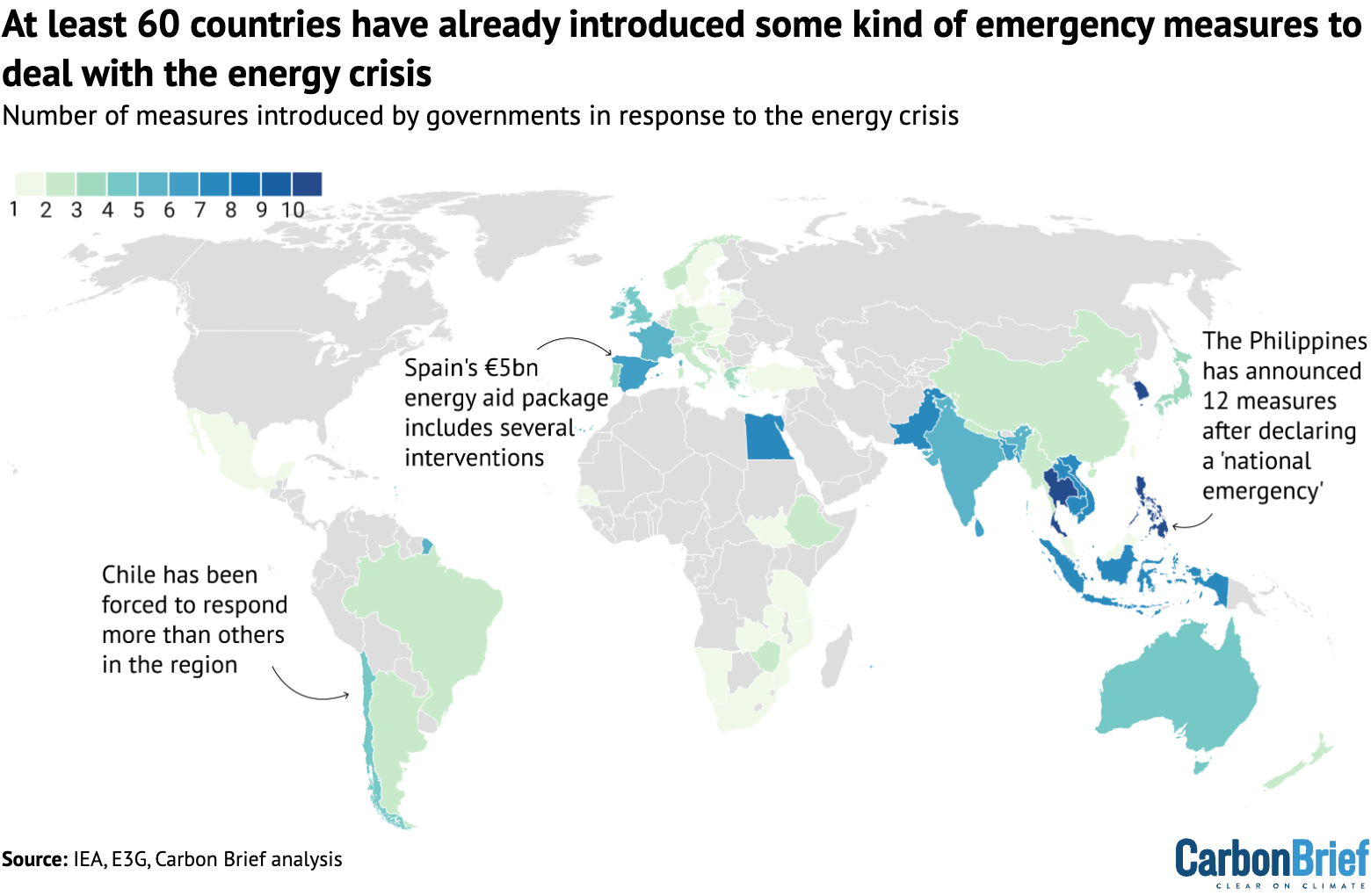
Nations including Indonesia, Japan, South Korea and India are already spending billions of dollars on fuel subsidies to protect people from rising costs.
At least 16 Asian countries are also taking drastic measures to reduce fuel consumption. For example, the Philippines has declared a “state of national emergency”, which includes limiting air conditioning in public buildings and subsidising public transport.
Other examples from the region include the government in Bangladesh asking the public and businesses to avoid unnecessary lighting, Pakistan reducing the speed limit on highways and Laos encouraging people to work from home.
Europe – which was hit hard by the 2022 energy crisis due to its reliance on Russian gas – is less immediately exposed to the current crisis than Asia. However, many nations are still heavily reliant on gas, including supplies from Qatar.
The continent is already feeling the effects of higher global energy prices as countries compete for more limited resources.
At least 18 European nations have introduced measures to help people with rising costs. Spain, which is relatively insulated from the crisis due to the high share of renewables in its electricity supply, nevertheless announced a €5bn aid package, with at least six measures to support consumers.
Many African countries, while also less reliant on direct fossil-fuel supplies via the Strait of Hormuz than Asia, are still facing the strain of higher import bills. Some, including Ethiopia, Kenya and Zambia, are also facing severe fuel shortages.
There have been fewer new policies across the Americas, which have been comparatively insulated from the energy crisis so far. One outlier is Chile, which is among the region’s biggest fuel importers and is, therefore, more exposed to global price increases.
Tax cuts
The most common types of policy response to the energy crisis so far have been efforts to protect people and businesses from the surge in fuel prices.
At least 28 nations, including Italy, Brazil and Australia, have introduced a total of 31 measures to cut taxes – and, therefore, prices – on fuel.
Even across Africa, where state revenues are already stretched, some nations – including Namibia and South Africa – are cutting fuel levies in a bid to stabilise prices.
Another 17 countries, including Mexico and Poland, have directly capped the price of fuel. Others, such as France and the UK, have opted for more targeted fuel subsidies, designed to support specific vulnerable groups and industries.
These measures are all shown in the dark blue “consumer support” bars in the chart below.
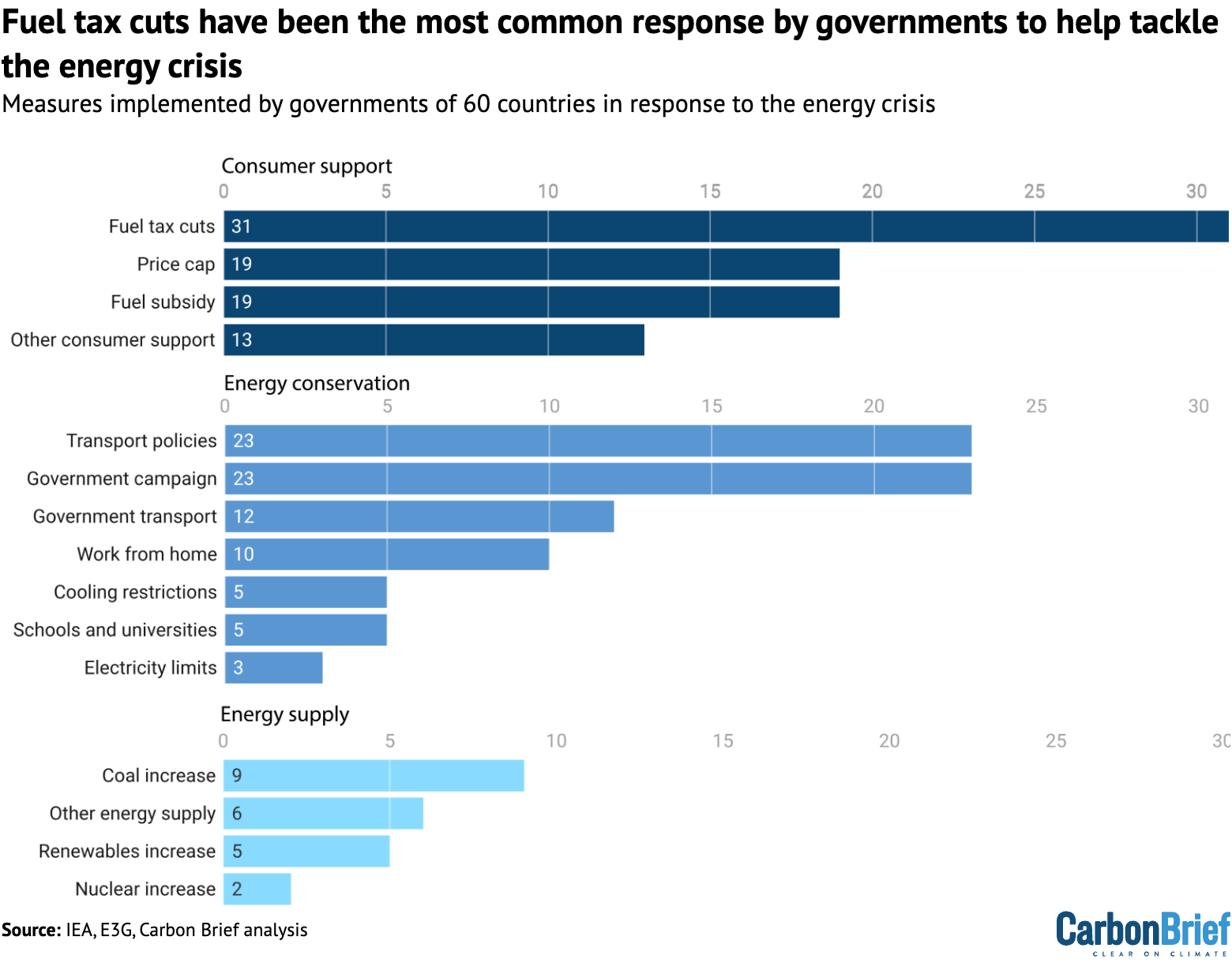
Such measures can directly help consumers, but some leaders, NGOs and financial experts have noted that there is also the risk of them driving inflation and reinforcing reliance on the existing fossil fuel-based system.
Christine Lagarde, president of the European Central Bank, spoke in favour of short-term measures to “smooth the shock”, but noted that “broad-based and open-ended measures may add excessively to demand”.
Measures to conserve energy, of the type that many developing countries in Asia have implemented extensively, have been described by the IEA as “more effective and fiscally sustainable than broad-based subsidies”.
So far, there have been at least 23 such measures introduced to limit the use of transport, particularly private cars.
These include Lithuania cutting train fares, two Australian states making public transport free and Myanmar and South Korea asking people to only drive their cars on certain days.
Clean vs coal
At least eight countries have announced plans to either increase their use of coal or review existing plans to transition away from coal, according to Carbon Brief’s analysis. These include Japan, South Korea, Bangladesh, the Philippines, Thailand, Pakistan, Germany and Italy.
These measures broadly involve delaying coal-plant closure, as in Italy, or allowing older sites to operate at higher rates, as in Japan – rather than building more coal plants.
There has been extensive coverage of how the energy crisis is “driving Asia back to coal”. However, as Bloomberg columnist David Fickling has noted, this shift is relatively small and likely to be offset by a move to cheap solar power in the longer term.
Indeed, some countries have begun to consider changes to the way they use energy going forward, amid a crisis driven by the spiralling costs of fossil-fuel imports.
Leaders in India, Barbados and the UK have explicitly stressed the importance of a structural shift to using clean power. Governments in France and the Philippines are among those linking new renewable-energy announcements with the unfolding crisis.
New renewable-energy capacity will take time to come online, albeit substantially less time than developing new fossil-fuel generation. In the meantime, some nations are also taking short-term measures to make their road transport less reliant on fossil fuels.
For example, the Chilean government has enabled taxi drivers to access preferential credit for purchasing electric vehicles (EVs). Cambodia has cut import taxes on EVs and Laos has lowered excise taxes on them.
Finally, there have been some signs that countries are reconsidering their future exposure to imported fossil fuels, given the current economics of oil and gas.
The New Zealand government has indicated that a plan to build a new LNG terminal by 2027 now faces uncertainty. Reuters reported that Vietnamese conglomerate Vingroup has told the government it wanted to abandon a plan to build a new LNG-fired power plant in Vietnam, in favour of renewables.


The post Iran war analysis: How 60 nations have responded to the global energy crisis appeared first on Carbon Brief.
Iran war analysis: How 60 nations have responded to the global energy crisis
Seven Senate Democrats launched the probe over controversial tax credits to the country’s largest exporter of liquefied natural gas.
Seven Democratic U.S. senators have launched a probe into a $370 million “alternative fuel” payout to Cheniere Energy, made earlier this year by the IRS, that critics say the liquefied natural gas export company never should have received.
US Senators Investigate $370 Million IRS Payout to Cheniere Energy

The Global Energy Supply in a Decade ‘Is Not a World We’re Going to Recognize’

Iran war analysis: How 60 nations have responded to the global energy crisis
US Senators Investigate $370 Million IRS Payout to Cheniere Energy
-
Climate Change8 months ago
Guest post: Why China is still building new coal – and when it might stop
-
Greenhouse Gases8 months ago
Guest post: Why China is still building new coal – and when it might stop
-

 Greenhouse Gases2 years ago
嘉宾来稿:满足中国增长的用电需求 光伏加储能“比新建煤电更实惠”
-
Climate Change2 years ago
Bill Discounting Climate Change in Florida’s Energy Policy Awaits DeSantis’ Approval
-

 Climate Change2 years ago
嘉宾来稿:满足中国增长的用电需求 光伏加储能“比新建煤电更实惠”
-
Climate Change Videos2 years ago
The toxic gas flares fuelling Nigeria’s climate change – BBC News
-

 Renewable Energy6 months ago
Sending Progressive Philanthropist George Soros to Prison?
-

 Carbon Footprint2 years ago
US SEC’s Climate Disclosure Rules Spur Renewed Interest in Carbon Credits