

 When we come across statements like the one at left, we have to wonder about the IQ of people who find this compelling.
I’ve known house cats far smarter than this.







Weather Guard Lightning Tech
Wavepiston Brings Wave Energy to Island Communities
Michael Henriksen, CEO at Wavepiston, joins to discuss wave energy’s advantages for island communities, the company’s hydraulic piston system, offshore wind co-location, and the Barbados pilot project.
Sign up now for Uptime Tech News, our weekly newsletter on all things wind technology. This episode is sponsored by Weather Guard Lightning Tech. Learn more about Weather Guard’s StrikeTape Wind Turbine LPS retrofit. Follow the show on YouTube, Linkedin and visit Weather Guard on the web. And subscribe to Rosemary’s “Engineering with Rosie” YouTube channel here. Have a question we can answer on the show? Email us!
Welcome to Uptime Spotlight, shining light on wind. Energy’s brightest innovators. This is the Progress Powering tomorrow.
Allen Hall: Michael, welcome to the program.
Thanks, Allen. A pleasure.
Allen Hall: Well, this is gonna be a, a really interesting discussion today because, uh, I don’t know a lot about wave power, but. Obviously the world has made some substantial progress in wind and solar, but the ocean energy is still relatively unknown and. I want you to, just to paint the picture of the problem, what gap exists in renewable energy today that wave energy can fill?
Michael Henriksen: Thanks. Thanks. A yes. Uh, that’s right. So ocean energy as such. And we have, um, we are working with the wave energy side of the other things here in Wave Piston has a very large potential because there’s a lot of waves around us. We all feel it when we are out in the sea, when we’re out swimming or whatever.[00:01:00]
So what can it fill out that is that, that the, the interesting thing about wave energy is that is, um, timewise shift compared to wind. You know, it’s the wind that builds up the waves. The waves come, uh, the wind comes and goes, but the waves that keep rolling also afterwards. Yeah. So this timewise shift that gives some extra value.
Of the energy that you can actually produce at the same time, it’s actually also, it’s a more of stable resource. So you, you don’t have these large fluctuation, it, it, it comes slowly and then dies away slowly depending on where you are in the world, of course. And then the last for the least is it’s very predictable.
So stable days advantage, you can actually very precise predict what sort of your energy production profile. So by adding an extra renewable energy source, you can actually sort of, it gives extra value to both have sort as much solar PV as possible, as much wind as possible, but also have wave energy there to have sort of a better, uh, in the end, uh, [00:02:00] uh, energy production.
Allen Hall: Yeah. And that, and the technology is really applicable to, uh, a lot of regions, uh, around just like island communities and places of a little more remote. Uh, because the cost of electricity on islands is incredibly high. They’re buying diesel usually, and they have a kind of a, a double problem in that they have to buy diesel to run electricity plants, and then at the same time they’re, they’re having to make fresh water all the time ’cause fresh water’s a problem.
Wave Piston solves both of these problems together. But why are we in this? Space right now. I, I just wanna back up a minute. I mean, there, there does seem like for the last 30, 40 years that I can remember, the island communities have been really stuck. Solar hasn’t really filled the void. Wind has been intermittent option at times.
Why waves?
Michael Henriksen: Yeah. But that’s actually, uh, where we see our, like our step to, uh, [00:03:00] you know, uh, go to market strategy, so to speak. See, that is the first step because as you mentioned, all the island communities, I would also say remote coastal communities still have this, this challenge of being dependent on fossil fuels.
And as you know, it’s, it’s mainly because of course you have limited, uh, uh, uh, land space. Uh, of course they should have as much solar PB as wind as possible, but you still have this, you know, you don’t wanna have it in your backyard. It’s difficult to have, you know, spatial beautiful islands where you have, uh, tourism, et cetera.
And then you have, uh, solar PB and winter turbines all over the place. It’s not gonna happen. So they’re looking at to go to, of course, offshore. What they have a lot of us is they have ocean. Yeah. And the challenge there again, is. Most places when you go just a few kilometers from shore get very, very deep.
Yeah. So you need to find something that is sustainable, something that it will not spoil the view. Something that is actually, uh, uh, an [00:04:00]environmental friendly way, you know, of harnessing the energy that that is where wave energy come into the picture because. It’s happening below the sea. So the, the surface and, and, and the, it can sort of coexist with other things happening there.
Of course, you need to have an area where just say this is for wave minute. Yeah. But you don’t, so sort of spoil view. You don’t have this issue with the, not in my background as such. So, so, so by coming in, of course we will be at another cost level to begin with. Yeah. By coming in, taking that part of it, then we can actually be a part of solutions for these remote islands and the coastal communities.
Allen Hall: Well, because some of these islands are spending more than 10% of the GDP just on energy to import it. That’s. Really high and a, on a big burden on the economy is how do you see wave piston affecting that?
Michael Henriksen: But it’s just actually that is this, uh, it’s, it’s both, you know, in the first phase, of course, the islands in milk richi, but also you can say [00:05:00] countries as such that are dependent on fossil.
Because you can just reduce your dependency and also these volatility of the price. Uh, but, but go coming back to wave piece, of course we, uh, the special thing about our system is that we actually, we can both produce electricity and we can also desalinate sea water ’cause it’s hydraulic system. So this about coming into an island community where they have both these challenges.
We can actually come with a double. Sort of a, uh, solution and then, uh, work with how much energy you need, how much water you need at a given time. It could be an off grid solution or an on grid or micro grid, whatever, where, where, where. That makes sense. Yeah. So coming in and that’s actually why there is a big uh, uh, sort of.
Focus on wave, not only on us, but also others in the sector, that we can be a part of the solution, which is actually when you come with a new thing, you need to sort of to say, okay, this is new, this is fantastic. But you also need to say, okay, we are part of the solution now. We are solving some of the problems you have.
We’re not [00:06:00] creating new ones. Or maybe you not, not, there’s always some challenges, but we are not creating that many of big ones. You know? We are solving things. Yeah, we’re solving. Your challenges?
Allen Hall: Well, e even if you look beyond the island, island economies, uh, there’s a bigger picture here about renewable energy sector that is not really considered wave energy too much, especially for offshore wind, right?
There’s, uh, uh, offshore wind, particularly in the North Sea and off the coast of England and other places where there’s our massive wave resources. We haven’t really addressed that at all. Are we missing out on a, on a lot of energy production? That would be relatively easy to go get.
Michael Henriksen: We are missing out.
That’s the, the, the short, the short, uh, uh, answers there. Of course, we see relatively easy need to look at the relatively side of it because it is difficult going offshore. You know why? But it’s also why I’m asking. It’s actually why it hasn’t wave energy succeeded so far. Well, that’s simply because it’s [00:07:00]not the low hanging fruit.
Now being able to take a wind turbine. You know, in Denmark it was the farmer. You could just go, or the local Smith blacksmith go, go and fix things. Now we need to go offshore immediately. You didn’t throw the wind turbines in the middle of the North Sea in the first place? No. So this of course, solving the issue with.
The survivability someplace. Sometimes you have really extreme large weight, large, uh, forces you need to work with. You have your ability, you know, you have this, that, that there are millions of cycles in the corrosive, uh, environment. So all that of course you need to, uh, design the system to handle and still being able to, you can see through cost trajectory will get you down to, to a competitive cost limit.
So of course, yes, we’re missing out. Uh. There is a large, uh, uh, sea space, especially in the, all the newer, uh, offshore wind turbine areas because they take up a lot of space. They have very large, beautiful wind turbines, but you have a large sea [00:08:00] space in between where you can actually use that for energy production.
So, so yes. That’s, uh, definitely a large of opportunity.
Allen Hall: Well, so let’s talk about what Wave Piston has built. Can you walk us through what the Wave Energy system does, kind of how it works in simple terms and what makes it different from some of the earlier Wave energy devices that have been tried over the years?
Michael Henriksen: So, so we, uh, in Wave Piston is actually going a bit back to the, the whole old style. It was not me actually, that’s the clever one There is by colleagues in, in, in, in Wave Piston. So, uh, but they, they was general analyzing. What are the, the challenges, you know, or has been the challenges, uh, on, on Wave 80.
Why haven’t we succeeded so far? And it, what they came up with is actually this brilliant concept we have now that is so hard so far, not so. Put it in a, in a labor perspective. Something also I understand, I understand. Even, I understand that is, you know, we’re not, you know, fighting the forces. We’re just working together with the forces of the ocean, and that’s what it came up with, this [00:09:00] concept where we have many of these.
Sail that are put in the water. They are like vertical sail. And when you put a sail in the water like that, it will move back and forth with a wave pass by and the breed thing, they say, okay, but what happens then? If you have many of these in the same structure, then actually they work together the the way together.
And that way they each can convert the energy in the waves to what we, we converted to high prices seawater. But the, the Im the way, the impact on the structure of the things that hold it together, they, that’s actually reduced. So we have forced cancellation because any of these are moving in different, you know, uh, uh, timings compared to where the waves comes by.
Yeah. So there are things, so to speak, so we can reduce the mooring loads. So the, the loads should keep things in place to less than a 10 compared to having, you know, individual wave in conversions out there. So that’s sort of the main thing. That’s our main concept. Uh, that’s our also made, made ip. And you can just a back to me, that’s one of our, that’s our actually test in the North Sea.
We did [00:10:00] in 20 18, 20 19, um, of, of string there was only four energy collectors on. So what we see is that we, we will go plus 20 on these sales that are on the same structure and then up to 30 in the, in the thirties on each of these strings.
Allen Hall: Yeah. So the, the concept is you have a string of sales that are tied together that are.
Pumps, basically water pumps, and instead of trying to create electricity in each of the pistons themselves, what the pistons are pushing water to another location, typically on shore, which is then spinning a turbine, which creates electricity. So it’s more of a. High pressure water pump system instead of something more complex.
The, the, the simplicity of it, I, I like because it, it is not a lot of moving parts here. Pumps are very well known, but one of the questions I think that comes up a lot about anything in the water is survivability because the ocean can get a little [00:11:00] crazy at times. How have you designed this system to handle some of the loads from the ocean?
Michael Henriksen: So how do we handle the loads? There are two things, the survivability of these extremes. We both have this, as I tried to explain before, that we that, that by having all these energy collectors, we call ’em these sails on the same structure. With the prob, we can reduce the total loads of the full system or the boring low.
To, to, to less than than 10%. So one 10th of what is needed normally, and then the local low that, so these sales, they are actually built away. So if I look at what my hand said, that’s a good way of showing it, that, that, uh, when the wage gets too large, they move back and forth. Then actually it’s just like spreading the fingers on, on, on, on, on, on the, the, the sails where they do the AC CJC pitch, a bit like the wind turbine blades, but it’s actually the, the.
The material in itself. Off the, the, the sail. So it’s, they consist of simple blades like my fingers, and they, they, they, uh, they, [00:12:00] um, flex out when the weight gets too high. So the material in itself is bending and opening up just like my fingers. So when you go swimming, if you open your fingers like this, you don’t get very far.
But if you do it like this, you get very far. So by, just by doing that, we reduce the load dramatically. That’s a sub variability mode, so to speak, but they keep working. We don’t, it’s a passage system. There’s no active control, so it’s the material in itself that takes off the loads.
Allen Hall: You’ve been through quite the journey on the design of way Piston, and you’ve gone from like a one 30 ish scale.
Lab model all the way out to full scale ocean testing. What were some of the critical milestones there? What did you learn from all that testing?
Michael Henriksen: Yeah. Uh, yeah. First of all, this about just sitting and, and, uh, and, uh, uh, you know, you’re designing, you doing or onshore, you think about what, what you need to think about, what can go wrong, whatever.
Not, you can’t compare with this by just going on and also trying it offshore because a lot of things happened out there, which [00:13:00] you did think about. Of course, we try to build in the learnings from oil and gas, from offshore wind for everything else, and have people that have experience with this. But still, this is a, this is a different system, you know, of course it has moorings.
We have different, uh, pipes, et cetera, we need to install, but there’s always this, you know. How do you install this the most efficient way? How do you operate these systems? How do you sort of, what will, how will they behave? Depend, you know, when you go from smaller scale to the larger scale, then there is this.
It is important to do. On short, it is important to do wave, wave tank. We still do that, go back, you know, and do when we do some tests and then see how would the behave with these situations, which gives a lot of input and then getting offshore that that is when you really. Uh, sort of gets the, the, the, the punches in the stomach where you see, okay, uh, you really, prince is like there, there’s also the human factor.
Yeah. When you [00:14:00] get out, you do some operation. You tell the, the crew on the vessel, you do this and this, and suddenly they don’t do it as you propose because they’re not used to these things. So you really need to be very. Uh, focused on following, these are the procedures, these are the quality check. These are the things we do.
So because we have had something water, they put on a wrong shackle that this broke or whatever things, and you need to go back. You need to do things again. So all this is just, is the sign, it’s the, it’s the procedures and, and that and that being able sort of to. Get that learning into the next versions and the next versions, et cetera, to where we are now.
Allen Hall: Well, you’ve come a long way because earlier this year, uh, Wade Piston signed a MOU with the government of Barbados. Can you tell us about that partnership and what it means moving forward and, and some of, take some of these studies into. Full scale.
Michael Henriksen: Yes, yes, yes. Because that, that’s of course important as you know, uh, we can create the most beautiful product if, if the market is not there.
One is, is not, you know, [00:15:00] uh, demanding or want to do this, uh, not having mentioned like, uh, hydrogen project, et cetera, which has issues with that. Yeah. So of course it’s very important to see, you know, are they, are there the cause of this? So the user import. Both. That is they, they would like this project and they, they are like an island and remote community.
So just right down our lane of where we wanna go in the step one. And they also want to co-invest in the beginning for the first projects where there’s still risk, you know, these pilot projects, the farms, of course there are still some risk here because you need to take the first, uh, farms in the water.
There’ll be learnings around this and that. Having customers that want to co-invest in this, in getting it out from a few megawatts and they want to have up to, uh, a mean 50 megawatt in the water. That’s of course very important both for us to show is as demand. There is are customers, there are someone who wants to pay for this and want to do it together with us, and also getting the first sales.[00:16:00]
Within a reasonably short time. Uh, and that is also sort of a good signal for getting a business on board. Yeah. Because they’re looking at, they say, okay, this looks very nice. You have a nice concept, but, but anyone wants to buy this. Uh, because you start at a higher price, it’s still a bit risky, and then you need to take it down.
Yeah. Because we’ve not been out there for more than 20 years lying like, uh, in the water, like offshore wind. We need to start, you know, a place where we get the first sch in the water. So that’s the way it’s.
Allen Hall: Well, let’s look forward then, if the Wave Pistons, Barbados projects is a success, which it is really headed in that direction right at the moment.
What does it look like for other Caribbean Island communities, uh, using Wave Piston? Is it just then taking the Barbados example on just carrying it over, or is it more of a bespoke solution for each of the different locations?
Michael Henriksen: Oh, let’s says we, we see that this is. This is, uh, I wouldn’t say one size fits all, but it is a modular system, [00:17:00] so you put in.
The system, the size of the system that you need at that game location. And we are not, it’s not with the wind turbines that we just, we go, when we scale, it has to be larger and larger sails. We actually see, especially the first number of years, it’s number of units that you put out. So it giving location, how much maker, what do you need?
Okay, what’s the wave climate? And then say, okay, then we put these number of units down and we can start with a smaller number, you know, and then we can just expand over time. So you go from. From, from any scale needed. And then you see, okay, this is fine. We need more, then we can just expand, uh, these, these wave farms.
Yeah. So that’s the modular approach that we’re working with,
Allen Hall: right? Because the wave piston actually comes in these chains, and then you can make them into array. So subsequent chains, so you, you start out, you could start out relatively small, see how it goes, and then keep expanding and expanding, expanding.
You can go from kilowatts to megawatts pretty easily from what I’ve seen from your technical information. So in, [00:18:00] in terms of, hey, let’s get, uh, an example in the water to, I’m using the energy as, uh, as part of my electricity grid. That step is very small. Basically, you’re just adding more units to an existing array.
Michael Henriksen: Exactly, so, so the main thing is because we have, we work as you, as we always talked about earlier, so we are out at sea because to keep it as similar as possible, we generate pressure as sea water. So if we are within a few kilometers from shore, that will be taken to an on shore. Conversion station. Yeah.
So this is just adding more modules. Then we will add more in the end. Uh, if you have the piping to, to, to show, you’ll add more modules to this or you add more pipes. Also over the time you can need that depending on the size of the system. Yeah. So this. Starting small, going larger, preparing the infrastructure and that we just get going to any size that’s needed.
Of course, giving the c space that they have availability available for this because we don’t want to go, you [00:19:00] know, where a la the, where the good servers are. We don’t wanna fight with the servers. I lost server so they can do surfing. The ways that we go, other places where you don’t wanna serve. Or, uh, with a fisherman that goes fishing some places.
But, but, so, but, but that’s actually also, I think it’s something we, it’s important about this having these, these, uh, sea space that you use for, for energy. Uh, or yeah, for either energy, water, and water. That actually they also become like a, um, a sealed area where we can see that marine life is actually thriving around this because, because like arts and fisheries.
So it almost becomes like a nature of the surf because you have a lot of life around it. So, so, so this is actually the, the, the benefit we see also for putting like these structures in and then at the same time being able to harvest the energy of the waves. Yeah.
Allen Hall: Oh, that all makes sense. So. Beyond the Caribbean, what is your vision for wave piston and wave [00:20:00] energy in the next five to 10 years?
Where do you think this technology ends up at?
Michael Henriksen: We see this as a, again, you know, um, if we look at this go to market, we have step one, step two. Step one are islands, remote, commun Caribbean, we are the Canary Islands. Uh, we can see things in the Pacific now also in the west of Atlantic. So there are a lot, there’s a lot of potential there.
Indian Ocean, we also talk with the potential or. Customer slash islands there. So that’s the step one. That’s actually the foundation that will continue the whole time. And then we can add on step two, which is the utility scale market. And that’s especially what we talked about earlier with about this co-location.
Wind and Wave has a very large uh, uh, uh. Opportunity here because you have these large areas. You have one giga lott of wind. You get there, let’s get the waves in there as well, and the wave energy devices within, between the, the turbine wind turbine, ensuring of course you have access to the wind turbines, et cetera, et cetera.
But, but the, and it is go for our type of technology and others in the sector that [00:21:00] that needs to be going. I think I call this a no brainer when I talk. Uh, and I when talk with the offshore wind developer, but they don’t want to, oh, don’t, don’t, Michael don’t come with any, you know, uncertainty now. No, no innovation.
We just want to get these offshore with the turbines out there and then we need to talk a bit with the politicians and others saying, okay, that’s fine, but please, you know, think a bit hits, be a bit more, you know, uh, look, what do we do in the next five to 10 years about this? And can we even get more out of the sea space?
And sea space will also be limited. Yeah. There’s a lot of things happening out there, so of course let’s try to use this as much as possible, as sustainable as possible, and then we can actually get more energy out of the systems or the same area and actually also more sustainable way. And then actually the last thing that’s this about when you have wind and wave, this is this about, you know, getting good quality energy, energy production to the.
And the impact on the grids that is this, this positive thing. That’s also, there’s been several studies about this that, uh, to balance in the grids, if you have [00:22:00] these different resources, especially wind the wave, you can actually reduce your, uh, grid balancing cost considerably.
Allen Hall: Well, Michael, final question.
What would you say to a wind energy professional or investor right now who is just curious and doesn’t know a lot about wave energy or hasn’t paid much attention to it? Why should they care? What should they do next?
Michael Henriksen: Well, they should, you know, of course, let’s get so much Austria wind going as possible.
The next thing will be that we have these co-location project that we have wind and wave, that we get, you know, more energy out of the same, same areas or even some areas where wind is not a good option. There are several areas where you can inspect up with the waves is, but we also talk about these locations where you have get very.
A deep. Now most of the oceans, you get very deep waters within a few kilometers, so you start having explosion offshore. Of course, it’s very good. You get that different areas, but it also gets very expensive when it gets, yeah, so then some places makes sense to wind. Some places wave, and a lot of [00:23:00] places wind and wave combined will be.
Allen Hall: Michael, how do people find out about Wave Piston? Where should they go look and how do they get ahold of you?
Michael Henriksen: They call my number. Uh, it’s on my website, wave Piston, dk. Uh, and then they all, of course, always, uh, welcome to reach out. Um, and, and we are. Open to talk, of course, with anyone that wants to, uh, do something together with us that are just as excited about wave energy and, and wave business such as, as we are.
And if there any investors out there, we are also open to discussing, you know, uh, potential investments here.
Allen Hall: Yeah. So the website is wave piston.dk up in Denmark. And check out the website ’cause the website is really good. It’s a a ton of resources there. So if you’re interested in Wave Energy, that’s where you should check First Wave piston.dk.
Michael, thank you so much for being on the podcast. I really appreciate this discussion. Very insightful.
Michael Henriksen: Well, thanks a lot Emily. It’s. Truly a pleasure and I’m looking very much forward to keeping in touch over the [00:24:00] next period of time. And then maybe next time we’ll do one with a large system in the water or we go to Barbados together, maybe even.
Yeah, to check the things out.
Allen Hall: You got a deal. Thank you, Michael.
Michael Henriksen: Thank you.
 I just came across the meme here, and I thought I’d react to it.
Let’s call these groups, from top to bottom, A, B, C, and D.
First, instead of joking around about C, let’s be clear: these are people who are dominated by hate, especially the tenets of white nationalism.
Then let’s add in group E, selfish pigs who are getting ever richer because of Trump’s corrupt policies.
Here’s my guess as to the percentage of each group, across the people eligible to vote in the United States:
A: 50
B: 5 (some of these people actually do exist)
C: 33 (Trump’s MAGA support base)
D: 10
E: 2
Now, a question that is often asked is: How is it possible that group E rules the country (and the world) with only 2% of the votes? Answer: They have almost all the money, and they couldn’t give a s*** about the wellbeing of others.
That this planet will slowly bake matters to most of us, but it doesn’t mean squat to a few.
Renewable Energy
Far-Right-wing Politician with No Scientific Training Says Climate Change Is a Hoax —- ZZzzzzzzz
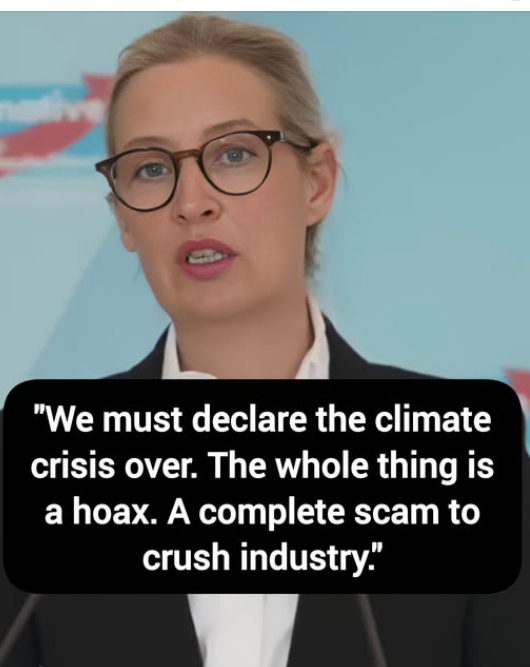 This is Germany’s Alice Weidel, a politician from Germany’s right-wing extremist party, Alternative for Germany. She studied economics and finance in college.
Who could possibly care what she thinks about climate change?
Far-Right-wing Politician with No Scientific Training Says Climate Change Is a Hoax —- ZZzzzzzzz



-
Climate Change8 months ago
Guest post: Why China is still building new coal – and when it might stop
-
Greenhouse Gases8 months ago
Guest post: Why China is still building new coal – and when it might stop
-

 Greenhouse Gases2 years ago
嘉宾来稿:满足中国增长的用电需求 光伏加储能“比新建煤电更实惠”
-
Climate Change2 years ago
Bill Discounting Climate Change in Florida’s Energy Policy Awaits DeSantis’ Approval
-

 Climate Change2 years ago
嘉宾来稿:满足中国增长的用电需求 光伏加储能“比新建煤电更实惠”
-
Climate Change Videos2 years ago
The toxic gas flares fuelling Nigeria’s climate change – BBC News
-

 Renewable Energy5 months ago
Sending Progressive Philanthropist George Soros to Prison?
-

 Carbon Footprint2 years ago
US SEC’s Climate Disclosure Rules Spur Renewed Interest in Carbon Credits