

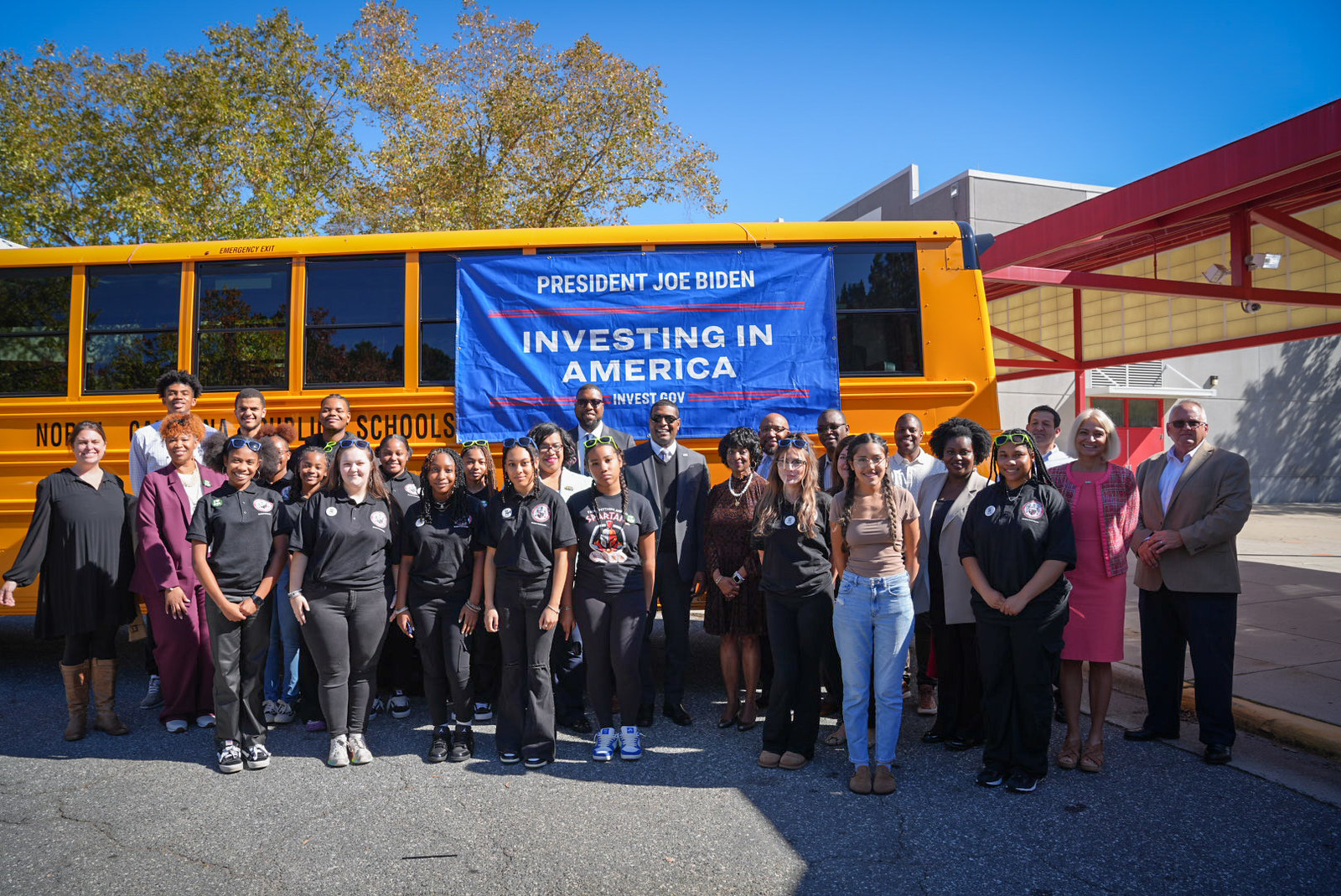
Photos courtesy of U.S. Environmental Protection Agency.
Last Thursday, Environmental Protection Agency (EPA) Administrator Michael Regan boarded an electric school bus in his home state of North Carolina. The bus would have been silent without the hum of a diesel-powered engine if not for the eager questions of Durham’s Southern School of Energy and Sustainability students.
Regan was in Durham for a ribbon-cutting ceremony with community leaders and elected officials including SACE’s Senior Electric Transportation Program Manager, Dory Larsen, to celebrate funding for 38 new electric school buses coming to Durham Public Schools. The $15 million grant comes from the EPA’s Clean School Bus Program, which uses funding from the Bipartisan Infrastructure Law (BIL) to replace existing school buses with zero-emission school buses.
Students wanted to know the EPA’s true motivations for investing in clean school buses. Was it an advantageous move in the clean energy market? A legal requirement? Or perhaps Regan, a Biden-Harris Administration member, was investing in cleaner air for the next generation.
“We are investing in you,” Regan said during a press conference after the electric school bus ride.

Photos courtesy of U.S. Environmental Protection Agency.
Regan, a North Carolina local, wasn’t the only government official with a personal connection to Thursday’s event. U.S. Representative Valerie Foushee (NC-04) once drove a school bus before climbing multiple levels of local government in Chapel Hill to U.S. Congress.
“As a former school bus driver myself, I am grateful for this significant federal investment that goes beyond upgrading buses and prioritizes the health of our children, our community, and generations to come,” Foushee said in a statement to SACE.
Energy and the environment have played key roles during Foushee’s time in government. Foushee voted in favor of the Bipartisan Infrastructure Law as a State Senator for North Carolina’s 23rd District in 2021 and is a supporter of the Inflation Reduction Act (IRA).
For Durham Mayor Leonardo Williams, a former teacher and school administrator, the Clean School Bus Program means being able to breathe easily.
“This new fleet of electric buses means even more to me, as I struggled with asthma as a kid and dealt with the smoke and fumes that can cause an attack,” Williams said. “Investments like these go a long way in ensuring that future generations have all the tools that they need to thrive in the classroom and beyond.”
Electric school buses emit zero tailpipe pollution, meaning students and drivers are at no risk of exposure to particulate matter and nitrous oxide from their school buses. These pollutants can contribute to respiratory disease, heart disease, cancer and other health problems. Lowered school bus emissions have even been shown to correlate with improved school performance.
“This federal investment in clean transportation will significantly reduce harmful emissions and air pollutants,” Congresswoman Foushee said.
Electrifying fleets also helps states lower their total contributions to carbon emissions, generating fewer greenhouse gas emissions and investing in a cleaner environment for students to grow up in.
Jackson Keith, a student at the Southern School of Energy and Sustainability, said he was grateful to be a part of the Clean School Bus Program.
“It was good to see people in power give back to the community,” Keith said. “Seeing people in the news taking care of the environment and taking strides to improve climate change with electric buses is great to see.”
Alexa Izquierdo, who introduced Administrator Regan as a student speaker at the event, said she has always been passionate about making changes to address climate change.
“I am glad that Durham is taking initiative to step forward to make a difference with climate change because a lot of people want to make changes but don’t take the steps to,” Izquierdo said.
Investing in the Clean Energy Generation
These students exemplify the Clean Energy Generation, a movement that bridges people of all ages and backgrounds with the common goal of addressing the climate crisis. With investments like the Clean School Bus Program, electric school buses and clean air could eventually be the new normal for generations to come.
“Last week’s announcement with EPA Administrator Michael Regan is a great reminder that the Biden-Harris Administration is making key investments into our youth and our environment,” Mayor Williams said.
There is currently a new round of funding available with the Clean School Bus Rebate Program, which school districts can apply for through January 9, 2025, at 4:00 p.m. ET. Watch this clip from our webinar with Maggie Dolan from EPA Region 4 on the EPA Clean School Bus Program for more information and resources to help you apply for your own electric school bus fleet.
JOIN THE CLEAN ENERGY GENERATION
The post EPA’s $15M Investment Brings 38 Electric School Buses to Durham, Protecting Kids’ Health appeared first on SACE | Southern Alliance for Clean Energy.
EPA’s $15M Investment Brings 38 Electric School Buses to Durham, Protecting Kids’ Health

 All I can say about the me here is that personally I refused, against considerable pressure from my family, to indoctrinate my children into something I myself could not accept.
Is it actually “psychological abuse” to indoctrinate children into monotheistic religion? Whether to take it that far is an open question.
My parents, both atheists, sent my brother and me to Sunday School, as they thought it wrong to cut us off from a modality of growing up in America in the early 1960s. I don’t blame them, but again, it’s not something I was willing to replicate with my own children.
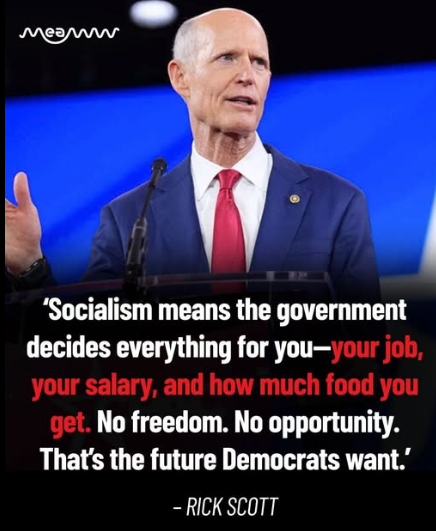 In less than a month, we’re going to learn how many idiots are buying this socialism crap.
Sure, there are people who don’t know anything about the way people live in northern England, New Zealand, Costa Rica, etc. Most of these people couldn’t find these countries on this globe.
But how many can there possibly be?
Clearly, Republicans are desperate, but isn’t asking voters to believe that the Swedes have to rely on the government for their job, salary, and food a bit over-the-top?
 I got the meme here from a neighbor, but I wonder who actually wrote it. There is a ton of propaganda on social media suggesting that we need to normalize the sociopathic criminality of the U.S. president.
It’s true that not every election is an apocalypse, but 2024 was disastrous for the U.S. democracy.
Yes, the country did not end. But it took a giant leap towards authoritarianism.
Even that’s not the end of the world. Democracies fail with great frequency on this planet. I just never thought I’d be living in the biggest socio-political collapse in the last 2000 years.
In an average week, I meet quite a few travelers here from lands all around this planet. Their most common thoughts on what’s happening here: “We simply feel sorry for you.”

A ‘victory’ for communities as High Court rules climate impacts from coal and gas must be considered even where fossil fuels are exported

Indoctrinating Children into Religion

Republicans’ Last-Ditch Effort to Lie to Voters
-
Climate Change1 year ago
Guest post: Why China is still building new coal – and when it might stop
-

 Greenhouse Gases2 years ago
嘉宾来稿:满足中国增长的用电需求 光伏加储能“比新建煤电更实惠”
-
Greenhouse Gases1 year ago
Guest post: Why China is still building new coal – and when it might stop
-

 Climate Change2 years ago
嘉宾来稿:满足中国增长的用电需求 光伏加储能“比新建煤电更实惠”
-

 Renewable Energy12 months ago
Sending Progressive Philanthropist George Soros to Prison?
-
Climate Change2 years ago
Bill Discounting Climate Change in Florida’s Energy Policy Awaits DeSantis’ Approval
-
Greenhouse Gases1 year ago
嘉宾来稿:探究火山喷发如何影响气候预测
-

 Climate Change2 years ago
Analysis: China’s CO2 falls 1% in Q2 2024 in first quarterly drop since Covid-19