


President Donald Trump has signed an executive order to ramp up U.S. production of critical minerals. The order uses emergency powers under the Defense Production Act to increase financing, streamline permits, and encourage domestic mining and processing of minerals vital for national security and economic growth.
The goal is to cut down on dependence on foreign suppliers, especially China. China leads the global supply chain for key minerals. The order has raised worries about its effect on the environment and how it matches climate goals.
What Are The Key Aspects of the Executive Order?
-
Defense Production Act for Critical Minerals
The executive order authorizes the use of the Defense Production Act (DPA) to provide financial support to U.S. mining and mineral processing projects. This includes loans and investments from the U.S. International Development Finance Corporation (DFC) and the Department of Defense. The goal is to speed up the production of key minerals. This includes lithium, cobalt, nickel, rare earth elements, and maybe coal.
-
Faster Permitting for Mining Projects
Trump’s order directs federal agencies to speed up the permitting process for new mining and processing facilities. The Department of the Interior has been tasked with prioritizing critical mineral production on federal lands. The administration wants to cut red tape. This will help private companies invest more in domestic mineral production.
-
Expanding the Scope of Critical Minerals
The order lets the National Energy Dominance Council add uranium, copper, potash, and gold to the list of critical minerals. Additionally, there is speculation that coal could be included. This can potentially lead to increased production of fossil fuels under the guise of national security.
Why Is the U.S. Expanding Mineral Production?
The U.S. gets 70% of its rare earth minerals from China. This makes the supply chain weak for important industries like defense, electronics, and renewable energy. China has also imposed export controls on key materials like gallium and germanium. This further increases the urgency for the U.S. to secure its own resources.
Critical minerals are key for military use, particularly antimony. They support missile systems, fighter jets, and advanced communications technology. By expanding domestic production, the U.S. aims to strengthen its defense capabilities and reduce the risk of supply chain disruptions.
Lastly, lithium, cobalt, and nickel are crucial for battery storage, electric vehicles (EVs), and renewable energy infrastructure. Boosting local production of these materials can speed up the clean energy shift and cut down on fossil fuel use.
Global Market Trends and U.S. Critical Mineral Production and Consumption
The global demand for critical minerals has been on the rise, driven by the transition to clean energy technologies. In 2023, lithium demand surged by 30%, while nickel, cobalt, graphite, and rare earth elements also saw significant increases.
Investment in critical mineral mining grew by 10% in 2023; however, this was a slowdown compared to the 30% growth observed in 2022. This is partly due to declining prices putting pressure on producers.

The United States has significant mineral resources but remains heavily dependent on imports for many critical minerals. According to the U.S. Geological Survey’s 2024 Mineral Commodity Summaries, the U.S. was 100% import-dependent for 15 nonfuel mineral commodities and over 50% import-dependent for 49 such commodities.
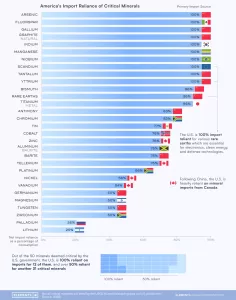
For instance, aluminum consumption in 2024 reached 4.3 million metric tons, underscoring the nation’s reliance on external sources. For other minerals, refer to the following table for US 2023 consumption and production per USGS report.

Trump’s recent executive order targets several critical minerals, including:
- Rare Earth Elements (REEs): Essential for electronics, defense systems, and renewable energy technologies.
- Lithium: Vital for battery production in electric vehicles and energy storage systems.
- Nickel: Used in stainless steel and battery manufacturing.
- Cobalt: Important for battery electrodes.
- Graphite: Used in batteries and fuel cells.
Economic, Environmental, and Climate Implications
The EO has a significant impact on mining companies. Shares of U.S. mining companies surged following the announcement.
MP Materials, a rare earth miner, saw its stock rise by 4.6%, while coal producer Peabody Energy gained more than 2%. However, Australian and Chinese mining companies experienced stock declines, reflecting concerns over reduced demand for imported minerals.
The decision also has the potential to spur international trade conflicts. China and other major mineral-exporting nations may view this policy shift as a direct threat to their economic interests. This could lead to trade tensions and potential retaliatory measures, further complicating global supply chains.
Environmental Concerns and Climate Impacts
Mining and processing critical minerals contribute about 8% of global carbon emissions. Copper production emits 4.6 tonnes of CO₂ per tonne, while nickel ranges between 12 and 78 tonnes per tonne. However, these emissions do not negate clean energy benefits—EVs still produce half the lifecycle emissions of gasoline cars. Using low-carbon electricity can further lower these emissions.
Coal’s potential inclusion as a critical mineral raises concerns. Fossil fuels from federal lands accounted for nearly 25% of U.S. CO₂ emissions over a decade. Expanding mining on public lands risks habitat destruction and toxic contamination, with 22,500 abandoned mine sites already leaking harmful chemicals.
Securing critical minerals is key for national security and clean energy. Yet, experts also stress the need for sustainable practices. This includes recycling, improved mining tech, and carbon-cutting ideas. For example, using CO₂ to weaken rocks could make mining carbon-negative.
The Biden administration used the Defense Production Act before. This was to boost the production of battery materials in the U.S. The goal is to cut emissions and support renewable energy. In contrast, Trump’s order may list coal and other fossil fuels as critical minerals. This could slow down efforts for net-zero emissions and hurt global climate leadership.
Expanding fossil fuel extraction on federal lands may worsen climate change, undermining progress toward emission reduction targets.
Conclusion: A Double-Edged Sword?
Trump’s executive order to boost critical mineral production is a significant policy shift that aims to reduce dependence on foreign sources, enhance national security, and support key industries. However, the inclusion of coal and the potential rollback of environmental safeguards raises concerns about its impact on climate goals.
As the U.S. moves forward with this strategy, it must find a balance between securing essential minerals and ensuring sustainable, environmentally responsible development. The outcome of this policy will shape not only the country’s economic future but also its role in global efforts to combat climate change.
The post Donald Trump Uses Emergency Powers to Boost U.S. Critical Mineral (and Coal?) Production appeared first on Carbon Credits.

Carbon Footprint
Climate Impact Partners Unveils High-Quality Carbon Credits from Sabah Rainforest in Malaysia

The voluntary carbon market is changing. Buyers are no longer focused only on large volumes of cheap credits. Instead, they want projects with strong science, long-term monitoring, and clear proof that carbon has truly been removed from the atmosphere. That shift is drawing more attention to high-integrity, nature-based projects.
One project now gaining that spotlight is the Sabah INFAPRO rainforest rehabilitation project in Malaysia. Climate Impact Partners announced that the project is now issuing verified carbon removal credits, opening access to one of the highest-quality nature-based removals currently available in the global market.
Restoring One of the World’s Richest Rainforest Ecosystems
The project is located in Sabah, Malaysia, on the island of Borneo. This region is home to tropical dipterocarp rainforest, one of the richest forest ecosystems on Earth. These forests store huge amounts of carbon and support extraordinary biodiversity. Some dipterocarp trees can grow up to 70 meters tall, creating habitat for orangutans, pygmy elephants, gibbons, sun bears, and the critically endangered Sumatran rhino.
However, the forest within the INFAPRO project area was not intact. In the 1980s, selective logging removed many of the most valuable tree species, especially large dipterocarps. That caused serious ecological damage. Once the key mother trees were gone, natural regeneration became much harder. Young seedlings also had to compete with dense vines and shrubs, which slowed the forest’s recovery.
To repair that damage, the INFAPRO project was launched in the Ulu-Segama forestry management unit in eastern Sabah.
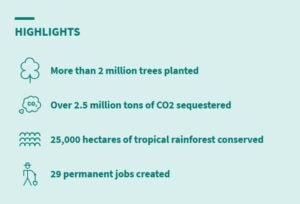
- The project has restored more than 25,000 hectares of logged-over rainforest.
- It was developed by Face the Future in cooperation with Yayasan Sabah, while Climate Impact Partners has supported the project and helped bring its credits to market.
Why Sabah’s Carbon Removals are Attracting Attention
What makes Sabah INFAPRO different is not only the size of the restoration effort. It is also the way the project measured carbon gains.
Many forest carbon projects issue credits in annual vintages based on year-by-year growth estimates. Sabah INFAPRO followed a different path. It used a landscape-scale monitoring system and waited until the forest moved through its strongest natural growth period before issuing removal credits.
- This approach gives the credits more weight. Rather than relying mainly on short-term annual estimates, the project measured carbon sequestration over a longer period. That helps show that the forest delivered real, sustained, and measurable carbon removal.
The scientific backing is also unusually strong. Since 2007, the project has maintained nearly 400 permanent monitoring plots. These plots have allowed researchers, independent auditors, and technical specialists to observe the full growth cycle of dipterocarp forest recovery. The result is a large body of field data that supports carbon calculations and strengthens confidence in the credits.
In simple terms, buyers are not just being asked to trust a model. They are being shown years of direct forest monitoring across the project landscape.
Strong Ratings Support Market Confidence
Independent assessment has also lifted the project’s profile. BeZero awarded Sabah INFAPRO an A.pre overall rating and an AA score for permanence. That places the project among the highest-rated Improved Forest Management, or IFM, projects in the world.
The rating reflects several important strengths. First, the project has very low exposure to reversal risk. Second, it has a long and stable operating history. Third, its measured carbon gains align well with peer-reviewed ecological research and independent analysis.
These points matter in today’s market. Buyers have become more cautious after years of debate over the quality of some forest carbon credits. As a result, they now look more closely at durability, transparency, and third-party validation. Sabah INFAPRO’s rating helps answer those concerns and makes the project more attractive to companies looking for credible carbon removal.
The project is also registered with Verra’s Verified Carbon Standard under the name INFAPRO Rehabilitation of Logged-over Dipterocarp Forest in Sabah, Malaysia. That adds another level of market recognition and verification.
A Wider Model for Rainforest Recovery
Sabah INFAPRO also shows why high-quality nature-based projects are about more than carbon alone. The restoration effort supports broader ecological recovery in one of the world’s most important rainforest regions.
Climate Impact Partners said it has worked with project partners to restore degraded areas, run local training programs, carry out monthly forest patrols, and distribute seedlings to support rainforest recovery beyond the project boundary. These efforts help strengthen the wider landscape and expand the project’s environmental impact.
That broader value is becoming more important for buyers. Companies increasingly want projects that support biodiversity, ecosystem health, and local engagement, along with carbon removal. Sabah INFAPRO offers that mix, making it a stronger fit for the market’s shift toward higher-integrity credits.
The post Climate Impact Partners Unveils High-Quality Carbon Credits from Sabah Rainforest in Malaysia appeared first on Carbon Credits.

Bitcoin’s recent drop below $70,000 reflects more than short-term market pressure. It signals a deeper shift. The world’s largest cryptocurrency is becoming increasingly tied to global energy markets.
For years, Bitcoin has moved mainly on investor sentiment, adoption trends, and regulation. Today, another force is shaping its direction: the cost of energy.
As oil prices rise and electricity markets tighten, Bitcoin is starting to behave less like a tech asset and more like an energy-dependent system. This shift is changing how investors, analysts, and policymakers understand crypto.
A Global Power Consumer: Inside Bitcoin’s Energy Use
Bitcoin depends on mining, a process that uses powerful computers to verify transactions. These machines run continuously and consume large amounts of electricity.
Data from the U.S. Energy Information Administration shows Bitcoin mining used between 67 and 240 terawatt-hours (TWh) of electricity in 2023, with a midpoint estimate of about 120 TWh.

Other estimates place consumption closer to 170 TWh per year in 2025. This accounts for roughly 0.5% of global electricity demand. Recently, as of February 2026, estimates see Bitcoin’s energy use reaching over 200 TWh per year.
That level of energy use is significant. Global electricity demand reached about 27,400 TWh in 2023. Bitcoin’s share may seem small, but it is comparable to the power use of mid-sized countries.
The network also requires steady power. Estimates suggest it draws around 10 gigawatts continuously, similar to several large power plants operating at full capacity. This constant demand makes energy costs central to Bitcoin’s economics.
When Oil Rises, Bitcoin Falls
Bitcoin mining is highly sensitive to electricity prices. Energy is the highest operating cost for miners. When power becomes more expensive, profit margins shrink.
Recent market movements show this link clearly. As oil prices rise and inflation concerns persist, energy costs have increased. At the same time, Bitcoin prices have weakened, falling below the $70,000 level.
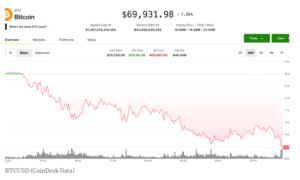
This is not a coincidence. Studies show a direct relationship between Bitcoin prices, mining activity, and electricity use. When Bitcoin prices rise, more miners join the network, increasing energy demand. When energy costs rise, less efficient miners may shut down, reducing activity and adding selling pressure.
This creates a feedback loop between crypto and energy markets. Bitcoin is no longer driven only by demand and speculation. It is now influenced by the same forces that affect oil, gas, and power prices.
Cleaner Energy Use Is Growing, but Fossil Fuels Still Matter
Bitcoin’s environmental impact depends on its energy mix. This mix is improving, but it remains uneven.
A 2025 study from the Cambridge Centre for Alternative Finance found that 52.4% of Bitcoin mining now uses sustainable energy. This includes both renewable sources (42.6%) and nuclear power (9.8%). The share has risen significantly from about 37.6% in 2022.
Despite this progress, fossil fuels still account for a large portion of mining energy. Natural gas alone makes up about 38.2%, while coal continues to contribute a smaller share.
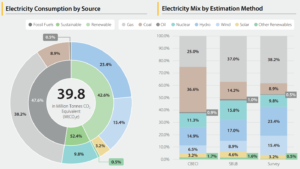
This reliance on fossil fuels keeps emissions high. Current estimates suggest Bitcoin produces more than 114 million tons of carbon dioxide each year. That puts it in line with emissions from some industrial sectors.
The shift toward cleaner energy is real, but it is not complete. The pace of change will play a key role in how Bitcoin fits into global climate goals.
Bitcoin’s Climate Debate Intensifies
Bitcoin’s growing energy demand has placed it at the center of ESG discussions. Its impact is often measured through three key areas:
- Total electricity use, which rivals that of entire countries.
- Carbon emissions are estimated at over 100 million tons of CO₂ annually.
- Energy intensity, with a single transaction using large amounts of power.
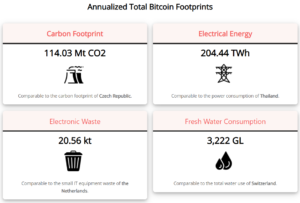
At the same time, the industry is evolving. Mining companies are adopting more efficient hardware and exploring new energy sources. Some operations use excess renewable power or capture waste energy, such as flare gas from oil fields.
These efforts show progress, but they do not fully address the concerns. The gap between Bitcoin’s energy use and its environmental impact remains a key issue for investors and regulators.
- MUST READ: Bitcoin Price Hits All-Time High Above $126K: ETFs, Market Drivers, and the Future of Digital Gold
Bitcoin Is Becoming Part of the Energy System
Bitcoin mining is now closely integrated with the broader energy system. Operators often choose locations based on access to cheap or excess electricity. This includes areas with strong renewable generation or underused energy resources.
This integration creates both opportunities and challenges. On one hand, mining can support energy systems by using power that might otherwise go to waste. It can also provide flexible demand that helps stabilize grids.
On the other hand, it can increase pressure on local electricity supplies and extend the use of fossil fuels if cleaner options are not available.
In the United States, Bitcoin mining could account for up to 2.3% of total electricity demand in certain scenarios. This highlights how quickly the sector is scaling and how closely it is tied to national energy systems.
Energy Markets Are Now Key to Bitcoin’s Future
Looking ahead, the connection between Bitcoin and energy is expected to grow stronger. The network’s computing power, or hash rate, continues to reach new highs, which typically leads to higher energy use.
Electricity will remain the main cost for miners. This means Bitcoin will continue to respond to changes in energy prices and supply conditions. At the same time, governments are starting to pay closer attention to crypto’s environmental impact, which could shape future regulations.
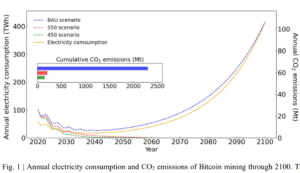
Some forecasts suggest Bitcoin’s energy use could rise sharply if adoption increases, potentially reaching up to 400 TWh in extreme scenarios. However, cleaner energy systems could reduce the carbon impact over time.
Bitcoin is no longer just a financial asset. It is also a large-scale energy consumer and a growing part of the global power system.
As a result, understanding Bitcoin now requires a broader view. Energy prices, electricity markets, and carbon trends are becoming just as important as market demand and investor sentiment.
The message is clear. As energy markets move, Bitcoin is likely to move with them.
The post Bitcoin Falls as Energy Prices Rise: Why Crypto Is Now an Energy Market Story appeared first on Carbon Credits.

The post LEGO’s Virginia Factory Goes Big on Solar as Net-Zero Push Speeds Up appeared first on Carbon Credits.


-
Greenhouse Gases7 months ago
Guest post: Why China is still building new coal – and when it might stop
-
Climate Change7 months ago
Guest post: Why China is still building new coal – and when it might stop
-

 Greenhouse Gases2 years ago
嘉宾来稿:满足中国增长的用电需求 光伏加储能“比新建煤电更实惠”
-
Climate Change2 years ago
Bill Discounting Climate Change in Florida’s Energy Policy Awaits DeSantis’ Approval
-

 Climate Change2 years ago
嘉宾来稿:满足中国增长的用电需求 光伏加储能“比新建煤电更实惠”
-
Climate Change Videos2 years ago
The toxic gas flares fuelling Nigeria’s climate change – BBC News
-

 Carbon Footprint2 years ago
US SEC’s Climate Disclosure Rules Spur Renewed Interest in Carbon Credits
-

 Renewable Energy5 months ago
Sending Progressive Philanthropist George Soros to Prison?