Welcome to Carbon Brief’s DeBriefed.
An essential guide to the week’s key developments relating to climate change.
This week
UK proposes new emissions target
‘ON COURSE’: The UK government has proposed reducing the country’s greenhouse gas emissions to 87% below 1990 levels by 2040, reported the Associated Press. The newswire cited scientists saying that the goal “puts the UK on course to meet its 2050 net-zero target”. To meet this target, the UK would “need to invest around £880bn over 25 years…but doing so would yield benefits worth £1,620bn”, according to an in-depth analysis of the plans by Carbon Brief.
UPCOMING ‘FLASHPOINT’: The Financial Times noted that, for the target to become “legally binding”, it must be approved by parliament. While the UK’s previous carbon budget “received cross-party support”, this time the proposal is “expected to become a flashpoint among lawmakers”, it added, with both the Conservatives and Reform pledging to “scrap” net-zero policies.
DRIVING FORCE: Separately, a new report by consultancy Confederation of British Industry (CBI) Economics has valued the UK’s “net-zero economy” at more than £100bn a year, reported the Guardian. It added that, by a broad measure, the UK energy transition supports 1.1m jobs and provides “nearly 4% of the UK’s economic output”.
US ‘dismantling’ oceans data
SYSTEMS OFFLINE: The Trump administration is “dismantling” a “$368m deep-ocean observation system” that, among other things, allows scientists to monitor the ocean currents that affect the global climate and understand how the “ocean is absorbing greenhouse gases from the atmosphere”, said the New York Times. Bloomberg reported that Trump’s efforts to close the National Center for Atmospheric Research (NCAR), a key climate science research institution, has been “temporarily blocked” by a judge.
RULE ROLLBACK: The US Securities and Exchange Commission (SEC), an independent body that regulates US securities markets, has proposed repealing the climate-disclosure rule, which “requires some public companies to report their greenhouse gas emissions and the risks they face from global warming”, said the Associated Press. The Trump administration also announced plans to allocate $700m to support “clean, beautiful coal” power and export infrastructure, said BBC News.
Around the world
- EU EXEMPTIONS: The EU will allow member states to breach the bloc’s fiscal rules to “cope with high energy prices stoked by the Iran war”, as long as the measures they use help “accelerate the transition away from fossil fuels”, reported Bloomberg.
- SLOW SPENDING: The German government has only paid out €24bn of the €37bn it was “supposed to disburse” in 2025 from a special fund for infrastructure and “climate neutrality”, reported Clean Energy Wire.
- URGENT WARNING: UN secretary-general António Guterres said a likely upcoming El Niño weather event must be treated as the “urgent climate warning it is”, said Al Jazeera.
- HOEKSTRA ON COP: The outcomes of many of the most recent COPs have been “underwhelming”, EU climate commissioner Wopke Hoekstra has said, according to Reuters. COPs should be supplemented by “smaller groups…who are willing to move faster”, he added.
3,400
The number of excess deaths across India caused by a single day of extreme heat, according to coverage in the Hindustan Times of a new study.
30,000
Excess deaths caused if the extreme heat lasts five days.
Latest climate research
- In a 1.5C warmer world, the timing of floods will shift by more than seven days across half of the world’s landmass | Nature Communications
- Temperature and rainfall together account for more than 13% of methane generated from landfills in Incheon, South Korea | Atmospheric Chemistry and Physics
- The postponed International Maritime Organisation “net-zero framework” could increase biofuel use in shipping to 40% by 2050 | Nature Energy
(For more, see Carbon Brief’s in-depth daily summaries of the top climate news stories on Monday, Tuesday, Wednesday, Thursday and Friday.)
Captured
China’s carbon dioxide emissions grew by 2% in the first quarter of 2026 due to a rise in “wasted” wind and solar generation, according to new analysis for Carbon Brief. However, emissions remain below their March 2024 peak, it added.
Spotlight
Why China’s solar boom is slowing down
China made headlines in 2025 for installing record levels of solar. But in 2026, new capacity is expected to be lower than last year’s figures.
This week, Carbon Brief examines what is behind China’s lower 2026 solar additions.
Solar power has been a major element of China’s renewables buildout since the mid-2010s.
The country installed 315 gigawatts (GW) of new capacity in 2025, adding more than half of all new solar globally. The year before, it added 277GW.
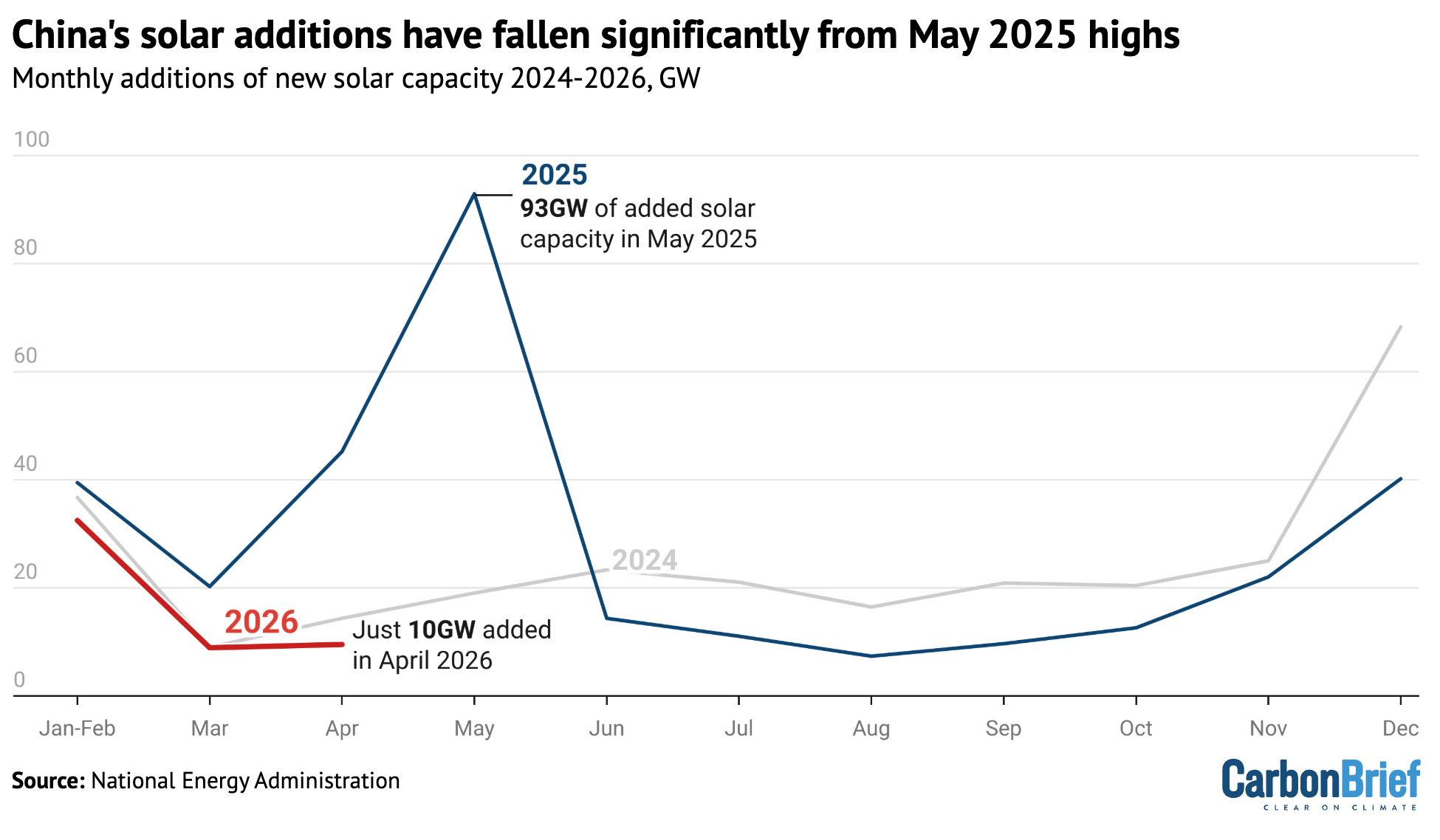
But the picture in 2026 to date is very different. Installations in March fell 56% year-on-year to 9GW, while new capacity in April totalled 10GW, a 79% drop compared to a year earlier, according to Carbon Brief’s analysis of official data.
Domestic uncertainty
The lower pace in 2026 had been anticipated by analysts.
In previous years, massive solar installations were driven by strong policy support for renewables, including a fixed-price tariff for generators.
In February 2025, the government announced that new solar and wind projects would instead be financed through a new “contract for difference” (CfD)-style system.
Under the new system, power from a certain amount of renewable capacity will be purchased for a fixed “strike price”, which to date has been far lower than previous guaranteed tariffs. Further projects will need to secure their own contracts on the open market.
While the new system is posing challenges for developers in the short term, it is part of a longer-term shift towards market-driven pricing for renewables, which has already made them cheaper than coal.
The change led to a rush of new project installations ahead of the June 2025 cut-off date, so that they could fall under the old fixed-price regime.
New solar additions totalled 45GW in April 2025 and 93GW in May 2025, before falling to 14GW in June 2025, according to Carbon Brief analysis of government data.
Additions also spiked in December, in both 2024 and 2025, as developers raced to meet completion deadlines including those under the 14th five-year plan.
Some reports have attributed the precipitous drop this year to falling demand for solar in China.
But this is a “major oversimplification”, David Fishman, principal at energy consultancy the Lantau Group, wrote on LinkedIn.
The real challenge, he said, is that “developers and banks [are] still figuring out how to finance and build projects without policy-backed revenue guarantees”.
Yang Biqing, energy analyst for Asia at thinktank Ember, agrees, telling Carbon Brief that the new CfD-style system has created “greater uncertainty” for developers, compounded by fierce competition and a growing push for “consolidation” in the industry.
The government set a target for 200GW of new solar and wind capacity in 2026.
Fishman told Carbon Brief that this will be “difficult” for the government to achieve, though not impossible. Current levels of solar additions – reaching perhaps 120GW for the year – plus an “ambitious” 80GW of new wind power, could help China to hit the target, he said.
Others are more bullish. The China Photovoltaic Industry Association forecasts 180-240GW of new solar in 2026.
But few believe additions will match the breakneck pace of 2025.
“China’s solar industry is no longer a story of capacity expansion”, said Yang, with officials now “increasingly” focused on integrating current generation into the grid.
Soaring exports
Meanwhile, China’s solar exports are still going strong.
China exported almost 1.2m tonnes of solar cells in April 2026, according to Reuters. Although down from a record high in March, it represented a 60% rise year-on-year, added the newswire.
This signals solar’s attractiveness globally in the face of rising energy prices caused by the Iran-US conflict, analysts have said.
High demand for panels has been reported across several continents, including Europe, Asia and Africa.
For example, in the Philippines, the conflict is “driving” solar uptake, one analyst told the Associated Press, adding:
“People want solar and people want solar now.”
A version of this article is also available on the Carbon Brief website.
Watch, read, listen
EL NIÑO IMPACTS: An interactive piece from BBC News described how the forecasted “super” El Niño could impact global climate and weather in the coming months.
‘CAUTIONARY TALE’: Two researchers wrote in Climate Home News that “Indonesia’s failing Just Energy Transition Partnership is a cautionary tale”.
‘CULTURE WAR’: Time magazine spoke to London mayor Sadiq Khan about how he “survived the climate culture war”.
Coming up
- 8 June: World Ocean Day
- 8-18 June: Bonn climate talks, Bonn, Germany
- 11 June: Climate Adaptation Innovation in Latin America and the Caribbean webinar, online
Pick of the jobs
- The New York Times, climate policy correspondent | Salary: $124,980-$160,000. Location: Washington DC
- Regulatory Assistance Project, associate, electricity systems and electrification | Salary: €50,000-€60,000. Location: Madrid and remote
- Future Energy Networks, head of policy | Salary: £75,000-£100,000. Location: London and remote
DeBriefed is edited by Daisy Dunne. Please send any tips or feedback to debriefed@carbonbrief.org.
This is an online version of Carbon Brief’s weekly DeBriefed email newsletter. Subscribe for free here.
The post DeBriefed 5 June 2026: UK eyes 2040 emissions cut | US ‘dismantling’ oceans research | China’s solar slump appeared first on Carbon Brief.
Climate Change
Is FOMO undermining climate diplomacy?
Benito Müller, Anju Sharma, Jen Allan, Matthias Roesti and Luis Gomez-Echeverri.
Every November, tens of thousands of people descend on the world’s annual UN climate conference. Presidents and prime ministers, negotiators, business executives, campaigners, journalists, celebrities and lobbyists converge on one city for two frenetic weeks, all convinced they need to be there.
Everyone with a stake in climate action feels they must be present. Any suggestion of a smaller, more focused conference is quickly met with concerns about exclusion. But it is time to ask an uncomfortable question: has the fear of missing out (FOMO) become one of the biggest obstacles to effective international climate cooperation?
The story in numbers
When governments first met under the UN Framework Convention on Climate Change (UNFCCC) in the 1990s, the annual Conferences of the Parties (COPs) attracted only a few thousand participants. Even the Kyoto conference, which produced the first legally binding emissions agreement, hosted fewer than 10,000 people.
Since then, analysis by ecbi reveals a striking trend: after each major treaty COP, the participation at the next COP approximately doubled (see chart below).
Why?
Part of the answer is success. As climate change has risen up the political and economic agenda, more actors quite rightly want to engage. But our analysis reveals that a less acknowledged force is also driving the spikes in participation: FOMO.
As more heads of state attended, ministers concluded they had to be there too. As ministers arrived in greater numbers, government delegations expanded. Businesses, investors, researchers, campaigners, journalists, city leaders and philanthropies reached the same conclusion: if everyone important is going to COP, we cannot afford to stay away.
The result is a self-reinforcing cycle. The larger COP becomes, the more indispensable attendance appears, because presence signals relevance.


The negotiating community has barely grown
The headline attendance figures tell only part of the story. At COP28, more than 42,000 Party badges were issued to official national delegations. However, only 1,581 delegates had also attended the technical negotiating session in Bonn just five months earlier. Fewer than 4% of Party delegates formed the core negotiating community.
Comment: The UN climate process was built for negotiation – now it must support implementation
This core negotiating community has remained remarkably stable: across the five COPs since Paris, between roughly 1,300 and 1,600 delegates consistently attended both the June negotiating session and the annual COP.
The negotiating community has not become twenty times larger, but the COP has.
One COP, three different events
Today’s COP has, in fact, evolved into three very different events rolled into one.
The first is the formal negotiating session, where governments agree rules, guidance and decisions under the Convention and the Paris Agreement.
The second is a global political summit, where leaders announce initiatives and demonstrate political commitment.
The third is a vast climate expo, where businesses, cities, researchers, financial institutions and civil society showcase solutions, build partnerships and engage the public.
Each of them serves a valuable purpose, but the problem is that they have become bundled together by historical accident rather than institutional design.
Bigger is not always better
The consequences of “mega-COPs” are becoming increasingly difficult to ignore.
The countries most vulnerable to climate change are increasingly less able to host COPs and thus lose the ability to have their voices properly heard. Hosting a modern COP now requires enormous financial resources, extensive security operations and accommodation capacity that many countries simply do not possess. Even wealthier nations have become more reluctant to take on the burden.
Inside the venue, size creates its own inefficiencies. Climate negotiations often advance through informal conversations: a chance meeting in a corridor, a discussion over coffee, an impromptu conversation between delegates who discover common ground. Those opportunities become rarer when participants spend hours navigating enormous venues and crowded security checkpoints.
Comment: COP presidencies should focus less on climate policy, more on global politics
Observer access is constrained by overcrowding. National delegations increasingly include large numbers of non-government participants, sometimes outnumbering officials from government ministries. Meanwhile, businesses, campaigners and journalists compete with negotiators for the same space and attention.
The very scale of the event also creates a reputational problem. A gathering of 60,000 or more people inevitably creates expectations of dramatic political breakthroughs every year. Yet much of today’s climate diplomacy involves steady, technical progress. When those quieter achievements are judged against the expectations generated by a mega-event, disappointment in the UN climate change process becomes almost inevitable.
Time to unbundle
Not everything must happen in the same place at the same time. Negotiations, political leadership and implementation partnerships each deserve their own space. They should become separate events.
Routine governing body sessions, involving the roughly 5,000 participants directly engaged in the formal process, could be held in Bonn, where the UN climate secretariat is based. Political summits could be convened separately when leaders’ intervention is genuinely needed. Climate expos could continue to rotate with the COP Presidency, providing dedicated opportunities for businesses, investors, cities, researchers and civil society to showcase solutions and forge partnerships.
Such an approach would strengthen, not weaken, participation. Negotiators would benefit from a more focused and effective working environment. Host countries would face a far more manageable logistical and financial challenge. Climate-vulnerable countries would once again have a realistic opportunity to host key meetings and shape the global agenda. Businesses, investors, cities and civil society would gain greater visibility by engaging in forums designed for partnership, innovation and implementation, rather than competing with formal negotiations for space and attention.
Comment: Not another COP-out: We must rewrite the rules of the UN climate talks
Today’s mega-COPs evolved incrementally, one seemingly sensible decision at a time, until their sheer scale began to undermine many of the objectives they were intended to serve. The fear of missing out now risks becoming one of the biggest barriers to the reforms needed to make the process more effective.
The greatest fear now is not missing out on the next COP, but missing the opportunity to redesign the process so it can deliver on its ultimate purpose: tackling the climate crisis.
Benito Müller is managing director of Oxford Climate Policy and director of the European Capacity Building Initiative (ecbi).
Anju Sharma is a climate policy specialist with Oxford Climate Policy.
Jen Allan is a senior Lecturer at Cardiff University and strategic advisor at the International Institute for Sustainable Development.
Matthias Roesti is a postdoctoral researcher studying the political economy of climate change at the University of Pennsylvania’s Environmental Politics Lab.
Luis Gomez-Echeverri is a former senior staff member with UNDP and UNFCCC and currently an emeritus research scholar at the International Institute for Applied Systems Analysis, working at the intersection of climate and development.
The post Is FOMO undermining climate diplomacy? appeared first on Climate Home News.
Climate Change
Factcheck: How nuclear, gas, wind and solar power are affected during heatwaves
Heatwaves are becoming more likely and more intense due to climate change, impacting sources of power generation around the world as they work to meet increased demand.
When temperatures soared past 40C in parts of Europe in June and July 2026, nuclear reactors shuttered, gas plants’ efficiency fell, wind speeds dropped and electricity networks sagged.
Yet, while all types of electricity generation are affected variously by extreme heat, some commentators are quick to point the finger at “intermittent” wind and solar, while downplaying the impact on sources such as gas or nuclear power.
Extreme heat also drives up electricity demand, as people turn on air conditioning and fridges work harder.
For example, in France, daily electricity demand rose by almost 20% during a two-week heatwave in June 2026.
This often leads to an increase in power prices, as generation strains and demand rises, putting a premium on electricity.
Below, Carbon Brief – amid a slew of misleading claims – explains how key power sources cope with extreme heat.
Nuclear
The impact of heatwaves on nuclear power generation is well documented, with a plethora of headlines often accompanying record temperatures in nations that rely on the technology.
For example, around 70% of electricity is generated by nuclear power in France, leaving it vulnerable to the impacts of heatwaves.
During the July 2026 heatwave, three of France’s 57 nuclear reactors had to shut down. Generation was reduced at another seven, causing an almost 9% dip in power production.
(This is a well-known phenomenon – France has seen reductions in nuclear generation due to heatwaves in 2003, 2006, 2015, 2018, 2019, 2022 and 2025.)
A similar story is true across various countries in Europe. Low river levels on the Danube have hit nuclear reactors in Romania, Hungary and Serbia this summer, while a Swiss nuclear reactor shuttered due to high river temperatures.
It is nuclear plants using river water to cool their reactors that are most significantly affected by heatwaves and droughts. These make up 14% of the global fleet. Around 60 of the world’s 440 river-cooled reactors are located in France, with a further seven across Europe.
Nuclear power plants use fission to generate heat, which is used to create steam. This steam spins the blades of a turbine that is connected to a generator to create electricity.
Following this process, the water is cooled to allow it to be recycled back through the system as steam again. Nuclear power plants generally use water from rivers or the sea to help cool and condense this steam.
As such, when water temperatures rise due to a heatwave, their cooling capacity is reduced and the overall efficiency of the nuclear power station is affected. Similarly, if there is less water available due to drought, they cannot be cooled as effectively.
Michael Tadrous, a researcher at McMaster University’s DeGroote School of Business in Canada, tells Carbon Brief that the “impact [of heatwaves] is real, but it is far smaller than many headlines suggest” and that the “effect [of heat] is gradual”. He adds:
“Warmer intake water makes a reactor slightly less efficient. [But] even an extreme 15C rise in cooling-water temperature would cost a large reactor only about 6% of its output.
“The real pressure point during a heatwave is usually legal rather than technical. Plants return their cooling water to the river a few degrees warmer than they drew it and the law limits how warm that water may be in order to protect aquatic life.”
Henry Preston, a spokesperson for the industry body the World Nuclear Association, adds that reactor shutdowns due to high river temperatures are “typically an automatic response to comply with regulations to protect local ecosystems, rather than a technological fault”.
He notes that in some extreme heatwaves, these regulations are waived given the “essential need for electricity and taking a proportional approach to climate risks”.
While nuclear power plants can generally return to standard operation quickly if they have been affected by high water temperatures, drought can cause a more significant impact.
Preston tells Carbon Brief:
“In contrast to high river temperatures, which can quickly return to acceptable levels once a heatwave passes, low river levels can persist for much longer, if drought conditions continue. As a result, low water levels may have a more prolonged impact on plant operations than elevated water temperatures.”
This is set to be the case in the current European drought, where multiple reactors in Hungary and Romania have shut down or reduced their output due to low water levels.

The Danube is not expected to return to normal water levels for “days or even weeks as no significant rainfall is forecast”, reported the Associated Press on 3 August 2026. It said this was “push[ing] some countries in eastern Europe to the brink of energy emergency”.
While heatwaves and drought can produce significant short-term effects, their impact on the availability of nuclear power across a full year is generally minimal.
On average, heatwaves cut annual nuclear generation by 0.6% between 2003 and 2022, according to a recent study that Tadrous co-authored.
He adds that, across the whole period studied, the only time a national nuclear fleet lost more than 1% of its nuclear power over a year to heat- and drought-related curtailments was France in 2003, which lost 1.3%.
According to an article in Forbes, for every additional degree Celsius in temperature, a nuclear power plant loses around 0.6-1% in cycle efficiency.
To minimise the impact on both energy security and costs, governments and nuclear companies are looking at a range of solutions to adapt to heatwaves.
For example, French nuclear-plant operator EDF is looking at additional cooling towers for its sites that are the most exposed to the impacts of a warming climate, reported Bloomberg recently.
Tadrous says the nuclear power industry is already adapting to heatwaves that are “more frequent and more intense”, adding:
“France’s river-cooled fleet lost 5.5 terawatt hours (TWh) of output to the 2003 heatwave. By 2022, one of the most severe heat-and-drought summers on record, losses had fallen to 0.5TWh, a reduction of roughly 90%, as utilities upgraded cooling systems, refined operating practices and scheduled maintenance around periods of extreme heat.”
There remain challenges for adapting nuclear power – and the wider electricity systems in which it sits – to heatwaves. However, Tadrous notes that this is less about “technical feasibility than of economic prioritisation and timely implementation”.
Gas
Gas power plants have a reputation for being reliable and able to switch on at any moment, sometimes referred to as “firm, dispatchable” capacity.
Yet, as a type of thermal generation, they are subject to many of the same stresses during heatwaves as nuclear power.
An article by the science advocacy organisation Union of Concerned Scientists (UCS) notes that the “purported ability of gas plants to be available at all times to generate electricity, particularly when the grid needs it most, is increasingly under scrutiny” due to heatwaves.
As a matter of physics, the efficiency of gas power plants drops as temperatures rise. At 40C, a gas-fired power station can expect its capacity to be reduced by 13% and its efficiency by 7% compared to when running at 20C, according to Electric Insights.
Dr Iain Staffell, associate professor in sustainable energy at Imperial College London, tells Carbon Brief:
“Simple gas turbines (the kind which turn on rapidly to meet peak demand) are hit harder [than solar, for example], with their power output falling by about 10% per 10C.”
(He adds that the transmission system struggles more than electricity generation during high temperature. Power line capacity can fall by up to 16% for a 10C rise in temperature, according to a report for the UK government.)
Several types of gas power plants require cooling as part of their process, including gas steam and combined cycle turbines (CCGTs). They usually rely on nearby bodies of water for this.
Additionally, as the UCS article notes, hot air has a lower density than cool air. As gas CCGTs rely on burning a mix of gas and air, this lower density means air takes up more space, leaving less room for gas.
Ultimately, this means that when the air is hot, gas power plants cannot generate as much electricity as normal.
These effects are not just theoretical. For example, across two nights in August 2020, there were rolling blackouts in California, US, as demand exceeded supply amid a heatwave.
While a number of factors contributed to the blackouts, gas plants made up around 79% of the capacity that dropped off the system on 14 August and a similar share the following day.
Amid record-breaking heat in summer 2026, gas power plants have also seen their capacity cut in the UK, France and other countries.

Dr Staffell adds that gas power stations are thought of as “reliable, because of the way we use them” in the UK.
Whereas wind and solar are usually used to the maximum extent possible, he says that on average, only around 40% of the gas fleet is in use at any one time. As such, even if the efficiency of one gas power plant is affected by high temperatures, “we have a lot of slack to call on more of them to run”. He adds:
“The issue is less that they can’t deliver, but we have to pay through the nose to persuade more to turn on at critical times, adding to sky-high energy bills.”
Wind
The impact of heatwaves on wind generation is less direct than for other technologies.
However, wind speeds often drop during heatwaves, which tend to build during periods of sustained high pressure into extreme events such as “heat domes”.
Dr Staffell, explains to Carbon Brief:
“The very hottest days tend to create heat domes with very low wind speeds, which directly reduces the output that windfarms can produce. Air is also less dense the hotter it is, so it carries less energy within it, so there is a double impact on wind turbines.”
High temperatures are linked to low wind speeds across three-quarters of the globe, according to one recent study, looking at data from 1980 to 2023.
The study found that, as a result, across Australia, northern Asia and Europe, wind power decreased by an average of 30-50% during heatwaves.
This is inconsistent globally, however, with the Amazon, the Great Plains in North America and central Africa actually seeing a slight increase in wind during high temperatures.
As such, while the effect of heatwaves on wind generation is less direct than other generation technologies, it can have a significant impact.
In the UK in June 2026, wind generation fell to around 15% of the electricity mix due to low wind speeds, from an average for the month of about 30%, according to Octopus.
Low wind generation during this period was a key feature of the strain on the grid experienced during this time – in particular, as demand rose amid record-high temperatures.
On Wednesday 24 June, for example, the National Electricity System Operator (Neso) had to pay high prices to balance supply and demand. This included paying as much as £1,400 a megawatt-hour to secure around 1.7 gigawatts (GW) of imported power, nearly 20 times the average price for electricity in June 2025.
A Neso spokesperson said in a statement: “This is due to the impact of extremely high temperatures affecting Great Britain and the continent, and low wind.”
While reduced wind generation is common during a heatwave, it is not generally viewed as a concern for energy system operators. This is due to wind following well-established seasonal patterns – it generates less power in summer than in winter – as well as being complementary to other renewable technologies, such as solar.
Dr Chris Rosslowe, senior energy analyst for Europe at Ember, tells Carbon Brief:
“Power systems are less reliant on wind power in the summer months and its lower-than-average output is already expected and planned for. Heatwaves often bring still, but clear conditions, highlighting the benefit of wind and solar as a duo – poor conditions for one often mean good conditions for the other.”
As such, wind power remains one of very few technologies considered “resilient” to heatwaves by the UK government.
However, this did not stop the anti-renewables Daily Mail from attempting to blame the technology for strain on the UK grid on 24 June 2026, despite its own article acknowledging that gas plants had also been forced to cut their output by 2.5GW on the day.
Solar
Another common claim seen in the media is that solar “struggles” during heatwaves, with high temperatures pushing down the technology’s efficiency.
Yet heatwaves tend to coincide with long, cloudless days, when solar generation is reliably above average – despite the impact of high temperatures.
While hot weather does reduce the efficiency of solar cells, the effect is relatively modest – and widely understood. Each 1C of temperature rise reduces output by around 0.4-0.5%, according to a recent study.
This is in line with an evidence review for the UK government, which suggests the performance of solar panels falls by 0.2-0.5% for every degree of heat above 25C.
Generally, however, this effect is easily outweighed by high sunlight hours during hot spells. For example, across a four-day heatwave in the UK in June 2026, solar generated 484 gigawatt-hours (GWh) of electricity – a 46% increase over the same period a week earlier.
Similar generation highs were seen across Europe, amid record temperatures and dangerous heat that was pushing people towards the use of air conditioning.
Solar generated a record 52TWh across the EU in June 2026, beating the high set just the month before of 47TWh.
In fact, solar – especially when combined with battery storage – is a complementary technology to air conditioning, given their similar seasonal patterns. Over the course of the day, demand from air conditioning and generation from solar also marry up well.
Dr Rosslowe says:
“Solar, battery storage and air conditioning are a highly complementary trio of technologies during heatwaves. There’s a high overlap between solar output and demand from AC.”
For example, on the hottest day of the year so far in Great Britain (the island grid serving England, Wales and Scotland), on 26 June 2026, solar surged to 13.9GW in the middle of the afternoon, as demand also hit its highest point, as shown in the chart below.

Across June 2026, homes with solar panels generated the equivalent of five hours of “free” self-supplied air conditioning, according to recent analysis.
Despite the impact of heat on solar efficiency, the technology is, therefore, well placed to bolster energy systems during heatwaves.
Indeed, as Dr Rosslowe tells Carbon Brief, solar suppresses power prices during daylight hours. But, even though it is predictable, there are still challenges around managing the dip in solar generation as the evening sets in. This is often compounded because it coincides with the usual evening increase in demand.
Dr Rosslowe explains:
“Problems arise when the sun goes down, but demand for cooling remains high. In the early evening hours, when gas power typically ramps up to replace solar, we have seen prices spike to extreme levels, made worse by high international gas prices.”
Storage
Energy storage systems are increasingly key to managing the impact of heatwaves on electricity systems.
The category of technologies is dominated by batteries, with more than 108GW of battery storage added in 2025 alone, according to the International Energy Agency.
Already, batteries have been used to take advantage of surges in solar generation during the daytime, amid high summer temperatures.
This is particularly useful to meet evening peaks in electricity demand, as well as the need for air conditioning overnight when temperatures do not fall.
In a statement, Pawel Czyzak , Europe programme director at Ember, said:
“Heatwaves will not go away – they will only get more severe in the future. Solutions that can help mitigate their impacts, such as battery storage, interconnection, demand flexibility and dynamic tariffs, should become a key part of grid planning and power market design.”
However, batteries are not without their challenges during heatwaves. Battery performance also decreases as temperatures exceed their optimal level.
Additionally, high temperatures can accelerate the degradation of components in lithium-ion batteries, which dominate the sector.
Analysis for the UK government found that prolonged operation at very high temperatures could – at least in theory – “overwhelm” the cooling systems built into batteries, “posing risks such as thermal runaway and explosions”. However, it noted that in practice, these cooling systems are “routinely” designed to handle temperatures of up to 45C.
(The analysis added that “developers and manufacturers have a strong understanding of risk to [battery storage systems] from high temperature and mitigate risks through regular maintenance, design improvements, and passive cooling strategies”.)
Other storage technologies also face challenges during heatwaves. For example, pumped hydro storage can be significantly impacted by drought.
Australia – which now has 4.3GW of large-scale battery storage capacity – saw its fleet of batteries and pumped hydro storage tested at the beginning of 2026, amid the most severe heatwave in years.
Temperatures above 40C posed “challenges” to storage technologies, reported Energy Storage News, which explained that their output and operating times were reduced by the increased need for their cooling systems to operate.
Despite these challenges, the use of battery storage is helping to spread the ability of renewables to meet electricity demand during heatwaves. For example, a combination of solar and battery energy storage “kept the lights on” in California amid a heatwave in 2024.
By storing abundant power during the day, it can be discharged during evening peaks, helping to minimise generation constraints and thereby keep power prices down.
Dr Rosslowe says:
“The extreme price spikes that we witness during heatwaves are a blaring signal for more power system flexibility. That could come from battery storage, demand response, or increased interconnection between countries or regions.”
The post Factcheck: How nuclear, gas, wind and solar power are affected during heatwaves appeared first on Carbon Brief.
Factcheck: How nuclear, gas, wind and solar power are affected during heatwaves
Climate Change
Governments weigh response to US going alone on deep-sea mining
As governments at the UN seek ways to prevent the US from unilaterally mining the deep ocean floor for critical minerals, the latest UN seabed talks launched “long” processes that would seek to challenge Washington’s approach.
The International Seabed Authority (ISA), the UN body regulating the deep ocean floor, held annual three-week talks ending on Friday. The discussions come as the US – which is not a member country – moved forward in its unilateral deep-sea mining push, and as mining companies applying for American permits fought back a UN inquiry into their behaviour.
The Trump administration and mining frontrunners, among them Canadian firm The Metals Company (TMC), want to mine a huge area of the Pacific Ocean known as the Clarion-Clipperton Zone. Although it holds deposits of mangenese, nickel and rare earths – key for military use and clean energy components – it is also an unexplored ecosystem with thousands of unnamed species.
The meeting, held at ISA headquarters in Jamaica’s capital Kingston, ended with no immediate breakthroughs. Instead, it started long processes that seeks to hold mining firms and the US accountable, according to ocean governance expert Pradeep Singh, from the Oceano Azul Foundation.
“It shows some level of maturity as well as understanding from member states that this is a long process that requires policy discussions that might not be resolved by acting right away without considerate thought” he said.
Countries have begun consultations on whether to request an advisory opinion from the International Tribunal for the Law of the Sea (ITLOS), which would seek to clarify the legality of the US-issued permits in the Clarion-Clipperton Zone and whether other states should recognise them.
The ISA will also move forward with an inquiry into its contractors, including The Metals Company (TMC). The company tried to prevent this inquiry by suing the ISA at the ITLOS for allegedly acting in bad faith, an argument that the world’s top maritime court rejected.
ISA secretary-general Letícia Carvalho said in her closing remarks that the past year “presented both significant challenges and noteworthy achievements”. Earlier in the talks, she said the agency’s role is “more important than ever” and that resources in the deep seabed are “the common heritage of humankind”.
Advisory opinion on legality of US mining push
Towards the end of the ISA assembly, Carvalho submitted a draft text to countries proposing they request an advisory opinion from the ITLOS, clarifying the legality of the US deep-sea mining push.

The initiative proposed questions to the court, including whether international law backs the principle that the deep seafloor cannot be appropriated by any single country, and whether other governments should avoid recognising any similar effort.
Several nations including the African group, New Zealand, Norway, France, Singapore, Jamaica and Canada argued that while they could back such a proposal, it required careful legal consideration. Some regretted that the note was not sent earlier in the talks.
Russia and China backed the request for an advisory opinion. The Chinese delegation suggested asking whether unilateral actions by non-member states – such as the US – would break international law, and what the consequences of such actions would be.
Egypt seeks to unlock renewable potential to power regional clean energy hub
By the end of the talks there was no consensus on this proposal. The assembly decided instead to hold consultations led by Malta, and decide on whether to request an advisory opinion by next year’s meeting.
“They are not rushing into this,” Singh explained. “It also seems that they are not feeling immediately threatened at this stage, and that there are still some things that could be done to find a way forward and perhaps persuading the US from acting unilaterally.”
Growing call for deep-sea mining moratorium
Activists were also critical of the ISA deciding to renew one of TMC’s exploration licenses in the Clarion-Clipperton Zone, which expired last month. Haldis Helle, ocean campaigner at Greenpeace, said this was a “reward” for TMC despite “their clear disregard for international law”.
But Singh argued that the renewal was “not an endorsement to act unilaterally” but an effort from countries to make the “whole decision-making including the inquiry process robust”, without showing signs of any bias.
Instead, campaigners highlighted a growing call for a moratorium on deep-sea mining, which seeks to halt all activity until enough scientific evidence can show that it is not harmful for marine wildlife. The initiative is now backed by 46 governments, with Mauritius, Mozamboque and the Republic of Congo becoming the latest supporters.
“The lesson from the past three weeks is clear: only a pause on exploitation, now backed by over a quarter of ISA member states, can deliver the legal certainty this moment demands and rein in a situation being driven out of control by a handful of reckless companies“, said Sofia Tsenikli, global campaign director at the Deep-Sea Conservation Coalition (DSCC).
The post Governments weigh response to US going alone on deep-sea mining appeared first on Climate Home News.
Governments weigh response to US going alone on deep-sea mining
-
Greenhouse Gases12 months ago
Guest post: Why China is still building new coal – and when it might stop
-
Climate Change12 months ago
Guest post: Why China is still building new coal – and when it might stop
-
Greenhouse Gases2 years ago嘉宾来稿:满足中国增长的用电需求 光伏加储能“比新建煤电更实惠”
-
Climate Change2 years ago嘉宾来稿:满足中国增长的用电需求 光伏加储能“比新建煤电更实惠”
-
Climate Change2 years ago
Bill Discounting Climate Change in Florida’s Energy Policy Awaits DeSantis’ Approval
-
Renewable Energy9 months agoSending Progressive Philanthropist George Soros to Prison?
-
Carbon Footprint2 years agoUS SEC’s Climate Disclosure Rules Spur Renewed Interest in Carbon Credits
-
Greenhouse Gases1 year ago
嘉宾来稿:探究火山喷发如何影响气候预测