

Welcome to Carbon Brief’s DeBriefed.
An essential guide to the week’s key developments relating to climate change.
This week
Fire and ice
OZ HEAT: The ongoing heatwave in Australia reached record-high temperatures of almost 50C earlier this week, while authorities “urged caution as three forest fires burned out of control”, reported the Associated Press. Bloomberg said the Australian Open tennis tournament “rescheduled matches and activated extreme-heat protocols”. The Guardian reported that “the climate crisis has increased the frequency and severity of extreme weather events, including heatwaves and bushfires”.
WINTER STORM: Meanwhile, a severe winter storm swept across the south and east of the US and parts of Canada, causing “mass power outages and the cancellation of thousands of flights”, reported the Financial Times. More than 870,000 people across the country were without power and at least seven people died, according to BBC News.
COLD QUESTIONED: As the storm approached, climate-sceptic US president Donald Trump took to social media to ask facetiously: “Whatever happened to global warming???”, according to the Associated Press. There is currently significant debate among scientists about whether human-caused climate change is driving record cold extremes, as Carbon Brief has previously explained.
Around the world
- US EXIT: The US has formally left the Paris Agreement for the second time, one year after Trump announced the intention to exit, according to the Guardian. The New York Times reported that the US is “the only country in the world to abandon the international commitment to slow global warming”.
- WEAK PROPOSAL: Trump officials have delayed the repeal of the “endangerment finding” – a legal opinion that underpins federal climate rules in the US – due to “concerns the proposal is too weak to withstand a court challenge”, according to the Washington Post.
- DISCRIMINATION: A court in the Hague has ruled that the Dutch government “discriminated against people in one of its most vulnerable territories” by not helping them to adapt to climate change, reported the Guardian. The court ordered the Dutch government to set binding targets within 18 months to cut greenhouse gas emissions in line with the Paris Agreement, according to the Associated Press.
- WIND PACT: 10 European countries have agreed a “landmark pact” to “accelerate the rollout of offshore windfarms in the 2030s and build a power grid in the North Sea”, according to the Guardian.
- TRADE DEAL: India and the EU have agreed on the “mother of all trade deals”, which will save up to €4bn in import duty, reported the Hindustan Times. Reuters quoted EU officials saying that the landmark trade deal “will not trigger any changes” to the bloc’s carbon border adjustment mechanism.
- ‘TWO-TIER SYSTEM’: COP30 president André Corrêa do Lago believes that global cooperation should move to a “two-speed system, where new coalitions lead fast, practical action alongside the slower, consensus-based decision-making of the UN process”, according to a letter published on Tuesday, reported Climate Home News.
$2.3tn
The amount invested in “green tech” globally in 2025, marking a new record high, according to Bloomberg.
Latest climate research
- Including carbon emissions from permafrost thaw and fires reduces the remaining carbon budget for limiting warming to 1.5C by 25% | Communications Earth & Environment
- The global population exposed to extreme heat conditions is projected to nearly double if temperatures reach 2C | Nature Sustainability
- Polar bears in Svalbard – the fastest-warming region on Earth – are in better condition than they were a generation ago, as melting sea ice makes seal pups easier to reach | Scientific Reports
(For more, see Carbon Brief’s in-depth daily summaries of the top climate news stories on Monday, Tuesday, Wednesday, Thursday and Friday.)
Captured
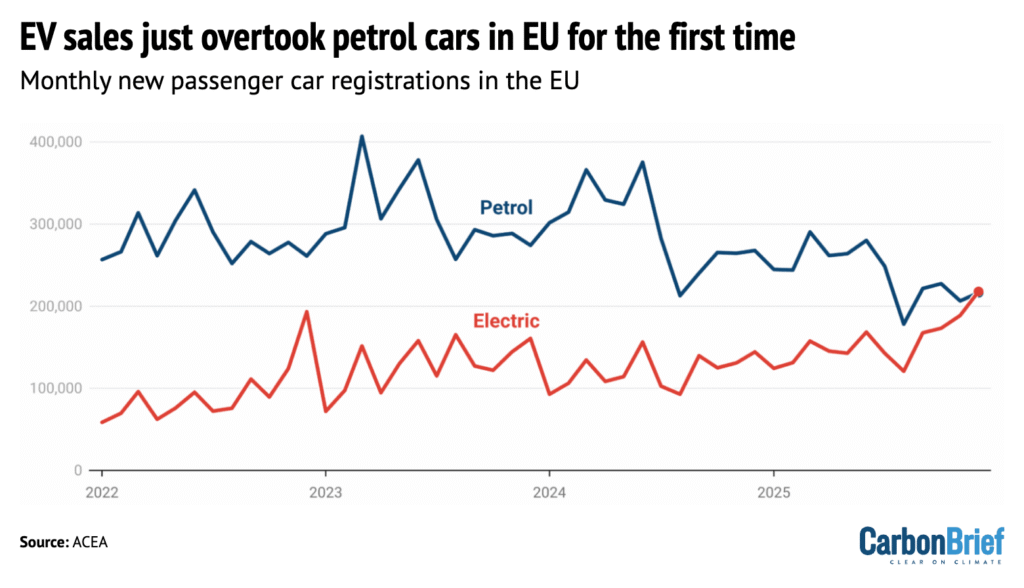
Sales of electric vehicles (EVs) overtook standard petrol cars in the EU for the first time in December 2025, according to new figures released by the European Automobile Manufacturers’ Association (ACEA) and covered by Carbon Brief. Registrations of “pure” battery EVs reached 217,898 – up 51% year-on-year from December 2024. Meanwhile, sales of standard petrol cars in the bloc fell 19% year-on-year, from 267,834 in December 2024 to 216,492 in December 2025, according to the analysis.
Spotlight
Looking at climate visuals
Carbon Brief’s Ayesha Tandon recently chaired a panel discussion at the launch of a new book focused on the impact of images used by the media to depict climate change.
When asked to describe an image that represents climate change, many people think of polar bears on melting ice or devastating droughts.
But do these common images – often repeated in the media – risk making climate change feel like a far-away problem from people in the global north? And could they perpetuate harmful stereotypes?
These are some of the questions addressed in a new book by Prof Saffron O’Neill, who researches the visual communication of climate change at the University of Exeter.
“The Visual Life of Climate Change” examines the impact of common images used to depict climate change – and how the use of different visuals might help to effect change.
At a launch event for her book in London, a panel of experts – moderated by Carbon Brief’s Ayesha Tandon – discussed some of the takeaways from the book and the “dos and don’ts” of climate imagery.
Power of an image
“This book is about what kind of work images are doing in the world, who has the power and whose voices are being marginalised,” O’Neill told the gathering of journalists and scientists assembled at the Frontline Club in central London for the launch event.
O’Neill opened by presenting a series of climate imagery case studies from her book. This included several examples of images that could be viewed as “disempowering”.
For example, to visualise climate change in small island nations, such as Tuvalu or Fiji, O’Neill said that photographers often “fly in” to capture images of “small children being vulnerable”. She lamented that this narrative “misses the stories about countries like Tuvalu that are really international leaders in climate policy”.
Similarly, images of power-plant smoke stacks, often used in online climate media articles, almost always omit the people that live alongside them, “breathing their pollution”, she said.

During the panel discussion that followed, panellist Dr James Painter – a research associate at the Reuters Institute for the Study of Journalism and senior teaching associate at the University of Oxford’s Environmental Change Institute – highlighted his work on heatwave imagery in the media.
Painter said that “the UK was egregious for its ‘fun in the sun’ imagery” during dangerous heatwaves.
He highlighted a series of images in the Daily Mail in July 2019 depicting people enjoying themselves on beaches or in fountains during an intense heatwave – even as the text of the piece spoke to the negative health impacts of the heatwave.
In contrast, he said his analysis of Indian media revealed “not one single image of ‘fun in the sun’”.
Meanwhile, climate journalist Katherine Dunn asked: “Are we still using and abusing the polar bear?”. O’Neill suggested that polar bear images “are distant in time and space to many people”, but can still be “super engaging” to others – for example, younger audiences.
Panellist Dr Rebecca Swift – senior vice president of creative at Getty images – identified AI-generated images as “the biggest threat that we, in this space, are all having to fight against now”. She expressed concern that we may need to “prove” that images are “actually real”.
However, she argued that AI will not “win” because, “in the end, authentic images, real stories and real people are what we react to”.
When asked if we expect too much from images, O’Neill argued “we can never pin down a social change to one image, but what we can say is that images both shape and reflect the societies that we live in”. She added:
“I don’t think we can ask photos to do the work that we need to do as a society, but they certainly both shape and show us where the future may lie.”
Watch, read, listen
UNSTOPPABLE WILDFIRES: “Funding cuts, conspiracy theories and ‘powder keg’ pine plantations” are making Patagonia’s wildfires “almost impossible to stop”, said the Guardian.
AUDIO SURVEY: Sverige Radio has published “the world’s, probably, longest audio survey” – a six-hour podcast featuring more than 200 people sharing their questions around climate change.
UNDERSTAND CBAM: European thinktank Bruegel released a podcast “all about” the EU’s carbon adjustment border mechanism, which came into force on 1 January.
Coming up
- 1 February: Costa Rican general election
- 3 February: UN Environment Programme Adaptation Fund Climate Innovation Accelerator report launch, Online
- 2-8 February: Intergovernmental Platform on Biodiversity and Ecosystem Services (IPBES) 12th plenary, Manchester, UK
Pick of the jobs
- Climate Central, climate data scientist | Salary: $85,000-$92,000. Location: Remote (US)
- UN office to the African Union, environmental affairs officer | Salary: Unknown. Location: Addis Ababa, Ethiopia
- Google Deepmind, research scientist in biosphere models | Salary: Unknown. Location: Zurich, Switzerland
DeBriefed is edited by Daisy Dunne. Please send any tips or feedback to debriefed@carbonbrief.org.
This is an online version of Carbon Brief’s weekly DeBriefed email newsletter. Subscribe for free here.


The post DeBriefed 30 January 2026: Fire and ice; US formally exits Paris; Climate image faux pas appeared first on Carbon Brief.
DeBriefed 30 January 2026: Fire and ice; US formally exits Paris; Climate image faux pas

LIVE VIDEO WILL BE BROADCAST HERE ON APRIL 9
After a strong push at COP30 to deliver a process for a global transition away from fossil fuels, the First Conference on Transitioning Away from Fossil Fuels, in Santa Marta, Colombia, is set to be a key boost of momentum for renewed talks on phasing out coal, oil and gas.
At this online webinar hosted by Climate Home News in partnership with the Fossil Fuel Treaty Initiative, government representatives and civil society observers will discuss how the landmark conference co-hosted by Colombia and the Netherlands can deliver on the momentum away from fossil fuels, especially at a time of global instability.
Speakers:
- Minister Irene Vélez Torres, Minister of Environment and Sustainable Development, Colombia
- Hon. Dr Maina Vakafua Talia, Minister of Home Affairs, Climate Change and Environment, Tuvalu
- Cedric Dzelu, Technical Director of the Office of the Minister for Climate Change and Sustainability, Ghana
- Tzeporah Berman, Chair and Founder of the Fossil Fuel Treaty Initiative
Want to join more of our events? Register here for free!
The post <mark style="background-color:rgba(0, 0, 0, 0)" class="has-inline-color has-vivid-red-color">LIVE on April 9</mark> | Santa Marta: fossil fuel transition in an unstable world appeared first on Climate Home News.
LIVE on April 9 | Santa Marta: fossil fuel transition in an unstable world
High costs, crowding and less-than-ideal land conditions make geothermal installations in downstate New York difficult—but not impossible.
The Rev. Kurt Gerhard stood near the lectern in Christ Church Bronxville. Beneath him, a network of pipes stretched into a nearby parking lot, where boreholes have been drilled hundreds of feet into the ground.
A Church’s Geothermal Experiment Could Pave the Way for Projects Across New York
Dr Laura-Jane Nolan is a carbon consultant and operations director at BOM Systems.
War leaves destruction in its wake – cities levelled, economies disrupted, lives lost. But another cost rarely enters the conversation: carbon emissions.
As the conflict in the Middle East grinds on, the world’s attention remains fixed on geopolitics and the loss of life and infrastructure. Yet the climate impact of modern warfare is largely invisible in both reporting and policy.
Using UK government greenhouse gas accounting frameworks and publicly available expenditure data, it is possible to estimate the emissions generated and the far larger footprint likely to follow during reconstruction.
Iran war could boost fossil fuel phase-out push, says Colombian minister
According to researchers at Queen Mary University of London, in just the first 14 days, US-Israeli war with Iran generated more than 5 million tonnes of carbon dioxide equivalent (CO₂e). While this represents only part of the total, it provides a rare, quantified entry point into the scale of the environmental damage caused so far.
Let’s be clear, direct measurement is not simple. Military fuel use, logistics and procurement data are rarely disclosed in detail. Researchers therefore rely on spend-based estimates, that is, the amount of CO2 equivalent per pound or dollar spent.
Post-conflict reconstruction
According to Reuters, the United States alone spent at least $11.3 billion (around £8.5 billion) in the first six days of the conflict. Using a conservative estimate of around 0.4 kg CO₂e per pound spent, the first six days of documented operations correspond to roughly 3.4 million tonnes of CO₂e.
After another week of conflict, the conservative estimate of over 5 million tonnes of CO₂e is not a small amount of greenhouse gases. It is roughly equivalent to 1.1 million cars driven for a year – all the cars in a large European city. It is also comparable to a million transatlantic flights.
If this seems shocking, these estimates likely underplay the situation. We haven’t considered the rebuilding of the destroyed buildings and infrastructure yet. Evidence from past conflicts shows that emissions from rebuilding, through cement, steel, asphalt and heavy machinery, can exceed those generated during active combat.
UK government data indicates that every £1 billion spent on construction generates approximately 250,000 to 350,000 tonnes of CO₂e, before accounting for debris clearance and supply-chain disruption.
In policy terms, this should prompt critical questions about how reconstruction should be financed and delivered, as investing in the green economy for new infrastructure will positively shape long-term emissions trajectories. Rebuilding antiquated infrastructure will be good money thrown after bad.
Gap in climate policy governance
Despite this, the climate cost of war remains largely absent from international frameworks. A loophole in the Kyoto Protocol even allowed countries to exclude military emissions from their national reporting. While the Paris Agreement removed Kyoto’s limited, sector-specific reporting rules and its focus on only developed countries – which had enabled greenhouse gases from overseas military activity to be kept out of the equation – military emissions are still inconsistently reported and rarely disaggregated.
This creates a gap in climate governance at precisely the historical moment when the climate system is shifting from predictable, linear change to a regime in which self-reinforcing, potentially irreversible changes will likely occur.
-
Nigerians bet on solar as global oil shock hits wallets and power supplies
Fed up with an increase in outages and surging fuel prices, a growing number of homes and businesses are ditching their backup generators for solar systems -
Nepal’s EV revolution pays off as oil crisis causes pain at the pumps
Import subsidies, abundant hydropower and charging investments have spurred EV adoption, with electric vehicles now making up about three-quarters of new car sales


Systematic carbon accounting for conflict and reconstruction using internationally agreed-upon frameworks such as ISO 14064-1 could set a new precedent for environmental accountability. Following Iraq’s invasion of Kuwait, the United Nations Compensation Commission awarded billions of dollars for environmental damage, including oil fires and ecosystem loss. Carbon accounting could support post-conflict environmental assessments and contribute to just liability frameworks and reparations.
Assessing infrastructure finance
International institutions are already moving in this direction. Multilateral development banks increasingly apply climate conditions to infrastructure finance, and post-conflict reconstruction funding could follow similar principles. Embedding emissions accounting into these processes would align recovery efforts with existing climate commitments.
The economic case is also completely clear for most people. The £8.5 billion spent in the first six days of the Iran conflict could have financed large-scale clean energy deployment, solar, wind, electrified heating and transport, delivering long-term returns, reducing fossil fuel dependence and strengthening energy security.
Major oil producers among 46 nations joining fossil fuel phase-out summit
Unlike military expenditure, these investments generate ongoing economic value. Yet the absence of systematic accounting for all aspects of war means these trade-offs remain largely invisible to policymakers, markets and the public.
As debates grow around recognising ecocide as a crime under international law, the legal and institutional frameworks for addressing environmental harm are evolving. Integrating carbon accounting into conflict and reconstruction processes would be a pragmatic next step, reflecting both climate realities and existing policy trends.
The climate cost of war is not hypothetical. It is measurable, material and increasingly unavoidable. The question is whether it will continue to be ignored.
The post Carbon accounting can help tackle the hidden emissions of war appeared first on Climate Home News.
Carbon accounting can help tackle the hidden emissions of war

LIVE on April 9 | Santa Marta: fossil fuel transition in an unstable world
A Church’s Geothermal Experiment Could Pave the Way for Projects Across New York

Sustainability In Your Ear: Don Carli On Tuning What We See Online To Reduce eCommerce Returns
-
Greenhouse Gases8 months ago
Guest post: Why China is still building new coal – and when it might stop
-
Climate Change8 months ago
Guest post: Why China is still building new coal – and when it might stop
-

 Greenhouse Gases2 years ago
嘉宾来稿:满足中国增长的用电需求 光伏加储能“比新建煤电更实惠”
-
Climate Change2 years ago
Bill Discounting Climate Change in Florida’s Energy Policy Awaits DeSantis’ Approval
-

 Climate Change2 years ago
嘉宾来稿:满足中国增长的用电需求 光伏加储能“比新建煤电更实惠”
-
Climate Change Videos2 years ago
The toxic gas flares fuelling Nigeria’s climate change – BBC News
-

 Renewable Energy5 months ago
Sending Progressive Philanthropist George Soros to Prison?
-

 Carbon Footprint2 years ago
US SEC’s Climate Disclosure Rules Spur Renewed Interest in Carbon Credits