Connect with us

Published

on

Welcome to Carbon Brief’s DeBriefed.
An essential guide to the week’s key developments relating to climate change.

This week

EU leaders agreed climate goal ‘truce’

‘BREAKTHROUGH’: EU leaders have reached a “breakthrough” on climate issues that “increases the likelihood” that the bloc will be able to sign off on its 2040 climate goal before COP30 in November, reported Bloomberg. Leaders reached a “truce” after agreeing to a raft of “enabling conditions”, designed to support carmakers and other energy-intensive industries through a “green transition”, it added.

‘COMPETING GOALS’: Reuters reported that leaders agreed “to proceed with the 2040 target, but [to] leave details for ministers to approve at a 4 November meeting”. It added that the European Commission had “promised to amend some climate measures” to win support from member states, including “controlling” carbon prices in the upcoming market for heat and transport fuels. France24 noted that leaders discussed how to manage the bloc’s “competing goals” of supporting business while playing a “lead role in the climate fight”.

Shipping industry delayed carbon price

NEGOTIATIONS COLLAPSE: Just hours after the previous issue of DeBriefed was published, member states of the UN’s International Maritime Organization agreed to delay a vote on whether to formally adopt a global carbon price for shipping by a year, reported the National. It said the negotiations “collapsed under US pressure”, meaning they were unable to finalise a deal agreed in April that would have “made shipping the first global industry subject to a carbon pricing system”. [Carbon Brief covered the deal and what it would have meant for shipping emissions at the time.]

‘MAJOR VICTORY’: The Financial Times described the delay as a “major victory” for US president Donald Trump’s “campaign to block a climate agreement for the global shipping industry” and “part of the wider Trump administration drive to sell more of its oil, coal and gas”. According to Agence France-Presse, the UN called the delay a “missed opportunity” and the European Commission said it was “regrettable”

‘REGRETABLE DERAILMENT’: A Financial Times editorial said the outcome was a “regrettable derailment” and “one of Trump’s most successful attempts yet to force all countries, rich and poor, to back his push to prolong the era of fossil fuels”. Elsewhere, US secretary of state Marco Rubio wrote a letter to the Wall Street Journal, outlining how the administration had “thwarted the UN’s tax”, dubbing the delay a “diplomatic victory” for the US. 

Around the world

  • DISASTER ALERTS: A new report from the UN’s World Meteorological Organization has called for a worldwide disaster alerts system as extreme weather events are leaving millions of people vulnerable, reported Al Jazeera
  • FOREST FUND: The World Bank has agreed to host the Tropical Forest Forever Fund (TFFF), being pushed by the Brazilian COP30 presidency Brazil, according to Folha de São Paulo. Separately, the country’s state-owned oil company Petrobras has been granted permission to drill for oil near the mouth of the Amazon, reported the Guardian
  • ‘GREEN JOBS’: The UK government announced a national clean-energy jobs plan, designed to “create…an extra 400,000 green jobs” in the next five years, the Guardian said. Meanwhile, UK prime minister Keir Starmer made a “last-minute decision” to attend COP30 in Brazil in November, the Financial Times reported. 
  • ‘BEAUTIFUL CHINA’: After a meeting in Beijing, top Chinese policymakers have listed “building a Beautiful China” as a “primary objective” for the 15th five-year plan covering 2026-2030, said International Energy Net. The concept, described in Carbon Brief’s glossary, covers tackling pollution and meeting China’s carbon neutrality targets..

$101bn 

The record-high cost of “climate disasters” in the US in the first half of 2025, according to new research from the Climate Central group reported by the Guardian


Latest climate research

  • Between 1997 and 2021, Antarctic ice shelves saw a decrease in “damaged area” | Nature Climate Change
  • Reducing food waste and dietary shifts could help halve emissions related to meat consumption in US cities | Nature Climate Change
  • In an “overshoot” scenario, where the world temporarily passes 1.5C of warming, permafrost area may “effectively recover” once temperatures fall, but carbon losses will be “largely irreversible” | Earth System Dynamics

(For more, see Carbon Brief’s in-depth daily summaries of the top climate news stories on Monday, Tuesday, Wednesday, Thursday and Friday.)

Captured
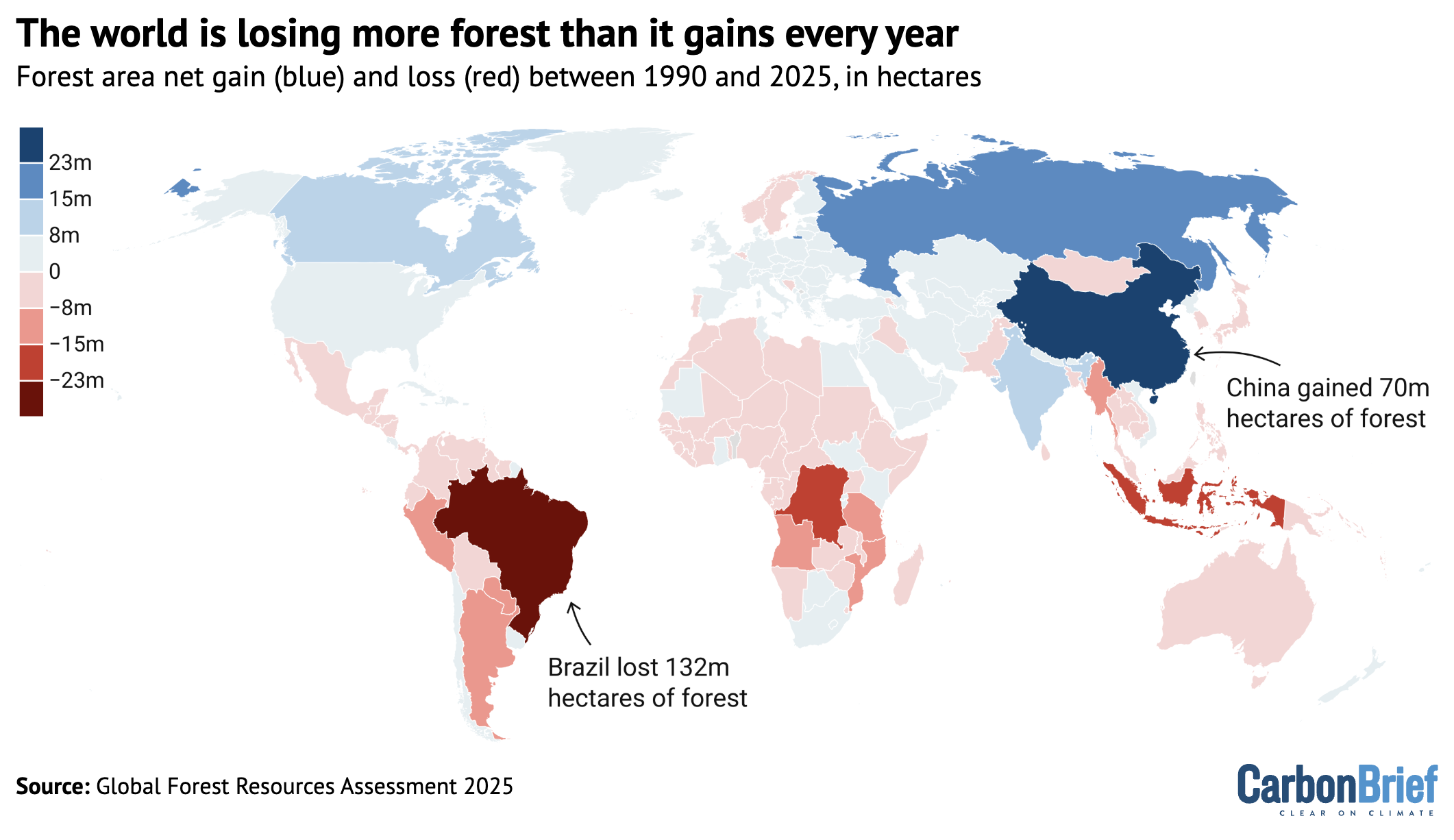
More forest is being lost than gained around the world each year

The amount of forest being lost around the world has reduced by millions of hectares each year in recent decades, Carbon Brief reported, based on the Global Forest Resources Assessment from the UN’s Food and Agriculture Organization. The report found that an estimated 10.9m hectares (Mha) of land was deforested each year between 2015 and 2025, nearly 7Mha less than the annual loss over 1990-2000. However, as the map above shows, more forest is still lost than gained each year. Between 2015 and 2025, there was an average 6.8Mha of forest growth each year, but 10.9Mha of loss. 

Spotlight

The Sámi people take Finland to court

This week, Carbon Brief reports on the launch of a “landmark” legal claim by the Indigenous Sámi people against the government of Finland, focused on the interplay between climate change and cultural traditions.

In June, 33 members of the Muddusjärvi Reindeer Herders’ Cooperative (MPLK), a Sámi community in northern Finland, brought a legal complaint to the UN human rights committee in Geneva. 

It alleged that the Finnish government had allowed multiple breaches of the International Covenant on Civil and Political Rights (ICCPR), which sets out the right to enjoy one’s culture, family life, non-discrimination and self-determination.

The MPLK has practised “nature-based Sámi reindeer herding” for centuries in Finland, as part of one of three remaining herding communities that use the endangered Inari Sámi language. The Sámi are the only Indigenous people recognised in Europe.

A Reindeer Rangifer tarandus in the snow in Finnish Laplan.
A Reindeer Rangifer tarandus in the snow in Finnish Laplan. Credit: Richard Tadman / Alamy Stock Photo

Changing conditions

Within its complaint, the MPLK  said it is being dispossessed from land traditionally used for reindeer herding, as a result of climate change and decades of intensive logging by the Finnish state-owned forestry agency Metsähallitus. These have “severely damaged” the land they depend on, the group’s lawyers Hogan Lovells said. 

In particular, the loss of lichen-rich, old-growth forests and changes to snow conditions have made it harder for reindeer to access natural food sources, creating an “existential threat” that “places in jeopardy the viability of the MPLK community’s way of life”, according to the complaint.

While there are additional funds provided by the Finnish government to compensate reindeer herders during harsh winters, this does not go far enough, the MPLK argued. For example, herders lost €32m between 2019 and 2020, but the MPLK only received €6m in compensation. 

There have already been a number of lawsuits brought by the Sámi people across the Nordic countries, in an effort to protect their lands and traditions. 

This includes the Norwegian government having to pay out millions to Sámi reindeer herders, an ongoing case in Sweden and two UN committees finding that Finland had violated Sámi rights to culture and land through mineral exploration permits on their territory. 

A new precedent

For the MPLK case, Hogan Lovells are relying on a precedent set at the committee in 2022 in a case brought by an indigenous group in Australia, whereby the government was ordered to compensate Torres Straits islanders who argued that climate change had a direct harmful consequence on their livelihood, culture and traditional ways of life. 

Finnish human rights law professor and human rights practitioner Martin Scheinin was involved in that case and is now co-counsel for the MPLK complaint. He told Carbon Brief that he had been “thrilled” by the 2022 outcome:  

“The [UN committee] broke [a] new path by focusing on Australia’s adaptation obligations as positive human rights obligations. As the committee also established that the right of minorities and Indigenous peoples to enjoy their own culture includes the right to transmit a distinctive way of life to new and even future generations, it was natural that the Indigenous Sámi people in Finland…want to build upon all these elements in their own case before the same committee.”

A formal response from the Finnish government to the complaint is expected this month. 

Watch, read, listen

INDONESIA’S ‘ENERGY PARADOX’: A new episode of the China-Global South Podcast discussed how China sits at the heart of Indonesia’s “energy paradox”. 

‘RARE-EARTHS TRAP’: Simon Nixon, former chief leader writer for the Times, wrote on his Substack about how the “west lost” to China, after the country “spent decades laying its rare-earths trap”. 

ANIMAL OBSTRUCTION: The latest episode of the Drilled podcast discussed how the animal agriculture industry has – and still does – “obstruct…climate policy”. 

Coming up

Pick of the jobs

DeBriefed is edited by Daisy Dunne. Please send any tips or feedback to debriefed@carbonbrief.org.

This is an online version of Carbon Brief’s weekly DeBriefed email newsletter. Subscribe for free here.


The post DeBriefed 24 October 2025:  EU 2040 climate goal progress; Shipping industry carbon price delayed; Europe’s indigenous people take Finland to court appeared first on Carbon Brief.

DeBriefed 24 October 2025:  EU 2040 climate goal progress; Shipping industry carbon price delayed; Europe’s indigenous people take Finland to court

Continue Reading

Climate Change

EU carbon credits could supercharge world’s clean cooking push, France says

Published

on

The European Union’s plan to use international carbon credits to help meet its 2040 climate target could provide a “super solution” to accelerate the rollout of cleaner cooking technologies across the Global South, according to France’s top climate envoy .

With the bloc set to become a “big investor” in carbon credits as a result of its new climate law, efforts to replace polluting cooking stoves with cleaner alternatives could be scaled up, French climate ambassador Benoît Faraco told a summit on clean cooking hosted by the International Energy Agency (IEA).

Faraco said he had discussed that possibility with French fossil fuel giant TotalEnergies, which is involved in clean cooking offsetting programmes in Africa and has major plans to expand the adoption of liquefied petroleum gas (LPG) for use in cookstoves in developing countries.

Controversial carbon credits

Starting in 2036, the EU will be allowed to count “high-quality” international carbon credits generated by partner countries under Article 6 of the Paris Agreement towards up to 5% of the emissions reductions required to meet its 2040 target of cutting greenhouse gas emissions by 90%. Several climate experts and activists accused the bloc of watering down its commitments by including carbon credits in its climate target for the first time.

The amended climate law adopted in early February says the credits will need to follow “robust safeguards” and “ensure environmental integrity”. The European Commission and its member states have yet to determine which types of credits would qualify or how they would be sourced.

But a French diplomatic source, speaking on condition of anonymity, told Climate Home News that clean cooking should be considered among the sectors to be supported through Article 6 funding, adding that France was willing to engage with its partners on the topic.

    Clean cooking credits have regularly faced significant criticism from researchers and campaigners who argue that climate benefits are often exaggerated and weak monitoring can undermine claims of real emission reductions.

    “There is a significant risk in trading credits that have repeatedly failed to deliver on their promises, which has been a particular issue with cookstove projects,” said Benja Faecks, an expert at Brussels-based NGO Carbon Market Watch (CMW), adding that it was “far too early” for France to make recommendations on specific credit types.

    The French diplomatic source told Climate Home News that France will continue to advocate for the EU to forge partnerships with countries to develop a high-quality carbon credits supply chain.

    Total’s cooking gas expansion

    Speaking at the IEA summit held in Paris late last month, Faraco said he had discussed the use of carbon credits to fund clean cooking initiatives with TotalEnergies a few days earlier when he joined the French multinational on a visit to deliver LPG cooking units.

    TotalEnergies says it is investing over $400 million in LPG infrastructure – including canister storage and filling stations – to give 100 million people in Africa and India access to cleaner cooking alternatives to wood and charcoal.

    Jayanty Pathinera, 78, cooks rice with firewood in the fuel shortage at her house at a residential area for low-income, amid the country’s economic crisis, in Colombo, Sri Lanka, July 31, 2022. REUTERS/Kim Kyung-Hoon

    Jayanty Pathinera, 78, cooks rice with firewood in the fuel shortage at her house at a residential area for low-income, amid the country’s economic crisis, in Colombo, Sri Lanka, July 31, 2022. REUTERS/Kim Kyung-Hoon

    But while the company promotes the programme as a win for public health and the climate, it also stands to benefit commercially: the rollout would create a vast new market to absorb the growing volumes of oil and gas the company wants to produce across Africa.

    In Uganda, where TotalEnergies is leading the development of a major and controversial oil drilling project on the shores of Lake Albert, the French firm says it also provides “affordable” LPG cooking solutions to local communities aiming to avoid “critical deforestation”.

    Campaigners have said that gas is not clean nor affordable and pushing its adoption for cooking would lock vulnerable communities into a fossil fuel system. Faecks from CMW said the distribution of LPG cookstoves “very much suits Total’s interests”.

    TotalEnergies did not immediately respond to a request for comment.

    Major carbon market player

    The French company has long been involved in carbon markets and, in 2025, spent $73 million to buy carbon credits used to offset, on paper, the greenhouse gas emissions caused by its oil and gas operations.

    Last year, it announced that it had partnered with a carbon credit developer to distribute 200,000 cookstoves to households in Rwanda that it said would prevent the emission of more than 2.5 million tons of carbon dioxide over the next 10 years. TotalEnergies will acquire the credits produced by the project and use them from 2030 to offset some of its direct emissions.

    “Clean cooking contributes to long-term social, economic and human development in a more sustainable way,” Arnaud Le Foll, senior vice-president new business and carbon neutrality at TotalEnergies, said at the time.

    The post EU carbon credits could supercharge world’s clean cooking push, France says appeared first on Climate Home News.

    EU carbon credits could supercharge world’s clean cooking push, France says

    Continue Reading

    Climate Change

    Explainer: Will AI data centres make or break the energy transition?

    Published

    on

    For tech entrepreneur Elon Musk, the answer to the rocketing energy needs of artificial intelligence (AI) data centres is to launch them into space, where they could tap limitless energy from the sun. But until that happens, the places on Earth where these number-crunching mega-hubs are located face big spikes in electricity demand to run them.

    In the US, this has sparked fears of higher energy prices for consumers. To allay those concerns, President Donald Trump will reportedly convene big tech firms this week to sign a pledge to provide or pay for the extra energy supplies they will need as their AI data centres expand.

    According to the International Energy Agency (IEA), data centres accounted for 1.5% of electricity demand worldwide in 2024 – a share set to rise to about 3% by 2030. Overall, data centre demand is expected to more than double to about 945 terawatt-hours (TWh) by then, which is slightly above the electricity consumption of Japan today.

    AI data centres, where AI models are trained and deployed, put far more strain on power supplies than traditional data centres, which each use between 10 and 25 megawatts (MW). In comparison, demand from a “hyperscale” AI centre can exceed 100 MW at any given time, which if running at full capacity could consume as much electricity in a year as 100,000 households.

    Data-centre electricity consumption in household electricity consumption equivalents (million households), 2024

    (Source: IEA, Paris, 2025, Licence: CC by 4.0)

    (Source: IEA, Paris, 2025, Licence: CC by 4.0)

    We look at where this power might come from and whether, as some warn, AI is going to blow the world’s efforts to transition away from fossil fuels out of the water.

    Why does AI need so much electricity?

    AI data centres differ in how they use electric power. In a conventional data centre, data requests from businesses, individuals and other users come in a randomised way, translating into a steady load level on the servers, with relatively little fluctuation in demand.

    But in an AI data centre, processors need to go through training or learning periods, using so-called “graphical processing units”. These are synchronised, being started up and switched off at the same time. This translates into “power bursts”, which last just a few seconds, but happen very frequently and concurrently, according to Gerhard Salge, chief technology officer at Hitachi Energy.

    “That is a different challenge than just providing the power and the energy for the conventional data centres,” he told journalists at the International Renewable Energy Agency assembly in Abu Dhabi earlier this year.

    Here, officials and business executives discussed how to meet those demand peaks, noting they cannot be dealt with just by installing huge batteries as those would wear out quickly.

    Martin Pibworth, chief executive of SSE, a Scotland-based energy firm, said AI-led demand will put pressure on the power system, but “the problem we all have is no one really knows the pace and trajectory of that demand lift”. In the UK, the government’s Clean Power Plan will be needed to make sure electricity operators can meet demand from AI and other data centres as more come online, he added.

      In the US, meanwhile, the Trump administration is eager to ensure that communities that are home to data centres, as well as the wider public, do not turn against the industry due to its perceived unfairly high use of energy and water.

      Ahead of a meeting scheduled on March 4, where US tech titans are due to sign a pledge on powering their own data centres, White House spokesperson Taylor Rogers told CNBC: “Under this bold initiative, these massive companies will build, bring, or buy their own power supply for new AI data centres, ensuring that Americans’ electricity bills will not increase as demand grows.”

      Will electricity for data centres and AI come from clean or dirty sources of energy?

      The answer to this question is key to how countries tackle climate change, as it will affect their energy mix, how electricity is produced and distributed, and therefore the trajectory of their greenhouse gas emissions. Decisions made by governments and businesses will shape how the AI industry powers the technology on which it relies.

      Under pro-fossil fuel Trump, the US has walked away from policy support for clean energy, meaning data centre operators can choose their energy sources freely. In January, data from Global Energy Monitor (GEM) showed the US now has the most gas-fired power capacity in development, surpassing China and accounting for nearly a quarter of the world’s total.

      More than one-third of this capacity is set to directly power data centres on-site, in hotspots like Texas, and many more grid-connected gas-fired projects are planned to meet an expected increase in energy demand from AI, GEM said.

      On the other hand, some tech companies – especially multinationals – have set goals to cut their emissions to net zero, and so are choosing to power their data centres with renewables, including in the US.

      For example, French energy giant TotalEnergies recently signed two long-term Power Purchase Agreements (PPA) to deliver 1 gigawatt (GW) of solar capacity for Google’s data centres in Texas. This followed two other PPAs with Google for 1.2 GW secured by Clearway, a California-based renewables company 50%-owned by TotalEnergies.

      Sources of global electricity generation for data centres – base case, 2020-2035

      (Source: IEA, Paris, Licence: CC by 4.0)

      (Source: IEA, Paris, Licence: CC by 4.0)

      Some countries are also moving to ensure the power needed for AI and the data centre industry is produced using clean energy.

      In Ireland, an effective ban on new data centre connections was lifted in December, provided at least 80% of the centres’ annual energy demand is met by new renewable electricity sources. The government also plans to build Green Energy Parks, where data centres can be located alongside renewables plants to avoid straining the national grid.

      Salge of Hitachi Energy said that with big investors wanting to drive investment in AI data-crunching so fast, “there is no other power generation technology than variable renewables which you can build in such a timeline” of two to three years. “Anything else will be in the 2030s and later,” he added.

      Some governments – such as Sweden’s centre-right coalition have proposed nuclear as a clean energy solution for AI data centres, saying they could fuel a “renaissance”. But building nuclear power plants requires massive investment and long timelines, while new small-scale modular reactors are not yet commercially available.

      How are power systems and regulators coping so far?

      In a February report forecasting electricity demand out to 2030, the IEA said AI and data centres are contributing to generation growth in advanced economies, which is now accelerating again after 15 years of stagnation. However, it flagged bottlenecks in connecting new data centres, because grids are not being built or improved fast enough to keep up with rising power demand, forcing big customers to wait.

      The report noted that at least 150 GW of queued data centre projects are estimated to be in the advanced stages, while one-fifth of the global data centre build-out is at risk of delay due to grid congestion.

      Comment: Using energy-hungry AI to detect climate tipping points is a paradox

      Planning, permitting and completing new grid infrastructure can take five to 15 years, whereas data centres need one to three years. Prices for key grid components have also nearly doubled over the past five years, the IEA noted.

      The European Commission, meanwhile, aims to support those operators that can save on energy use. It plans to adopt a “Data Centre Energy Efficiency Package” in April that will contain an assessment of data submitted under a reporting scheme, introduce a rating scheme for data centres in the EU, and start work on minimum performance standards.

      Can AI help to resolve the issue?

      Experts say it’s important to look at both sides of the coin, pointing to ways in which AI can contribute to more effective power grid management and integration of renewables into national power supplies.

      According to new analysis by energy think-tank Ember, AI applications such as short-term renewables forecasting, predictive maintenance, and real-time monitoring and adjustment of transmission line capacity can deliver operational improvements in power systems.

      It estimates that AI could enable Southeast Asian nations, for example, to reduce their power sector costs by $45 billion-$67 billion through to 2035, depending on how much renewable energy they deploy. Potential AI-driven efficiency gains could cut emissions by 290 million to 386 million tonnes of CO2 over the next decade in ASEAN countries, it adds.

      “While power-hungry AI might initially stress the power systems, with various powerful applications it has the potential to significantly accelerate the energy transition and offset consumed energy rapidly,” Ember data analyst Lam Pham said in a statement.

      The post Explainer: Will AI data centres make or break the energy transition? appeared first on Climate Home News.

      Explainer: Will AI data centres make or break the energy transition?

      Continue Reading

      Climate Change

      New Investigation Reveals Forced Labour Tied to Tuna Sold in Australia

      Published

      on

      A new investigative report released by Greenpeace Southeast Asia, in collaboration with the Uniting Church in Australia, Synod of Victoria and Tasmania, has uncovered disturbing links between suspected forced labour in the Indonesian tuna fishing industry and seafood sold in Australia.

      The investigation analysed testimonies from 25 fishers working on 17 Indonesian tuna fishing vessels that supply the Australian market. These vessels supply five Indonesian processing companies, which in turn export to 18 Australian seafood companies, including major brands seen on our supermarket shelves.

      The findings raise urgent questions about human rights protections at sea and the integrity of seafood supply chains reaching Australian supermarket shelves.

      The crew of an Asian-flagged tuna longliner at work during a transshipment to a carrier mothership. © Greenpeace

      What the Investigation Found

      Fishers interviewed described experiencing multiple internationally recognised indicators of forced labour.

      Of the 11 forced labour indicators identified by the International Labour Organisation, the most frequently reported were:

      • Abuse of vulnerability (56%)
      • Debt bondage (56%)
      • Deception (40%)

      The report reveals a multi-layered recruitment network in Indonesia that channels vulnerable workers from rural areas into exploitative situations. Labour brokers, known locally as calo, collaborate with vessel administrators and manage recruitment. Fishers reported being lured with promises of high salaries and advance loans, only to be charged illegal and inflated fees for travel, training and documentation.

      Diver Joel Gonzaga of the the Philippine purse seiner ‘Vergene’ at work in the international waters of high seas. © Alex Hofford / Greenpeace

      The investigation also found that labour exploitation at sea is intertwined with environmental crime. Companies allegedly pushed vessels and fishers to engage in illegal, unreported and unregulated fishing practices, including shark finning and the deployment of illegal fish aggregating devices.

      75 kilograms of shark fins from at least 42 sharks found in the freezer of the Shuen De Ching No.888. Under Taiwanese law and Pacific fishing rules, shark fins may not exceed 5% of the weight of the shark catch, and with only three shark carcasses reported in the log book, the vessel was in clear violation of both. © Paul Hilton / Greenpeace

      The link between labour abuse and environmental destruction is not accidental. It reflects an extractive system that externalises both human and ecological costs to sustain profit margins.

      Industrial fishing not only exploits vulnerable workers and undermines human rights, it also strips life from our oceans, degrading fragile ecosystems and pushing marine wildlife toward collapse.

      What Needs to Happen Now

      The report calls for urgent action from both governments and industry.

      The Indonesian Government must:

      • Enforce decent and effective work at sea policies aligned with international standards.
      • Ensure ethical recruitment practices.
      • Guarantee fair wages and protections for Indonesian fishers.

      The Australian Government must:

      • Prohibit seafood products linked to labour exploitation and forced labour from entering Australian markets.

      Seafood companies in both countries must:

      • Conduct robust human rights and environmental due diligence across their supply chains.

      These are not abstract policy fixes. They are necessary steps to prevent modern slavery at sea and to stop environmental crime from being embedded in global seafood trade.

      Environmental Justice and Ocean Protection Go Hand in Hand

      This investigation highlights something fundamental. Human rights and ocean protection are inseparable.

      Environmental justice means the fair treatment and meaningful involvement of everyone in creating a healthy environment. When workers are exploited and forced into dangerous conditions, environmental laws are often ignored too. Abuse at sea and ocean destruction are two sides of the same industrial system.

      Destructive industrial fishing methods such as longlining and bottom trawling continue to pillage and industrialise the ocean. They kill wildlife, destroy fragile habitats and undermine the resilience of marine ecosystems.

      If we want a thriving ocean, we must protect both the people who work on them and the ecosystems themselves.

      Why This Matters for Australia and the Global Ocean Treaty

      The Australian Government is on the cusp of ratifying the Global Ocean Treaty, the legal instrument allowing governments to create high seas ocean sanctuaries free from industrial fishing. Once Australia has ratified, it has the critical tool it needs to protect the ocean and safeguard beautiful and endangered species like whales, dolphins and sharks from destructive fishing methods in the high seas.

      A silky shark and other marine life. © Paul Hilton / Greenpeace

      Vast, robust ocean sanctuaries are a crucial solution to the ocean crisis. These high seas sanctuaries will provide a blue haven where wildlife can rest, recover and thrive. Greenpeace Australia Pacific is calling on the Australian government to champion multiple high sea ocean sanctuaries in our region, starting with a first generation ocean sanctuary in the South Tasman Sea between Australia and Aotearoa, free from industrial fishing, whaling and the threat of deep sea mining.

      As this investigation shows, the stakes are not only environmental, they are deeply human.

      Australia has an opportunity to lead by cleaning up seafood supply chains at home and by championing ambitious ocean protection globally by creating fully protected ocean sanctuaries. Protecting workers’ rights and protecting ocean wildlife must happen together.

      https://www.greenpeace.org.au/article/new-investigation-reveals-forced-labour-tied-to-tuna-sold-in-australia/

      Continue Reading

      Trending

      Copyright © 2022 BreakingClimateChange.com

