

Welcome to Carbon Brief’s DeBriefed.
An essential guide to the week’s key developments relating to climate change.
This week
Bonn talks wrap up
‘STEEP MOUNTAIN’: As climate negotiations in the German city of Bonn drew to a close on Thursday night, UN climate chief Simon Stiell said that nations had “a very steep mountain to climb” ahead of the COP29 summit in Baku, Azerbaijan, later this year, according to Agence France-Presse.
FINANCE DIVIDE: The talks were marked by “polarised views and sharp disagreements”, the Hindustan Times reported. The divide over climate finance was particularly notable, with countries failing to find common ground, despite the expectation they will come up with a new target “for helping poorer countries cut their emissions and protect their societies in a harsher, hotter world”, Reuters explained.
RAISING AMBITION: In its final daily dispatch from the talks in Bonn, Climate Home News covered an event that saw negotiators from the past, present and future COP presidencies – the UAE, Azerbaijan and Brazil – discuss their efforts to boost the ambition of other countries’ climate plans. All three said they will submit new strategies that are aligned with the Paris Agreement goal of 1.5C, but the article noted that none of them plan to stop producing fossil fuels. Carbon Brief has just published an in-depth article on the key takeaways from Bonn.
Europe goes to the polls
GREEN LOSSES: Losses by Green parties in the European parliamentary elections have “raised concerns” about EU climate policies, the Guardian reported. The Associated Press noted significant Green losses in Germany and France, amid a wider “electoral shift to the right”. Nevertheless, Reuters stated that the EU’s Green Deal package of laws would prove “hard to undo” – a point broadly echoed by experts speaking to Carbon Brief.
UK ELECTION: UK parties began launching their election manifestos. The incumbent Conservatives have drawn criticism for their “pragmatic” net-zero policies, according to the Press Association. By contrast, the Liberal Democrats have pledged to bring the UK’s net-zero goal forward to 2045, BusinessGreen reported. Labour, which polling suggests is likely to form the next government, confirmed its goal to bring forward a target to fully decarbonise the electricity grid from 2035 to 2030, according to Edie. Carbon Brief is tracking where all the parties stand on climate, energy and nature.
Around the world
- DROUGHT RIOTS: Riots have erupted over water shortages in the drought-stricken Algerian city of Tiaret, according to the Associated Press. It described the fossil-fuel-rich nation as being in “among the world’s worst-hit regions by climate change”.
- BAN REVERSAL: New Zealand’s right-wing government has announced it will reverse a ban on oil-and-gas exploration brought in by the previous government, Radio New Zealand reported.
- WET FIRES: A record area of Brazil’s Pantanal wetlands has burned in the first half of 2024, as weak rains have disrupted the usual seasonal flooding, BBC News reported.
- DIRTY MONEY: Sources have told Reuters that Organisation for Economic Co-operation and Development (OECD) members intend to launch a plan to end new private-sector financing for coal projects at the COP29 climate summit.
- REJECT YOUR ELDERS: The Swiss parliament has rejected a European Court of Human Rights ruling, which accused the nation of violating the rights of a group of “female climate elders” by enacting weak climate policies, according to the Guardian.
- TRADE WARS: The EU will impose additional levies on electric cars from China next month, taking tariffs to as high as 48%, Bloomberg said.
$1.1-1.3 trillion
The amount of climate finance developing countries at Bonn want developed countries to provide to them every year, according to Climate Home News.
Latest climate research
- The extreme rainfall that hit Afghanistan, Pakistan and Iran in April and May this year was made twice as likely by El Niño, according to rapid analysis covered by Carbon Brief. The scientists were unable to determine the role of climate change.
- Nitrous oxide emissions from human activities rose by 40% over the past four decades, partly driven by growing global demand for meat and dairy, according to new research reported on by Carbon Brief.
- Exposure to high and low temperatures during pregnancy and the early years of a child’s life “may have lasting impacts” on brain development, according to new research in Nature Climate Change.
(For more, see Carbon Brief’s in-depth daily summaries of the top climate news stories on Monday, Tuesday, Wednesday, Thursday and Friday.)
Captured

New Carbon Brief analysis by Dr Zeke Hausfather examined when the world is likely to exceed the 1.5C and 2C limits set out in the Paris Agreement. The chart above shows observed global average temperature from 1850 to 2023 in black, along with a vast array of colours illustrating the wide range of possible futures derived from 37 different climate models. This approach suggests that the world will pass 1.5C around the year 2030, with a range of anywhere from 2028 up to 2036.
Spotlight
Fossil fuels, billionaires and weapons: are taxes the solution to climate finance?
Reporting from the UN climate talks in Bonn, Carbon Brief considers proposals to raise much-needed funds for climate action by taxing everything from fossil fuels to bombs.
Developing countries require trillions of dollars to achieve their climate goals and they want developed countries to foot a large chunk of this bill. But, by the most recent count, climate finance from those nations had reached just $116bn in 2022.
In the hunt for climate investment, one option gaining momentum is the idea of new taxes.
Tackling climate change by “making polluters pay” is not a new concept. However, as climate-finance negotiations have stalled at the UN climate talks in Bonn, some provocative ideas have made their way out of NGO reports and into the halls of power.
Tax the rich
Tucked away in the “global stocktake” text that emerged from the COP28 climate summit last year was a reference to “taxation” as an “innovative” source of climate finance.
G20 chair Brazil has taken up this idea, pushing a global “billionaire tax” that could raise around $250bn a year.
Germany and France are among those supporting this tax, arguing it could be a tool to raise climate finance.
COP28 also saw the launch of the International Tax Task Force – a group of countries exploring various levies on fossil fuels, transport and financial transactions.
Speaking to Carbon Brief in Bonn, one of the initiative’s leaders, Ali Mohamed, who is also the African Group chair, said “it’s important that we look at whatever is possible”, given the crises facing the world. He added:
“We hope just to bring together a group of countries that are willing to experiment.”
Some of these ideas are already being discussed at a high level. In particular, negotiators at the UN International Maritime Organisation are considering a shipping-emissions levy.
Oil and bombs
Ahead of Bonn, Bloomberg reported that Azerbaijan, the host of COP29, was considering a new climate fund filled by taxing oil, gas and coal production.
Fossil-fuel levies have already been employed in some countries and have been championed by UN secretary-general António Guterres. Nevertheless, Catherine Abreu, executive director of Destination Zero, told Carbon Brief it is “significant” to see such a fund proposed by the oil-producing COP president. But she added:
“So far, what we’ve heard about Azerbaijan’s proposal makes it sound more like an investment or profit-making scheme than a true climate fund.”
(This idea was further dampened in Bonn by a Politico interview with Yalchin Rafiyev, Azerbaijan’s lead negotiator, in which he suggested that their proposal would not only single out fossil fuel companies – and may consist of voluntary contributions.)
Meanwhile, the Arab Group – led by Saudi Arabia – submitted a proposal at Bonn calling for developed countries to provide $441bn in public spending a year.
Saudi negotiator Mohammad Ayoub went into more detail about how they could achieve this goal, suggesting “a tax on defence companies in developed countries”.
The proposal stood out, not least given Saudi Arabia’s status as the world’s second-largest arms importer. Climate Home News revealed that other taxes proposed by the Arab Group would target “luxury” items, such as fashion and technology.
Iskander Erzini Vernoit, director of the Imal Initiative for Climate and Development, told Carbon Brief the proposal was “a response to the constant refrain, which we hear from the US and others, that there supposedly is not sufficient public finance”.
Tax justice
This all comes against a wider backdrop of calls for “tax justice”. To this end, African nations in particular have been fighting for a new UN Framework Convention on International Tax Cooperation.
“This could potentially lead to global tax measures that might target aviation or international financial transactions,” Teresa Anderson, global climate justice lead at ActionAid, told Carbon Brief.
Taxation is not generally regarded as a vote-winner. Yet, as wealthy countries face pressure to commit public money to climate action, Cat Pettengell, executive director of Climate Action Network UK, said “fair taxes and ending harmful subsidies are there for the taking”.
Watch, read, listen
‘COOKING AND COUGHING’: An on-the-ground report by the Associated Press examined how women are increasingly turning to burning firewood for food preparation in Kenya.
FIRE ERA: The Bloomberg Zero podcast explored how the 21st century could be “shaped by destructive fire weather”.
CLIMATE GRIEF: The Climate Pod spoke to climate justice writer Mary Annaïse Heglar about her new book, Troubled Waters, covering themes of climate racism and grief.
Coming up
- 13-15 June: G7 summit, Borgo Egnazia, Italy
- 17-20 June: 67th meeting of the Global Environment Fund (GEF) council, Washington DC
- 18-21 June: ICLEI (Local governments for sustainability) World Congress 2024, São Paulo, Brazil
- 19-21 June: G20 third climate and environment sustainability working group meeting, Manaus, Brazil
Pick of the jobs
- UN Climate Summit News, editor (part-time) | Salary: Unknown. Location: Remote
- Greenpeace International, senior scientist | Salary: £43,116-£49,944. Location: Exeter, UK
- WWF Malaysia, forestry manager | Salary: RM5,800-RM6,300. Location: Sabah, Malaysia
DeBriefed is edited by Daisy Dunne. Please send any tips or feedback to debriefed@carbonbrief.org.
This is an online version of Carbon Brief’s weekly DeBriefed email newsletter. Subscribe for free here.

The post DeBriefed 14 June 2024: Bonn climate talks; When Earth could breach 1.5C; How polluter taxes could raise climate funds appeared first on Carbon Brief.

With the U.S. bombing Iran and the Strait of Hormuz closed, energy experts say countries transitioning to renewables will be more resilient in the “face of the shock.”
The United States’ war on Iran could fundamentally alter how countries consume and generate energy and hamper international progress in combating climate change, a panel of energy experts said today.
The Global Energy Supply in a Decade ‘Is Not a World We’re Going to Recognize’
One month into the US and Israel’s war on Iran, at least 60 countries have taken emergency measures in response to the subsequent global energy crisis, according to analysis by Carbon Brief.
So far, these countries have announced nearly 200 policies to save fuel, support consumers and boost domestic energy supplies.
Carbon Brief has drawn on tracking by the International Energy Agency (IEA) and other sources to assess the global policy response, just as a temporary ceasefire is declared.
Since the start of the war in late February, both sides have bombed vital energy infrastructure across the region as Iran has blocked the Strait of Hormuz – a key waterway through which around a fifth of global oil and liquified natural gas (LNG) trade passes.
This has made it impossible to export the usual volumes of fossil fuels from the region and, as a result, sent prices soaring.
Around 30 nations, from Norway to Zambia, have cut fuel taxes to help people struggling with rising costs, making this by far the most common domestic policy response to the crisis.
Some countries have stressed the need to boost domestic renewable-energy construction, while others – including Japan, Italy and South Korea – have opted to lean more on coal, at least in the short term.
The most wide-ranging responses have been in Asia, where countries that rely heavily on fossil fuels from the Middle East have implemented driving bans, fuel rationing and school closures in order to reduce demand.
‘Largest disruption’
On 28 February, the US and Israel launched a surprise attack on Iran, triggering conflict across the Middle East and sending shockwaves around the world.
There have been numerous assaults on energy infrastructure, including an Iranian attack on the world’s largest LNG facility in Qatar and an Israeli bombing of Iran’s gas sites.
Iran’s blockade of the Strait of Hormuz, a chokepoint in the Persian Gulf, is causing what the IEA has called the “largest supply disruption in the history of the global oil market”.
A fifth of the world’s oil and LNG is normally shipped through this region, with 90% of those supplies going to destinations in Asia. Without these supplies, fuel prices have surged.
Governments around the world have taken emergency actions in response to this new energy crisis, shielding their citizens from price spikes, conserving energy where possible and considering longer-term energy policies.
Even with a two-week ceasefire announced, the energy crisis is expected to continue, given the extensive damage to infrastructure and continuing uncertainties.
Asian crunch
Carbon Brief has used tracking by the IEA, news reports, government announcements and internal monitoring by the thinktank E3G to assess the range of national responses to the energy crisis roughly one month into the Iran war.
In total, Carbon Brief has identified 185 relevant policies, announcements and campaigns from 60 national governments.
As the map below shows, these measures are concentrated in east and south Asia. These regions are facing the most extreme disruption, largely due to their reliance on oil and gas supplies from the Middle East.
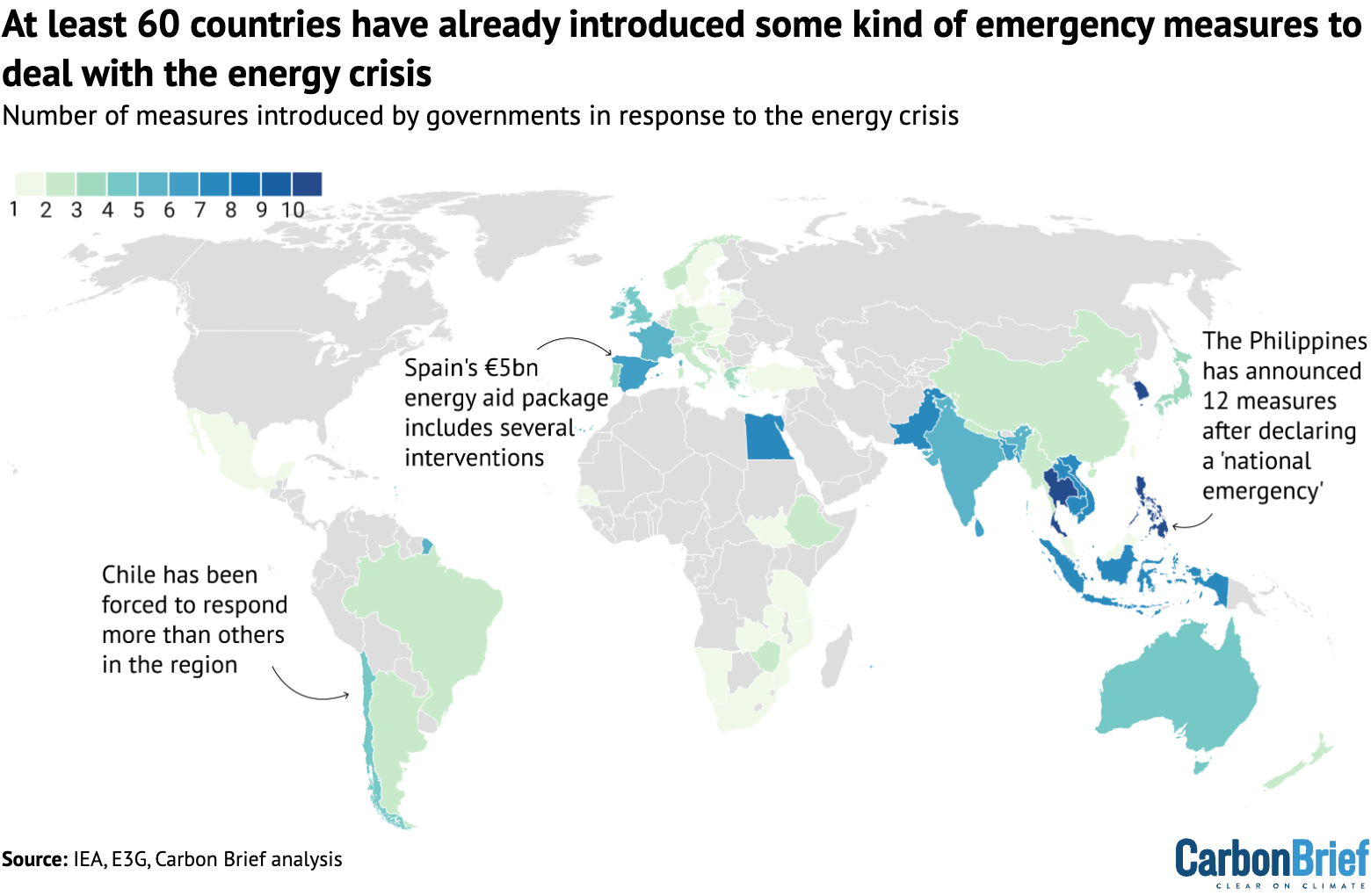
Nations including Indonesia, Japan, South Korea and India are already spending billions of dollars on fuel subsidies to protect people from rising costs.
At least 16 Asian countries are also taking drastic measures to reduce fuel consumption. For example, the Philippines has declared a “state of national emergency”, which includes limiting air conditioning in public buildings and subsidising public transport.
Other examples from the region include the government in Bangladesh asking the public and businesses to avoid unnecessary lighting, Pakistan reducing the speed limit on highways and Laos encouraging people to work from home.
Europe – which was hit hard by the 2022 energy crisis due to its reliance on Russian gas – is less immediately exposed to the current crisis than Asia. However, many nations are still heavily reliant on gas, including supplies from Qatar.
The continent is already feeling the effects of higher global energy prices as countries compete for more limited resources.
At least 18 European nations have introduced measures to help people with rising costs. Spain, which is relatively insulated from the crisis due to the high share of renewables in its electricity supply, nevertheless announced a €5bn aid package, with at least six measures to support consumers.
Many African countries, while also less reliant on direct fossil-fuel supplies via the Strait of Hormuz than Asia, are still facing the strain of higher import bills. Some, including Ethiopia, Kenya and Zambia, are also facing severe fuel shortages.
There have been fewer new policies across the Americas, which have been comparatively insulated from the energy crisis so far. One outlier is Chile, which is among the region’s biggest fuel importers and is, therefore, more exposed to global price increases.
Tax cuts
The most common types of policy response to the energy crisis so far have been efforts to protect people and businesses from the surge in fuel prices.
At least 28 nations, including Italy, Brazil and Australia, have introduced a total of 31 measures to cut taxes – and, therefore, prices – on fuel.
Even across Africa, where state revenues are already stretched, some nations – including Namibia and South Africa – are cutting fuel levies in a bid to stabilise prices.
Another 17 countries, including Mexico and Poland, have directly capped the price of fuel. Others, such as France and the UK, have opted for more targeted fuel subsidies, designed to support specific vulnerable groups and industries.
These measures are all shown in the dark blue “consumer support” bars in the chart below.
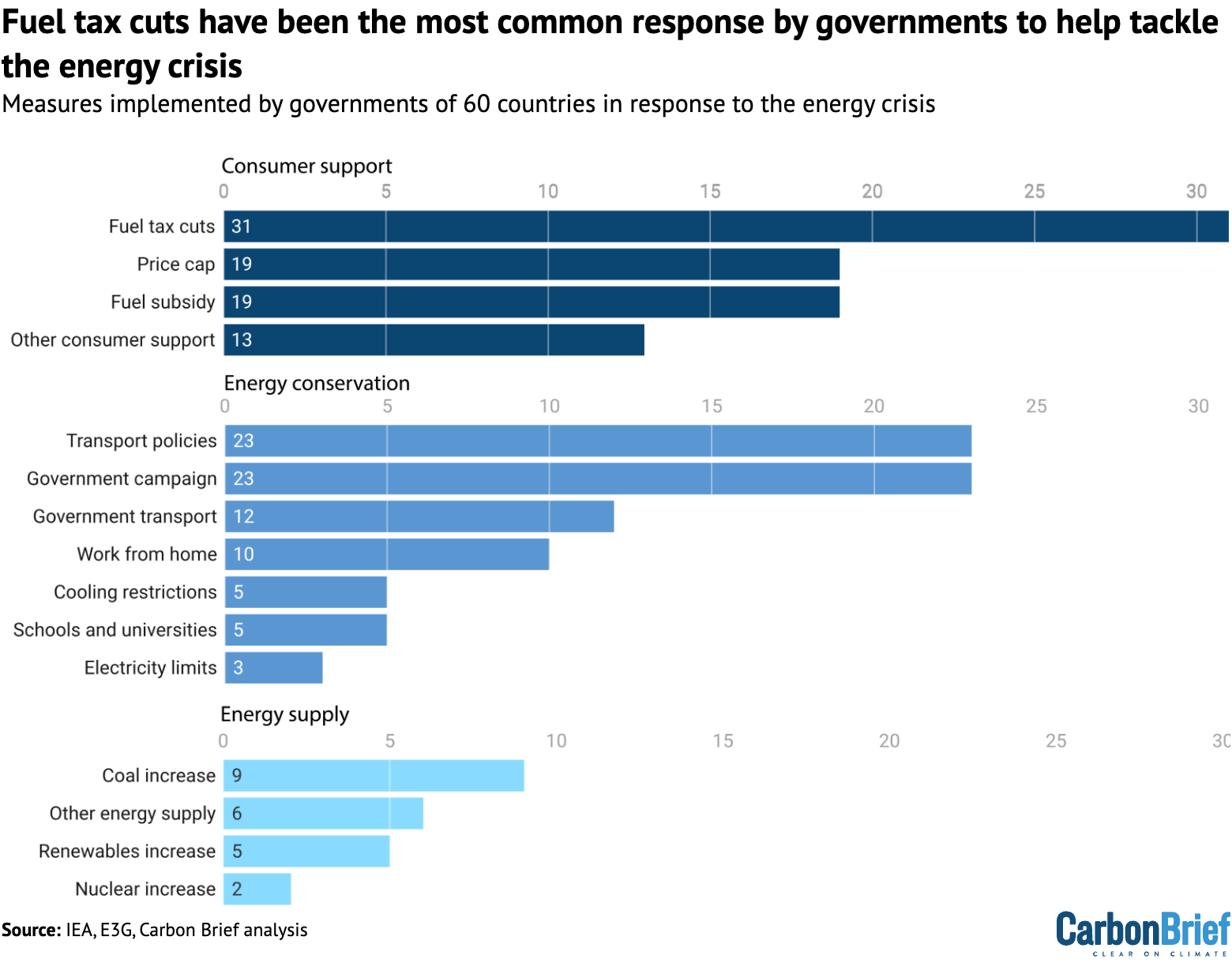
Such measures can directly help consumers, but some leaders, NGOs and financial experts have noted that there is also the risk of them driving inflation and reinforcing reliance on the existing fossil fuel-based system.
Christine Lagarde, president of the European Central Bank, spoke in favour of short-term measures to “smooth the shock”, but noted that “broad-based and open-ended measures may add excessively to demand”.
Measures to conserve energy, of the type that many developing countries in Asia have implemented extensively, have been described by the IEA as “more effective and fiscally sustainable than broad-based subsidies”.
So far, there have been at least 23 such measures introduced to limit the use of transport, particularly private cars.
These include Lithuania cutting train fares, two Australian states making public transport free and Myanmar and South Korea asking people to only drive their cars on certain days.
Clean vs coal
At least eight countries have announced plans to either increase their use of coal or review existing plans to transition away from coal, according to Carbon Brief’s analysis. These include Japan, South Korea, Bangladesh, the Philippines, Thailand, Pakistan, Germany and Italy.
These measures broadly involve delaying coal-plant closure, as in Italy, or allowing older sites to operate at higher rates, as in Japan – rather than building more coal plants.
There has been extensive coverage of how the energy crisis is “driving Asia back to coal”. However, as Bloomberg columnist David Fickling has noted, this shift is relatively small and likely to be offset by a move to cheap solar power in the longer term.
Indeed, some countries have begun to consider changes to the way they use energy going forward, amid a crisis driven by the spiralling costs of fossil-fuel imports.
Leaders in India, Barbados and the UK have explicitly stressed the importance of a structural shift to using clean power. Governments in France and the Philippines are among those linking new renewable-energy announcements with the unfolding crisis.
New renewable-energy capacity will take time to come online, albeit substantially less time than developing new fossil-fuel generation. In the meantime, some nations are also taking short-term measures to make their road transport less reliant on fossil fuels.
For example, the Chilean government has enabled taxi drivers to access preferential credit for purchasing electric vehicles (EVs). Cambodia has cut import taxes on EVs and Laos has lowered excise taxes on them.
Finally, there have been some signs that countries are reconsidering their future exposure to imported fossil fuels, given the current economics of oil and gas.
The New Zealand government has indicated that a plan to build a new LNG terminal by 2027 now faces uncertainty. Reuters reported that Vietnamese conglomerate Vingroup has told the government it wanted to abandon a plan to build a new LNG-fired power plant in Vietnam, in favour of renewables.
The post Iran war analysis: How 60 nations have responded to the global energy crisis appeared first on Carbon Brief.
Iran war analysis: How 60 nations have responded to the global energy crisis
Seven Senate Democrats launched the probe over controversial tax credits to the country’s largest exporter of liquefied natural gas.
Seven Democratic U.S. senators have launched a probe into a $370 million “alternative fuel” payout to Cheniere Energy, made earlier this year by the IRS, that critics say the liquefied natural gas export company never should have received.
US Senators Investigate $370 Million IRS Payout to Cheniere Energy



-
Climate Change8 months ago
Guest post: Why China is still building new coal – and when it might stop
-
Greenhouse Gases8 months ago
Guest post: Why China is still building new coal – and when it might stop
-

 Greenhouse Gases2 years ago
嘉宾来稿:满足中国增长的用电需求 光伏加储能“比新建煤电更实惠”
-
Climate Change2 years ago
Bill Discounting Climate Change in Florida’s Energy Policy Awaits DeSantis’ Approval
-

 Climate Change2 years ago
嘉宾来稿:满足中国增长的用电需求 光伏加储能“比新建煤电更实惠”
-
Climate Change Videos2 years ago
The toxic gas flares fuelling Nigeria’s climate change – BBC News
-

 Renewable Energy6 months ago
Sending Progressive Philanthropist George Soros to Prison?
-

 Carbon Footprint2 years ago
US SEC’s Climate Disclosure Rules Spur Renewed Interest in Carbon Credits