

Welcome to Carbon Brief’s DeBriefed.
An essential guide to the week’s key developments relating to climate change.
This week
Trump’s latest climate rollback
RULES REPEALED: The US Environmental Protection Agency (EPA) has begun dismantling Biden-era regulations limiting pollution from power plants, including carbon dioxide emissions, reported the Financial Times. Announcing the repeal, climate-sceptic EPA administrator Lee Zeldin labelled efforts to fight climate change a “cult”, according to the New York Times. Politico said that these actions are the “most important EPA regulatory actions of Donald Trump’s second term to date”.
WEBSITE SHUTDOWN: The Guardian reported that the National Oceanic and Atmospheric Administration (NOAA)’s Climate.gov website “will imminently no longer publish new content” after all production staff were fired. Former employees of the agency interviewed by the Guardian believe the cuts were “specifically aimed at restricting public-facing climate information”.
EVS TARGETED: The Los Angeles Times reported that Trump signed legislation on Thursday “seeking to rescind California’s ambitious auto emission standards, including a landmark rule that eventually would have barred sales of new gas-only cars in California by 2035”.
UK goes nuclear
NEW NUCLEAR: In her first spending review, UK chancellor Rachel Reeves announced £14.2bn for the Sizewell C new nuclear power plant in Suffolk, England – the first new state-backed nuclear power station for decades and the first ever under a Labour government, BBC News reported. The government also announced funding for three small nuclear reactors to be built by Rolls-Royce, said the Times. Carbon Brief has just published a chart showing the “rise, fall and rise” of UK nuclear.
MILIBAND REWARDED: The Times described energy secretary Ed Miliband as one of the “biggest winners” from the review. In spite of relentless negative reporting around him from right-leaning publications, his Department of Energy Security and Net Zero (DESNZ) received the largest relative increase in capital spending. Carbon Brief’s summary has more on all the key climate and energy takeaways from the spending review.
Around the world
- UN OCEAN SUMMIT: In France, a “surge in support” brought the number of countries ratifying the High Seas Treaty to just 10 short of the 60 needed for the agreement to become international law, according to Sky News.
- CALLING TRUMP: Brazil’s president Luiz Inácio Lula da Silva said he would “call” Trump to “persuade him” to attend COP30, according to Agence France-Presse. Meanwhile, the Associated Press reported that the country’s environmental agency has fast tracked oil and highway projects that threaten the Amazon.
- GERMAN FOSSIL SURGE: Due to “low” wind levels, electricity generation from renewables in Germany fell by 17% in the first quarter of this year, while generation from fossil-fuel sources increased significantly, according to the Frankfurter Allgemeine Zeitung.
- BATTERY BOOST: The power ministry in India announced 54bn rupees ($631m) in funding to build 30 gigawatt-hours of new battery energy storage systems to “ensure round-the-clock renewable energy capacities”, reported Money Control.
-19.3C
The temperature that one-in-10 London winters could reach in a scenario where a key Atlantic ocean current system “collapses” and global warming continues under “intermediate” emissions, according to new research covered by Carbon Brief.
Latest climate research
- A study in Science Advances found that damage to coral reefs due to climate change will “outpace” reef expansion. It said “severe declines” will take place within 40-80 years, while “large-scale coral reef expansion requires centuries”.
- Climatic Change published research which identified “displacement and violence, caregiving burdens, early marriages of girls, human trafficking and food insecurity” as the main “mental health” stressors exacerbated by climate change for women in lower and middle-income countries.
- The weakening of a major ocean current system has partially offset the drying of the southern Amazon rainforest, research published in Environmental Research has found, demonstrating that climate tipping elements have the potential to moderate each other.
(For more, see Carbon Brief’s in-depth daily summaries of the top climate news stories on Monday, Tuesday, Wednesday, Thursday and Friday.)
Captured
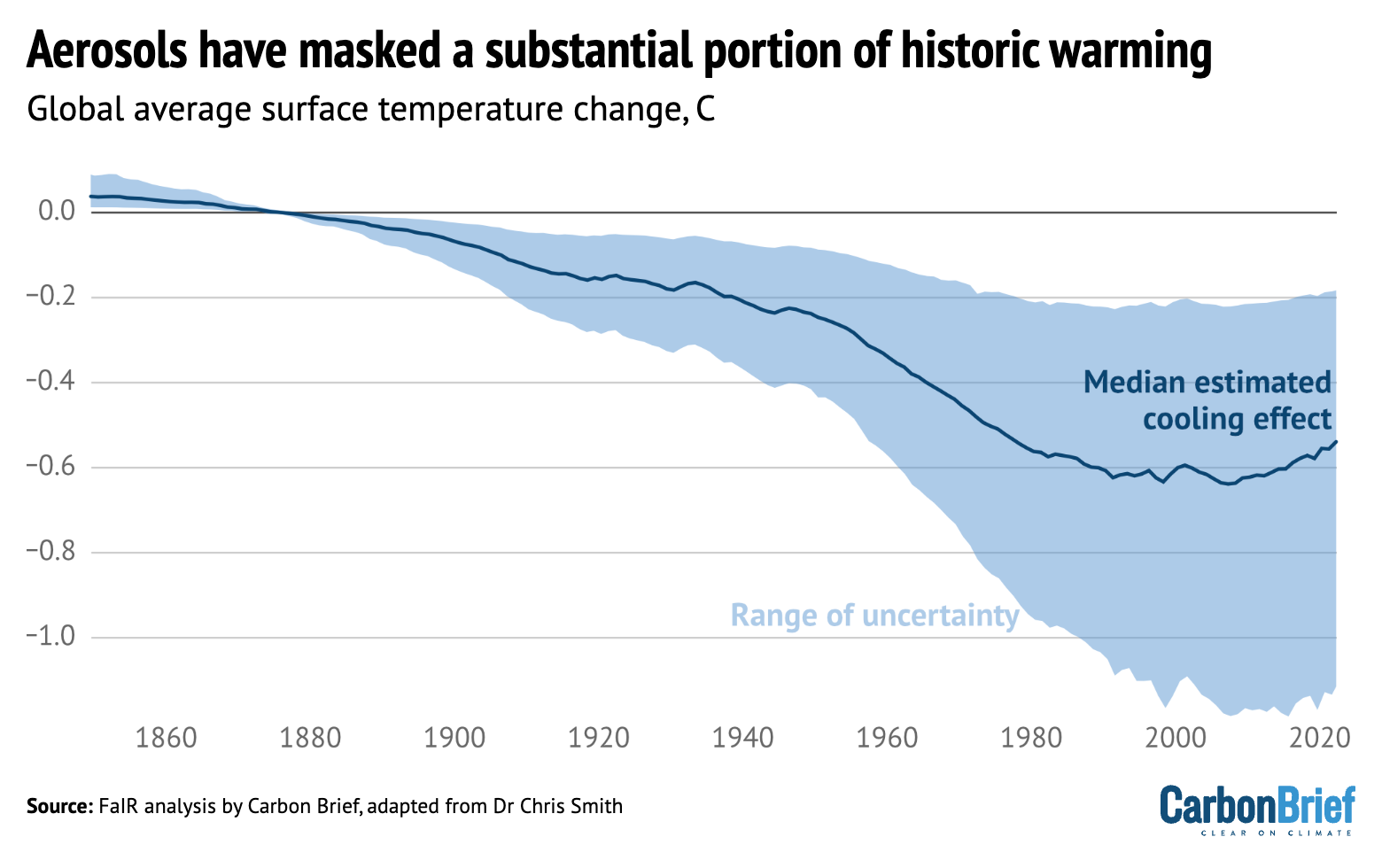
Aerosols – tiny light‑scattering particles produced mainly by burning fossil fuels – absorb or reflect incoming sunlight and influence the formation and brightness of clouds. In this way they have historically “acted as an invisible brake on global warming”. New Carbon Brief analysis by Dr Zeke Hausfather illustrated the extent to which a reduction in aerosol emissions in recent decades, while bringing widespread public health benefits through avoided deaths, has “unmasked” the warming caused by CO2 and other greenhouse gases. The chart above shows the estimated cooling effect of aerosols from the start of the industrial era until 2020.
Spotlight
How Carbon Brief turns complex research into visuals
This week, Carbon Brief’s interactive developer Tom Pearson explains how and why his team creates visuals from research papers.
Carbon Brief’s journalists will often write stories based on new scientific research or policy reports.
These documents will usually contain charts or graphics highlighting something interesting about the story. Sometimes, Carbon Brief’s visuals team will choose to recreate these graphics.
There are many reasons why we choose to spend time and effort doing this, but most often it can be boiled down to some combination of the following things.
Maintaining editorial and visual consistency
We want to, where possible, maintain editorial and visual consistency while matching our graphical and editorial style guides.
In doing this, we are trying to ease our audience’s reading experience. We hope that, by presenting a chart in a way that is consistent with Carbon Brief’s house style, readers will be able to concentrate on the story or the explanation we are trying to communicate and not the way that a chart might have been put together.
Highlighting relevant information
We want to highlight the part of a chart that is most relevant to the story.
Graphics in research papers, especially if they have been designed for a print context, often strive to illustrate many different points with a single figure.
We tend to use charts to answer a single question or provide evidence for a single point.
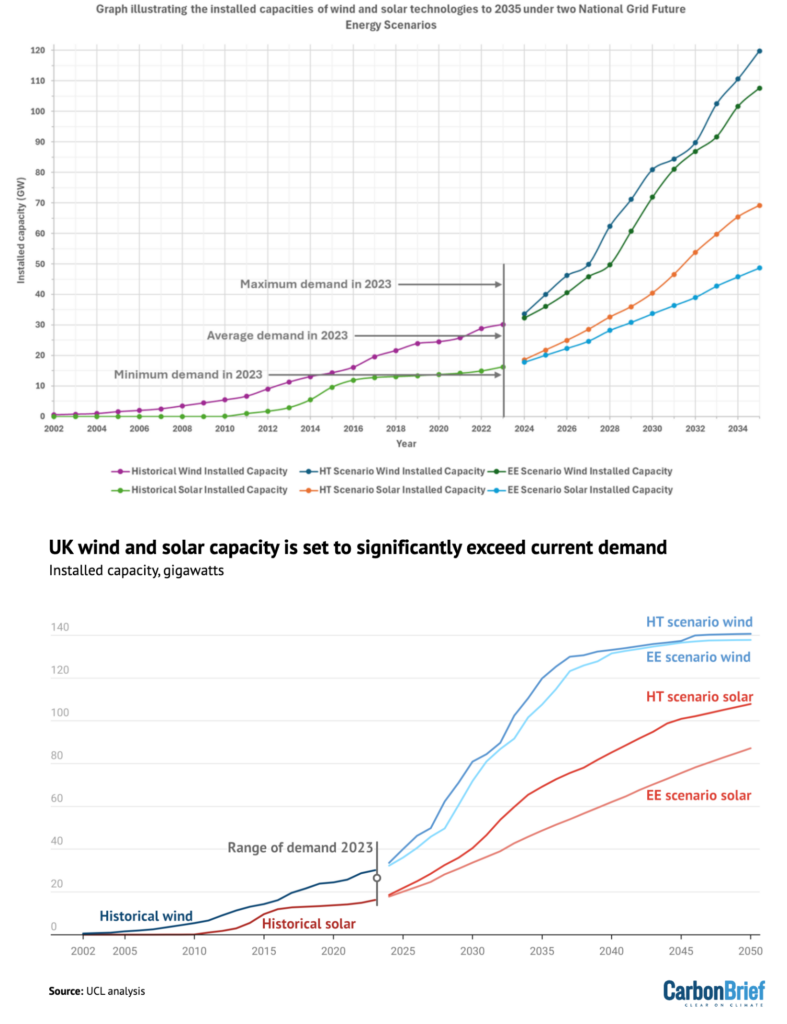
Paring charts back to their core “message”, removing extraneous elements and framing the chart with a clear editorial title helps with this, as the example below shows.
Ensuring audience understanding
We want to ensure our audience understands the “message” of the chart.
Graphics published in specialist publications, such as scientific journals, might have different expectations regarding a reader’s familiarity with the subject matter and the time they might be expected to spend reading an article.
If we can redraw a chart so that it meets the expectations of a more general audience, we will.
Supporting multiple contexts
We want our graphics to make sense in different contexts.
While we publish our graphics primarily in articles on our website, the nature of the internet means that we cannot guarantee that this is how people will encounter them.
Charts are often shared on social media or copy-pasted into presentations. We want to support these practices by including as much context relevant to understanding within the chart image as possible.
Below illustrates how adding a title and key information can make a chart easier to understand without supporting information.

When we do not recreate charts
When will we not redraw a chart? Most of the time! We are a small team and recreating data graphics requires time, effort, accessible data and often specialist software.
But, despite these constraints, when the conditions are right, the process of redrawing maps and charts allows us to communicate more clearly with our readers, transforming complex research into accessible visual stories.
Watch, read, listen
SPENDING $1BN ON CLIMATE: New Scientist interviewed Greg de Temmerman, former nuclear physicist turned chief science officer at Quadrature Climate Foundation, about the practicalities and ethics of philanthropic climate-science funding.
GENDER HURDLES: Research director Tracy Kajumba has written for Climate Home News about the barriers that women still face in attending and participating in COPs.
OCEAN HEATWAVES: The New York Times presented a richly illustrated look at how marine heatwaves are spreading across the globe and how they affect life in the oceans.
Coming up
- 16-26 June: Bonn climate talks, Bonn, Germany
- 16 June: 79th meeting of the World Meteorological Organization executive council, Geneva, Switzerland
- 17 June: International Energy Agency (IEA) Oil 2025 report launch
Pick of the jobs
- Inside Climate News, California environmental reporter | Salary: Unknown. Location: Southern California
- Natural Resources Wales, lead marine and energy policy advisor | Salary: £45,367-£50,877. Location: Wales
- Children’s Investment Fund Foundation, senior manager, climate | Salary: £82,000. Location: London/hybrid
- Green Party,social media and digital content officer | Salary: £33,211. Location: London/remote
DeBriefed is edited by Daisy Dunne. Please send any tips or feedback to debriefed@carbonbrief.org.
This is an online version of Carbon Brief’s weekly DeBriefed email newsletter. Subscribe for free here.


The post DeBriefed 13 June 2025: Trump’s ‘biggest’ climate rollback; UK goes nuclear; How Carbon Brief visualises research appeared first on Carbon Brief.

This is a republication of November’s edition of The Climate Agenda – a subscriber-only newsletter designed to keep you informed of the key events, negotiations and announcements happening every month. If you want to receive The Climate Agenda straight to your inbox at the start of each month, sign up as a subscriber today.
COP31 begins in one week, and we’ll have five specialist reporters on the ground in Antalya, Türkiye, bringing you every development as it happens. From the negotiations to leaders’ speeches and side events, we’ll be there to dissect what it all means for international climate policy on electrification, just transition, adaptation finance and much more.
Here’s what you need to know for November, why it matters and what to expect.
US midterm elections
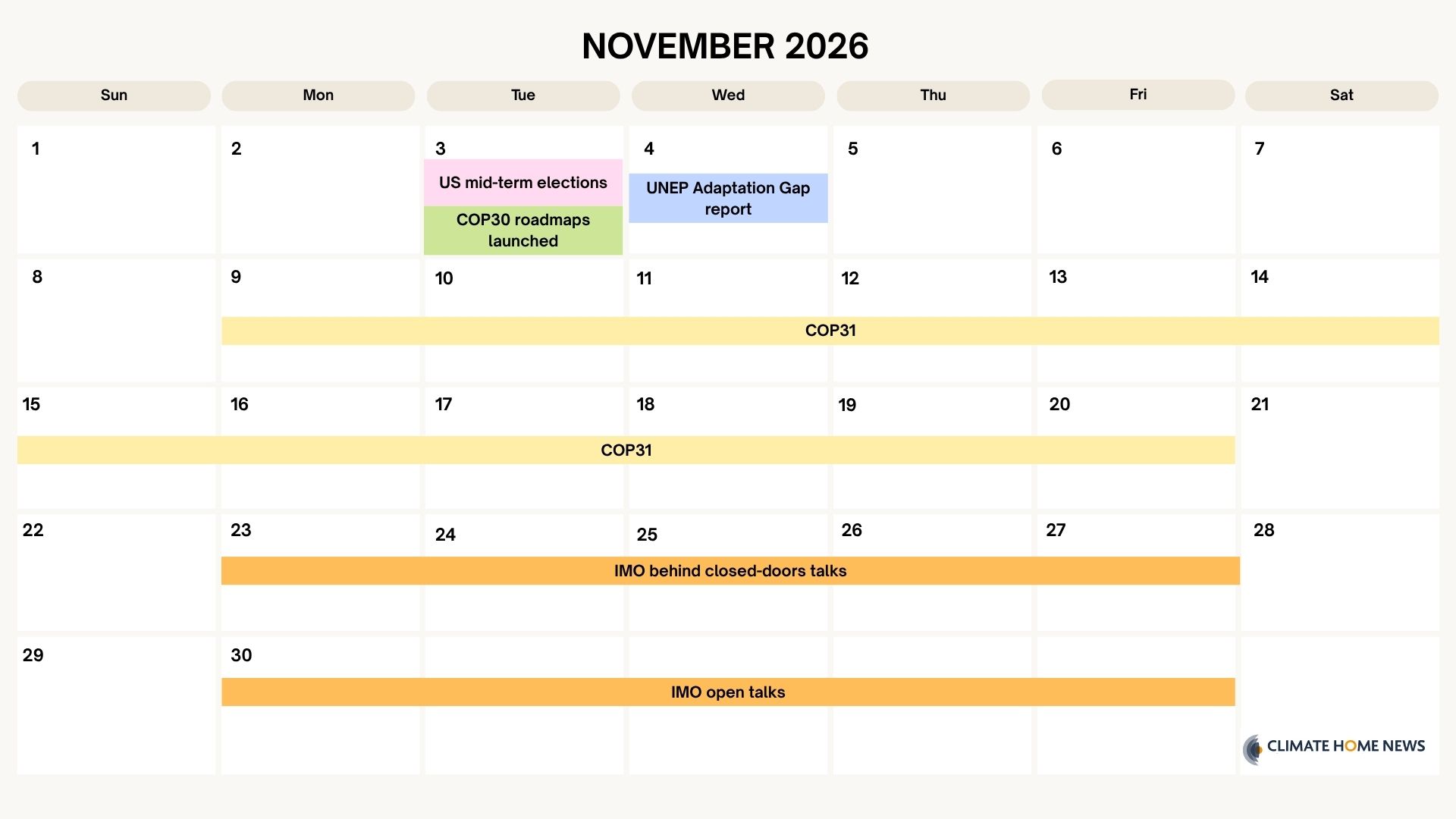
Tuesday 3 November – United States
The geopolitical highlight for the first week of November is the US midterm elections, which will show whether American voters are in any mood to forgive President Donald Trump for failing to bring down the cost of living. From an energy perspective, his pro-oil and gas stance hasn’t led to cheaper prices for consumers, pushed up by the US-instigated Iran conflict. And his diesel deal with Russia won’t yet have made a difference at the pump.
The key issue for climate and energy policy is whether the Republicans hold onto their governing trifecta. If so, then expect continued dismantling of regulations that protect the environment, as well as strong backing for fossil fuel production. If the Democrats regain control of Congress, which polls suggest is possible, it could trigger a push to restore Biden-era clean energy tax credits, and support states wanting to restart mothballed wind and solar projects.
Data centres have been a hot-wire issue, with growing community opposition to their expansion – partly due to concerns over rising utility bills as the facilities gobble power. Whether Republicans or Democrats win Congress, both are likely to make tech firms pay for the extra electricity production they need, with the latter favouring renewable sources.
Governor races are also taking place in key states for climate issues, including Democrat-run California, which has used the courts to fight Trump’s attacks on clean energy.
Read more: National climate plans now promise half the emission cuts expected by UN
Read more: The more Europe relies on the US for energy, the more it’s vulnerable to pressure by Trump

COP30 Deforestation and Fossil Fuel Transition Roadmaps
Tuesday 3 November – Brazil
Brazil is set to unveil two global roadmaps: one for transitioning away from fossil fuels, the other for ending deforestation.
The COP30 presidency promised them in the dying hours of the Belém summit last November as a last-minute fix to break a political impasse. Since then, it has been consulting with countries, experts and campaigners around the world to gather ideas and sketch out the elements to include in these blueprints.
Don’t expect the roadmaps to offer any new global targets or give direct instructions on what countries must do, either to cut fossil fuel production and consumption or better protect forests. Rather, Brazil has said the documents will identify barriers and priority actions, highlight existing mechanisms and present a range of options that can be adapted to different national contexts.
It remains unclear what will happen with the reports once they are delivered on Tuesday. At the Bonn talks last June, a group of European and small island nations called for the roadmaps to be brought into the official negotiations, warning that a one-off report won’t cut it. But such efforts would undoubtedly face stiff opposition from fossil fuel-producing nations that objected to drafting the energy transition roadmap within the formal UN process last year.
Read more: European, island states seek clear future for global roadmap to cut fossil fuels
Read more: COP30 roadmap to end deforestation will invite countries to draft domestic plans
Read more: What we need to see in the roadmap to transition away from fossil fuels
UNEP Adaptation Gap Report
Wednesday 4 November – Nairobi, Kenya
The UN Environment Programme (UNEP) will publish its annual assessment of how well the world is planning, implementing and – crucially – financing measures to cope with worsening climate impacts.
Past editions have made for grim reading. Last year’s report warned of a widening gap between what developing countries need for adaptation and what they can access. It estimated they will need $310–365 billion a year by 2035, which is 12 to 14 times current international flows. The report also found that a goal of doubling international public adaptation finance by 2025 was likely to have been missed.
This year’s edition will be closely watched with adaptation expected to be a big-ticket item at COP31. Governments are likely to discuss the specifics of a commitment to triple adaptation finance for developing nations by 2035, agreed at COP30 last year – particularly what the baseline for that pledge is. Negotiators will be debating how to track progress against the 59 indicators of the Global Goal on Adaptation.
Read more: Editor’s Desk: Nepal’s disaster has laid bare the world’s adaptation accountability gap
Read more: Bonn climate talks end in “gridlock” on adaptation and emissions-cutting
Read more: New data shows rich nations likely missed 2025 goal to double adaptation finance
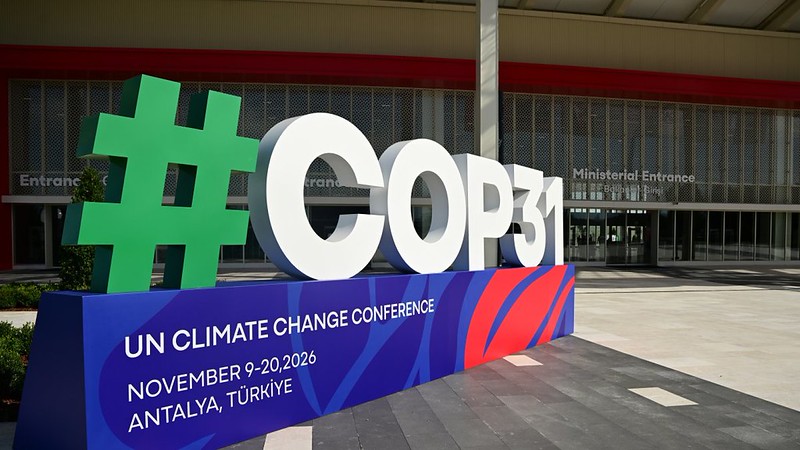
COP31 Climate Conference
Monday 9 November – Friday 20 November – Antalya, Türkiye
The climate community’s attention turns this month to Antalya for the annual UN climate summit. From the outset, COP31 will have an unprecedented, and potentially explosive, set-up: Türkiye is COP president overseeing the non-negotiated Action Agenda, while Australia runs the negotiations.
Billed, once again, as an “implementation COP”, the talks come amid a global energy crisis largely sparked by the actions of the US government, which is not expected to show up on the Turkish Riviera. It is also the first COP in the era of climate overshoot, coming just weeks after the UN officially confirmed the 1.5C warming limit will be breached and set out a narrow pathway to bring temperatures back down to the most ambitious Paris goal.
Unlike most recent COPs, the formal negotiations lack a clear headline item. Countries are due to establish and define the scope of the Just Transition Mechanism agreed in Belém last year, including its rules, governance and possible funding arrangements. On adaptation, vulnerable countries want a clearer path to delivering last year’s pledge to triple finance by 2035 and to putting the new progress indicators to work on the ground.
Governments are also likely to clash over next steps on the transition away from fossil fuels, and especially over whether the mitigation work programme – the forum dedicated to emission-cutting measures – has any future beyond this year.
Notable events to look out for in Antalya:
Opening session (9 November): The summit kicks off with the customary first-morning plenary. After the usual pageantry from the host nation, negotiating blocs and individual countries will deliver statements setting out their stall for the next two weeks. Watch out for a potential fight over the summit’s agenda – perhaps on issues relating to finance and trade following submissions requesting additional items – also a COP tradition.
Electrification (10 November): On Energy Day, the Turkish presidency is expected to formally launch its flagship electrification pledge, revealing which countries have signed up. Signatories will voluntarily commit to raising electricity’s share of global final energy consumption to 35% by 2035, though the current text does not require that power to come from clean sources. There is also a question mark over whether and how this can be included in the political cover decision the COP co-hosts have said they will aim to produce.
Leaders Summit (11-12 November): Heads of state and governments will jet into town for the traditional high-level segment in the middle of the first week, where world leaders typically talk up their climate record, air their grievances and call for more action.
Relatively few powerful leaders are on the list this time. Brazil’s Lula is set for another star turn this year, fresh from his surprise election win in October. The UK’s Andy Burnham, Spain’s Pedro Sanchez and China’s vice-premier Ding Xuexiang are expected, alongside Türkiye’s Recep Tayyip Erdogan and Australia’s Anthony Albanese. In addition, African and small island nations will feature prominently.
Our COP31 Briefing newsletter will offer a more in-depth preview of the talks later this week.
Read more: Early speakers’ list suggests few powerful leaders will attend COP31
Read more: COP31 electrification pledge leaves out clean power commitment
Read more: From Belém to Antalya – gains, gaps and challenges for a new Just Transition Mechanism
International Maritime Organization (IMO) Shipping Talks
Monday 23 November – Friday 4 December – London, United Kingdom
One year on from explosive talks in which Trump’s officials teamed up with Saudi Arabia to delay a deal to make the shipping industry greener, governments will gather on the banks of the Thames for another attempt to reach agreement.
The Net Zero Framework, provisionally agreed in October 2025, includes a series of emissions reduction targets for the owners of large ships along with penalties for not meeting them, rewards for doing so and measures to make the maritime transition fair.
The framework is likely to be either tweaked or radically rewritten so that it’s more acceptable to the US and Saudis. Brazil and Japan have submitted compromise proposals. Analysts find those will move shipping further away from being able to meet its climate goals.
There will be closed-door talks between November 23-27 and a second week of talks open to accredited media from November 30 to December 4. Agreement on a proposal, perhaps decided through a vote, is expected after long and technical negotiations. The shipping industry’s 3% share of the world’s emissions is at stake.
Read more: London talks raise hopes for green shipping deal
The post What’s on the climate calendar for November 2026? appeared first on Climate Home News.