

“Exceptionally heavy” rainfall that led to deadly flooding across southern Africa in recent weeks was made more intense by a combination of climate change and La Niña.
This is according to a rapid attribution study by the World Weather Attribution service.
From late December 2025 to early January, south-eastern Africa was hit hard by intense downpours that resulted in more than a year’s worth of rain falling in some areas in just a few days, according to the study.
This led to severe flooding that left at least 200 people dead, thousands sheltering in temporary accommodation and tens of thousands of hectares of farmland waterlogged.
The analysis finds that periods of intense rainfall over southern Africa have become 40% more severe since pre-industrial times, according to observations.
The authors say they were unable to calculate how much of this increase was driven specifically by climate change, due to limitations in how climate models simulate African rainfall.
However, the study notes that the researchers “have confidence that climate change has increased both the likelihood and the intensity” of the rainfall.
The authors also note that the El Niño-Southern Oscillation phenomenon played a role in the “devastating” flooding, estimating that a La Niña event made the rainfall around five times more likely.
Major disruption
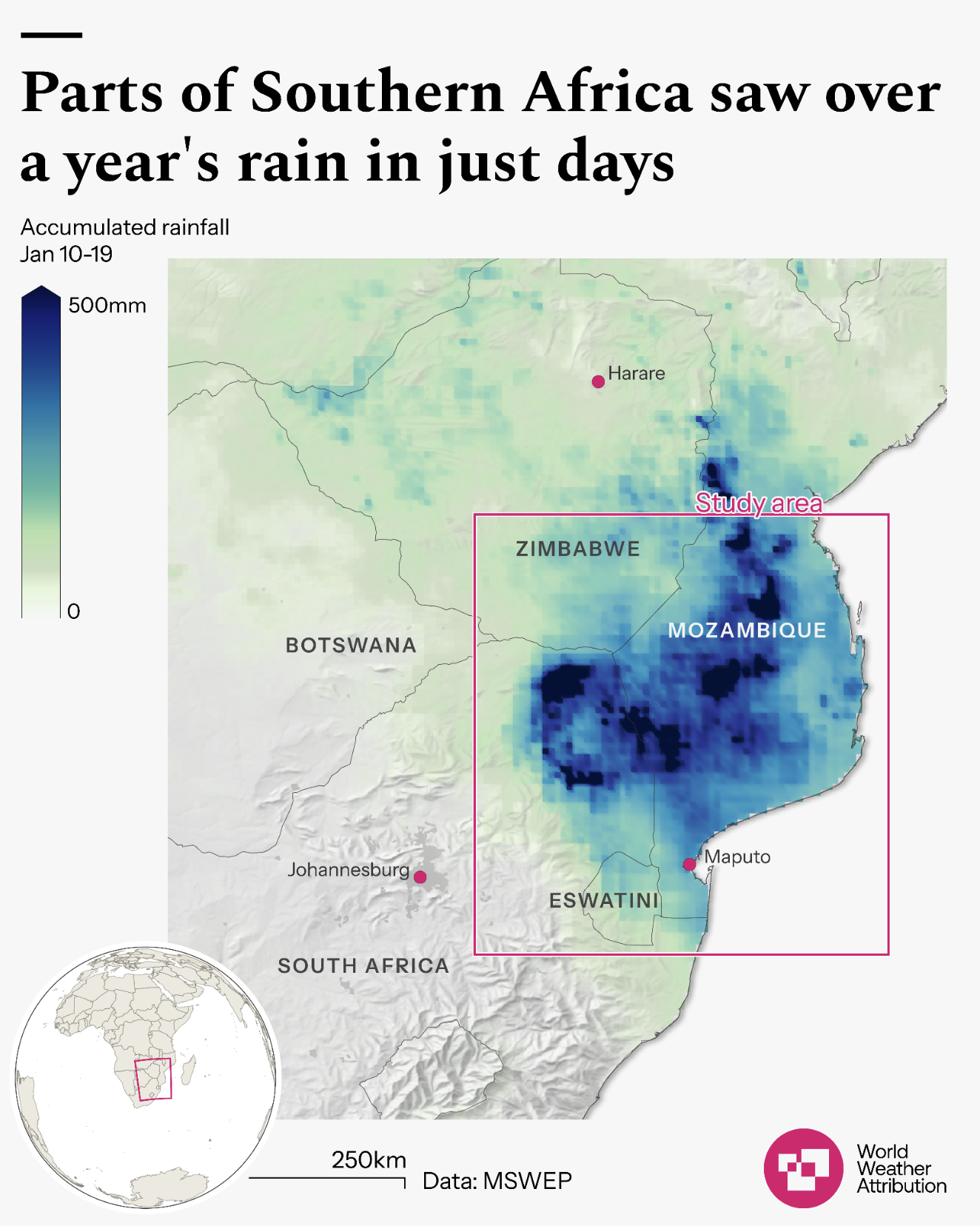
The heavy rainfall started on 26 December last year and intensified from early January. The most-extreme rainfall took place between 10 and 19 January.
The countries most affected by the floods, and analysed by the study, are Eswatini, Mozambique, South Africa and Zimbabwe, with some areas receiving up to 200mm of rain, according to the study authors.
Study author Bernardino Nhantumbo – a researcher at Mozambique’s National Institute of Meteorology – told a press briefing that in just two or three days, some areas recorded the amount of rainfall that is “expected for the whole rainy season”.
The map below shows the areas most affected by intense rainfall over 10-19 January. Darker blue indicates a greater accumulation of rainfall, while light green indicates less rainfall. The pink box shows the study area.
In Mozambique, the floods damaged nearly 5,000km of roads, which has hindered the transport of goods and affected pharmaceutical supply chains, the study says. In Zimbabwe, bridges, roads and infrastructure were “significantly damaged or destroyed”.
More than 75,000 people have been affected by the floods in Mozambique, according to the study. BBC News reported the floods were the worst seen “in a generation” in the country.
Dr Izidine Pinto, a climate scientist from Mozambique currently working at the Royal Netherlands Meteorological Institute, told a press briefing that the country was particularly affected because it “lies downstream of major river basins”.
The flooding prompted Mozambique’s education minister to consider rescheduling the start of the academic year, according to Channel Africa.
In South Africa, the country’s weather service said that areas receiving more than 50mm of rain over 11-13 January were “widespread”, with some places seeing up to 200mm.
South Africa’s Kruger National Park – the largest national park in South Africa – was severely damaged by floods and temporarily closed after several rivers burst their banks, reported TimesLIVE.
The South African news outlet quoted environment minister Willie Aucamp as saying: “The indication is that it will take as long as five years to repair all the bridges and roads and other infrastructure.”
Extreme rainfall
The peak of the rainy season in southern Africa falls between December and February.
To put the extreme rainfall into its historical context and determine how unlikely it was, the authors analysed a timeseries of 10-day maximum rainfall data for the December-February season.
They find that in today’s climate, extreme rainfall events of the scale seen this year in southern Africa would be expected only once every 50 years.
They add that such events have become “significantly more intense”, with observational data showing a 40% increase in rainfall severity since pre-industrial times.
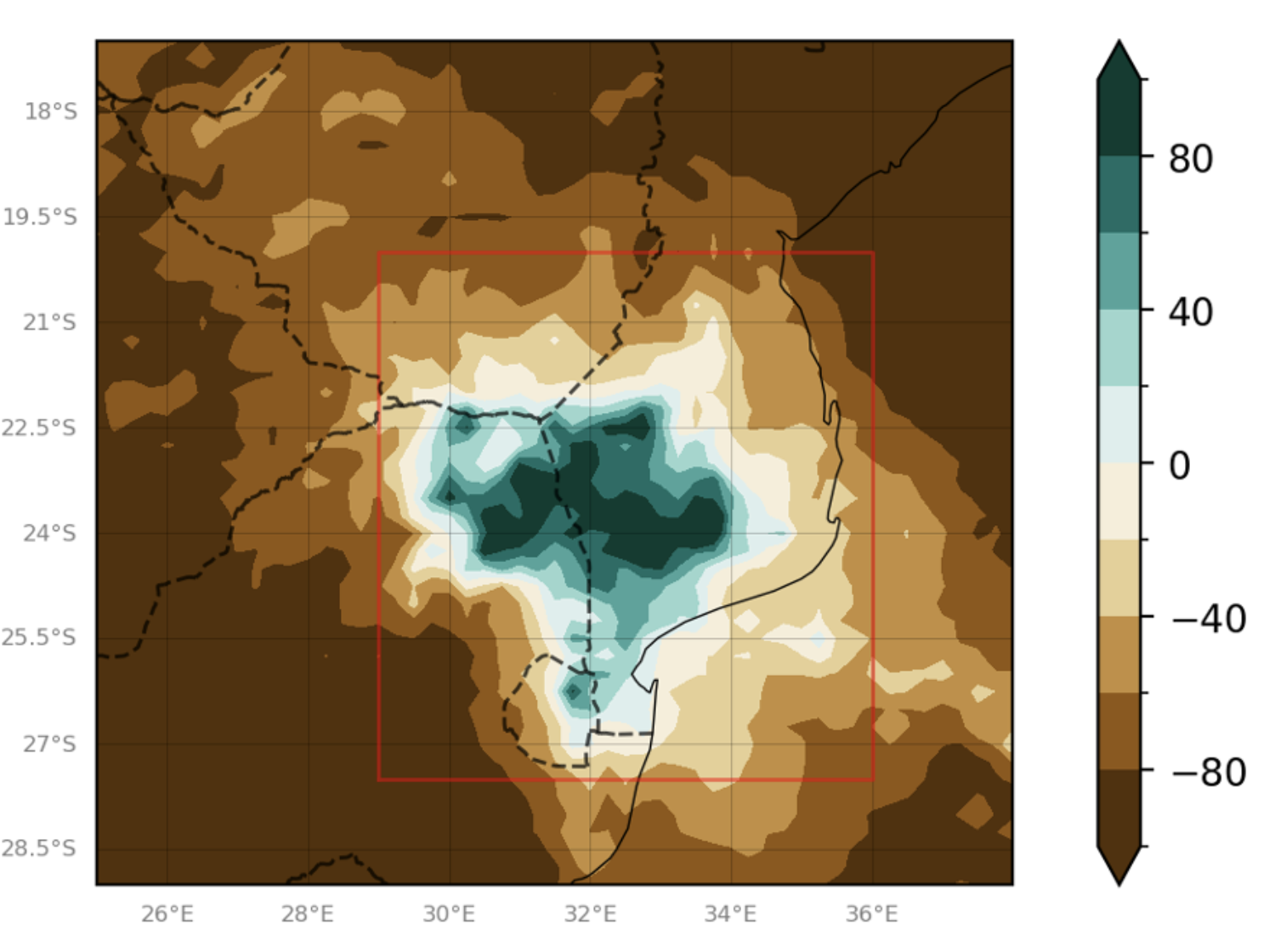
The map below shows accumulated rainfall over Eswatini, Mozambique, South Africa and Zimbabwe over 10-19 January, as a percentage of the average December-February rainfall for the region over 1991-2020.
Green shading indicates that the rainfall in 2026 was higher than in 1991-2020, while brown indicates that it was lower. The red box indicates the study region.
The study explains that in January and February, rainfall patterns in southern Africa are “strongly influenced” by the El Niño-Southern Oscillation (ENSO), a naturally occurring climate phenomenon that affects global temperatures and regional weather patterns.
La Niña is the “cool” phase of ENSO, which typically brings wetter weather to southern Africa.
Pinto told the press briefing that “most past extreme rainfall events [in the region] have occurred during La Niña years”.
The authors estimate that the current weak La Niña event made the extreme rainfall five times more likely and increased the intensity of the event by around 22%.
For attribution studies, which identify the “fingerprint” of human-caused climate change on extreme weather events, scientists typically use climate models to simulate and compare worlds with and without global warming.
However, many models have limitations in their simulations of African rainfall. In this study, the authors found that the models available to them cannot “adequately capture” the influence of ENSO on rainfall in the region.
Study author Prof Fredi Otto, a professor in climate science at the Imperial College London, told a press briefing that these limitations are “well known”. They stem, in part, because the models were “developed outside of Africa” by modellers with different priorities, she explained.
This means that the authors were unable to calculate how much more intense or likely the rainfall event was specifically as a result of human-caused warming.
However, Otto explained that the authors are “very, very confident that climate change did increase the likelihood and intensity of the rainfall” to some extent. This is because the observations all show an increase in rainfall over time and other existing literature supports this assumption, she added.
She told the press briefing that the results of this study were “definitely not 100% satisfactory”, adding that this study will “definitely not be the last of its kind in this region”.
(These findings are yet to be published in a peer-reviewed journal. However, the methods used in the analysis have been published in previous attribution studies.)
Vulnerability
The study warns that the flooding “exposed deep and persistent social vulnerability in the region”.
The authors say that a large proportion of the population – especially in urban areas – live in poor housing with “inadequate planning and insufficient provision of basic services”.
Paola Emerson, head of office at the UN Office for the Coordination of Humanitarian Affairs (OCHA) in Mozambique, told a UN press briefing about the flooding that nearly 90% of people in the country live in traditional adobe houses that “basically melt after a few days’ rains”.
In a WWA press release, study author Nhantumbo explained:
“When 90% of homes are made of sun-dried earth, they simply cannot withstand this much rain. The structural collapse of entire villages is a stark reminder that our communities and infrastructure are now being tested by weather they are just not designed to endure.”
Study author Renate Meyer – an adviser with the conflict and climate team at the Red Cross Red Crescent Centre – said in a WWA press briefing that the “recurring frequency of hazards such as drought and extreme rainfall have had a significant impact on communities experiencing, amongst others, displacement, health challenges, socioeconomic loss and psychological distress”.
For example, the World Health Organization (WHO) said in a press release that the event had disrupted access to health services and increased the risks of water- and mosquito-borne diseases, as well as respiratory infections across southern Africa.
Meyer explained that the countries included in this study have “substantial populations living below or near the poverty line with limited savings, low insurance cover and a high dependence on climate sensitive livelihoods”.


The post Climate change and La Niña made ‘devastating’ southern African floods more intense appeared first on Carbon Brief.
Climate change and La Niña made ‘devastating’ southern African floods more intense

Business has never been as brisk for Nigerian solar panel retailer Samuel Okechukwu and his team of installation technicians, who are struggling to keep up with orders since the Iran war caused local fuel prices to double.
“There’s too much work, I’m even having to outsource some services to keep up with the work rate,” Okechukwu told Climate Home News, as he installed solar panels on the roof of an apartment building in the southern city of Port Harcourt.
Before the war, he had installations once or twice a week, but is now busy almost every day.
Okechukwu’s surge in orders in recent weeks suggests that more Nigerians are buying solar systems due to soaring fuel prices caused by the conflict in the Middle East, which has effectively blocked the Strait of Hormuz through which a fifth of the world’s oil and liquefied natural gas previously flowed.
-
Africa records fastest-ever solar growth, as installations jump in 2025
Africa’s solar power installations have increased sharply, driven by utility-scale projects and privately financed rooftop and commercial systems -
Boom in solar panel imports boosts hopes for clean energy take-off in Africa
Africa’s solar imports from China jumped 60% in the 12 months to June 2025, reaching an all-time high -
Ugandan farmers use British court to try to stop East Africa oil pipeline
The farmers and their lawyers will argue that a UK-based entity linked to the East African Crude Oil Pipeline has breached Ugandan law and construction should halt


Plagued by frequent failures on Nigeria’s national grid, many homes and businesses buy diesel and petrol to supply generators to keep the lights on and equipment operating.
Even before the latest fuel price shock, solar installations had been increasing in Nigeria in recent years as an alternative to generators among those able to afford the initial outlay.
It costs about 600,000 naira ($450) to buy just one inverter battery and two 300-watt solar panels to charge it – roughly 10 times the minimum monthly wage – and eyebrows were raised when the government announced last year that the presidential villa was being kitted out with a $6 million solar mini-grid.
Power plants hit by gas shortages
Nigeria’s erratic power supplies have become even more unreliable in recent weeks as gas shortages constrain already fragile power generation. Most of Nigeria’s electricity supply comes from gas-fired plants.

Last month, the Nigerian Independent System Operator said several of the oil- and gas-producing nation’s thermal power plants were being affected by “persistent gas supply constraints” that were causing a decline in electricity generation.
While Nigeria has abundant gas reserves, the shortages are largely driven by structural issues, including mounting government debts owed to gas suppliers and pipeline constraints. Power Minister Adebayo Adelabu said last week that gas suppliers are prioritising export markets which have become more attractive and offer better returns over domestic markets.
This week, the Nigerian government increased gas prices for power generation companies, a move likely to deepen cost pressures in the electricity sector already struggling with debt and supply shortages.
At the same time, Okechukwu said rising temperatures in recent years were also increasing demand for an affordable source of electricity to power air conditioners.
Global oil shock makes case for renewables
Installations of solar power in Africa jumped 54% in 2025, according to a report by the Global Solar Council (GSC), marking the fastest annual growth on record.
The continent’s solar power capacity still represents only about 1% of the world’s total, though industry experts say the continent may have significantly more than official data reflects, with many rooftop installations going uncounted.
Precarious power supplies are already a key driver of solar adoption in many African nations, propelling fast growth rates in countries including Nigeria, which was Africa’s second-largest solar installer last year, installing more than 800 MW of capacity, according to the GSC, a nonprofit trade body.

Surging energy costs due to the Iran war could give further momentum to growth, the GSC’s CEO Sonia Dunlop told Climate Home News.
“It’s clear the people of Nigeria saw the writing on the wall … and have gone all in on rooftop solar as a result,” Dunlop said.
The increase in energy prices since the conflict began have cost consumers and businesses around the world more than $100 billion, according to a March 2026 analysis by 350.org, a non-profit organisation.
It said that would be enough to build sufficient solar capacity to supply about 150 million people in lower-consumption countries, for example in Africa, adding that investing in renewables was the best way to stabilise prices and strengthen energy security.
Anne Jellema, 350.org’s CEO, urged governments meeting in Colombia next month to discuss the transition away from oil and gas to “seize this moment to adopt binding targets to phase out fossil fuels and ramp up investment in a clean, safe energy future”.
Africa records fastest-ever solar growth, as installations jump in 2025
The global energy shock unleashed by the U.S.-Israeli war “definitely supports the case for longer-term mitigation, not being reliant on imported oil”, said Karl Boyce, CEO of ARC Power, a mini-grid developer operating in Africa, adding that securing sufficient investment would be crucial to realising Africa’s renewables potential.
“It’s so reliant on really heavy investment,” Boyce said. “So globally, there should be a focus on seeing how more investment can go into that sector just to give more stability in the longer term.”

“Forget about buying petrol”
In Port Harcourt, another solar trader, Sunday Onuchukwu, said his business has been “moving faster than before” as people get tired of power cuts and rising fuel costs that make investing in panels seem a better bet.
Located in a solar panels retail market, Onuchukwu’s shop was busy with customers, but the market itself was unusually quiet – without the usual whirr of generators thanks to the solar panels on the roof.
“Most of my customers complain that the fuel issue is one reason why they have decided to go solar. I have clients who transition both their offices and homes at the same time and move away from the bad power supply,” Onuchukwu told Climate Home News.
He said many businesses spend more than 20,000 naira ($15) per day on petrol to power generators.
Green Climate Fund picks locations for five developing country hubs
“With that money, calculated over a one-year period, you can install solar and forget about ever buying petrol,” he said, adding that some lower-cost solar products were now becoming available such as a 50,000-naira ($36) kit that provides enough power to light a single bulb and charge a mobile phone.

Lifting two heavy panels onto his head in Onuchukwu’s shop, one customer said ensuring a steady supply of power – after months without mains supplies – was vital for his barber shop and would also help his wife’s small business.
“This is what I am using to run my business and ensure electricity,” the man said, giving his family name as Amadi.
“With these two panels, I can also power my wife’s inverter freezer for her to be selling frozen foods.”
The post Nigerians bet on solar as global oil shock hits wallets and power supplies appeared first on Climate Home News.
Nigerians bet on solar as global oil shock hits wallets and power supplies
Climate Change
Pennsylvania Lawmakers Are Talking the Talk on Data Center Regulations. But Will They Walk?
As public opposition to AI data center development ratchets up in Pennsylvania, politicians are promising to protect local communities. Whether the state’s fractious politics can deliver is another question.
Ask Gemini, Google’s AI chatbot, whether Pennsylvania politicians are doing anything about the swelling public concern over data center development in the commonwealth, and it answers confidently.
Pennsylvania Lawmakers Are Talking the Talk on Data Center Regulations. But Will They Walk?
Greenpeace International and Greenpeace organisations in the US filed on 27 March 2026 a motion for a new trial in North Dakota District Court. This demand for justice follows the absurd and flawed US$ 345 million judgment issued by the same court in Energy Transfer’s SLAPP lawsuit against the Greenpeace parties returned on 27 February 2026. Energy Transfer’s back-to-back SLAPP lawsuits are attempts to erase Indigenous leadership of the Standing Rock Movement, punish solidarity with the ongoing resistance to the Dakota Access Pipeline, and intimidate environmental activists from speaking out against Big Oil companies.
The motion for a new trial should be granted to prevent one of the largest miscarriages of justice in North Dakota’s history. We are demanding the court right the wrongs committed at trial and to ensure the rights and freedoms promised under the US constitution are protected.
Greenpeace will not rest until justice is served and Big Oil can no longer use and abuse the legal system in North Dakota or anywhere else.
Greenpeace International General Counsel Kristin Casper
There is no question the Greenpeace defendants were denied a fair trial — even a concise summary of the errors and injustices that marred the trial runs to over 100 pages.
Among the numerous egregious flaws documented in the motion for a new trial are:
- The Greenpeace defendants could not receive a fair and impartial trial in Morton County.
- Seven out of nine jurors that decided the case had clear biases due to fossil fuel industry ties, experiences with the Standing Rock protests, and/or preexisting negative views of the Greenpeace defendants.
- Despite the fact that thousands of individuals and hundreds of organisations were involved in actions at Standing Rock and speaking out against DAPL, and North Dakota law clearly requiring damages to be split among everyone who contributed to alleged harms, the jury and the court assigned 100% of the claimed damages to the Greenpeace defendants.
- The jury’s verdict was contrary to the weight of the evidence on each and every count.
- The jury verdict was tainted by the inclusion of inadmissible, prejudicial information.
- The jury was improperly prevented from hearing relevant, admissible evidence that was favorable to the Greenpeace defendants.
- The jury was provided erroneous and incomplete instructions and a flawed verdict form.


Nigerians bet on solar as global oil shock hits wallets and power supplies
Pennsylvania Lawmakers Are Talking the Talk on Data Center Regulations. But Will They Walk?

Classic Sustainability In Your Ear: Coastal Flooding in 2050 With Climate Scientist James Renwick
-
Climate Change8 months ago
Guest post: Why China is still building new coal – and when it might stop
-
Greenhouse Gases8 months ago
Guest post: Why China is still building new coal – and when it might stop
-

 Greenhouse Gases2 years ago
嘉宾来稿:满足中国增长的用电需求 光伏加储能“比新建煤电更实惠”
-
Climate Change2 years ago
Bill Discounting Climate Change in Florida’s Energy Policy Awaits DeSantis’ Approval
-

 Climate Change2 years ago
嘉宾来稿:满足中国增长的用电需求 光伏加储能“比新建煤电更实惠”
-
Climate Change Videos2 years ago
The toxic gas flares fuelling Nigeria’s climate change – BBC News
-

 Renewable Energy5 months ago
Sending Progressive Philanthropist George Soros to Prison?
-

 Carbon Footprint2 years ago
US SEC’s Climate Disclosure Rules Spur Renewed Interest in Carbon Credits