

Welcome to Carbon Brief’s China Briefing.
China Briefing handpicks and explains the most important climate and energy stories from China over the past fortnight. Subscribe for free here.
Key developments
Floods in the south, drought in the north
EXTREME WEATHER: China has been hit by extreme weather over the past two weeks. About 35% of its corn production was affected by severe drought in north China where some rivers had “dried up a month ago”, reported Reuters. In the south, torrential rain and flooding killed at least 38 people in Guangdong province – China’s most populated – as well as eight people in Hunan province and two in Anhui province. Local newspaper Guangxi Daily reported that this week’s floods in Guilin, capital city of Guangxi province, were the largest in the area since 1998. Chinese president Xi Jinping “has urged all-out efforts to fight floods and droughts, and to ensure solid work in disaster relief”, said state agency Xinhua. Some 33 rivers in China “exceeded warning levels”, according to Xinhua.
-
Sign up to Carbon Brief’s free “China Briefing” email newsletter. All you need to know about the latest developments relating to China and climate change. Sent to your inbox every Thursday.
GLOBAL WARNING: Yang Pingjian, director of the environmental sociology department at the Chinese Academy of Environmental Sciences, wrote in China Environment News that “the adverse effects of climate change have become more and more obvious: heavy rainfall, typhoons, hail and other extreme weather occur” in China. The National Climate Center said that China is “experiencing more frequent and intense heatwaves due to global warming”, reported China Daily. The “average onset of high temperatures (those exceeding 35C) has advanced by 2.5 days per decade” and the average heatwave starting date has moved from 24 June in 1981-1990 to 7 June in 2011-2020, the outlet added. New research covered by the Hong Kong-based South China Morning Post found that “widespread heat stress will be felt by most of China’s population by the end of the century due to climate change, with the north of the country expected to be hit hardest”.
SUMMER PRESSURE: These high temperatures may cause peak electricity consumption to grow by more than 100 gigawatts (GW) year-on-year during this summer’s peak period, putting pressure on “ensuring power supply”, China Securities Journal reported. Writing in financial newspaper Caixin, Qin Qi, China analyst at the Centre for Research on Energy and Clean Air (CREA) noted that this expected 100GW increase is “similar to 2022’s growth, which saw power shortages and blackouts”, adding that this “highlighted the need for a more flexible inter-provincial electricity trading mechanism”. She also pointed to the need for flexible grid operations and demand-side measures to help China “effectively manage peak demand pressures without compromising its climate commitments”.
Renewable energy pushed thermal power into decline
THERMAL DECLINE: A surge in solar power and hydropower in China in May led to a 4.3% decline in thermal power – mainly coal – that month, Bloomberg reported, adding that this supported earlier Carbon Brief analysis finding China’s emissions may fall this year. The drop in thermal power was the largest since 2022 and could continue as long as China does not “reprioritise carbon-heavy investment to revive growth”, the outlet added. Hydropower generation rose 38.6% year-on-year in May 2024 and solar by 29.1%, state-run industry newspaper China Energy Net said.
SOLAR CAPACITY: China’s National Energy Administration (NEA) pledged in a press conference to “guide production capacity expansion” and “prevent unnecessary investments” in the country’s solar manufacturing sector, following a call for help from industry participants “grappl[ing] with a surge in capacity”, according to finance newswire Yicai. Economic news outlet Jiemian quoted Li Chuangjun, director of the NEA’s new energy and renewable energy department, saying at the press conference that the industry should “avoid repetitive construction of low-end solar capacity”.
NO OVERCAPACITY?: NEA head Zhang Jianhua said at the same press conference that “whether from the perspective of comparative advantage or of global market demand, China’s new energy industry does not have a so-called ‘overcapacity’ problem”, state-run newspaper Science and Technology Daily reported. Zhang added that “supply moderately exceeding demand is helpful for achieving technological progress and reducing product costs”, and that the solar industry specifically is characterised by a strong private sector, “sufficient” competition and companies “choosing to expand production” due to “optimistic outlooks towards future markets”, according to the newspaper.

EU and China to discuss electric vehicle tariffs
NEW TALKS: After expressing opposition to the EU’s additional tariffs on Chinese electric vehicles (EVs) and announcing an anti-dumping investigation into pork products from the EU, China agreed to a new discussion over the tariffs this week, the Financial Times reported. Bloomberg said the talks “may buy time” for China to “sow enough opposition” between EU member states, as Beijing suggested German luxury automakers “could benefit if Berlin convinces the EU to drop tariffs”.
MIDDLEMAN GERMANY?: Germany’s economy minister Robert Habeck, who visited China last weekend, showed there was an “open attitude of China and some politicians in the EU in seeking dialogue and cooperation amid trade friction”, said a Global Times’ editorial. Habeck said the EU’s tariffs measures were “not a punishment” and its “doors are open for discussions”, Reuters reported. The German Chamber of Commerce in East China, a business advocacy group, also argued that the EU tariffs “cannot offer protection to German carmakers or increase their competitiveness”, SCMP reported. Reuters said that China’s share of Germany’s EV imports rose to 40.9% in the first quarter of this year.
CHINA COMPROMISE?: China’s state-controlled Global Times newspaper wrote “observers said the best outcome the Chinese side wants is that the EC, the executive body of the EU, scrap its tariff decision before 4 July and abide by WTO rules”. Another state-run newspaper China Daily said in an editorial that Beijing is “willing…to try and resolve the reasonable concerns of the EU” and hopes that Brussels will avoid escalating frictions “by meeting China halfway”. In an interview with the Financial Times, Zhu Min, a member of China’s “five-year plan” committee, argued there was no “overcapacity” or “dumping” of cheap EVs on the European market. He said the price of EVs is higher overseas than in the domestic market and that China’s domestic buyer rebate also applied to foreign EV brands, such as Tesla in China, added the outlet.
EU-China climate dialogue and Li’s new commitment
CHINA-EU TALKS: Amid their ongoing tariff dispute, China and the EU held the fifth “high-level environment and climate dialogue” on 18 June, said Xinhua. The Chinese vice premier Ding Xuexiang and the European Commission’s Maroš Šefčovič agreed there were “common interests” and discussed “climate change and protecting the ecological environment”, the state news agency continued. Ding also said the EU’s tariff plan was “typical protectionism” which is “not conducive to the EU’s green transformation”, added the agency. China’s minister of ecology and environment, Huang Runqiu, and the EU’s commissioner for climate action, Wopke Hoekstra, signed “an updated memorandum of understanding to enhance cooperation on emissions trading”, the Chinese International Environment Net reported.
PREMIER’S REMARKS: The Chinese premier Li Qiang announced yesterday that “China is committed to addressing climate change and has been proactively developing green industries such as new energy” at the World Economic Forum’s “summer Davos” meetings in Dalian, China, Xinhua reported. Li said “the green transition itself holds immense potential for development” and that all nations should “create more growth drivers for the green economy”, added Xinhua. Reuters said Li also “hit back” at overcapacity accusations from the US and EU, arguing that China’s production of clean energy technologies “first met our domestic demand, but also enrich[es] global supply”. At a domestic conference, president Xi encouraged technology innovation and said Chinese EVs “add[ed] new momentum to the global automotive industry”, according to Xinhua.
Spotlight
How is China adapting to increasingly frequent flooding?
In recent years, China has seen more frequent floods caused by heavy rains. Dozens of people have died in south China this month due to torrential rain and flooding. In April, floods caused damage worth 12bn yuan ($1.65bn) – “the worst [losses] in 10 years”.
In this issue, Carbon Brief looks at the reasons for China’s recent floods and how the country is trying to adapt. A full version of this article will be published on Carbon Brief’s website.
Rising floods
There are various factors behind the frequent heavy rain and flooding in China in recent years.
In a press briefing covered by China Daily, Zheng Zhihai, chief forecaster at the National Climate Centre of the China Meteorological Administration (CMA), said that “higher than normal temperatures” were behind frequent heavy rainfall in southern provinces since April.
China Daily noted: “This temperature increase has elevated the atmospheric moisture levels, intensified convective processes, and led to more frequent occurrences of heavy rainfall.”
Sea level rise has also been cited as a primary factor behind China’s coastal floods, as it increases the intensity and frequency of storm surges and raises baseline water levels.
The El Niño-Southern Oscillation, a natural climate cycle that entered its warmer El Niño phase in mid 2023, was partly to blame as it raised sea surface temperatures and directed vast amounts of water vapour from the South China Sea and the Bay of Bengal towards southern China, found one analysis.
Dr Faith Chan, head of the School of Geographical Sciences at the University of Nottingham Ningbo China, told Carbon Brief that the rainfall pattern in Guangdong during this April was quite similar to the intensive rainstorm on 6-8 September in 2023 after Typhoon Haikui.
In addition to the natural causes, human activity also played a role. Chan said:
“Of course, the El Niño effect enhanced the wet and low-pressure moist current in the east coast of China and the west Pacific. But human-induced climate change led to the greenhouse effect and caused sea temperature to rise, which caused more storms and low-pressure rain belts. That is a fact.”
Indeed, Prof Yang Chen of the Chinese Academy of Meteorological Sciences told Carbon Brief that human-caused intensification of heavy rainfall over China had been even larger than expected.
Adaptation measures
China has built a number of large water projects to prevent flooding, such as the south-north water transfer projects in the Yangtze river that was launched in 2002.
In the most recent “national water network construction planning outline” published by the State Council – China’s top administrative authority – constructing “national water networks” by 2035 is labelled as the “backbones” of future flood prevention.
China also launched the “sponge city programme (SCP)” in 2015.
Sponge cities cost the government 1.5–1.8bn yuan ($210-250m) between 2015 and 2018. They are designed to collect, purify and re-use at least 70% of the floodwaters through “green-blue facilities”, such as green roofs, permeable pavements and stormwater parks, in urban areas. The overall system was meant to resolve the issues of urban heating, freshwater scarcity and flooding all at once.
But the 2021 floods in Zhengzhou, a showcase sponge city, laid bare the inadequacy of the SCP in the face of climate change.
A paper suggested the SCP, which is designed to withstand one-in-30-year rain events, has limited effectiveness against more intense downpours.
Additionally, SCP can create a false sense of security, which encourages more people to move to high-risk areas, leading to an increase in population and assets in exposed areas that require ever-increasing protection in a cycle referred to as a “levee effect”, said Chen.
Meanwhile, a lack of coordination added another layer of difficulties. Zheng Yan, researcher at China Academy of Social Sciences, noted in the aftermath of the 2023 Beijing flood that government bodies often looked after their own jurisdiction and aimed only to move the problem and divert the floods quickly, which piled pressure on cities in downstream areas.
Looking abroad
As flooding is a challenge faced by cities across the world, there is a plethora of ideas and technologies that China can draw on.
Rotterdam, a Dutch delta city of 600,000 people that is surrounded by water on four sides, has built water storage facilities, such as an underground parking garage with a basin the size of four Olympic swimming pools. It has also installed green roofs and facades to absorb rainwater.
Japan has built an intricate network of concrete tunnels and vaults about 14 storeys beneath the Saitama prefecture in the outskirts of Tokyo, Japan’s capital city, that could hold more than 1,000 Olympic pools of rainwater.
Both cities’ underground flood diversion facilities are often used as a prime example of a viable flood defence system for urban cities on the frontline of climate change.
Hong Kong has a similar underground stormwater storage system beneath the sport pitches of the Happy Valley Racecourse, designed to withstand one-in-50-years flood events.
Chan said it is difficult to compare flood mitigation measures as each city is very different in terms of geography, demographic, densities and topography.
Nevertheless, he told Carbon Brief:
“In my opinion, China’s megacities should think about using underground spaces to store the sudden extreme discharge from super intensive rainstorms…Tokyo and Rotterdam are quite wise in that regard for using their underground spaces.”
This Spotlight is written by freelance climate journalist Jia Ning Tan for Carbon Brief.
Watch, read, listen
CHINA IN SPACE: The Economist’s “The Intelligence” podcast aired an episode about China becoming a “superpower” in the physical sciences.
RUSSIA-CHINA PIPELINE: A Financial Times podcast said Russia and China are “deadlocked” over a gas pipeline deal.
FARMING LAND: The Chinese communist party’s magazine Qiu Shi published an article by Hunan province’s communist theory study group on protecting arable land and the “political responsibilities” related to it.
CARBON FOOTPRINT: Finance outlet Southern Finance Omnimedia’s social media account 21 Low Carbon published an explanation of China’s new “national unified carbon footprint management system”.
$940m
The total value of an international “sustainability bond” issued by the Bank of China for investment in “renewable energy, sustainable water resources and wastewater management infrastructure projects” in the countries that joined China’s Belt and Road Initiatives (BRI). (The total value of loans for BRI countries reached $87bn in 2016 and $3.7bn in 2021.)
New science
Climate Policy
China and the US – two of the world’s biggest methane emitters – should make their methane policies more “climate-centric”, according to a new study. Existing policies relating to methane are concentrated in the energy sector and are “largely driven” by safety, pollution concerns and use of resources, rather than reducing greenhouse gas emissions, the study said. The researchers suggested that both countries should focus on methane mitigation and “consider more climate-centric policies”.
Energy Policy
The Chinese government has employed economic incentives to offset the financial impact of the clean energy transition, but “these measures may not fully address the underlying issue of climate apathy, wherein individuals prioritise immediate interests over long-term climate concerns”, a new study said. Surveying 4,700 Chinese adults each year for three years, the study found that those on low incomes were less likely to support climate policy, with “climate apathy” explaining a much larger share of this effect – some 38% – than “economic burden”, which only explained 8% of the effect on policy support. The authors concluded: “Addressing climate apathy is a cost-effective strategy to boost policy support.”
Investigating the impact of weather on stroke in summer
International Journal of Biometeorology
A new study collected data of stroke hospitalisation in the city of Tianjin, China, from 2016 to summer 2022. The study found a direct link between temperature extremes and hospitalisation: “83% of the Inpatient-heavy events within the study period were caused by a combination of dramatic temperature changes and continuous high temperatures.” The authors concluded: “More attention should be paid to the combined effects of continuous high temperature and sudden temperature changes in summer stroke prevention.”
China Briefing is compiled by Wanyuan Song and Anika Patel. It is edited by Wanyuan Song and Dr Simon Evans. Please send tips and feedback to china@carbonbrief.org

The post China Briefing 27 June 2024: Extreme weather; New talks on EV tariffs; Coal power decline appeared first on Carbon Brief.
China Briefing 27 June 2024: Extreme weather; New talks on EV tariffs; Coal power decline

With the U.S. bombing Iran and the Strait of Hormuz closed, energy experts say countries transitioning to renewables will be more resilient in the “face of the shock.”
The United States’ war on Iran could fundamentally alter how countries consume and generate energy and hamper international progress in combating climate change, a panel of energy experts said today.
The Global Energy Supply in a Decade ‘Is Not a World We’re Going to Recognize’
One month into the US and Israel’s war on Iran, at least 60 countries have taken emergency measures in response to the subsequent global energy crisis, according to analysis by Carbon Brief.
So far, these countries have announced nearly 200 policies to save fuel, support consumers and boost domestic energy supplies.
Carbon Brief has drawn on tracking by the International Energy Agency (IEA) and other sources to assess the global policy response, just as a temporary ceasefire is declared.
Since the start of the war in late February, both sides have bombed vital energy infrastructure across the region as Iran has blocked the Strait of Hormuz – a key waterway through which around a fifth of global oil and liquified natural gas (LNG) trade passes.
This has made it impossible to export the usual volumes of fossil fuels from the region and, as a result, sent prices soaring.
Around 30 nations, from Norway to Zambia, have cut fuel taxes to help people struggling with rising costs, making this by far the most common domestic policy response to the crisis.
Some countries have stressed the need to boost domestic renewable-energy construction, while others – including Japan, Italy and South Korea – have opted to lean more on coal, at least in the short term.
The most wide-ranging responses have been in Asia, where countries that rely heavily on fossil fuels from the Middle East have implemented driving bans, fuel rationing and school closures in order to reduce demand.
‘Largest disruption’
On 28 February, the US and Israel launched a surprise attack on Iran, triggering conflict across the Middle East and sending shockwaves around the world.
There have been numerous assaults on energy infrastructure, including an Iranian attack on the world’s largest LNG facility in Qatar and an Israeli bombing of Iran’s gas sites.
Iran’s blockade of the Strait of Hormuz, a chokepoint in the Persian Gulf, is causing what the IEA has called the “largest supply disruption in the history of the global oil market”.
A fifth of the world’s oil and LNG is normally shipped through this region, with 90% of those supplies going to destinations in Asia. Without these supplies, fuel prices have surged.
Governments around the world have taken emergency actions in response to this new energy crisis, shielding their citizens from price spikes, conserving energy where possible and considering longer-term energy policies.
Even with a two-week ceasefire announced, the energy crisis is expected to continue, given the extensive damage to infrastructure and continuing uncertainties.
Asian crunch
Carbon Brief has used tracking by the IEA, news reports, government announcements and internal monitoring by the thinktank E3G to assess the range of national responses to the energy crisis roughly one month into the Iran war.
In total, Carbon Brief has identified 185 relevant policies, announcements and campaigns from 60 national governments.
As the map below shows, these measures are concentrated in east and south Asia. These regions are facing the most extreme disruption, largely due to their reliance on oil and gas supplies from the Middle East.
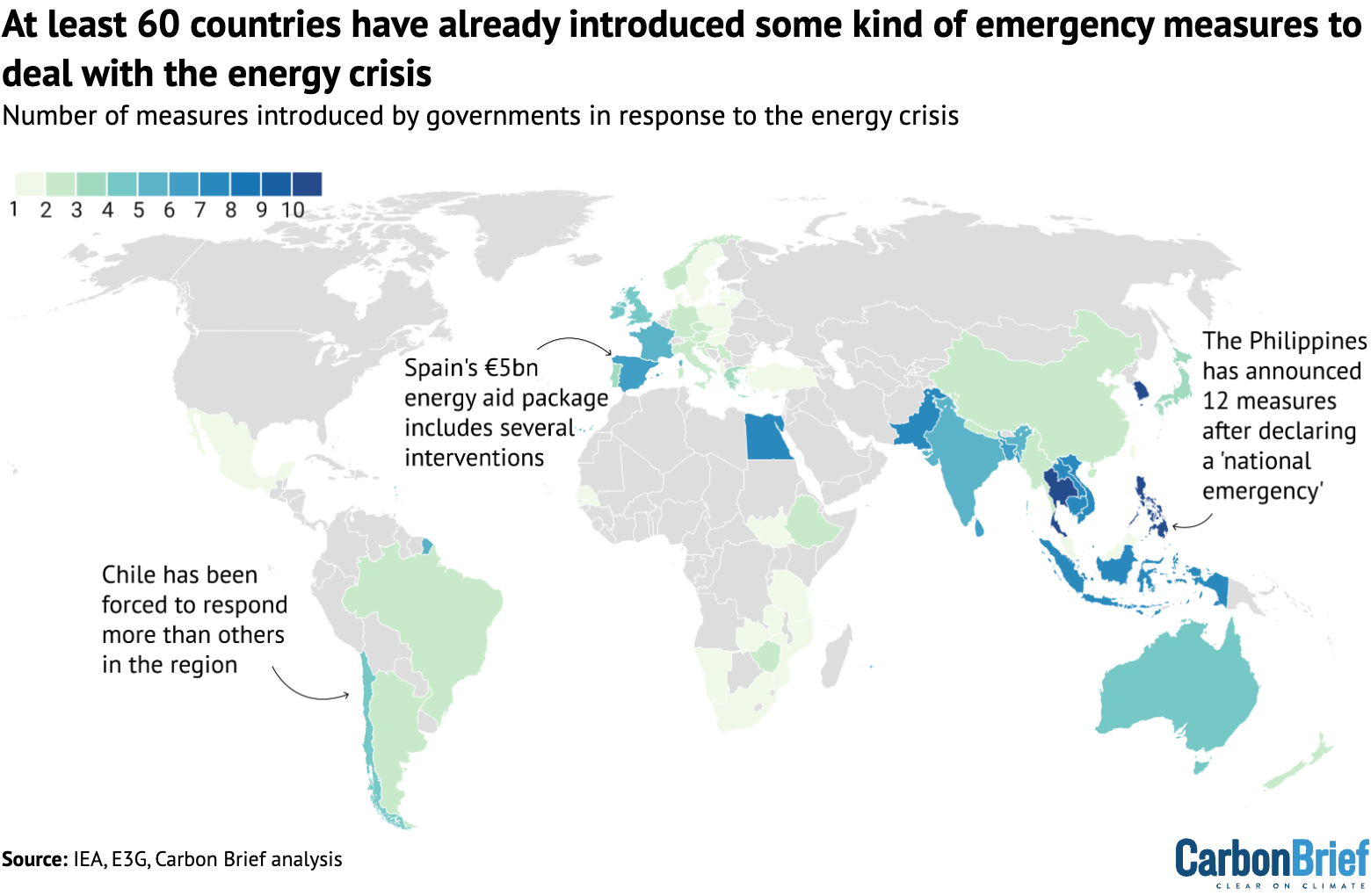
Nations including Indonesia, Japan, South Korea and India are already spending billions of dollars on fuel subsidies to protect people from rising costs.
At least 16 Asian countries are also taking drastic measures to reduce fuel consumption. For example, the Philippines has declared a “state of national emergency”, which includes limiting air conditioning in public buildings and subsidising public transport.
Other examples from the region include the government in Bangladesh asking the public and businesses to avoid unnecessary lighting, Pakistan reducing the speed limit on highways and Laos encouraging people to work from home.
Europe – which was hit hard by the 2022 energy crisis due to its reliance on Russian gas – is less immediately exposed to the current crisis than Asia. However, many nations are still heavily reliant on gas, including supplies from Qatar.
The continent is already feeling the effects of higher global energy prices as countries compete for more limited resources.
At least 18 European nations have introduced measures to help people with rising costs. Spain, which is relatively insulated from the crisis due to the high share of renewables in its electricity supply, nevertheless announced a €5bn aid package, with at least six measures to support consumers.
Many African countries, while also less reliant on direct fossil-fuel supplies via the Strait of Hormuz than Asia, are still facing the strain of higher import bills. Some, including Ethiopia, Kenya and Zambia, are also facing severe fuel shortages.
There have been fewer new policies across the Americas, which have been comparatively insulated from the energy crisis so far. One outlier is Chile, which is among the region’s biggest fuel importers and is, therefore, more exposed to global price increases.
Tax cuts
The most common types of policy response to the energy crisis so far have been efforts to protect people and businesses from the surge in fuel prices.
At least 28 nations, including Italy, Brazil and Australia, have introduced a total of 31 measures to cut taxes – and, therefore, prices – on fuel.
Even across Africa, where state revenues are already stretched, some nations – including Namibia and South Africa – are cutting fuel levies in a bid to stabilise prices.
Another 17 countries, including Mexico and Poland, have directly capped the price of fuel. Others, such as France and the UK, have opted for more targeted fuel subsidies, designed to support specific vulnerable groups and industries.
These measures are all shown in the dark blue “consumer support” bars in the chart below.
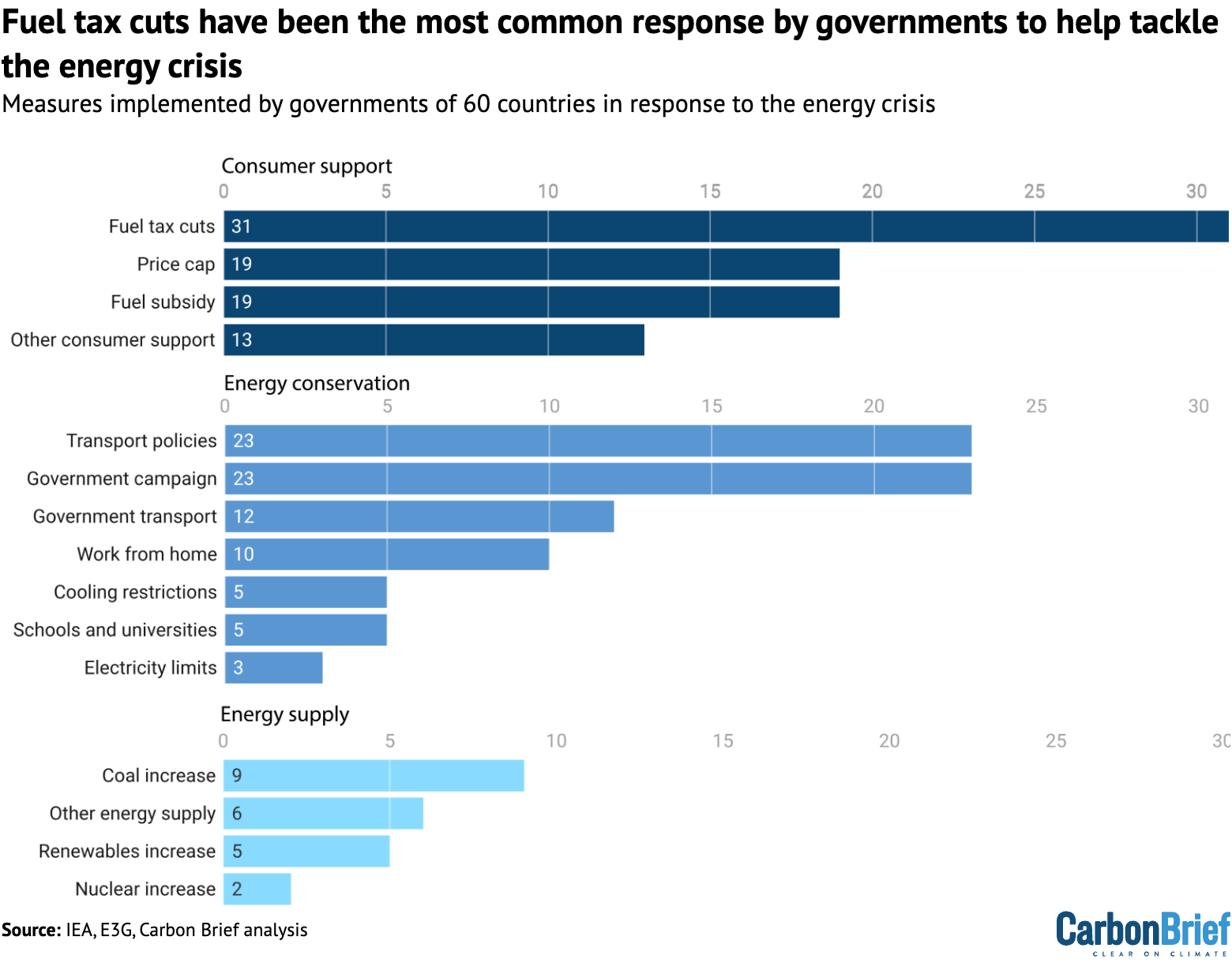
Such measures can directly help consumers, but some leaders, NGOs and financial experts have noted that there is also the risk of them driving inflation and reinforcing reliance on the existing fossil fuel-based system.
Christine Lagarde, president of the European Central Bank, spoke in favour of short-term measures to “smooth the shock”, but noted that “broad-based and open-ended measures may add excessively to demand”.
Measures to conserve energy, of the type that many developing countries in Asia have implemented extensively, have been described by the IEA as “more effective and fiscally sustainable than broad-based subsidies”.
So far, there have been at least 23 such measures introduced to limit the use of transport, particularly private cars.
These include Lithuania cutting train fares, two Australian states making public transport free and Myanmar and South Korea asking people to only drive their cars on certain days.
Clean vs coal
At least eight countries have announced plans to either increase their use of coal or review existing plans to transition away from coal, according to Carbon Brief’s analysis. These include Japan, South Korea, Bangladesh, the Philippines, Thailand, Pakistan, Germany and Italy.
These measures broadly involve delaying coal-plant closure, as in Italy, or allowing older sites to operate at higher rates, as in Japan – rather than building more coal plants.
There has been extensive coverage of how the energy crisis is “driving Asia back to coal”. However, as Bloomberg columnist David Fickling has noted, this shift is relatively small and likely to be offset by a move to cheap solar power in the longer term.
Indeed, some countries have begun to consider changes to the way they use energy going forward, amid a crisis driven by the spiralling costs of fossil-fuel imports.
Leaders in India, Barbados and the UK have explicitly stressed the importance of a structural shift to using clean power. Governments in France and the Philippines are among those linking new renewable-energy announcements with the unfolding crisis.
New renewable-energy capacity will take time to come online, albeit substantially less time than developing new fossil-fuel generation. In the meantime, some nations are also taking short-term measures to make their road transport less reliant on fossil fuels.
For example, the Chilean government has enabled taxi drivers to access preferential credit for purchasing electric vehicles (EVs). Cambodia has cut import taxes on EVs and Laos has lowered excise taxes on them.
Finally, there have been some signs that countries are reconsidering their future exposure to imported fossil fuels, given the current economics of oil and gas.
The New Zealand government has indicated that a plan to build a new LNG terminal by 2027 now faces uncertainty. Reuters reported that Vietnamese conglomerate Vingroup has told the government it wanted to abandon a plan to build a new LNG-fired power plant in Vietnam, in favour of renewables.

The post Iran war analysis: How 60 nations have responded to the global energy crisis appeared first on Carbon Brief.
Iran war analysis: How 60 nations have responded to the global energy crisis
Seven Senate Democrats launched the probe over controversial tax credits to the country’s largest exporter of liquefied natural gas.
Seven Democratic U.S. senators have launched a probe into a $370 million “alternative fuel” payout to Cheniere Energy, made earlier this year by the IRS, that critics say the liquefied natural gas export company never should have received.
US Senators Investigate $370 Million IRS Payout to Cheniere Energy

Thacker Pass Is Being Built: Here Is Why That Is the Best News NILI Investors Have Heard All Year.
Boeing Locks in 40,000 Tons of Soil Carbon Removal with Texas-Based Grassroots Carbon
Tesla Reclaims EV Sales Crown from BYD in Q1 2026, Heating Up the EV Race
-
Climate Change8 months ago
Guest post: Why China is still building new coal – and when it might stop
-
Greenhouse Gases8 months ago
Guest post: Why China is still building new coal – and when it might stop
-

 Greenhouse Gases2 years ago
嘉宾来稿:满足中国增长的用电需求 光伏加储能“比新建煤电更实惠”
-
Climate Change2 years ago
Bill Discounting Climate Change in Florida’s Energy Policy Awaits DeSantis’ Approval
-

 Climate Change2 years ago
嘉宾来稿:满足中国增长的用电需求 光伏加储能“比新建煤电更实惠”
-
Climate Change Videos2 years ago
The toxic gas flares fuelling Nigeria’s climate change – BBC News
-

 Renewable Energy6 months ago
Sending Progressive Philanthropist George Soros to Prison?
-

 Carbon Footprint2 years ago
US SEC’s Climate Disclosure Rules Spur Renewed Interest in Carbon Credits