

Climate change played a key role in the “catastrophic” 2023 floods in the Himalayan state of Sikkim in India, a new study says.
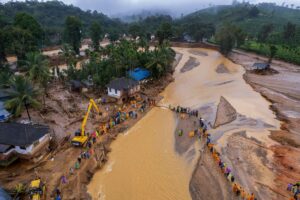
The breach of one of the “largest, fastest-growing and most hazardous” glacial lakes in Sikkim, the South Lhonak lake, led to cascading floods that killed 55 people and washed away a 1,200 megawatt (MW) hydropower dam.
The event was identified as a glacial lake outburst flood (GLOF), which is a sudden release of water from a lake fed by glacial melt.
The research, published in Science, explores the many drivers of the GLOF, its extensive impacts and policy implications going forward.
“There are many, many factors that came together here,” the study’s lead author tells Carbon Brief, but the “main driver” was the destabilising effect caused by thawing permafrost.
The research also finds that the South Lhonak lake has been expanding for decades, due to meltwater from the glacier above, with its area growing 12-fold between 1975 and 2023.
The paper concludes that the GLOF highlights the “complex interactions” between climate change, glacier mass loss and human infrastructure in mountainous regions.
It also demonstrates the importance of “robust monitoring systems and proactive measures to minimise devastating consequences and enhance resilience”, the authors add.
Flood cascade
Sikkim is a small Himalayan state in north-east India, bordering China in the north, Bhutan in the east, Nepal in the west and the state of West Bengal in the south.
Part of the eastern Himalaya, Sikkim is host to more than 90 glaciers and Kanchenjunga, the world’s third-highest peak. Sikkim serves as the origin and upper river basin for the Teesta river, one of the largest tributaries of the Brahmaputra river system.
On the night of 3 October 2023, a ridge of frozen rock and other debris on the side of the South Lhonak glacier – called a “lateral moraine” – collapsed into the glacial lake. This set off a tsunami-like wave nearly 20 metres high that breached the front of the lake, sending 50m cubic metres of water – almost half the lake’s volume – downstream.
According to the study, the GLOF’s peak discharge “vastly exceeds” the magnitude of any meteorological flood in the region’s history, equivalent to a “rare” one-in-200-year event.
Dr Ashim Sattar, a glaciologist at the Indian Institute of Technology, Bhubaneswar and the lead author of the study, tells Carbon Brief the sheer scale of impact is not always evident in satellite images. He explains:
“Here, 270m cubic metres of sediment was eroded, enough to fill 108,000 Olympic swimming pools. The South Lhonak Lake itself is 2.2km long. Just walking around it will make you sweat.”
Two hours later, the GLOF and huge volumes of eroded sediment reached the village of Chungthang 35km away, destroying the 1,200MW Teesta-III hydropower project on impact and damaging four other dams downstream.
Exclusive visuals from completely damaged Chungthang Dam in Sikkim
Received from Pokhraj Rai Ji pic.twitter.com/x9gFxs1PC6
— Weatherman Shubham (@shubhamtorres09) October 12, 2023
As the GLOF travelled, it set off 45 secondary landslides, many of them deep-seated and up to 150 metres in depth, with impacts not just in Sikkim, but also in neighbouring West Bengal and Bangladesh.
In all, the flood cascade damaged 25,900 buildings, 31 major bridges and flooded 276km2 of agricultural land. The most heavily inundated zone was in Bangladesh 300km away, where intense cyclonic rainfall – initially attributed as a main GLOF driver – exacerbated flooding.
The figure below, taken from the study, shows before-and-after images and illustrations of the moraine collapse and the flood’s path from Sikkim to Bangladesh, where floodwaters finally discharged into the Brahmaputra river.

Dr Jakob Steiner, a geoscientist at the University of Graz and a member of the Himalayan University Consortium, who was not involved in the study, says the assessment captures the “cascading” impacts of GLOFs and their interaction with other complex, climatic factors in great detail. He tells Carbon Brief:
“Even if the glacial lake is relatively small, it can trigger other movements downstream and that can have far-reaching consequences, even for hydropower plants miles away from any lakes. So the message [of the study] is that you’re not safe anywhere and, hopefully, that’s a message that policymakers will get. Institutionally, however, we are not yet prepared to receive that kind of message.”
What caused the flood?
To study such a complex and multifaceted event, researchers combined satellite imagery, meteorological data, field observations and numerical modeling.
Study lead Sattar tells Carbon Brief that “capturing this entire process into one model is very tricky and complex”.
Throughout the paper, the authors emphasise the “multi-hazard” nature of the disaster, explaining that multiple short- and long-term changes in the climate and terrain converged to create the conditions needed for the event.
However, Sattar tells Carbon Brief that the “main driver” of the GLOF was the long-term impact of rising temperatures on permafrost – the perennially frozen ground that makes up much of the mountain’s slope.
According to the authors, decades of rising temperatures have led to permafrost thaw, which caused “extensive, rapid deformation” of the slope for years preceding the collapse. The paper estimates that permafrost warming has reached a depth of 100 metres below the surface of the soil.
The study also identifies the expansion of the South Lhonak lake as an important driver. The authors find that the South Lhonak glacier, which sits above the lake, has been melting for decades. Meltwater from the glacier flows directly into the lake, which has been gradually filling up.
The charts below show the annual mass balance of the glacier (left) – where a negative number indicates a shrinking glacier – and the increasing area of the lake (right) between 1951 and 2023.

The research finds that the lake has been expanding by 0.32km2 per year over 1975-2023. It notes there has been a “doubling” in the rate of expansion over the past two decades.
The authors suggest that rising temperatures are responsible for the glacier losing mass, as the annual average temperature in the region has been increasing by 0.08C per decade since the 1950s.
The long-term permafrost thaw and growth of the lake means that, by October 2023, the region was in a state of “increased sensitivity” to a multi-hazard cascade, the paper says.
The authors say the final “trigger” was the intense rainfall that hit Sikkim on 3-4 October. Though the rainfall was “typical” for the region and season, the authors say that it “saturated the soil and increased the vulnerability of slopes to failure”.
Dr Stephan Harrison – a researcher from the University of Exeter – tells Carbon Brief that the study is “very significant” and is “written by some of the leading scientists in the field”.
Dr Miriam Jackson is the programme coordinator for the cryosphere initiative at the International Centre for Integrated Mountain Development, and was not involved in the study. She echoes Harrison’s praise, but warns about the “lack of good data” in the region for these sorts of studies. She says:
“We desperately need more data on the status of glaciers and glacial lakes, more meteorology measurements at high elevation and more data on the status of frozen ground in the Hindu Kush Himalaya.”
Harrison and Jackson gave conflicting answers about whether GLOFs are increasing or decreasing globally. However, both pointed to the lack of data on GLOFs, noting that datasets are incomplete or unavailable in many regions and emphasised the need to get better records before definitive answers can be drawn.
Hydropower rush
The Sikkim GLOF event joins a chain of recent disasters in high-mountain Asia that have destroyed hydropower plants. Given the sheer “physical magnitude” of these events and their impacts, the study highlights “potential limits to adaptation” in the Himalaya, warning that “even the most diligent and comprehensive suite of disaster risk reduction strategies [is] unlikely to entirely prevent” loss and damage.
The study draws attention to a “surge” of hydropower development in the Himalayan region near glacial lakes, which it attributes to a rising demand for “stable and renewable energy”.
With more than 650 projects planned or under construction in high-mountain Asia, it warns that many dams are “moving closer to these hazard-prone areas” and this could “exacerbate” GLOF impacts. The Teesta basin, for instance, hosts the highest density of hydropower projects in the Himalayan region, with 47 dams planned, including the reconstruction of the Teesta-III project.

While dams themselves are “susceptible” to a wide array of high-mountain hazards, they also increase the exposure of communities, workers and infrastructure investments to a “greater likelihood” of GLOFs in the future, according to the paper.
Comprehensive risk assessments, stringent building standards, regulating land use and regional cooperation among river-sharing countries are among the measures suggested by the study to reduce GLOF risks.
Sattar says governments “can make a start” by developing “basin-scale” early-warning systems. However, he cautions that structural measures such as draining glacial lakes “are easy to say, but difficult to do” in harsh terrain.
Meanwhile, geoscientist Steiner says it is critical that the key role played by infrastructure development in damage caused by GLOFs is not downplayed – noting that a failure to do so risks “absolv[ing] local institutions of their responsibility”. He concludes:
“As scientists, we find it important to show that climate change is involved, but we have to be aware that the science we create is very, very political… [A] big part of the disaster is not climate change; it’s institutional failures, it’s infrastructural failures.
“If nobody takes the responsibility and everyone just says: ‘it’s my neighbour and not me’, then we are truly in deep shit. Maybe we already are.”


The post ‘Catastrophic’ 2023 lake outburst in India driven by glacial melt and permafrost thaw appeared first on Carbon Brief.
‘Catastrophic’ 2023 lake outburst in India driven by glacial melt and permafrost thaw

The moratorium is the first of its type to pass a legislative chamber, but about a dozen other states have pending proposals.
Maine is now the first state to pass a moratorium on the development of large data centers, and others may follow.
Maine Presses Pause on Large Data Centers. Will Other States Follow Its Lead?
The Trump EPA’s repeal of the 2009 endangerment finding revokes the agency’s authority to regulate climate pollution. Environmental activists are mourning the loss while vowing to resurrect it.
A procession of mourners representing sea level rise, melting permafrost, ecocide and other climate calamities grieved the demise of a groundbreaking climate rule outside the Environmental Protection Agency’s Region 9 headquarters in downtown San Francisco on Tuesday.
Climate Activists Stage Mock Funeral for Landmark Climate Rule
Global oil demand is expected to be almost one million barrels per day less than was forecast before the Iran war, as shortages and soaring costs prompt drastic cutbacks by consumers and businesses, a report by the International Energy Agency (IEA) said on Wednesday.
With the closure of the Strait of Hormuz choking off supplies and keeping prices high, less oil is being used to make products such as jet fuel, LPG cooking gas and petrochemicals, the Paris-based IEA said in its monthly oil report, forecasting the biggest quarterly demand drop since the COVID pandemic.
The Iran war “upends our global outlook”, the government-backed agency said, adding that it now expects oil demand to shrink by 80,000 barrels per day in 2026 from last year.
Before the conflict began, the IEA said in February it expected oil demand to rise by 850,000 barrels per day this year, meaning the difference between the pre-war and current estimates is 930,000 barrels a day, or 340 million barrels a year.
That could have a significant impact on the outlook for planet-heating carbon emissions this year.
At an intensity of 434 kg of carbon dioxide per barrel of oil – the estimate used by the US Environmental Protection Agency – the annual reduction in carbon dioxide emissions from oil for 2026, compared with the pre-war forecast, is similar to the amount emitted by the Philippines each year.
Harry Benham, senior advisor at Carbon Tracker, told Climate Home News that he expects at least half of the reduction in oil demand to be permanent because of efficiency gains, behavioural change and faster electrification.
The oil shock is leading to oil being replaced, especially in transport, with electricity and other fuels, just as past oil shocks drove lasting reductions in consumption, he said. “The shock doesn’t delay the transition – it reinforces it,” he added.
Demand takes a hit
While demand for oil has fallen significantly, supplies have fallen even further. Supply in March was 10 million barrels a day less than February, the IEA said, calling it the “largest disruption in history”.
This forecast relies on the assumption that regular deliveries of oil and gas from the Middle East will resume by the middle of the year, the IEA said, although the prospects for this “remain unclear at this stage”.
-
Italy pushes coal exit back after gas prices rise
Analysts say the move sends a negative signal, but its impact will be limited given coal’s marginal role in Italy’s energy mix -
Charging worries, high prices put brakes on EV growth in Bangladesh
Sales of e-bikes and rickshaws are up amid queues at fuel stations, but a lack of charging infrastructure and high prices still deter many Bangladeshis from going electric -
Fossil Free Zones can be on-ramps to the clean energy transition
Oil and gas blocks overlap with a fifth of forests in the Amazon, Congo Basin and SE Asia – policies are needed to transition away from fossil fuels and halt deforestation together


Last month, US Energy Secretary Chris Wright told the CERAWeek oil industry conference that prices were not high enough to lead to permanent reductions in demand for oil, known as demand destruction.
But the IEA said on Wednesday that “demand destruction will spread as scarcity and higher prices persist”.
Industries contributing to weaker demand for oil include Asian petrochemical producers, who are cutting production as oil supplies dry up, the report said, while consumers are cutting back on liquefied petroleum gas (LPG), which is mainly used as a cooking gas in developing countries, the IEA said.
Flight cancellations caused by the war have dampened demand for oil-based jet fuel, the IEA said. As well as cancellations caused by risk from the conflict itself, airports have warned that fuel shortages could lead to disruption.
Across the world, governments, businesses and consumers have sought to reduce their oil use after the war. The government of Pakistan has cut the speed limit on its roads, so that people drive at a more fuel-efficient speed, and Laos has encouraged people to work from home to preserve scarce petrol and diesel.
Nepal’s EV revolution pays off as oil crisis causes pain at the pumps
Consumers in Bangladesh are seeking electric vehicles (EVs) to avoid fuel queues and, in Nigeria, more people are seeking to replace petrol and diesel generators with solar panels, Climate Home News has reported.
In the longer term, the European Union is considering cutting taxes on electricity to help it replace fossil fuels and France is promoting EVs and heat pumps.
IEA urged to help “future-proof” economies
Meanwhile, the IEA came under fire last week from energy security experts, including former military chiefs, who signed an open letter in which they accused the agency of offering “only a temporary response to turbulent markets”, calling for stronger structural action “to future-proof our economies”.
They said that besides releasing emergency oil stocks and offering advice on how to reduce oil demand in the short term, the IEA should show countries how to reduce their exposure to volatile oil and gas markets.
The IEA has also been under pressure from the Trump administration to talk less about the transition away from fossil fuels.
This article was amended on 15 April 2026 to correct the drop in 2026 forecast oil demand from “nearly a billion” to “nearly a million”
The post IEA slashes pre-war oil demand forecast by nearly a million barrels per day appeared first on Climate Home News.
IEA slashes pre-war oil demand forecast by nearly a million barrels per day

Maine Presses Pause on Large Data Centers. Will Other States Follow Its Lead?
OpenAI Hits Pause on $40B UK AI Project: Energy Costs Shake Data Center Economics
U.S. Uranium Mining Returns: UEC Launches First New Mine in a Decade
-
Climate Change8 months ago
Guest post: Why China is still building new coal – and when it might stop
-
Greenhouse Gases8 months ago
Guest post: Why China is still building new coal – and when it might stop
-

 Greenhouse Gases2 years ago
嘉宾来稿:满足中国增长的用电需求 光伏加储能“比新建煤电更实惠”
-
Climate Change2 years ago
Bill Discounting Climate Change in Florida’s Energy Policy Awaits DeSantis’ Approval
-

 Climate Change2 years ago
嘉宾来稿:满足中国增长的用电需求 光伏加储能“比新建煤电更实惠”
-
Climate Change Videos2 years ago
The toxic gas flares fuelling Nigeria’s climate change – BBC News
-

 Renewable Energy6 months ago
Sending Progressive Philanthropist George Soros to Prison?
-

 Carbon Footprint2 years ago
US SEC’s Climate Disclosure Rules Spur Renewed Interest in Carbon Credits