

As COP30 approaches, the Caribbean counts the cost of Hurricane Melissa and Spain marks one year since the flooding disaster in its eastern region of Valencia, the need for stronger climate resilience and more financing for climate adaptation has taken centre stage.
Experts told Climate Home News that last year’s destruction in Spain highlights a little considered problem that can put people at greater risk from increasingly heavy rains: an over-reliance on road transportation.
In late October 2024, a weather system known locally as the DANA killed 229 people and turned towns near Valencia into rivers of mud. In the days that followed, images of wrecked cars swept by floodwaters into piles as high as buildings circulated around the world.
It emerged that many of the victims had died while trying to rescue their cars from flooded garages. The disaster destroyed about 130,000 vehicles in the Valencia region and claimed another 800 that were never found.
Residents are now pushing local governments to consider climate change in rebuilding efforts and to rethink how people get around, to protect them better against future torrential rains.
-
Business-as-usual: Donors pour climate adaptation finance into big infrastructure, neglecting local needs
A deep-sea port project in Bangladesh highlights how some major donor nations are labelling funds for industry-friendly transport and energy projects as adaptation finance, reporting by Climate Home News shows -
Jamaica set for post-Melissa payout but experts warn of limits to hurricane insurance
Catastrophe bonds are likely to bring Jamaica $150 million but critics say premiums may now rise and it’s unfair that taxpayers must fund them -
UN accepts overshooting 1.5C warming limit – at least temporarily – is “inevitable”
UN chief António Guterres says the world’s temperature will rise by more than 1.5C over pre-industrial levels but can be brought down


Over the past year, survivors and victims’ relatives have fiercely criticised the Valencian regional government for only sending out warnings several hours after the floods started, when it was far too late to prepare and people were already drowning or missing. Carlos Mazon, Valencia’s right-wing leader, resigned on Monday over his handling of the crisis.
According to a group of researchers from the University of Valencia, the damage to vehicles and people’s attempts to salvage them reflect the central role played by cars and vans in many suburban areas of Spain, underscoring the urgent need to make sustainable mobility a key pillar of climate adaptation.
‘Crucial to daily life’
Josep Vicent Boira Maiques, a human geography professor at the University of Valencia who has studied the issue following the DANA floods, said building mobility systems that prioritise rail transport between municipalities could help reduce carbon emissions from petrol and diesel cars, and also avoid situations where piled-up vehicles hamper drainage or rescue of survivors.
The Valencia metro area – home to 2.5 million people – has five suburban train lines. Buses cover the rest of the region, but travelling between small towns on public transport can be a challenge.
“You cannot criticise the behaviour of people who died while trying to save their car from a garage without understanding that those people saw their car as a crucial element in their daily life,” Boira Maiques told Climate Home News.

The post-flood rebuilding process must be an occasion to strengthen climate adaptation, and mobility should be a big part of that, he believes.
“If we build back with the same territorial model and the same mobility model, which is a car-centric one, we can find ourselves again in similarly dangerous situations,” he added.
Josep Eliseu Pardo Pascual, professor of cartographic engineering at the Polytechnic University of Valencia, built an interactive map showing how the water level rose as high as 3 metres during the floods. He said the high number of cars parked on roadsides and along riverbanks likely played a big role in this.
More dangerous rains
Maria Jimenez Collado, 45, was born and raised in Aldaia, a town of about 30,000 people a few kilometres west of Valencia. Growing up, she remembers seeing rain during the months of October and November, but not of the intensity experienced in 2024.
“It would rain for weeks, but slowly,” she said. “That way, the water was able to flow and didn’t destroy things the way it does now. The DANA [flooding] has given us a lot of information about what awaits us. We used to say that was the future, but it’s now the present.”
Jimenez Collado’s family home was flooded a year ago, and she is still living with her furniture and personal belongings piled up in her living room as she waits for the remaining humidity to dry out. Her family also lost two cars, and she was only recently able to buy a new one thanks to government aid.


While she had no car, Jimenez Collado would walk to places or take buses, which she said were often impossible to get on due to overcrowding.
Since she was little, the number of cars in the area has increased, she explained, because workplaces like factories and offices have moved to bigger towns – and while people can no longer walk to work, public transport hasn’t caught up.
Climate-friendly railways
Jimenez Collado is part of a group of citizens that is pushing the local government to consider climate change in the post-flood rebuilding process, and to retrofit existing infrastructure so as to cope better with future extreme weather events.
They are proposing, for example, a redesign of one of the existing rail lines that connect the city of Valencia – Spain’s third largest – to some of the surrounding towns.
According to a proposal the group is presenting to the Spanish infrastructure ministry, the old train line – which is also a CO2 emitter as it only supports diesel-powered trains – would be replaced with a tramway lined with cycling paths and green space.

Alejandro Gaita, a resident of Sedavì, another town that was flooded last year, has been gathering evidence and adaptation ideas to discuss with the government. He said the current train lines in the Valencia area can worsen flooding in nearby towns, because their high barriers and track underpinnings hold back water instead of letting it flow away.
“This has been causing us serious issues,” Gaita said. “We are asking either to put railways in tunnels, or to turn them into light rails.” The adaptation proposals from Gaita’s committee were included in a public consultation by the Spanish ecological transition ministry last summer.
Cost-effective for governments
To geographer Boira Maiques, this kind of intervention is more difficult when metropolitan areas have fragmented municipal governments, as is the case in Valencia and many other urban areas in Spain whose regions also have considerable autonomy from Madrid.
France, Germany and the UK, on the other hand, have more unified metropolitan governments and better integrated transport systems between towns.
In the German city of Hanover, a regional government was formed in recent decades that oversees public transport. Suburban trains connect the city with the surrounding towns and villages.
Urda Eichhorst, mobility and cities team lead at Germany’s GIZ development agency, said climate impact assessments and climate risk management must be mainstreamed into infrastructure planning processes – not least to keep costs down in the longer-term.
“Nothing is more expensive than not adapting to climate change,” Eichhorst told Climate Home News.
The missing piece in COP climate talks: Market signals for adaptation
A recent study from the World Resources Institute found that every dollar invested in climate resilience and adaptation generates more than $10 in benefits over a ten-year period.
The COP30 presidency recently said it expects “a major turning point” in adaptation at the upcoming climate summit in Brazil, adding that investing in adaptation can not only protect communities, but also bring major economic benefits and help tackle inequality.
For people living on the frontlines of climate change, as Jimenez Collado and other Valencia residents found out last year, concrete plans to adapt cannot come soon enough: “Someone has to listen to us,” she said. “Our lives are at stake.”
The post Car-driven climate risk: Valencia floods expose need for sustainable transport appeared first on Climate Home News.
Car-driven climate risk: Valencia floods expose need for sustainable transport

Casting doubt on the determination that greenhouse gas emissions endanger public health and welfare, he said, “we’re not accepting all of the narrative of the left without any question or pushback.”
WASHINGTON—Addressing a conference of scientists and other experts skeptical of climate change, Environmental Protection Agency Administrator Lee Zeldin on Wednesday celebrated his decision to repeal what is known as the “endangerment finding,” which provided the backbone for federal regulation of greenhouse gas emissions.
Zeldin Celebrates Endangerment Finding Repeal With Climate Skeptics
With the U.S. bombing Iran and the Strait of Hormuz closed, energy experts say countries transitioning to renewables will be more resilient in the “face of the shock.”
The United States’ war on Iran could fundamentally alter how countries consume and generate energy and hamper international progress in combating climate change, a panel of energy experts said today.
The Global Energy Supply in a Decade ‘Is Not a World We’re Going to Recognize’
One month into the US and Israel’s war on Iran, at least 60 countries have taken emergency measures in response to the subsequent global energy crisis, according to analysis by Carbon Brief.
So far, these countries have announced nearly 200 policies to save fuel, support consumers and boost domestic energy supplies.
Carbon Brief has drawn on tracking by the International Energy Agency (IEA) and other sources to assess the global policy response, just as a temporary ceasefire is declared.
Since the start of the war in late February, both sides have bombed vital energy infrastructure across the region as Iran has blocked the Strait of Hormuz – a key waterway through which around a fifth of global oil and liquified natural gas (LNG) trade passes.
This has made it impossible to export the usual volumes of fossil fuels from the region and, as a result, sent prices soaring.
Around 30 nations, from Norway to Zambia, have cut fuel taxes to help people struggling with rising costs, making this by far the most common domestic policy response to the crisis.
Some countries have stressed the need to boost domestic renewable-energy construction, while others – including Japan, Italy and South Korea – have opted to lean more on coal, at least in the short term.
The most wide-ranging responses have been in Asia, where countries that rely heavily on fossil fuels from the Middle East have implemented driving bans, fuel rationing and school closures in order to reduce demand.
‘Largest disruption’
On 28 February, the US and Israel launched a surprise attack on Iran, triggering conflict across the Middle East and sending shockwaves around the world.
There have been numerous assaults on energy infrastructure, including an Iranian attack on the world’s largest LNG facility in Qatar and an Israeli bombing of Iran’s gas sites.
Iran’s blockade of the Strait of Hormuz, a chokepoint in the Persian Gulf, is causing what the IEA has called the “largest supply disruption in the history of the global oil market”.
A fifth of the world’s oil and LNG is normally shipped through this region, with 90% of those supplies going to destinations in Asia. Without these supplies, fuel prices have surged.
Governments around the world have taken emergency actions in response to this new energy crisis, shielding their citizens from price spikes, conserving energy where possible and considering longer-term energy policies.
Even with a two-week ceasefire announced, the energy crisis is expected to continue, given the extensive damage to infrastructure and continuing uncertainties.
Asian crunch
Carbon Brief has used tracking by the IEA, news reports, government announcements and internal monitoring by the thinktank E3G to assess the range of national responses to the energy crisis roughly one month into the Iran war.
In total, Carbon Brief has identified 185 relevant policies, announcements and campaigns from 60 national governments.
As the map below shows, these measures are concentrated in east and south Asia. These regions are facing the most extreme disruption, largely due to their reliance on oil and gas supplies from the Middle East.
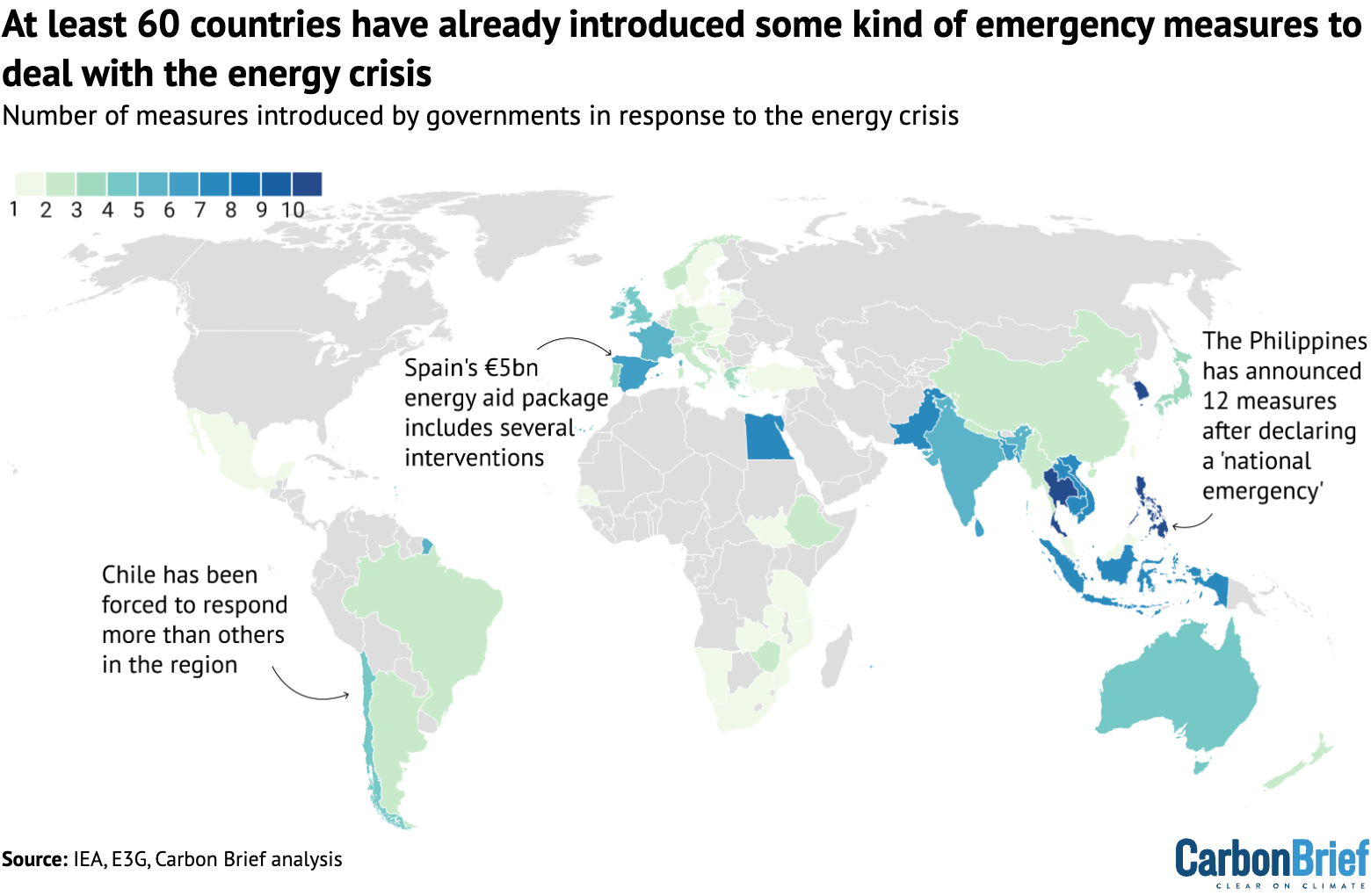
Nations including Indonesia, Japan, South Korea and India are already spending billions of dollars on fuel subsidies to protect people from rising costs.
At least 16 Asian countries are also taking drastic measures to reduce fuel consumption. For example, the Philippines has declared a “state of national emergency”, which includes limiting air conditioning in public buildings and subsidising public transport.
Other examples from the region include the government in Bangladesh asking the public and businesses to avoid unnecessary lighting, Pakistan reducing the speed limit on highways and Laos encouraging people to work from home.
Europe – which was hit hard by the 2022 energy crisis due to its reliance on Russian gas – is less immediately exposed to the current crisis than Asia. However, many nations are still heavily reliant on gas, including supplies from Qatar.
The continent is already feeling the effects of higher global energy prices as countries compete for more limited resources.
At least 18 European nations have introduced measures to help people with rising costs. Spain, which is relatively insulated from the crisis due to the high share of renewables in its electricity supply, nevertheless announced a €5bn aid package, with at least six measures to support consumers.
Many African countries, while also less reliant on direct fossil-fuel supplies via the Strait of Hormuz than Asia, are still facing the strain of higher import bills. Some, including Ethiopia, Kenya and Zambia, are also facing severe fuel shortages.
There have been fewer new policies across the Americas, which have been comparatively insulated from the energy crisis so far. One outlier is Chile, which is among the region’s biggest fuel importers and is, therefore, more exposed to global price increases.
Tax cuts
The most common types of policy response to the energy crisis so far have been efforts to protect people and businesses from the surge in fuel prices.
At least 28 nations, including Italy, Brazil and Australia, have introduced a total of 31 measures to cut taxes – and, therefore, prices – on fuel.
Even across Africa, where state revenues are already stretched, some nations – including Namibia and South Africa – are cutting fuel levies in a bid to stabilise prices.
Another 17 countries, including Mexico and Poland, have directly capped the price of fuel. Others, such as France and the UK, have opted for more targeted fuel subsidies, designed to support specific vulnerable groups and industries.
These measures are all shown in the dark blue “consumer support” bars in the chart below.
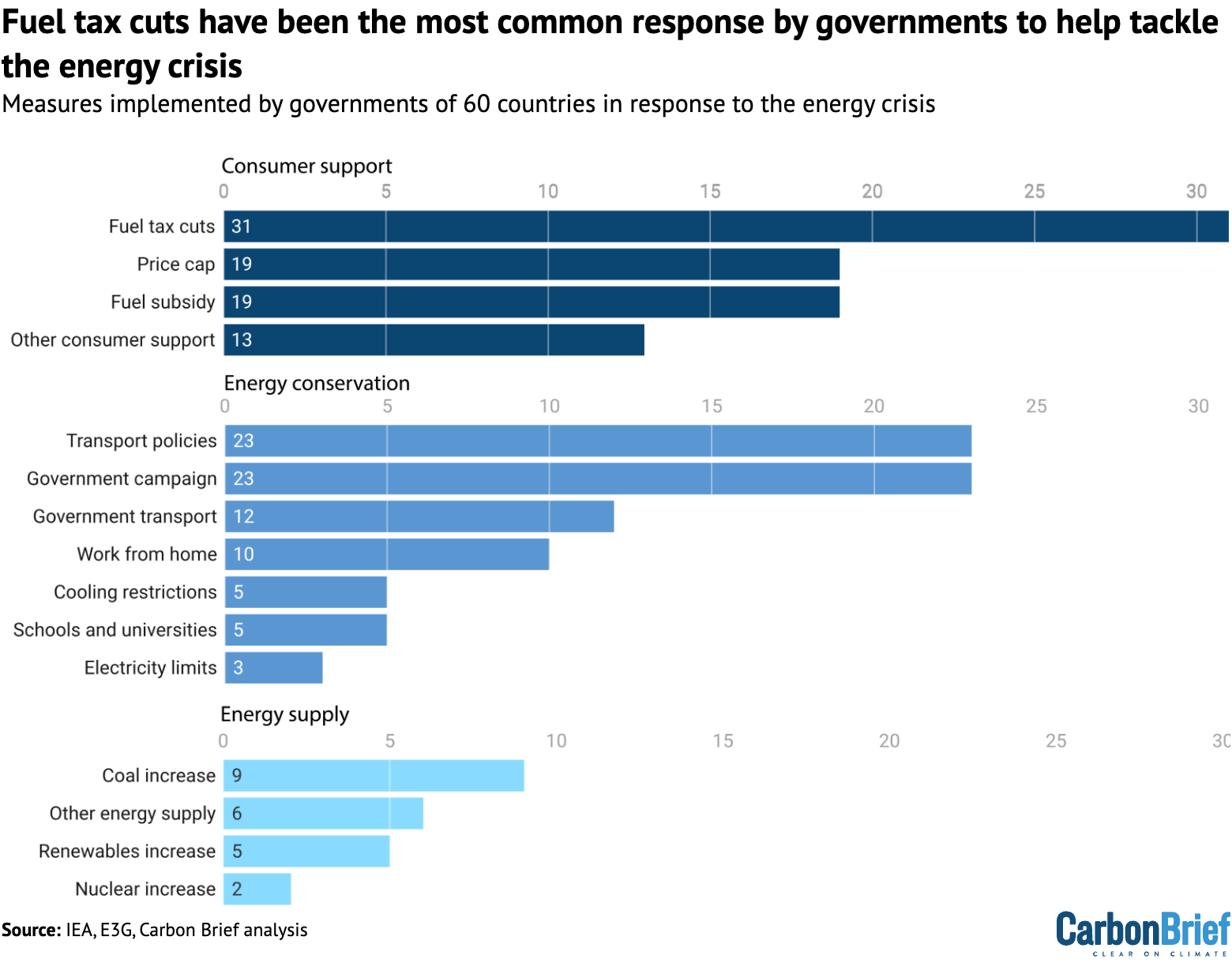
Such measures can directly help consumers, but some leaders, NGOs and financial experts have noted that there is also the risk of them driving inflation and reinforcing reliance on the existing fossil fuel-based system.
Christine Lagarde, president of the European Central Bank, spoke in favour of short-term measures to “smooth the shock”, but noted that “broad-based and open-ended measures may add excessively to demand”.
Measures to conserve energy, of the type that many developing countries in Asia have implemented extensively, have been described by the IEA as “more effective and fiscally sustainable than broad-based subsidies”.
So far, there have been at least 23 such measures introduced to limit the use of transport, particularly private cars.
These include Lithuania cutting train fares, two Australian states making public transport free and Myanmar and South Korea asking people to only drive their cars on certain days.
Clean vs coal
At least eight countries have announced plans to either increase their use of coal or review existing plans to transition away from coal, according to Carbon Brief’s analysis. These include Japan, South Korea, Bangladesh, the Philippines, Thailand, Pakistan, Germany and Italy.
These measures broadly involve delaying coal-plant closure, as in Italy, or allowing older sites to operate at higher rates, as in Japan – rather than building more coal plants.
There has been extensive coverage of how the energy crisis is “driving Asia back to coal”. However, as Bloomberg columnist David Fickling has noted, this shift is relatively small and likely to be offset by a move to cheap solar power in the longer term.
Indeed, some countries have begun to consider changes to the way they use energy going forward, amid a crisis driven by the spiralling costs of fossil-fuel imports.
Leaders in India, Barbados and the UK have explicitly stressed the importance of a structural shift to using clean power. Governments in France and the Philippines are among those linking new renewable-energy announcements with the unfolding crisis.
New renewable-energy capacity will take time to come online, albeit substantially less time than developing new fossil-fuel generation. In the meantime, some nations are also taking short-term measures to make their road transport less reliant on fossil fuels.
For example, the Chilean government has enabled taxi drivers to access preferential credit for purchasing electric vehicles (EVs). Cambodia has cut import taxes on EVs and Laos has lowered excise taxes on them.
Finally, there have been some signs that countries are reconsidering their future exposure to imported fossil fuels, given the current economics of oil and gas.
The New Zealand government has indicated that a plan to build a new LNG terminal by 2027 now faces uncertainty. Reuters reported that Vietnamese conglomerate Vingroup has told the government it wanted to abandon a plan to build a new LNG-fired power plant in Vietnam, in favour of renewables.

The post Iran war analysis: How 60 nations have responded to the global energy crisis appeared first on Carbon Brief.
Iran war analysis: How 60 nations have responded to the global energy crisis



-
Climate Change8 months ago
Guest post: Why China is still building new coal – and when it might stop
-
Greenhouse Gases8 months ago
Guest post: Why China is still building new coal – and when it might stop
-

 Greenhouse Gases2 years ago
嘉宾来稿:满足中国增长的用电需求 光伏加储能“比新建煤电更实惠”
-
Climate Change2 years ago
Bill Discounting Climate Change in Florida’s Energy Policy Awaits DeSantis’ Approval
-

 Climate Change2 years ago
嘉宾来稿:满足中国增长的用电需求 光伏加储能“比新建煤电更实惠”
-
Climate Change Videos2 years ago
The toxic gas flares fuelling Nigeria’s climate change – BBC News
-

 Renewable Energy6 months ago
Sending Progressive Philanthropist George Soros to Prison?
-

 Carbon Footprint2 years ago
US SEC’s Climate Disclosure Rules Spur Renewed Interest in Carbon Credits