

Climate diplomats have finished another two weeks of intense negotiations in the German city of Bonn, discussing global efforts to cut emissions and protect people from climate hazards.
Developed and developing countries were locked in a bitter struggle over who should provide the trillions of dollars required to tackle climate change across the global south.
This issue cast a shadow over wider proceedings. Discussions of everything from assessing climate adaptation, to carrying forward the outcomes from last year’s “stocktake” in Dubai, were held up by financial disputes.
Nations are expected to reach an agreement at COP29 in Baku, Azerbaijan, on a new, global climate-finance goal that will come into play after 2025.
The COP29 presidency has highlighted this as one of its priorities, along with technical issues concerning “Article 6” carbon markets. However, neither issue made much progress in Bonn, suggesting the months ahead will be challenging.
Last year’s UN climate talks in Dubai secured the first-ever COP agreement to curb fossil fuels. Yet many delegates in Bonn were frustrated that negotiations were still not reckoning with the need to ramp up global climate ambition.
Here, Carbon Brief gives an overview of the key outcomes and disputes at the 60th biannual sessions of the UN Framework Convention on Climate Change (UNFCCC) subsidiary bodies (SB60).
- Climate finance
- Adaptation
- Mitigation
- Just transition
- Article 6
- Loss and damage
- Global stocktake, NDCs and ambition
- Road to COP29
Climate finance
Climate finance was top of the agenda in Bonn. The issue is particularly urgent this year, as countries are expected to agree on a new global climate finance goal in Baku.
Negotiations took place against a bleak financial backdrop. Many rich nations have been cutting their aid budgets, citing fiscal pressures, even as developing countries struggle with debt that makes spending on climate action harder.
Developing countries say they need financial support from developed countries if they are to spend the trillions needed to meet their climate targets. As UNFCCC executive secretary Simon Stiell told delegates in Bonn at the beginning of the talks, finance is the “great enabler of climate action”.
“Developed” countries – including western Europe, the US, Japan and a handful of others – are obliged to provide finance under the Paris Agreement. They support climate projects in developing countries, largely through their foreign aid budgets.
However, these nations have fallen short on their commitments. In particular, they missed the $100bn annual target that they pledged to meet by 2020.
While the latest data compiled by the Organisation for Economic Co-operation and Development (OECD) suggests they exceeded that goal in 2022, many activists and global-south negotiators contest the figures. They point to the reliance on loans, money from the private sector and development aid that has been “relabelled” as climate finance.
By the end of COP29, all the parties must agree on a “new collective quantified goal” (NCQG) to guide the provision of climate finance. This goal is supposed to replace the $100bn target after 2025.
Progress on negotiating the NCQG has been slow. Nations have disagreed on almost every aspect of the new target, including the amount of money that should be provided, who should provide it, who should receive it and what kind of funds should be included.
The main dividing lines are between the developed countries that have traditionally been obliged to provide finance and the developing countries who are eligible to receive it. However, country groupings have different priorities. The interactive table below captures some of this complexity.
The focus of the finance talks in Bonn was an “ad hoc work programme”, which held its first meeting in April and is meant to yield a text that can form the basis for negotiations in Baku.
Across the two weeks in Bonn, there were four sessions of the work programme, as well as a “technical expert dialogue” where experts and governments exchanged views on the goal.
Prior to the start of negotiations, countries submitted written statements explaining their – often highly divergent – positions on the topic. These were used by two co-chairs to compile a 63-page “input paper” intended to capture the full range of views.
In the first week, parties asked co-chairs to “streamline” the text, resulting in an updated “input paper”, with a somewhat slimmed-down 45 pages.
After more submissions, another text, with 35 pages, was released as the weekend drew to a close. Despite pressure to seek compromises, the text essentially remained a summary of all the proposals on the table – including many that directly contradicted each other.
As the last meeting came to a close on the second Tuesday, deep divisions remained between the parties. Numerous developed countries said the text was “unbalanced” and asked for sections to be deleted.
Developed-country parties including the US, the EU and Australia said they were frustrated by the other parties’ unwillingness to accommodate their inputs.
One of the major disputes was over the “quantum” of climate finance – that is, the amount of money that would be put towards the new goal.
Unlike the $100bn target, the new goal is meant to be based on analysis of developing countries’ needs – which are significant. Various independent assessments have estimated that trillions of dollars are required every year if these nations are to hit their climate targets.
Some developing country groups – including the Arab Group, the LMDCs of China, India and others, as well as the small island states (AOSIS) – have proposed targets in the trillions, in the range of around $1.1-1.3tn.
(The Arab Group provided more detail, suggesting that $441bn could come from public funds – including taxes on arms companies – and the remainder “mobilised” from other funding streams.)
They have also called for “arrears” from the $100bn goal, to make up for the two years in which the target was missed.
By contrast, the US, the EU and other developed countries have been hesitant to propose specific financial targets. The only exception is what the US described as its “quantum” proposal, which was that the target should be “from a floor of $100bn” – the bare minimum set by the Paris Agreement itself.

Instead, developed countries have sought to focus the talks on the many “layers” of finance that they see making up the final goal. They emphasise that this needs to be agreed before a number can be picked.
These groups have stressed the importance of an expansive goal that includes money “mobilised” from the private sector, the reform of multilateral development banks (MDBs) and even domestic spending within countries.
By contrast, developing countries broadly want to keep the talks tightly focused on money channelled from the public coffers of developed countries and given to developing countries.
Liliam Chagas, the head of the Brazilian delegation in Bonn, explained to Carbon Brief that G77 countries want to see these negotiations between national governments focusing on funding streams that are within their power to provide:
“Others think ‘oh no, the task is so big that we must put everything [in]’ – other layers – but the other layers we don’t control.”
Another stumbling block within the negotiations is the issue of expanding the “donor base”. The group of developed countries that is currently responsible for providing funds to developing countries wants wealthy, high-emitting – but still “developing” – countries, such as China and the Gulf states, to start contributing.
The EU has suggested that contributor status could be based on a combination of “economic conditions” and emissions or membership of institutions, such as the G20 and the OECD. Switzerland even proposed it could be based on which countries have space programmes.
The G77 and China group of developing countries, meanwhile, has been firm in its position that developed countries have committed under the Paris Agreement to provide climate finance to developing countries.
These nations also want to include the principle of “common but differentiated responsibilities” reflected in the goal, emphasising the historical responsibilities of developed countries for causing climate change. Developed countries rejected this idea.
Michai Robertson, a climate-finance negotiator with AOSIS, told Carbon Brief that such fundamental differences of opinion were preventing any progress:
“[Developed countries] have connected the whole quantum to who’s contributing, which is a tough pill to swallow.”
He pointed out that it was highly unlikely countries would reach a consensus in which a handful of developing countries agree to provide climate finance.
Further disagreements exist around the timescale of the new goal, which countries should be the primary recipients of the money and even how to define “climate finance”. As it stands, developed countries all use different metrics to measure how much finance they provide, leading to widespread mistrust in the figures. Robertson noted:
“The number – yes, that’s important – but making sure we understand exactly what we’re counting is probably even more important, or equally important.”
Parties identified more common ground around the issues of improving countries’ access to finance and updating the Paris Agreement’s “enhanced transparency framework” in order to effectively report on climate finance.
Most of the major issues were viewed as too important to be resolved without direct input from ministries, which will take place in the run up to COP29.
“The G7, Ministerial on Climate Action and UN General Assembly are some of the opportunities in the next few months for leaders to have frank conversations that will be necessary to move beyond entrenched positions,” Joe Thwaites, a senior advocate for international climate finance at the Natural Resources Defence Council, tells Carbon Brief.
One issue raised by negotiators Carbon Brief spoke with in Bonn was that several major donor countries face changes of government in the coming months, bringing potential disruption to climate finance plans. In the US, a second term for Donald Trump could even lead to withdrawal from international climate action.
To conclude the session, the NCQG co-chairs said they would produce a new “input paper” ahead of the next meeting of the work programme – asking negotiators to propose some compromises.
Finally, a separate but very much related issue in Bonn was Article 2.1c of the Paris Agreement. This calls for “financial flows” in general to be made consistent with cutting emissions and “climate-resilient development”.
Alexandra Sgobbi, head of the climate finance unit at the European Commission, explained at a press briefing early in the talks how she saw Article 2.1c:
“My personal opinion [is] that means that we should be heading to a time when we actually don’t talk about climate finance any more because everything is actually supporting countries and companies and individuals in meeting climate neutrality and climate resilient objectives.”
In Bonn, the Sharm el-Sheikh dialogue provided space to discuss this issue.
However, it also related directly to the broadly developed-country notion in NCQG negotiations that the goal should incorporate all kinds of finance – and potentially discourage investment in fossil fuels.
Many developing countries, meanwhile, interpret Article 2.1c as a way to distract attention from developed countries’ responsibilities to provide climate finance. Groups such as the LMDCs and the Arab Group, which include major fossil-fuel producers, have been particularly resistant to discussing the issue.
Adaptation
The issue of climate adaptation featured across multiple strands of the Bonn negotiations. Much of the tension in these talks came back to the question of climate finance.
At COP28, negotiators made long-awaited progress on a “global goal on adaptation” (GGA). They agreed on a “framework” to guide countries in their efforts to prepare for rising global temperatures – dubbed the UAE Framework for Global Climate Resilience.
Developing countries in the G77 and China group had pushed hard in Dubai for adaptation finance to feature prominently in the GGA. Some had also advocated for a clear recognition of “common but differentiated responsibilities” – highlighting the historical responsibility that they say developed countries must accept when addressing climate adaptation.
They were ultimately unsuccessful in this push. However, demands for developed countries to provide climate finance continued to be a live issue throughout the negotiations in Bonn.
Among the major adaptation-related issues discussed at Bonn was the UAE-Belém work programme on “indicators” – a two-year effort that was also agreed in the GGA negotiations.
“Indicators” could include any measures that are relevant for climate adaptation – from the area of land available for food production to the number of climate-related deaths. Many are already available and used in other contexts, but this work involves identifying a set that can be applied globally under the GGA.
Negotiators were meant to discuss the “modalities” of this programme in Bonn. This refers to practicalities, such as overall plan, timeline and who is involved, which must be organised before the programme can begin its technical work.
There was frustration among some parties and delegates that little progress was being made on these, given it was expected to be a relatively straightforward part of the programme.
Developing countries raised the issue of finance throughout, wanting to include it as one of the key indicators. Ugandan negotiator Adonia Ayebare, who is also chair of the G77 and China, told Carbon Brief that their focus on finance in these negotiations was straightforward:
“Without finance, there’s nothing that can happen from a developing country’s perspective…It’s in the Paris Agreement. We agreed on it, so we should do it.”
The argument goes that dealing with adaptation cannot be separated from the urgent need for investment in adaptation – which has been severely lacking. The most recent UN analysis found that developing countries’ annual adaptation financial needs were 10-18 times greater than the public funds they received from developed countries in 2021.
Ultimately, negotiators found a compromise in the outcome text, which will be forwarded on to talks in Baku. This included “recall[ing]” an opening paragraph from the GGA, which in turn referenced the importance of equity and common but differentiated responsibilities.
Another major divergence was the question of which organisation should be charged with “mapping” existing adaptation indicators. Developed parties, such as the US, the EU and Japan, wanted this to be handled by the Adaptation Committee, but G77 countries broadly wanted it to be handled by a newly formed “expert group”.
In the end, another compromise was found, with a footnote in the final text that left different options open for future talks. It said negotiators would consider the “Adaptation Committee and/or an ad hoc expert group and/or expert groups”.
The other notable strand of adaptation negotiations at Bonn focused on countries’ national adaptation plans (NAPs). As the name suggests, NAPs allow countries to plan for climate impacts, but an assessment of them has been repeatedly delayed.
Around 50 countries have NAPs in place, but the GGA envisages comprehensive NAP coverage by 2030. Again, finance is a central issue, as developed countries say they need money not only to implement NAPs, but to actually put them together in the first place.
In the end, following disputes over the role of private finance in adaptation and the long delays in receiving funds for NAP production, negotiators settled on a lengthy, seven-page “informal note” that included issues both developed and developing countries disagreed with.
This too will be taken up by negotiators at COP29 in November, but unlike the “draft conclusions” on indicators and the GGA, its status as an “informal note” means it carries less weight and is further from any legal decision that would be agreed in Baku.
Jeffrey Qi, a policy advisor with the International Institute for Sustainable Development’s (IISD) resilience programme, tells Carbon Brief.
“Countries will find it rather challenging to streamline this text in the first week of Baku, especially when there are many elements they find uncomfortable…A lot of time will be spent on repeating the same positions again and again hoping for flexibility and compromise.”
Other negotiations also covered adaptation, such as the “matters relating to the least developed countries” and the “Nairobi work programme”, but these passed without much event.
Mitigation
Parties in the mitigation ambition and implementation work programme (MWP) were unable to come to an agreement on draft conclusions at Bonn, due to disagreements around whether there should be a procedural versus substantive outcome.
(At Bonn in 2023 similar debates arose, becoming one of the key areas of contention at the talks. The MWP’s inclusion in the agenda was one of the sticking points that led it to not even be agreed until the day before the two-week session was due to close.)
The MWP was adopted at COP27 in Sharm-el-Sheikh and is expected to run until 2026, when a decision will be made about the extension of its work.
Ahead of the start of the wider Bonn session, the third “global dialogue and investment-focused event” under the work programme was held in the city between 27-29 May, focused on “Cities: buildings and urban systems“.
Informal consultations then began on 4 June with co-facilitators Kay Harrison (New Zealand) and Carlos Fuller (Belize) inviting parties to share their views on substantive elements they would like addressed under the programme and its outcomes. According to Third World Network (TWN), divergence among parties quickly became clear.
Much of the disagreement within the work programme focused on its mandate, in particular with regard to the outcome of the “global stocktake” (GST) that was finalised at COP28 and called, among other things, for countries to “transition away” from fossil fuels.
A number of negotiating groups including small island states (AOSIS), the Environmental Integrity Group (EIG, including Switzerland and Mexico), the EU and Latin American countries (AILAC), as well as Japan, called for a decision that would reflect and build on the outcomes of the GST, according to the Earth Negotiations Bulletin (ENB).
Paragraph 186 of the GST outcome document “invites the relevant work programmes and constituted bodies under or serving the Paris Agreement to integrate relevant outcomes of the first global stocktake in planning their future work, in line with their mandates”.
However, the Like-Minded Developing Countries (LMDC), including China and India, noted that this paragraph also contains the caveat that GST outcomes should be applied “in line with [the] mandates” of programmes.
Together with the Arab Group, they argued that this does not apply to the MWP, and opposed the GST being reflected in the decision text.
Speaking on a panel following the first week, David Knecht, program manager for energy and climate justice at Swiss NGO Fastenaktion, said it was very important to unblock the MWP, given it was the only agenda item explicitly focused on mitigation. He added:
“We wish that the mitigation work programme can also contribute to the implementation of the global stocktake elements, which are related to mitigation, so that the mitigation work programme can start to deliver to its potential.”
Other disagreements emerged around the appropriate relationship between the MWP and nationally determined contributions (NDCs).
In a statement, Fernanda Carvalho, global policy manager for climate and energy practice at WWF International, said there needed to be a “dramatic change of pace on the mitigation work programme and on discussions related to nationally determined contributions”. She added:
“Discussions on mitigation in Bonn – or the lack of them – are completely disconnected from a sad reality: the window to 1.5C is closing fast. To get there, we need to collectively reduce emissions by 43% by 2030 and 65% by 2035 in relation to 2019 levels. That demands much stronger nationally determined contributions in 2025, backed up by solid technical and financial support.”
The LMDCs, African Group and Arab Group stressed that the MWP should not impose any targets on countries, arguing instead that the objective of the programme was to facilitate dialogues, TWN reported. New targets through the inclusion of key messages would go beyond the mandate of the MWP and place further burdens on developing countries, they noted.
AOSIS pointed to the urgency of the need to mitigate the impact of climate change, instead insisting that there should be “strong outcomes” from the MWP.
These disagreements continued through the informal consultations on 6 and 8 June. By this point, there was general agreement to continue the discussion on “improvement of future global dialogues and the investment focused events”, noted TWN.
On 12 June, the co-chairs presented a draft conclusions text and an informal note produced under their own authority.

LMDCs, the Arab group and others refused to even engage with the documents, arguing that Harrison and Fuller had not been mandated to produce them, according to ENB.
ENB added that, at the final informal meeting, several parties highlighted their disappointment with how the negotiations had been conducted, including calling into question the neutrality of the co-facilitators.
The divides between countries targeting substantive and those who preferred a strictly procedural decision ran across both weeks, ultimately leading to the failure to agree draft conclusions.
Within ENB’s “in the corridor” section, it quoted a seasoned delegate who quipped: “To speak about a mitigation work programme for this many hours and still not come out with a definition of our own mandate…well, there’s got to be some kind of award for that.”
Just transition
In Bonn, progress stalled once again in the just transition work programme (JTWP), as familiar challenges resurfaced.
The JTWP was established at COP27 in Sharm el-Sheikh. Since then, there have been ongoing disagreements about the focus of the programme. Developed countries broadly view it as focused on jobs, while developing countries argue it needs to be broader.
Last year at Bonn, for example, the G77 and China said their views were being overlooked in the talks, which they described as being “mitigation-centric”. While this dynamic continued to play out in Dubai at COP28, progress was made and parties agreed on the elements of the work programme.
However, over the two weeks of Bonn the same issues re-emerged, with the TWN noting that the negotiations were “like déjà vu”.
The first dialogue of the programme took place on 2-3 June, just ahead of the start of Bonn.
Speaking at the opening of the dialogue, Nabeer Munir (Pakistan), chair of the UN climate regime’s Subsidiary Body for Implementation (SBI) said:
“Just transition is not just about reducing carbon emissions; it is about building a future with social justice and environmental sustainability to go hand in hand…safeguarding biodiversity and ensuring [a] prosperous planet for the generations to come.”
Within this first dialogue, the goal was to discuss how just transitions could be incorporated into NDCs, national adaptation plans and long term strategies.
Here, there were areas of agreement, including that just transition actions should be tailored to local contexts and national circumstances, that there should be a whole-of-government approach and that they should align with the Paris Agreement goals, while including the rights of workers, Indigenous Peoples and other vulnerable groups, according to the Earth Negotiations Bulletin (ENB).
A draft text was introduced by co-chair Marianne Karlsen (Norway) on 5 June, with parties invited to share their views.
Disputes quickly emerged, in particular with the G77 and China group proposing a work plan for the JTWP, supported by others including the African Group and the LMDCs. The US opposed this, arguing that it was “a premature anticipation of the outcome of the JTWP’s review in 2026”, according to ENB.
Across the two weeks, this disagreement became increasingly entrenched. The African Group also called for the development of a work plan at COP29 later this year. The EU, US, Canada, Australia and Japan opposed the call, with Canada subsequently arguing that it would be premature.
Speaking to Carbon Brief, Dr Leon Sealey-Huggins, senior campaigner at charity War on Want, says:
“The creation of a work plan was a sticking point, but I think it was more a broader refusal of developed countries to agree to anything that made the JTWP more than just a talk shop or talking shop.”
Parties clashed on the “modalities” of the UAE JTWP, with different parties having different interpretations of the agreement from Dubai. This refers to practicalities, such as overall plan, timeline and who is involved, which must be organised before the programme can begin its technical work.
Speaking to Carbon Brief, Anabella Rosemberg, senior advisor on the just transition at NGO Climate Action Network International (CAN), explains that developed countries broadly viewed the modalities as having been set at COP28, while developing countries and civil society viewed them as a platform to be built on. She adds:
“[In Bonn many developed countries argued] there’s no further clarification needed. There’s no need for adding more activities. There’s no need for knowing more about the themes. We are happy as it is.
“That was not seen as sufficient…On the one side, it does look like some of the developed countries have flexed that position, realised that those two [already agree] dialogues might not be enough, but at the same time, they are raising concerns about funding and other issues that may make things complicated.”
Additionally, there were disagreements around language, with the G77 and China proposing that the draft conclusions “take note” rather than “welcome” the first hybrid dialogue, while the LDCs suggested “acknowledge”, noted ENB.
Speaking on a panel on 8 June, Caroline Brouillette, executive director of CAN Canada, said momentum was lost over the first week of Bonn. Echoing others, she said negotiations had become a “talkshop”, simply reopening discussions on elements that were agreed in Dubai.
On 12 June, co-chair Kishan Kumarsingh (Trinidad and Tobago) noted that as no decision could be reached, draft procedural conclusions would be put together. However, parties reconvened again in the evening to try and find agreement.

This renewed push continued into 13 June. Ultimately, an agreement was reached with draft conclusions and an informal note published.
While a work plan was absent from the conclusions, the informal note included a “placeholder on the workplan for the work programme”, albeit within square brackets, meaning the wording had not yet been agreed by all parties.
In a statement at the end of the two weeks, Brouillette, added:
“Parties agreed to procedural conclusions in Bonn which give the Just Transition Work Programme a bit of oomph. But now they need to show up in Baku with a clear vision on how the JTWP delivers justice for people: this includes stronger and more inclusive modalities and deeper content discussions. Bringing workers, communities and all peoples along and ensuring adequate support and international cooperation is the only way we can move fast enough to limit warming to the crucial threshold of 1.5C.”
Article 6
Coverage of these negotiations will follow shortly.
Loss and damage
Coverage of these negotiations will follow shortly.
Global stocktake, NDCs and ambition
Coverage of these negotiations will follow shortly.
Road to COP29
With Bonn coming to a close, attention is turning to COP29 host Azerbaijan, which, like its predecessor the United Arab Emirates, is a major fossil fuel producer.
The country is planning to expand its gas operations, with President Ilham Aliyev saying the country’s fossil fuel reserves were “a gift of the gods”, according to Politico.
European officials have also recently suggested that Azerbaijan could run its gas through a pipeline currently used to bring Russian fuel to the EU via Ukraine, in an effort to reduce the bloc’s dependance on Russia, a separate article in Politico reported.
Because of its role in the oil and gas industry, being a former Soviet bloc country and sitting between the east and the west, Mukhtar Babayev, the minister of ecology for Azerbaijan and COP29 president designate, has looked to position the country as the crossroads of the world, an interview with the Guardian noted.
COP29 will take place amid a period of high geopolitical tension. In addition, Azerbaijan has already drawn criticism for media crackdowns, with Human Rights Watch reporting the country had arrested or sentenced at least 25 journalists and activists in the past year.
Speaking to Carbon Brief, Anabella Rosemberg, senior advisor on the just transition at CAN says:
“The mood for cooperation going into COP is a very difficult one. Of course, there is Gaza, but there are also many other things, multiple elections still coming and the multilateralism across the board that is under attack.
“So, yeah, the extent to which we are able to maintain this line of conversation from governments that today are hardly able to agree on anything without going into a lowest common denominator approach to save the process, which is something that CAN could not accept. It’s a very difficult balancing act.”
Efforts will continue over the coming months to lay the groundwork for COP29. This will include further work from the COP presidencies “Troika”, made up of the hosts of COP28, COP29 and COP30. Collectively, they launched the Roadmap to Mission 1.5C in April.
The spotlight will continue to be on finance, with the importance of the new global climate finance goal in Baku hanging over preparations.
In a statement at the end of Bonn, Alden Meyer, senior associate at E3G said:
“As in past years, it will take hard work by ministers and leaders over the next several months to lay the groundwork for the political agreements that will make COP29 in Baku a success. We must create the conditions that will drive high ambition in the next round of national emissions reduction pledges due by early next year to give us a fighting chance to keep the 1.5C Paris temperature limitation goal in reach as is needed to avert even more devastating climate impacts than those people are already experiencing all across the world.”
| Date | Milestone |
|---|---|
| 13 to 15 June 2024 | G7 summit, Italy |
| 12-14 July 2024 | G20 summit, Brazil |
| 21 October to 1 November 2024 | Biodiversity COP16, Cali, Columbia |
| 11 to 22 November 2024 | COP29, Baku, Azerbaijan |


The post Bonn climate talks: Key outcomes from the June 2024 UN climate conference appeared first on Carbon Brief.
Bonn climate talks: Key outcomes from the June 2024 UN climate conference

With the U.S. bombing Iran and the Strait of Hormuz closed, energy experts say countries transitioning to renewables will be more resilient in the “face of the shock.”
The United States’ war on Iran could fundamentally alter how countries consume and generate energy and hamper international progress in combating climate change, a panel of energy experts said today.
The Global Energy Supply in a Decade ‘Is Not a World We’re Going to Recognize’
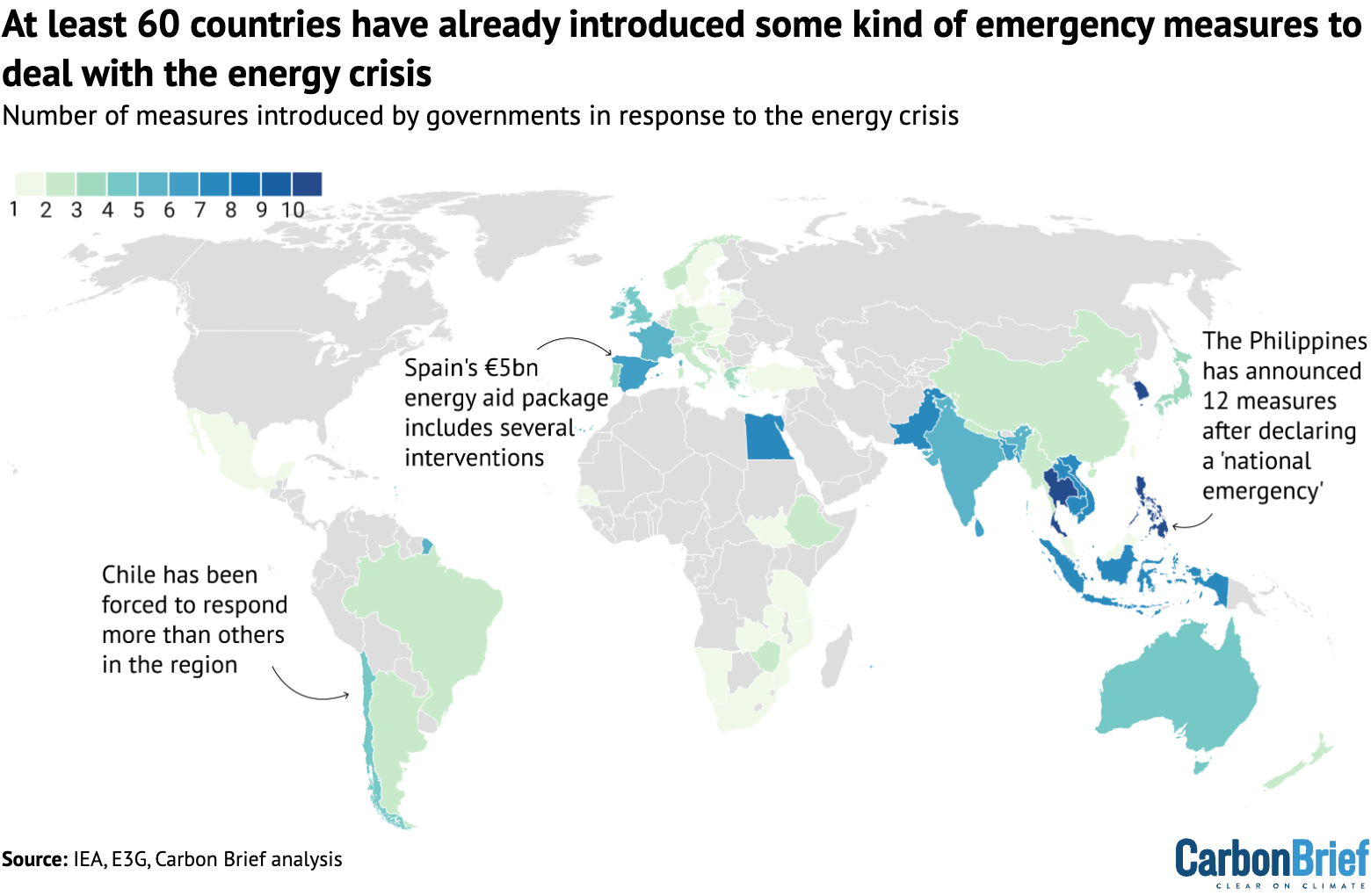
One month into the US and Israel’s war on Iran, at least 60 countries have taken emergency measures in response to the subsequent global energy crisis, according to analysis by Carbon Brief.
So far, these countries have announced nearly 200 policies to save fuel, support consumers and boost domestic energy supplies.
Carbon Brief has drawn on tracking by the International Energy Agency (IEA) and other sources to assess the global policy response, just as a temporary ceasefire is declared.
Since the start of the war in late February, both sides have bombed vital energy infrastructure across the region as Iran has blocked the Strait of Hormuz – a key waterway through which around a fifth of global oil and liquified natural gas (LNG) trade passes.
This has made it impossible to export the usual volumes of fossil fuels from the region and, as a result, sent prices soaring.
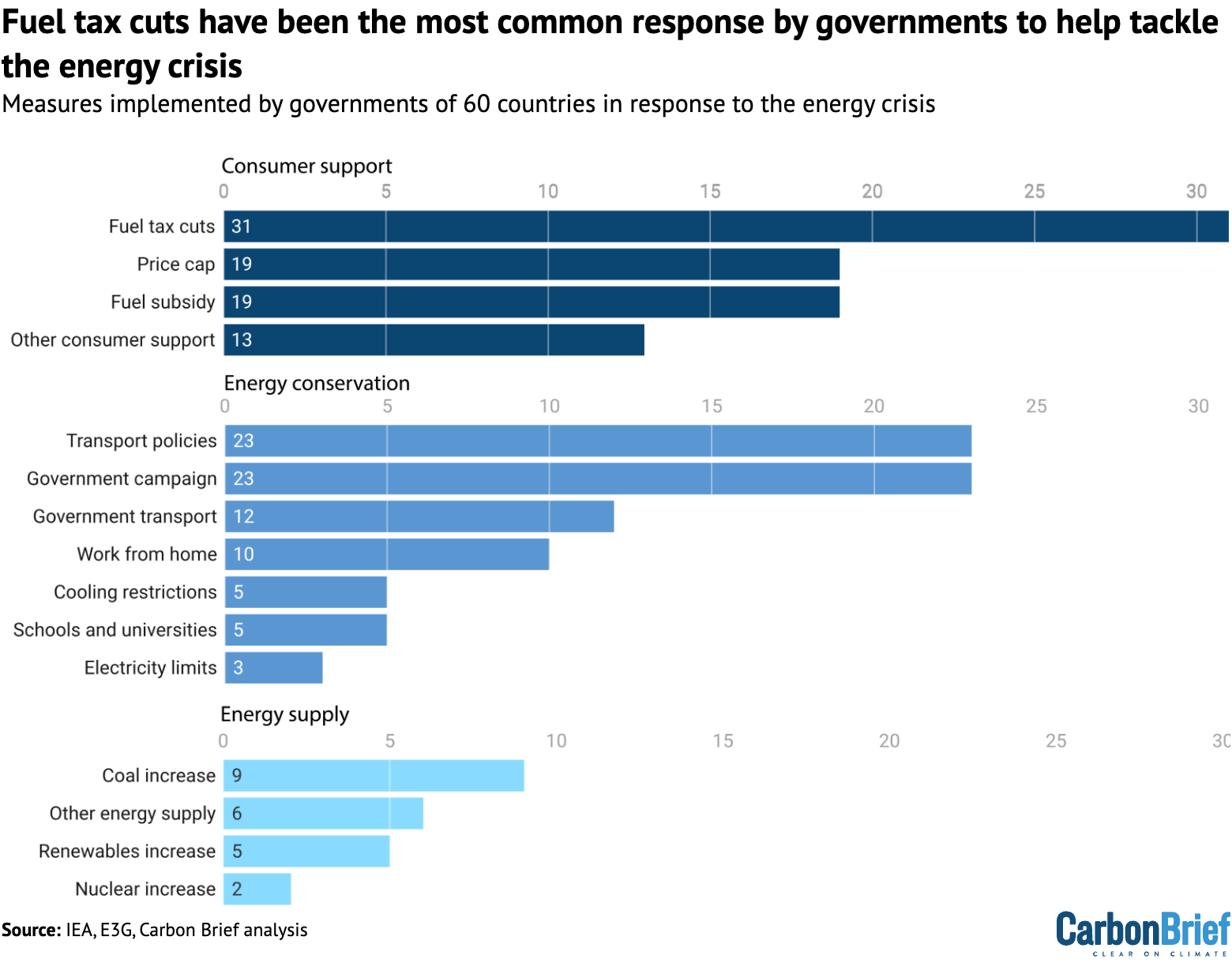
Around 30 nations, from Norway to Zambia, have cut fuel taxes to help people struggling with rising costs, making this by far the most common domestic policy response to the crisis.
Some countries have stressed the need to boost domestic renewable-energy construction, while others – including Japan, Italy and South Korea – have opted to lean more on coal, at least in the short term.
The most wide-ranging responses have been in Asia, where countries that rely heavily on fossil fuels from the Middle East have implemented driving bans, fuel rationing and school closures in order to reduce demand.
‘Largest disruption’
On 28 February, the US and Israel launched a surprise attack on Iran, triggering conflict across the Middle East and sending shockwaves around the world.
There have been numerous assaults on energy infrastructure, including an Iranian attack on the world’s largest LNG facility in Qatar and an Israeli bombing of Iran’s gas sites.
Iran’s blockade of the Strait of Hormuz, a chokepoint in the Persian Gulf, is causing what the IEA has called the “largest supply disruption in the history of the global oil market”.
A fifth of the world’s oil and LNG is normally shipped through this region, with 90% of those supplies going to destinations in Asia. Without these supplies, fuel prices have surged.
Governments around the world have taken emergency actions in response to this new energy crisis, shielding their citizens from price spikes, conserving energy where possible and considering longer-term energy policies.
Even with a two-week ceasefire announced, the energy crisis is expected to continue, given the extensive damage to infrastructure and continuing uncertainties.
Asian crunch
Carbon Brief has used tracking by the IEA, news reports, government announcements and internal monitoring by the thinktank E3G to assess the range of national responses to the energy crisis roughly one month into the Iran war.
In total, Carbon Brief has identified 185 relevant policies, announcements and campaigns from 60 national governments.
As the map below shows, these measures are concentrated in east and south Asia. These regions are facing the most extreme disruption, largely due to their reliance on oil and gas supplies from the Middle East.
Nations including Indonesia, Japan, South Korea and India are already spending billions of dollars on fuel subsidies to protect people from rising costs.
At least 16 Asian countries are also taking drastic measures to reduce fuel consumption. For example, the Philippines has declared a “state of national emergency”, which includes limiting air conditioning in public buildings and subsidising public transport.
Other examples from the region include the government in Bangladesh asking the public and businesses to avoid unnecessary lighting, Pakistan reducing the speed limit on highways and Laos encouraging people to work from home.
Europe – which was hit hard by the 2022 energy crisis due to its reliance on Russian gas – is less immediately exposed to the current crisis than Asia. However, many nations are still heavily reliant on gas, including supplies from Qatar.
The continent is already feeling the effects of higher global energy prices as countries compete for more limited resources.
At least 18 European nations have introduced measures to help people with rising costs. Spain, which is relatively insulated from the crisis due to the high share of renewables in its electricity supply, nevertheless announced a €5bn aid package, with at least six measures to support consumers.
Many African countries, while also less reliant on direct fossil-fuel supplies via the Strait of Hormuz than Asia, are still facing the strain of higher import bills. Some, including Ethiopia, Kenya and Zambia, are also facing severe fuel shortages.
There have been fewer new policies across the Americas, which have been comparatively insulated from the energy crisis so far. One outlier is Chile, which is among the region’s biggest fuel importers and is, therefore, more exposed to global price increases.
Tax cuts
The most common types of policy response to the energy crisis so far have been efforts to protect people and businesses from the surge in fuel prices.
At least 28 nations, including Italy, Brazil and Australia, have introduced a total of 31 measures to cut taxes – and, therefore, prices – on fuel.
Even across Africa, where state revenues are already stretched, some nations – including Namibia and South Africa – are cutting fuel levies in a bid to stabilise prices.
Another 17 countries, including Mexico and Poland, have directly capped the price of fuel. Others, such as France and the UK, have opted for more targeted fuel subsidies, designed to support specific vulnerable groups and industries.
These measures are all shown in the dark blue “consumer support” bars in the chart below.
Such measures can directly help consumers, but some leaders, NGOs and financial experts have noted that there is also the risk of them driving inflation and reinforcing reliance on the existing fossil fuel-based system.
Christine Lagarde, president of the European Central Bank, spoke in favour of short-term measures to “smooth the shock”, but noted that “broad-based and open-ended measures may add excessively to demand”.
Measures to conserve energy, of the type that many developing countries in Asia have implemented extensively, have been described by the IEA as “more effective and fiscally sustainable than broad-based subsidies”.
So far, there have been at least 23 such measures introduced to limit the use of transport, particularly private cars.
These include Lithuania cutting train fares, two Australian states making public transport free and Myanmar and South Korea asking people to only drive their cars on certain days.
Clean vs coal
At least eight countries have announced plans to either increase their use of coal or review existing plans to transition away from coal, according to Carbon Brief’s analysis. These include Japan, South Korea, Bangladesh, the Philippines, Thailand, Pakistan, Germany and Italy.
These measures broadly involve delaying coal-plant closure, as in Italy, or allowing older sites to operate at higher rates, as in Japan – rather than building more coal plants.
There has been extensive coverage of how the energy crisis is “driving Asia back to coal”. However, as Bloomberg columnist David Fickling has noted, this shift is relatively small and likely to be offset by a move to cheap solar power in the longer term.
Indeed, some countries have begun to consider changes to the way they use energy going forward, amid a crisis driven by the spiralling costs of fossil-fuel imports.
Leaders in India, Barbados and the UK have explicitly stressed the importance of a structural shift to using clean power. Governments in France and the Philippines are among those linking new renewable-energy announcements with the unfolding crisis.
New renewable-energy capacity will take time to come online, albeit substantially less time than developing new fossil-fuel generation. In the meantime, some nations are also taking short-term measures to make their road transport less reliant on fossil fuels.
For example, the Chilean government has enabled taxi drivers to access preferential credit for purchasing electric vehicles (EVs). Cambodia has cut import taxes on EVs and Laos has lowered excise taxes on them.
Finally, there have been some signs that countries are reconsidering their future exposure to imported fossil fuels, given the current economics of oil and gas.
The New Zealand government has indicated that a plan to build a new LNG terminal by 2027 now faces uncertainty. Reuters reported that Vietnamese conglomerate Vingroup has told the government it wanted to abandon a plan to build a new LNG-fired power plant in Vietnam, in favour of renewables.

The post Iran war analysis: How 60 nations have responded to the global energy crisis appeared first on Carbon Brief.
Iran war analysis: How 60 nations have responded to the global energy crisis
Seven Senate Democrats launched the probe over controversial tax credits to the country’s largest exporter of liquefied natural gas.
Seven Democratic U.S. senators have launched a probe into a $370 million “alternative fuel” payout to Cheniere Energy, made earlier this year by the IRS, that critics say the liquefied natural gas export company never should have received.
US Senators Investigate $370 Million IRS Payout to Cheniere Energy

Boeing Locks in 40,000 Tons of Soil Carbon Removal with Texas-Based Grassroots Carbon
Tesla Reclaims EV Sales Crown from BYD in Q1 2026, Heating Up the EV Race
The Global Energy Supply in a Decade ‘Is Not a World We’re Going to Recognize’
-
Climate Change8 months ago
Guest post: Why China is still building new coal – and when it might stop
-
Greenhouse Gases8 months ago
Guest post: Why China is still building new coal – and when it might stop
-

 Greenhouse Gases2 years ago
嘉宾来稿:满足中国增长的用电需求 光伏加储能“比新建煤电更实惠”
-
Climate Change2 years ago
Bill Discounting Climate Change in Florida’s Energy Policy Awaits DeSantis’ Approval
-

 Climate Change2 years ago
嘉宾来稿:满足中国增长的用电需求 光伏加储能“比新建煤电更实惠”
-
Climate Change Videos2 years ago
The toxic gas flares fuelling Nigeria’s climate change – BBC News
-

 Renewable Energy6 months ago
Sending Progressive Philanthropist George Soros to Prison?
-

 Carbon Footprint2 years ago
US SEC’s Climate Disclosure Rules Spur Renewed Interest in Carbon Credits