

BHP has reported record copper production, highlighting its strength and resilience in a shifting global market. Copper remains a key pillar of the company’s long-term growth strategy, supported by a diverse portfolio of assets across Chile, Australia, and Peru.
This copper ramp-up not only underscores BHP’s operational excellence but also aligns with its push for sustainable mining. Let’s take a closer look at the company’s latest copper supply, green strategies, and long-term outlook.
BHP Sees Strong Results at Key Copper Assets
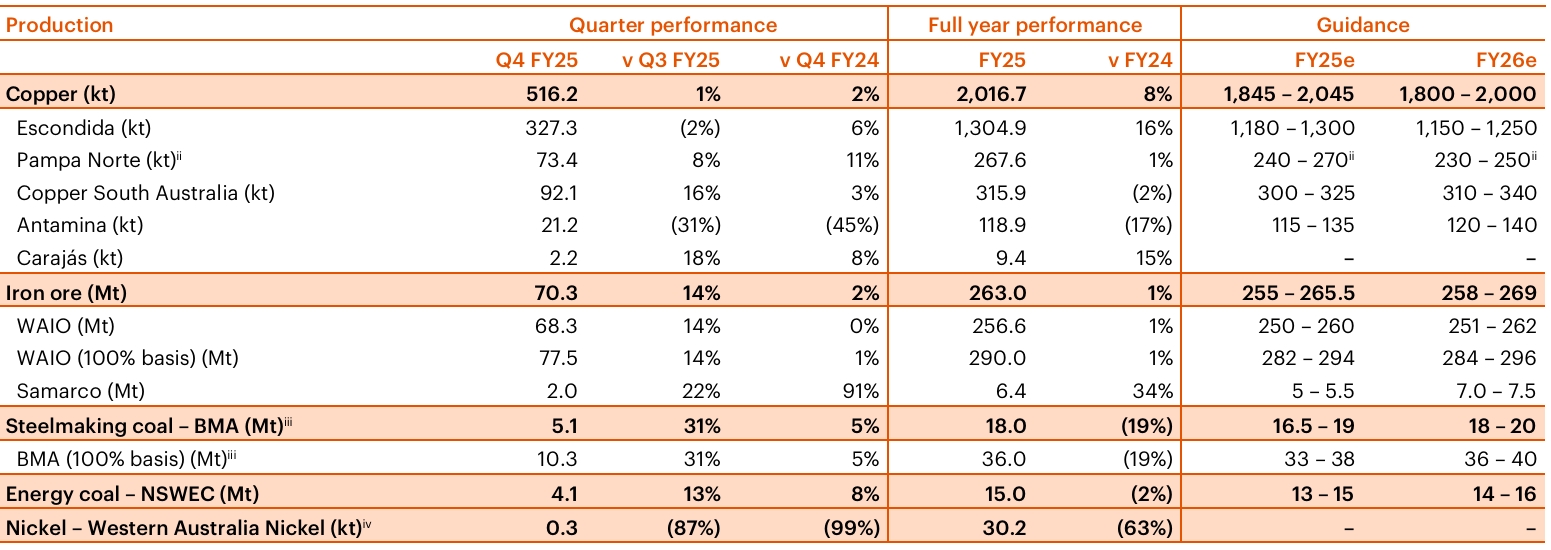
Copper production reached an all-time high of 2,017 thousand tonnes (kt), up 8% from last year. This marks three years of growth and a 28% increase since FY22. Copper is key for energy transition technologies, urban development, and digital infrastructure.
Escondida Hits 17-Year High
At Escondida in Chile, copper output rose 16% to 1,305 kt—its highest in 17 years. This increase came from better recoveries, higher concentrator throughput, and a rise in feed grade from 0.88% to 1.02%. The mine also began production from its Full SaL leaching project in Q4 FY25. FY26 production is expected to be between 1,150 and 1,250 kt, with a forecasted feed grade of around 0.85%.
Spence Delivers Record Production
Pampa Norte, which includes Spence and Cerro Colorado, produced 268 kt, a 1% rise. Spence alone saw a 5% boost due to improved feed grades. However, FY26 guidance is slightly lower at 230 to 250 kt due to transitional ore processing and reduced feed grades.
Copper South Australia Rebounds
Copper South Australia produced 316 kt, down 2% from a two-week power outage in Q2. Still, the region bounced back with an 18% production boost and record quarterly output in Q4. FY26 output is projected between 310 and 340 kt, weighted toward the second half.
Other operations included Antamina in Peru, where copper production fell 17% to 119 kt due to lower feed grades and throughput. However, Antamina expects to produce 120 to 140 kt of copper and 90 to 110 kt of zinc in FY26. In Brazil, Carajás contributed 9.4 kt of copper.
Iron Ore Output Reaches All-Time High
Total iron ore output hit 263 million tonnes in FY25. WAIO led with a record 257 Mt (290 Mt on a 100% basis), driven by better mine productivity and logistics. Samarco, BHP’s joint venture with Vale, saw production rise 34% to 6.4 Mt (12.8 Mt on a 100% basis) due to an early ramp-up of its second concentrator.
Additionally, the company expects FY26 output to range from 258 to 269 Mt.
BHP’s Sustainable Shipping Contracts and Logistics Overhaul
BHP signed contracts with COSCO Shipping Bulk Co., Ltd. for two ammonia dual-fuel Newcastlemax bulk carriers. These vessels, expected by 2028, will mainly transport iron ore from Western Australia to Northeast Asia.
- Powered by low or zero GHG emissions ammonia, these ships can cut greenhouse gas emissions by 50 to 95% per voyage compared to traditional fuels.
Notably, this initiative supports BHP’s commitment under the First Movers Coalition, aiming for 10% of its chartered shipping to use zero-emission fuels by 2030.
The partnership with COSCO followed a detailed evaluation process. BHP will also work on ammonia bunkering plans to ensure safe refueling of these advanced vessels. An ongoing tender will identify the source of the lower-carbon ammonia fuel.
$1.5 Billion Logistics Overhaul in Copper SA
The copper giant also partnered with Australian freight operator Aurizon for a logistics overhaul in Copper South Australia. Four contracts worth A$1.5 billion over ten years will shift copper concentrate and cathode transport from road to rail, covering Olympic Dam, Carrapateena, and Prominent Hill.
The freight will now move by rail between Pimba and Port Adelaide and will be handled by a local transport partner.
This change is expected to remove over 11,000 truck movements from South Australian roads each year, replacing around 13 million kilometers of road travel. Benefits include improved road safety, reduced congestion, and significant emissions cuts.
- This shift highlights operational synergies after the OZ Minerals acquisition and shows BHP’s commitment to regional sustainability.
Advances in Emissions Reductions with Strong Progress
BHP is making solid progress toward its climate goals, aiming to reduce Scope 1 and 2 greenhouse gas (GHG) emissions by at least 30% by 2030 (from a 2020 baseline) and reach net zero by 2050.
As of 2024, the company had already reduced its operational emissions by 32%, lowering them to 9.2 million tonnes of CO₂-equivalent. However, Scope 3 emissions coming mainly from customers using BHP’s products, remained high at 377 million tonnes CO₂-e.
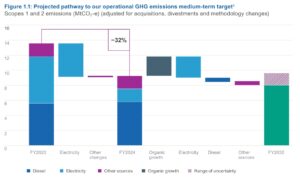
Looking beyond FY2030, BHP’s path to achieving net zero includes several key strategies:
- Electrifying operations: Replacing diesel-powered equipment such as haul trucks, excavators, shovels, and locomotives with electric alternatives.
- Expanding renewable energy use: Securing more renewable or low-emission electricity to power the growing fleet of electric vehicles and equipment.
- Reducing methane emissions: Minimizing fugitive methane releases through the use of current and emerging technologies, wherever technically and commercially viable.
These actions are central to BHP’s long-term decarbonization efforts and reflect its commitment to lowering emissions across both its direct operations and value chain.
BHP Stock: Market Position and Shareholder Outlook
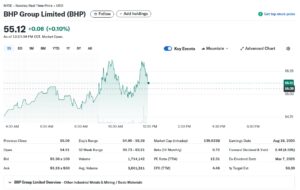
BHP (NYSE: BHP) shares are currently trading at $55.305 on the New York Stock Exchange. Analyst sentiment is cautious for the next 12 months, with the stock generally rated a “hold.” Most price targets are near current levels, suggesting limited short-term upside.
Long-term outlooks are still positive. Experts say, if commodity markets stay steady, BHP’s solid production, smart spending, and focus on innovation could boost financial growth and increase returns for shareholders.
Following the copper surge, BHP’s Chief Executive Officer, Mike Henry, remarked,
“BHP delivered record iron ore and copper production, which demonstrates the strength and resilience of our business and underpins our ability to deliver growth and returns to shareholders amid global volatility and uncertainty.”
BHP is All Set to Meet Growing Global Copper Demand
With this record-breaking output, the mining giant is stepping up to help meet the world’s fast-growing need for copper.
- BHP expects global copper demand to rise by about 70% by 2050, reaching over 50 million tonnes per year.
That’s an average growth rate of 2% each year. And demand will come from both traditional uses like homes and appliances, and new ones such as electric vehicles, renewable energy, and data centers.
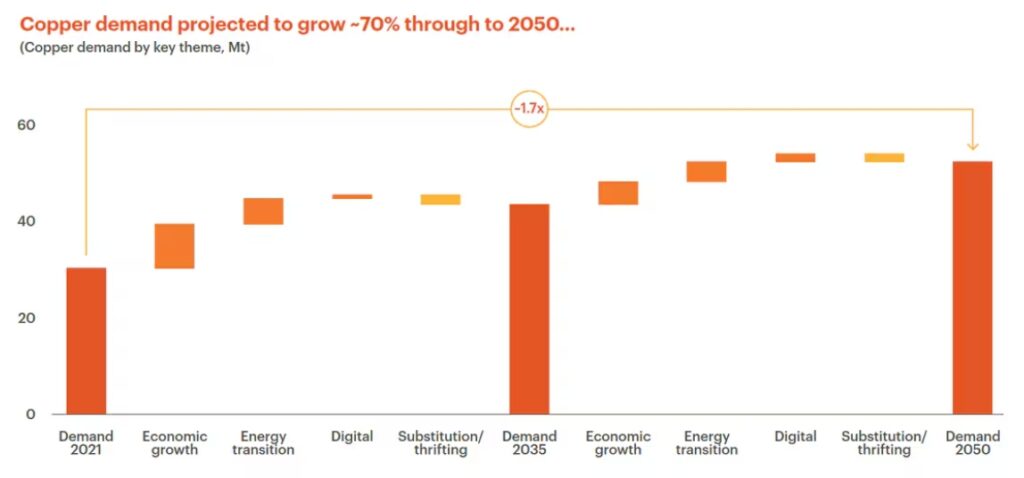
Even with cost pressures, trade changes, and tariffs, the company is investing smartly and looking for long-term growth. Additionally, recycled copper will also play a vital role in meeting rising demand over the next 30 years.
With strong operations and clean energy goals, BHP is well-prepared to support the world’s shift to a lower-carbon, more secure future.
- ALSO READ: BHP’s $14B Investment Plan for its Chile Copper Mines. Will it Impact Global Copper Supply?
The post BHP’s Copper Boom: Sustainable Mining to Meet Soaring Global Demand appeared first on Carbon Credits.

EU carbon credit claims changed on 27 September 2026, the day the Directive (EU) 2024/825 began to apply across the European Union. The change is narrow. It changes how a company can talk about the credits it buys. A product can no longer be called neutral on the strength of compensation alone; however, every specific, evidenced statement about what a company measured, reduced, and funded stays fully available.

The post Promoting Improved Cooking Practices in Nigeria appeared first on Terrapass.



-
Climate Change1 year ago
Guest post: Why China is still building new coal – and when it might stop
-

 Greenhouse Gases2 years ago
嘉宾来稿:满足中国增长的用电需求 光伏加储能“比新建煤电更实惠”
-
Greenhouse Gases1 year ago
Guest post: Why China is still building new coal – and when it might stop
-

 Climate Change2 years ago
嘉宾来稿:满足中国增长的用电需求 光伏加储能“比新建煤电更实惠”
-

 Renewable Energy12 months ago
Sending Progressive Philanthropist George Soros to Prison?
-
Climate Change2 years ago
Bill Discounting Climate Change in Florida’s Energy Policy Awaits DeSantis’ Approval
-
Greenhouse Gases1 year ago
嘉宾来稿:探究火山喷发如何影响气候预测
-

 Climate Change2 years ago
Analysis: China’s CO2 falls 1% in Q2 2024 in first quarterly drop since Covid-19