

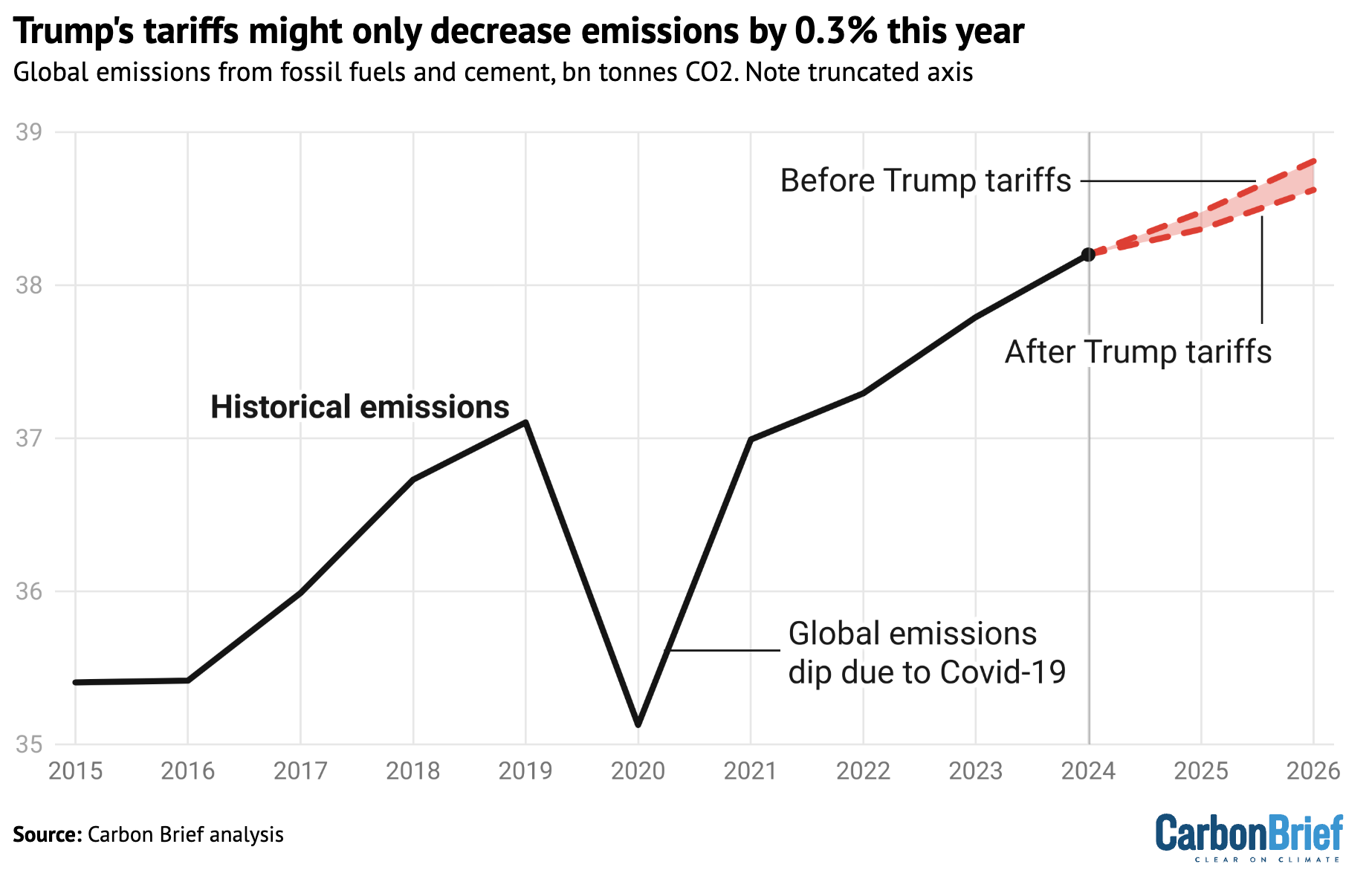
US president Donald Trump’s tariffs might only shave 0.3% off global carbon dioxide (CO2) emissions this year, according to Carbon Brief analysis.
While the Trump administration is setting back international climate action through policies such as the “one big beautiful bill”, some analysts have argued that his tariffs would inadvertently cut carbon by throwing sand into the engine of the global economy.
However, Carbon Brief’s analysis, based on changing projections of economic growth since the tariffs were announced, shows that this effect is likely to be very limited.
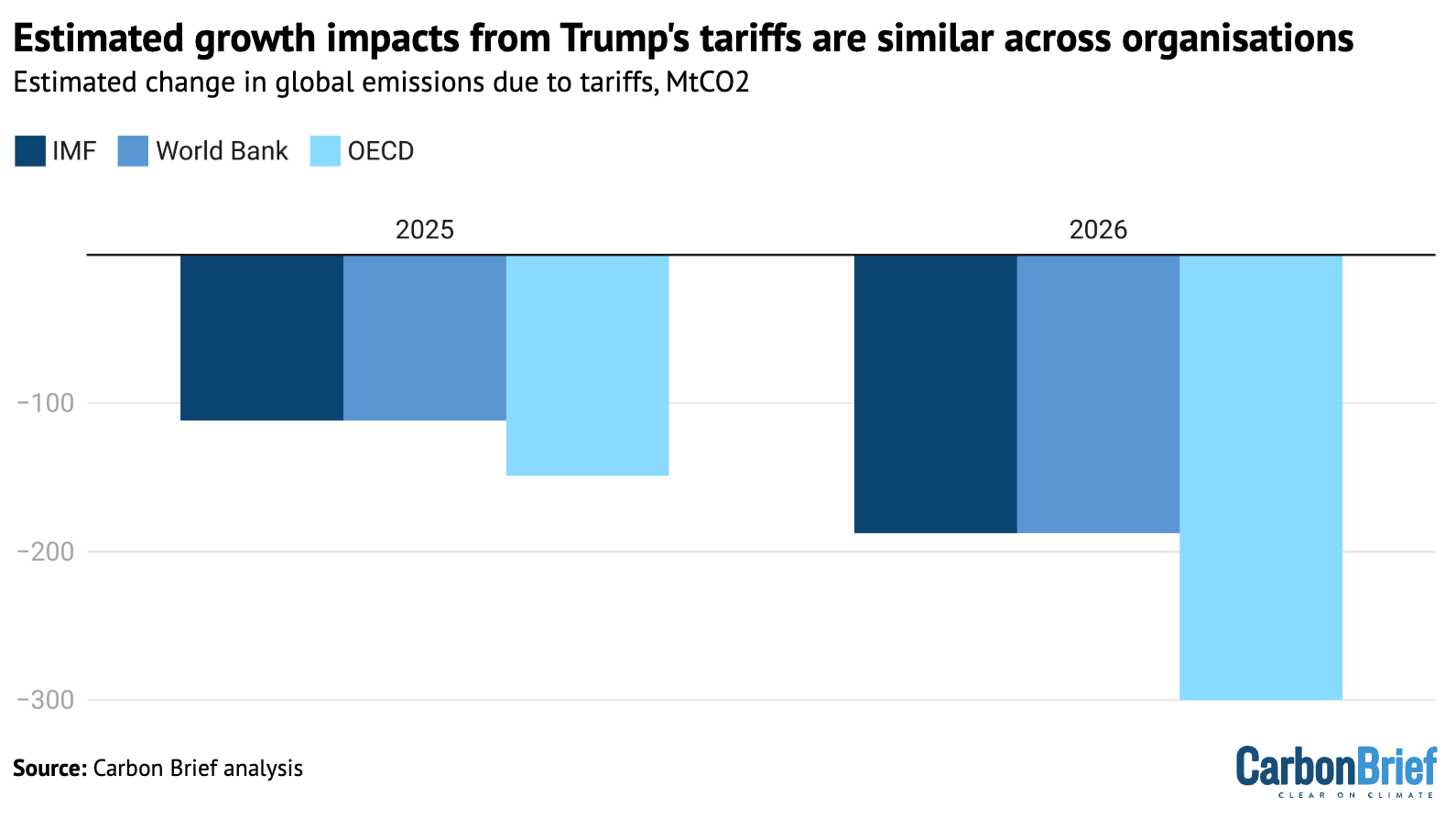
The slew of new tariffs – initially announced on 2 April, dubbed by the president as “liberation day” – might only knock 110-150m tonnes of CO2 (MtCO2) off global emissions in 2025 (0.3-0.4%), the analysis shows.
For 2026, the tariffs could have a slightly higher impact, but still only 190-300MtCO2 (0.5-0.8%).
Trump’s “liberation day” tariffs included a 10% universal levy on all imported goods, alongside additional “reciprocal tariffs” on a number of countries he claimed had “cheated” the US.
The announcement sent the world’s stock markets into “turmoil”. The move has hit a range of diverse industries, including steel and aluminium, oil and more.
Despite initially saying he had no plans to pause the tariffs, Trump announced on 10 April that he would pause them for 90 days.
This pause was set to come to an end on 9 July, but, just days before this, he announced a further extension to 1 August. On his social-media network, Truth Social, Trump said countries would receive “letters and/or deals” on tariffs in the interim.
More recently, he has signed tariff deals with the European Union and countries such as the UK, Japan, the Philippines and others.
These deals reduce the headline tariff rates relative to the “liberation day” situation, as well as typically including a range of carve-outs and exemptions.
However, they do not end uncertainty over tariff levels and still leave US import levies at their highest levels “since the 1930s”, reducing expectations for trade and growth.
Since returning to office at the beginning of 2025, Trump – a climate sceptic – has rolled back a large number of environmental policies and protections.
Most recently, his “one big beautiful bill” was passed on 4 July, bringing an end to a number of former president Joe Biden’s policies, such as the Inflation Reduction Act (IRA), which provided support for electric vehicles, clean-technology manufacturing and more.
In combination with other Trump administration policies, this means the US will breach its now-defunct emissions reduction for 2030 target by a cumulative total of 7bn tonnes of CO2, previous Carbon Brief analysis found.
Nevertheless, numerous people suggested that the economic damage from Trump’s tariffs could “unintentionally” lead to a drop in carbon emissions.
For example, an April 2025 article in the New York Times stated: “Trump’s economic approach may inadvertently reduce greenhouse gas emissions, as consumption slows in response to a global trade war.”
The piece noted that the “reprieve for the planet” was likely to be short-lived, with longer-term impacts potentially hitting clean-energy deployment as international supply chains are hampered.
Similarly, an April 2025 Associated Press article quoted Global Carbon Project head Prof Rob Jackson saying that tariffs “might help the climate in the first year or two”. However, it quoted him continuing that this would come at a high cost and might backfire:
“I would say it might help the climate in the first year or two if we have a downturn in economic activity or a recession, which no one wants. But it will hurt the climate long-term because tariffs impact clean tech more than most other industries because of trade with China.”
Carbon Brief’s analysis shows that the emissions impact, even in the short term, is expected to be minimal.
It assessed the expected emissions impact of reduced global GDP by looking at changes to GDP forecasts from the International Monetary Fund (IMF), Organisation for Economic Cooperation and Development (OECD) and the World Bank, before and after Trump’s tariffs announcements.
The OECD suggests the biggest impact from the tariffs, as shown in the chart below.
The medium- to long-term impact of Trump’s trade wars is expected to be negative for climate action. In a recent interview, UK climate envoy Rachel Kyte told Carbon Brief that it created uncertainty and was likely to slow down clean-energy investment. She said:
“Investment flows when everybody feels confident, right?…[I]f I don’t know if the tariff is 10%, 20%, 25%, 56%, whatever, well, let me put it off till the next quarter to make that investment decision.”
Kyte added: “It’s the hesitancy that it puts in the mind of government, but also in the mind of investors and the private sector…[T]he sort of tariff era we’re in, the risk is that it slows down the investment in the clean-energy transition at a time when it needs to speed up.”
Methodology
Carbon Brief estimated the impact of Trump’s tariffs on global GDP by comparing growth forecasts published during June and July 2025 by the IMF World Economic Outlook, OECD Economic Outlook and World Bank Global Economic Prospects against corresponding forecasts published in December 2024 or January 2025, before Trump’s tariff announcements.
While Trump’s tariffs are not the only factor to have changed in these forecasts over the time period in question, they do represent a singular and sudden effect, which would be expected to have a significant impact on the global economic outlook.
The analysis estimates global GDP over 2025/2026 by applying the growth forecasts to historical GDP from the World Bank.
The reductions in forecast global GDP growth are translated into estimated emissions impacts by assuming that the “carbon intensity” of the world’s economy continues to improve at a steady rate, with or without the tariffs. Carbon intensity is the emissions per unit of GDP and has been improving slowly and steadily over many years.
The analysis only considers CO2 emissions from fossil fuels and cement production. Historical CO2 emissions data is taken from the Global Carbon Budget.
The range of estimated CO2 impacts stems from the varying GDP forecasts of the three different organisations.
For comparison, the International Energy Agency (IEA) has revised down its forecasts for global oil demand growth in 2025 by some 350,000 barrels of oil per day since the start of the year. This is equivalent to cutting global emissions this year by 40MtCO2.
The IEA’s forecasts for global coal demand in 2025 are broadly unchanged since the start of the year, with demand expected to grow 0.2% this year.

The post Analysis: Trump’s tariffs could cut just 0.3% from global CO2 emissions in 2025 appeared first on Carbon Brief.
Analysis: Trump’s tariffs could cut just 0.3% from global CO2 emissions in 2025

A first set of biodiversity plans filed by countries to reverse nature loss are “insufficient” to meet this decade’s global targets, including a landmark goal to protect at least 30% of the world’s land and marine ecosystems by 2030, a landmark UN report warned on Thursday.
The State of Biodiversity Action, put together by a panel of technical experts for the UN Convention on Biological Diversity (CBD), was released in Yerevan, ahead of the COP17 nature talks starting on Monday in the Armenian capital.
Over the next two weeks, governments will for the first time take stock of progress towards the Global Biodiversity Framework (GBF) agreed in 2022 – a set of 23 targets also known as the “Paris Agreement for nature” – and will decide on policy guidelines for ramping up ambition before the 2030 deadline. The UN report will be the main basis for these negotiations.
At a press conference in Armenia, UN Secretary-General António Guterres highlighted that, while there has been some progress on the GBF, the “bad news” is that less than half of country plans are on track to meet its targets.
If current commitments are met by the end of the decade, only 26% of land ecosystems and 12% of marine ecosystems will be protected – falling “real short” of the 30% target agreed in Montreal in 2022, Guterres said. “The war on nature has not yet ended,” he added.
UN Environment chief Inger Andersen said the report “sets the tone for the focus, ambition and urgent action we need to deliver” in Armenia, including by reducing subsidies that harm nature and mobilising new finance for biodiversity. “All leaders and all negotiators must respond to these findings,” she emphasised.
Andersen added that climate change amplifies threats to biodiversity, which makes protection all the more important as global warming is now almost certain to rise above a key threshold. “Exceedence of 1.5C increases the likelihood of forest diebacks, phenological shifts, warming oceans that become more inhospitable to species, irreversible tipping points and so much more,” she said.
-
Global deforestation slowed in 2025 but Brazil’s election could undo “fragile” gains
Countries remain 70% off track to meet a goal to end deforestation by 2030, as progress in Latin America offset by failures in Africa -
Carbon capture industry faces tough future, as UK raids green spending
Despite a spate of projects getting underway, the mood at an industry conference in London this week was low with government subsidies set to shrink -
World Bank and IMF should lead the financial system in responding to the climate crisis
Multilateral development banks have a vital role to play in delivering on donors’ climate finance promises and protecting the most vulnerable



Progress on land but ocean lags behind
The report shows that if countries meet all the biodiversity targets in their plans, this would protect about 27% of the world’s land and sea by 2030, a fivefold increase in the span of ten years.
Progress has been uneven, with most conservation efforts focused on terrestrial ecosystems. The report suggests that currently about 19% of land ecosystems are protected, up two percentage points from 2020, which UN authorities welcomed but said is not a fast enough pace.
However, the real gap is at sea, where only about 10% of the global ocean has some sort of protection. Coastal areas under national jurisdiction have done better, as currently 23% of this marine territory is protected, but the report shows most of the deep ocean is not.
Brian O’Donnell, director of Campaign for Nature, an advocacy group, said the new High Seas Treaty – which entered into force this year and will allow for the creation of Marine Protected Areas in the deep ocean – represents an opportunity, as only about 1.5% is under protection so far.
A group of environmental NGOs including WWF and Bloomberg Philanthropies has issued a call for governments to scale up ocean conservation and to designate $16 billion annually for marine protection measures, up from $1.8bn now.
SE Asia speeds up plan for connected clean power grid after oil shock
Some countries did not set a conservation target at all for both land and sea, the report says, blaming technical challenges like how to account for overlapping protected areas, difficulty recognising protections for private land and land-accounting methodologies changing over time.
A separate report by Campaign for Nature suggests that the 30×30 goal could still be met with “increased ambition and commitment”, and says that around 50 countries have already protected about 30% of their land.
A group of environmental NGOs has warned that, beyond the 30% headline figure, protected areas need to be “high integrity” and recognise the stewardship of local communities and Indigenous peoples.

Developing countries call for finance
Rich countries will arrive at COP17 with shrinking aid budgets and geopolitical preoccupations – yet they will likely hear the same plea they’ve heard for the past few years: stepping up commitments will require finance.
A submission by African countries in August said the “implementation gap” has at its core a shortfall in the provision of funds, and that bridging it will require predictable and accessible finance.
Pacific island nations launched a similar call, arguing there is “a treaty obligation” that developing countries, including themselves, will effectively implement commitments depending on the finance and technology made available by developed nations.
To close this gap, the EU made a proposal at preliminary talks in Nairobi in August to expand the base of donors so that richer developing countries could voluntarily assume donor responsibilities. Saudi Arabia and Qatar rejected the idea, while China said this should not weaken the responsibility of developed nations.
Pre-COP draws attention to Pacific’s climate plight and 1.5C goal
So far, wealthy governments have missed a target to provide $20bn per year in international public finance for nature protection by 2025, reaching only about $16bn per year from 2023 to 2025, according to an OECD report. By 2030, the GBF aims for developed countries to directly transfer $30bn per year, and mobilise $200bn from all sources.
The UN report released on Thursday shows even slower progress in redirecting harmful subsidies such as those which encourage the overuse of fertilisers and the production and consumption of new fossil fuels, and below-market fees that encourage overfishing. UN Environment estimates that for every dollar spent protecting nature, $30 goes on destroying it.
UN biodiversity chief Astrid Schomaker told journalists in Yerevan that “if you hear there is no finance, please do not believe it” because economies are continuing to grow. “It is being spent on activities that harm the economy rather than those that work with nature and sustain life on this planet,” she said.
Guterres said developed countries tend to say they are grappling with budget constraints due to increased defence expenditure, which “in my view does not justify a reduction” in international aid. He added that existing resources can be multiplied if they are used to mobilise private capital.
Campaigners, companies and the Armenian government want to shift the needle on this situation at COP17 by highlighting how positive subsidies help restore biodiversity. They will launch a flagship call to action that will be taken forward by countries and groups working to reform damaging incentives.

Global review: the main act
The Global Review of Collective Progress – a bit like the Global Stocktake for climate action – is set to be the most important outcome from COP17, and it will be the first time this process unfolds at the biodiversity talks. The actions decided in Yerevan will respond to the gaps outlined in the State of Biodiversity Action report and determine whether countries can turn the tide of biodiversity loss this decade.
Overall, the report shows that while countries have taken action to address all 23 targets in the GBF, none “present a fully positive picture”. A target to strengthen the resilience of ecosystems to climate impacts is the only one with high relative progress, the report says, as government have already made effective interventions that show “a positive trend”.
The report assessed each country’s national targets, which define their contribution to the global goals, as well as their separate National Biodiversity Strategy and Action Plans (NBSAPs) outlining how they will achieve the national targets.
But it does not paint a complete picture, since at the cut-off date, only 89 NBSAPs and national targets from 162 countries had been submitted, leaving out a couple of dozen plans that arrived late. Pacific island nations said this might undercount commitments.
Many of those lacking an NBSAP are biodiversity-rich developing countries, which say they need financial and technical support to fully develop these plans. Some large nations pending an NBSAP include South Africa, Bolivia and Russia.
Since the GBF was agreed in 2022, governments have mostly focused on developing their biodiversity targets and plans, while the lion’s share of implementation is expected to happen towards the end of the decade, according to UN biodiversity chief Schomaker.
But O’Donnell said “accelerated political ambition” is still needed to improve commitments and translate them into effective protection on the ground or at sea.
The post Countries urged to ramp up “insufficient” nature policies at COP17 appeared first on Climate Home News.
Countries urged to ramp up “insufficient” nature policies at COP17
Countries will meet in Armenia this month to carry out the first global review of progress towards meeting key nature targets by 2030.
These targets – and the wider ambition to halt and reverse biodiversity loss around the world – were agreed in the landmark Kunming-Montreal Global Biodiversity Framework in 2022.
But the ambitions will not be achieved in time for the 2030 deadline unless action “accelerates rapidly”, a key UN report found.
It noted that nations are falling short on 22 of 23 nature targets, which focus on restoring ecosystems, increasing nature finance and reducing harmful subsidies.
This report and other findings will inform the global progress review taking place at the COP17 biodiversity summit in Armenia over 19-30 October.
The sections below summarise the report’s findings on where progress has – and has not – been made on each of the 23 targets.
They also rank the extent to which countries have addressed elements of each target on a national basis. Click on each target for more information. Key terms are defined throughout each section and in a glossary below.