

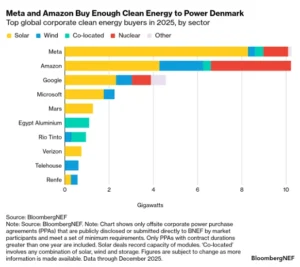
Amazon, once again, is one of the top corporate buyers of clean and renewable energy in the world. For the fifth year in a row, the company leads global corporate renewable energy procurement. BloombergNEF again recognized Amazon as a top corporate purchaser of carbon-free power, with a portfolio that adds significant new clean energy to grids.
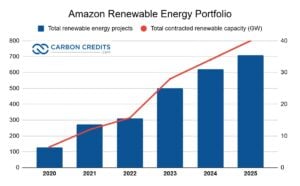
Amazon’s clean energy projects now span more than 700 global initiatives. These include utility-scale solar and wind farms, battery storage, onsite solar, and other carbon-free energy sources across 28 countries.
So far, Amazon has invested in over 40 gigawatts (GW) of carbon-free energy capacity. This amount of power could supply the annual electricity needs of more than 12.1 million U.S. homes if it were used for residential demand.
These investments make Amazon not just a buyer of clean power for itself, but a major driver of new renewable energy build-out around the world.
From First PPA to 40GW Global Portfolio
Amazon’s renewable energy footprint has expanded rapidly over the past decade. The big tech company was the biggest corporate buyer of renewable energy in 2025, based on BloombergNEF data. It signed multiple power purchase agreements (PPAs) and grew its clean energy portfolio.
- Amazon has backed over 700 wind and solar projects around the world. This clean energy can power more than 12.1 million U.S. homes each year.
This expansion includes utility-scale wind and solar farms. It also covers renewable energy bought through PPAs. Additionally, it features on-site rooftop and ground-mount solar projects at Amazon facilities.
Over time, these efforts have helped the tech giant use more clean energy for its electricity, which is a key part of its climate strategy.
Solar, Wind, Storage — and Next-Gen Power
Amazon’s clean energy portfolio includes a broad mix of technologies:
- Solar power: 300+ utility-scale solar and wind farms and 300+ onsite solar projects.
- Wind energy: Large wind farms in multiple countries, with 6 offshore wind farms in Europe.
- Energy storage: Battery storage projects that help balance intermittent renewable output. It has 11 utility-scale battery storage projects.
- Emerging technologies: Amazon has invested in advanced options like nuclear small modular reactors (SMRs), with 4 nuclear power agreements. These help provide firm, low-carbon baseload power.
These investments help replace fossil fuel generation on local grids. They also support grid reliability and reduce electricity costs over the long term.
In Mississippi, for example, Amazon worked with a utility to enable 650 megawatts (MW) of new renewable energy on the grid. Once operational, this capacity will serve the equivalent of over 150,000 homes and improve grid reliability.
Moreover, the company’s 253 MW Amazon Wind Farm Texas contributes around 1,000 GWh of clean power annually. Meanwhile, its European solar and wind assets alone total about 4,600 MW of capacity.
All these efforts form part of the e-commerce’ push for its 2040 net zero targets.
Powering the Path to Net Zero 2040
Amazon has set multiple climate and sustainability targets. The company aims to reach net-zero carbon emissions by 2040 — a goal it committed to early as part of The Climate Pledge.

To work toward that long-term target, Amazon set a goal to match its electricity use with renewable energy. It reached 100% renewable electricity for its operations ahead of schedule, well before its original 2030 goal.
This means Amazon is purchasing an amount of renewable electricity equal to its total annual consumption. Clean power comes from renewable projects connected to the grid. These projects are supported by long-term PPAs and other contracts.
The renewable energy purchases lower Amazon’s Scope 2 emissions, which come from the electricity it buys. They also help decarbonize the grids where the company operates.
Corporate Buyers Now Rival National Grids
Amazon’s clean energy efforts are part of a larger shift across the corporate world.
Since 2008, companies have bought almost 200 GW of renewable energy worldwide through corporate PPAs and other agreements. This capacity exceeds the total electricity generation of some countries, like France or the United Kingdom.
In 2023, companies revealed a record 46 GW of clean energy deals. These renewable power commitments support new solar and wind farms.
Large tech companies, including Amazon, Google, Microsoft, and Meta, are some of the most active buyers. Those tech firms accounted for a significant share of corporate clean energy procurement over the last decade.
This trend shows that corporate demand can speed up the clean energy shift by providing renewable power developers with long-term revenue certainty.
Jobs, Grid Stability, and Market Transformation
Corporate clean energy procurement, though slowed down in 2025, has broader economic and energy-system impacts. Investments in renewable projects contribute to job creation, local economic growth, and grid resilience.
Amazon’s solar and wind farms create many construction and operation jobs. They also boost the economy in rural areas. For example, the Great Prairie Wind Farm in Texas has 350 wind turbines. These turbines provide over 1,000 MW of capacity and are one of the largest assets in Amazon’s portfolio.
Also, Amazon’s clean energy deals boost renewable capacity. These projects are in Brazil, India, China, Australia, and Europe, which support markets with different grid mixes. These projects can cut down on fossil fuel-based electricity. They also help local grids stay cleaner and stronger.
Permitting, Policy, and the Next Growth Wave
Despite strong progress, corporate clean energy procurement still faces challenges.
Renewable projects often depend on grid capacity, permitting, and supportive policy frameworks. In some regions, complex regulations or limited grid access can slow project development and clean energy adoption.
Nevertheless, the trend of corporate power purchasing is expected to grow. Data from the Clean Energy Buyers Association (CEBA) shows that U.S. businesses have signed contracts for 100 GW of clean energy. This milestone highlights how important companies are in today’s energy landscape.
Global renewable capacity is also expanding rapidly. According to IRENA, global renewable power capacity reached 4,448 GW at end-2024 after adding a record 585 GW. That’s 15.1% growth with solar leading 75%+ of additions. The 2025 additions are expected to maintain record growth toward the 2030 tripling goal.
Renewables are now growing faster than fossil fuels in new capacity. Looking ahead, strong demand from companies for clean energy will boost growth. Better policies and tech advancements will also help renewable power buying and grid decarbonization.
Private Capital Driving Public Energy Changeaction
Amazon’s clean energy leadership shows how corporate buyers can influence the global energy transition. By securing large portfolios of renewable power, the tech giant and other major corporations are investing in the future of clean electricity. These investments not only help reduce their own emissions but also fund new clean energy capacity that benefits broader society.
As corporate renewable procurement grows, so does the clean energy market. This can lower costs, stimulate innovation, and increase the pace of emission reductions across power systems worldwide.
With more companies setting clean energy goals and signing long-term agreements, the private sector continues to be a powerful force in the shift toward a low-carbon economy.
- READ MORE: Amazon Expands Its Carbon Credit Strategy with Lower-Carbon Fuel and Superpollutant Solutions
The post Amazon Tops Global Clean Energy Rankings With 40GW Renewable Projects Says BNEF appeared first on Carbon Credits.

The post Promoting Improved Cooking Practices in Nigeria appeared first on Terrapass.
For most companies, the largest figure in the carbon inventory is not the office, the vehicle fleet, or the electricity bill. It sits upstream, in the goods and materials a business buys to make and sell its products. These purchased inputs form the bulk of a company’s Scope 3 emissions, which routinely exceeds everything the business controls directly, and can add up to 90% of their global footprint.




-
Climate Change1 year ago
Guest post: Why China is still building new coal – and when it might stop
-

 Greenhouse Gases2 years ago
嘉宾来稿:满足中国增长的用电需求 光伏加储能“比新建煤电更实惠”
-
Greenhouse Gases1 year ago
Guest post: Why China is still building new coal – and when it might stop
-

 Climate Change2 years ago
嘉宾来稿:满足中国增长的用电需求 光伏加储能“比新建煤电更实惠”
-

 Renewable Energy12 months ago
Sending Progressive Philanthropist George Soros to Prison?
-
Climate Change2 years ago
Bill Discounting Climate Change in Florida’s Energy Policy Awaits DeSantis’ Approval
-
Greenhouse Gases1 year ago
嘉宾来稿:探究火山喷发如何影响气候预测
-

 Climate Change2 years ago
Analysis: China’s CO2 falls 1% in Q2 2024 in first quarterly drop since Covid-19