
Aluminum is moving from a supporting role to center stage in the global green transition. The metal is light and strong, and also endlessly recyclable. This makes it essential for electric vehicles (EVs), solar panels, power lines, and low-carbon buildings.
Global demand for aluminum is rising fast as countries expand renewable power and electric transport. The International Aluminium Institute (IAI) expects aluminum demand to rise by 40% by 2030. This growth is fueled by clean-tech uses.
But as the market expands, so does scrutiny on emissions. Aluminum smelting is one of the most energy-intensive industrial processes in the world. Reducing its carbon footprint is now a top goal for both industry and governments.
Aluminum Prices Hit 3-Year High Amid Tight Supply
On October 10, 2025, aluminum prices surged to their highest level in three years, topping around $2,800 per tonne. The rally shows rising supply worries and increasing demand from clean energy sectors. This includes electric vehicles (EVs), renewable power, and construction.
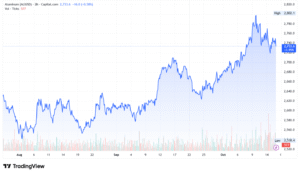
Analysts attribute the spike to several factors. China’s power shortages have limited smelting output. Also, new environmental rules are tightening production limits on coal-powered plants. In addition, unrest in Guinea, which supplies over 45% of China’s bauxite imports, has raised fears of disruptions in the global supply chain.
Meanwhile, inventories tracked by the London Metal Exchange fell to their lowest point since 2021, signaling a tightening market.
“Supply can’t keep up with the clean-energy boom,” said analysts from BloombergNEF. They pointed out that aluminum’s use in solar, EVs, and transmission lines is growing faster than producers can adapt.
The recent price rise shows that investors prefer low-carbon aluminum. This type of aluminum now has a significant premium. Demand for verified low-emission materials is outpacing supply. This is the case for automakers, construction firms, and renewable developers in Europe and North America.
Experts think that prices over $2,500 per tonne could boost investments in recycling and renewable-powered smelters. This is especially true in places like Canada, Norway, and the Middle East. However, the rally also underscores a broader challenge: balancing the green transition with resource security.
Why Aluminum Is the Unsung Hero of Clean Energy
Aluminum saves weight — and that means energy. Lighter cars and trucks travel farther on the same battery charge. According to the Aluminum Association, modern EVs use 30–40% more aluminum than traditional gas vehicles.
It’s not just cars. Each 1-MW solar farm uses roughly 40 tons of aluminum for panel frames, mounts, and wiring. Power grids also rely on aluminum for transformers and long-distance transmission lines.
The metal’s high recyclability adds major sustainability value. Recycled aluminum uses only 5% of the energy required for primary production. Yet recycling accounts for only about 36% of global aluminum output today, leaving huge room for expansion.
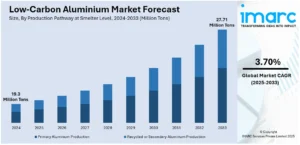
The low-carbon aluminum market was 19.3 million tons in 2024, per IMARC estimates. It can grow to 27.7 million tons by 2033, with an annual growth rate of 3.7%. That growth mirrors global renewable investment trends.
China’s Dominance and the Global Supply Imbalance
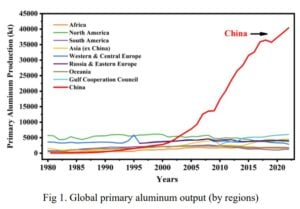
China dominates the aluminum industry. It produces over 40 million tons of primary aluminum annually — nearly 60% of global supply. It also tops in refining and processing, as well as in demand for raw materials like bauxite.
Exports of bauxite from Guinea to China jumped 35% in 2024, making Guinea the world’s top bauxite exporter. This raw material feeds China’s vast smelting network.
Worldwide, primary aluminum production has topped 70 million tons in recent years. But the carbon footprint varies greatly by location.
Smelters powered by coal — common in parts of China — emit far more CO₂ than those powered by renewables. Producers in Norway, Iceland, and Canada use hydropower. They create aluminum with emissions below 4 kg CO₂ per kg aluminum. This is much lower than the global average of 16.7 kg CO₂ per kg (IAI, Hydro).
This huge gap shows why energy source matters as much as output in the global supply chain.
The Emissions Problem — and Low-Carbon Solutions
Traditional aluminum production is energy-hungry. The International Energy Agency (IEA) estimates that aluminum accounts for around 2% of global CO₂ emissions from materials production.
Producers are now turning to renewable power and recycled inputs to cut this footprint. Norsk Hydro, for example, produces low-carbon aluminum emitting only 3 kg CO₂/kg, among the world’s cleanest.
If all smelters switched to renewable power, global aluminum emissions could fall by 400 million tonnes of CO₂ each year. That’s like the yearly emissions from 100 coal plants.
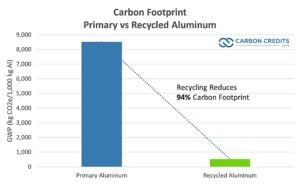
Recycling is another big win. Recycling rates in Europe could double by 2030, potentially saving 39 million tonnes of CO₂ per year by 2050. Globally, if all used aluminum were recycled, the industry’s total energy demand could fall by 60%, says MARC Group.
Pricing, Premiums, and the Push for Low-Carbon Metal
Aluminum remains a major commodity. The global aluminum market was valued at roughly $190 billion in 2024, with steady growth projected through 2030.
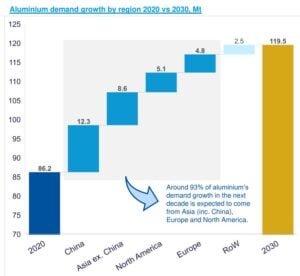
The IAI forecasted the following for aluminum demand growth by 2030:
-
By Region:
Around 93% of global aluminum demand growth between 2020 and 2030 will come from Asia (especially China), Europe, and North America, reflecting industrial expansion, renewable power deployment, and strong EV manufacturing in these regions.
-
By Sector:
Aluminum demand is set to grow most in transportation (+11.8 Mt), followed by electrical (+5.2 Mt), construction (+4.6 Mt), and packaging (+3.3 Mt) — with transport leading due to electric mobility and the electrical sector driven largely by solar and renewable infrastructure. -
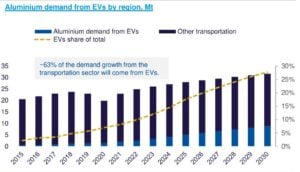
By EV Demand:
Electric vehicles will account for roughly 63% of new aluminum demand in transport, adding about 7.4 million tonnes by 2030; EVs use 60–80 kg more aluminum per vehicle than traditional models, with China, Europe, and North America driving about 93% of this growth.
Low-carbon aluminum commands a premium. Market data shows that buyers pay $20 to $150 per tonne more for certified low-carbon products, depending on the region and energy source.
Smelters that use renewable power gain a cost edge as carbon pricing expands. For instance, hydropower-based smelters in Iceland and Quebec report operating costs up to 30% lower than coal-based plants in China.
Investment in renewable-powered smelting hubs is also accelerating. In 2025, new projects in Europe, Canada, and the Middle East are expected to increase global capacity for low-carbon aluminum by 3–4 million tons.
Industry Moves, Policy Levers, and Challenges Ahead
Automakers, electronics makers, and construction firms are driving the shift. Mercedes-Benz, Apple, and Volvo all signed long-term contracts for low-carbon aluminum to cut supply chain emissions.
The European Union’s Carbon Border Adjustment Mechanism (CBAM), set to take effect in 2026, will tax imports based on embedded CO₂. This policy will pressure high-emission producers to decarbonize faster.
Governments are also funding clean smelting projects. In 2025, the U.S. Department of Energy awarded over $500 million program. This program aims to boost aluminum decarbonization and improve recycling infrastructure.
Countries rich in bauxite, like Guinea and Indonesia, are enjoying higher global demand. However, they also face pressure to improve environmental standards in mining and refining.
Scaling low-carbon aluminum faces three main challenges:
- Energy transition: Replacing fossil electricity with renewables near smelters requires billions in new investments.
- Recycling infrastructure: Global collection systems remain fragmented; less than 40% of post-consumer scrap is recovered.
- Verification: Without strict standards, false “green aluminum” claims risk damaging trust.
Aluminum could become one of the biggest enablers of decarbonization. Every tonne of low-carbon aluminum can reduce lifecycle emissions in cars, solar farms, and power lines by several tonnes of CO₂.
To meet climate goals, producers, investors, and governments must collaborate. Expanding renewable energy for smelting is key. Scaling up recycling is also important, as well as having traceable and verified supply chains to succeed.
With the right policies and innovation, aluminum can become a cleaner material. It can support the energy transition by helping create lighter, stronger, and more sustainable systems.
The post Aluminum Prices Hit 3-Year High: Is It the Next Key Metal in the Clean Energy Shift? appeared first on Carbon Credits.
Carbon Footprint
EU Eyes International Carbon Credits to Meet 2040 Climate Target and Expand Clean Cooking
The European Union (EU) is considering a new policy that could allow the use of international carbon credits to help meet its ambitious 2040 climate target. If implemented carefully, the plan could unlock significant climate finance for projects in developing countries, particularly initiatives that expand access to clean cooking technologies.
At a recent clean cooking summit hosted by the International Energy Agency (IEA), France’s climate ambassador Benoît Faraco suggested that the EU could become a major investor in carbon credit projects. These investments could help accelerate efforts to replace polluting wood and biomass stoves with cleaner alternatives across Africa and other regions.
However, the proposal has also revived a long-standing debate in climate policy. Supporters argue that carbon credits can finance climate solutions globally, while critics warn that poorly designed projects can exaggerate emissions reductions and undermine climate integrity.
As global demand for carbon credits grows, the EU’s upcoming rules could shape the future of the voluntary carbon market.
EU’s 2040 Climate Target and the Role of Carbon Credits
The European Union plans to cut greenhouse gas emissions by 90% from 1990 levels by 2040, making it one of the most ambitious climate targets globally. To support this goal, policymakers are exploring allowing a limited share of emissions reductions to come from high-quality international carbon credits.
Under the emerging framework, these credits could account for up to about 5% of the emissions reductions needed to meet the 2040 goal. The mechanism would likely begin in 2036 and would include strict safeguards designed to ensure environmental integrity.
EU officials believe this approach could ease pressure on domestic industries while still maintaining the bloc’s overall climate ambition. At the same time, it could channel new climate finance into developing countries where emissions reductions can often be achieved at lower costs.
However, the European Commission has not yet finalized the rules governing which projects would qualify or how these credits would be sourced and verified.

Clean Cooking Projects Could Benefit
One area that could receive significant investment is clean cooking technology. During the IEA summit, Benoît Faraco suggested that EU participation in carbon markets could help scale up efforts to replace traditional cooking methods with cleaner alternatives such as liquefied petroleum gas (LPG).
Across many developing countries, households still rely heavily on wood, charcoal, or biomass for cooking. These fuels create severe indoor air pollution and contribute to deforestation and greenhouse gas emissions.
Globally, the challenge remains enormous:
- More than two billion people still lack access to clean cooking
- Indoor air pollution linked to traditional cooking contributes to millions of deaths every year
Most of those without access live in rural areas where energy infrastructure remains limited.
Expanding access to modern cooking technologies requires large investments in equipment, fuel distribution systems, and consumer financing. Carbon credit funding could help close these financial gaps.
SEE MORE: EU Mobilizes €15.5 Billion to Boost Africa’s Clean Energy Boom
Rwanda Cookstove Initiative Shows the Model
Private companies are already experimenting with this approach. TotalEnergies, for example, has invested in LPG infrastructure aimed at expanding clean cooking access across Africa and India.
One notable initiative involves a cookstove project in Rwanda developed with the organization DelAgua. The program aims to distribute 200,000 high-performance cookstoves to rural households.
Within a year, the project is expected to benefit more than 800,000 people living in rural communities. Compared with traditional open fires, the improved cookstoves significantly reduce pollution and fuel consumption.
The new stoves cut harmful smoke emissions by about 81% and reduce wood use by roughly 71%. Over ten years, the initiative could prevent more than 2.5 million tonnes of carbon dioxide equivalent emissions.
These avoided emissions generate carbon credits that companies can purchase as part of their climate strategies. The program also supports Rwanda’s national goal of providing universal access to clean cooking by 2030.
Global Carbon Markets Are Expanding
Recent developments in international climate policy suggest that clean cooking projects may play a growing role in carbon markets.
In February 2026, a United Nations body approved the first carbon credits to be issued under the global carbon market established by the Paris Agreement. The approved activity focuses on distributing efficient cookstoves in Myanmar.
The project aims to reduce household air pollution and limit pressure on forests by lowering fuelwood consumption. Some of the credits will be used within South Korea’s emissions trading system, while the remaining credits will support Myanmar’s own climate commitments.
UN climate officials highlighted the broader benefits of clean cooking initiatives. These projects not only cut emissions but also improve health, protect forests, and reduce the burden on women and girls who often spend hours collecting firewood.
Meanwhile, data from the voluntary carbon market shows growing activity. A report from SCB Group found that carbon credit issuances increased by 28% quarter-on-quarter in the second quarter of 2025.
During that period, about 68 million credits were issued globally. Cookstove projects accounted for the largest share of these credits, representing roughly 29% of total issuances. Wind projects followed with about 20%, while forest conservation initiatives made up around 13%.
Most cookstove credits were certified under the Verra and Gold Standard programs.

Concerns About Credit Integrity
Despite their potential benefits, cookstove carbon credits have long been controversial. Some climate experts argue that many projects exaggerate their emissions reductions.
Monitoring real-world stove usage can be difficult. Households may receive improved stoves but continue using traditional cooking methods alongside them. In such cases, the actual emissions reductions may be smaller than estimated.
Environmental organizations have also raised concerns about weak monitoring systems and inconsistent verification standards across carbon markets.
An expert from the Brussels-based NGO Carbon Market Watch warned that relying on credits that have repeatedly failed to meet expectations could pose significant risks for climate policy.
These concerns reflect lessons from earlier offset systems, including the Clean Development Mechanism under the Kyoto Protocol. Several projects approved under that framework later faced criticism for overstating emissions reductions.
Because of this history, regulators are now under pressure to ensure that any new carbon credit systems deliver real and measurable climate benefits.
Strong Standards Will Be Critical
EU policymakers say the success of their carbon credit strategy will depend on strict oversight and transparency.
Future rules are expected to focus on three key principles:
- strong monitoring and independent verification
- clear safeguards to prevent double-counting of emissions reductions
- proof that projects deliver additional climate benefits beyond the host countries’ own targets
If implemented effectively, these standards could strengthen confidence in international carbon markets.
At the same time, critics argue that carbon credits should only play a limited role in meeting climate targets. They warn that over-reliance on external offsets could delay necessary emissions reductions within Europe itself.
A Major Global Challenge Remains
The clean cooking challenge illustrates why new financing mechanisms are urgently needed. IEA estimates that around 300 million people must gain access to clean cooking solutions every year to achieve universal access by 2030.
Sub-Saharan Africa accounts for roughly half of the population still relying on traditional cooking fuels. Many rural communities lack access to modern energy infrastructure and affordable alternatives.
Replicating the progress achieved in countries such as China, India, and Indonesia will require large investments and coordinated policy efforts. Carbon finance could become an important tool to accelerate this transition.

Overall, the European Union’s potential use of international carbon credits could reshape the global carbon market and unlock new funding for climate solutions in developing countries.
Clean cooking projects represent one of the most visible opportunities. They deliver clear health and environmental benefits while reducing greenhouse gas emissions.
However, the debate over carbon credits highlights a deeper challenge. Policymakers must ensure that these credits represent real, measurable emissions reductions rather than accounting shortcuts.
If the EU succeeds in designing a robust framework with strict quality standards, international carbon markets could channel billions of dollars into projects that improve lives and reduce emissions worldwide.
- READ MORE: The Carbon Credit Market in 2025 is A Turning Point: What Comes Next for 2026 and Beyond?
The post EU Eyes International Carbon Credits to Meet 2040 Climate Target and Expand Clean Cooking appeared first on Carbon Credits.
Carbon Footprint
Svante Buys Carbon Alpha to Scale Canada’s Carbon Removal Hub
The carbon removal industry is expanding fast, with new projects moving from the pilot stage to the commercial scale. Companies are racing to build infrastructure that can permanently remove carbon dioxide from the atmosphere. One of them is a Canadian carbon management company, Svante Technologies, which announced that it acquired Carbon Alpha Corporation. This move brings together carbon capture technology with carbon dioxide removal (CDR) project development.
The acquisition strengthens Svante’s role in the carbon capture and storage (CCS) value chain. It also adds Carbon Alpha’s development portfolio to Svante’s operations.
Claude Letourneau, President & CEO of Svante, remarked:
“This project is a game-changer for Svante and a pivotal moment for scaling verifiable, durable engineered carbon removal solutions working in tandem with nature. By integrating Carbon Alpha’s team, we’re accelerating the delivery of high‑integrity CDR credits at commercial scale in partnership with the MLTC leadership, who is closely coordinating with us on the North Star Project.”
The North Star Project: A New Source of Carbon Removal Credits
The key asset in the deal is the North Star Bioenergy Carbon Capture and Storage (BECCS) project in Saskatchewan. The facility will capture carbon dioxide from the Meadow Lake Tribal Council Bioenergy Centre. This is how it works:
- This plant produces renewable electricity and heat using forestry waste biomass from nearby sawmills.
- Phase one of the project is designed to capture up to 140,000 tonnes of CO₂ per year from biomass combustion emissions.
- The captured carbon dioxide will move through a dedicated pipeline to a deep saline aquifer. There, it will be stored permanently underground.
This process removes carbon from the natural cycle because biomass absorbs CO₂ while growing. Capturing and storing that carbon after combustion results in net negative emissions.
The project will generate durable carbon dioxide removal credits. Each credit represents one ton of CO₂ removed. These credits can be sold to companies seeking verified carbon removal to meet climate targets.
Carbon Alpha had already developed the project structure and storage system before the acquisition. Svante now takes over development and integration. The next step will be a front-end engineering design (FEED) study and test-well drilling program. A final investment decision is expected in early 2027.
Industry analysts say deals like this show how the carbon removal sector is shifting from research to deployment. Companies are now building full systems that include capture, transport, and long-term storage.
Building an End-to-End Carbon Management Platform
The acquisition expands Svante’s strategy to build an integrated carbon management company. It develops modular carbon capture systems that use nanoengineered solid sorbent filters to capture CO₂ from industrial emissions.
The technology is designed for industries that are difficult to decarbonize. These include cement, steel, hydrogen production, and power generation.
Before the acquisition, Svante already had expertise in capture technology. Carbon Alpha adds expertise in project development, geological storage, and carbon credit generation. This combination creates a full value chain for CCS in Canada:
- Capture CO₂ from industrial sources or biomass energy
- Transport the CO₂ through pipelines
- Store the carbon permanently underground
- Generate verified carbon removal credits
Industry experts say this type of integration is important. Carbon removal projects often fail because separate companies handle capture, storage, and financing.
The strategic acquisition includes Carbon Alpha’s development expertise, North Star Carbon Solutions LP’s ownership structure, and eligibility for Canada’s 50% CCUS investment tax credit, positioning Svante to scale multiple BECCS projects rapidly.
By combining these elements, Svante aims to scale projects faster.
First Nations Partnership Anchors the Project in Saskatchewan
The North Star project is being developed in partnership with the Meadow Lake Tribal Council (MLTC). The organization represents nine First Nations communities in northwest Saskatchewan.
Under the project structure, MLTC will be a co-owner of the BECCS facility alongside Svante. The partnership focuses on three main goals: local economic development, job creation, and long-term environmental leadership.
The bioenergy facility already produces renewable electricity and heat using forestry residues. The carbon capture system adds another layer of value. It turns the facility into a carbon removal hub that can produce verified CDR credits.
The project also includes the development of a regional CO₂ pipeline and storage hub. This infrastructure could support other emitters in the region.
Biogenic carbon sources from forestry, agriculture, or bioenergy plants could connect to the same storage network. This approach could turn the region into a carbon removal cluster.
Global Demand for Carbon Removal Is Rising Fast
The acquisition comes at a time when demand for carbon removal is increasing worldwide. Most countries now include carbon removal in long-term climate plans. Industry groups expect global carbon removal markets to reach hundreds of millions of tonnes of capacity by the 2030s.

Boston Consulting Group (BCG) outlines three demand scenarios for 2030–2040: low (40–80 MtCO₂/year), medium (70–230 MtCO₂/year), and high (200–870 MtCO₂/year). McKinsey also estimates durable CDR demand could hit 100 MtCO₂ by 2030, with announced supply at ~50 MtCO₂, creating a supply-demand gap.
The Intergovernmental Panel on Climate Change says that limiting global warming to 1.5°C will require removing billions of tonnes of CO₂ annually by mid-century. Many climate models further show that 5 to 10 billion tonnes of carbon removal per year may be needed by 2050. That translates to between $6 – $16 trillion of investment by mid-century.

Today, global carbon removal capacity is still very small. Most engineered projects remove only thousands or tens of thousands of tonnes annually.
However, investment is rising quickly. Major corporations such as Microsoft, Stripe, and Alphabet have signed large contracts for high-quality carbon removal credits.
Governments are also supporting the sector. In Canada, carbon capture projects can receive financial support through the CCUS investment tax credit. This covers up to 50% of eligible capture equipment costs, depending on project type. These incentives aim to help scale early infrastructure.

At 140,000 tCO₂/year, North Star Phase 1 represents about 35x the capacity of Climeworks‘ Orca plant. It also aligns with Microsoft‘s annual CDR purchasing scale, demonstrating commercial viability for durable removal credits.
Why BECCS Is a Key Carbon Removal Technology
Bioenergy with carbon capture and storage is one of the most widely studied carbon removal technologies. BECCS combines three steps:
- Biomass absorbs CO₂ while growing.
- The biomass is used to produce energy.
- Carbon emissions are captured and stored underground.
This creates net negative emissions. The technology also produces electricity or heat, which can improve project economics. However, large-scale BECCS projects require several conditions, including:
- sustainable biomass supply
- reliable geological storage
- carbon capture technology
- carbon credit markets
North Star aims to bring these elements together.
Canada has strong potential for BECCS development because of its forestry resources and suitable geological formations. Western Canada already hosts major CCS infrastructure. For example, large carbon storage reservoirs exist in Alberta and Saskatchewan.
Map of Canada showing saline formations and sedimentary basins

This geological capacity could store billions of tonnes of CO₂ over time. Developers say regional storage hubs will be essential for scaling carbon removal.
The Next Phase for Carbon Removal Infrastructure
The acquisition of Carbon Alpha marks an important step in the industrialization of carbon removal. Instead of isolated pilot projects, companies are now building complete carbon management systems.
For Svante, the deal strengthens its ability to build and operate large carbon removal projects. For the broader market, it shows how carbon removal is moving from concept to infrastructure.
As governments and companies push toward net-zero targets, the demand for durable carbon removal credits is expected to keep rising. Projects like North Star may become an important part of the global climate strategy.
- READ MORE: Deep Sky and Skyrenu Launch North America’s First Direct Air Capture (DAC) Storage Facility
The post Svante Buys Carbon Alpha to Scale Canada’s Carbon Removal Hub appeared first on Carbon Credits.
Carbon Footprint
Brookfield, NBIM, and BCI Launch a $2.6 Billion Clean Energy Platform
Three major global investors have joined forces to build a new renewable energy platform in North America. Brookfield Asset Management, Norges Bank Investment Management (NBIM), and British Columbia Investment Management Corporation (BCI) have launched a new company, Northview Energy.
Jehangir Vevaina, Chief Investment Officer for Brookfield’s Renewable Power & Transition group, remarked:
“This partnership marks the creation of a scalable platform for Brookfield and our partners. Northview Energy will be an owner of high-quality operating assets that deliver affordable and clean power to the grid, and the framework for future acquisitions provides a clear growth pathway for the vehicle to add de-risked, high-quality, cash-yielding assets delivering strong returns.”
Norway’s $2 Trillion Sovereign Fund Enters North American Renewables
The Northview Energy platform will own and acquire renewable energy infrastructure across the United States and Canada. It begins with a large portfolio of operating solar and wind projects.
The initial portfolio includes 22 utility-scale renewable assets with a total operating capacity of about 2.3 gigawatts (GW). The projects include 17 solar plants and five onshore wind farms.
These assets are spread across 11 U.S. states and six regional power markets. The projects are already operational and supply electricity to the grid.

The portfolio has an estimated enterprise value of about $2.6 billion. Each of the three partners will hold an equal 33.3% ownership stake in the new platform.
The launch of Northview Energy also marks an important step for NBIM. The firm manages Norway’s sovereign wealth fund, officially known as the Government Pension Fund Global. It is the largest sovereign wealth fund in the world, with assets of about $2 trillion.
NBIM will invest about $425 million to acquire its one-third stake in the renewable portfolio. This deal represents NBIM’s first renewable infrastructure investment in North America.
The partnership allows the fund to expand its real asset portfolio while supporting the growth of clean energy. Renewable infrastructure investments can generate stable income and help diversify long-term portfolios.
Institutional investors, such as pension funds and sovereign wealth funds, are putting more money into renewable energy. This trend has grown in recent years. These assets often offer predictable cash flows through long-term electricity contracts.
A Portfolio Built on Long-Term Power Contracts
The Northview platform focuses on operating renewable assets with contracted revenue. This model reduces investment risk. All projects in the initial portfolio have long-term power purchase agreements (PPAs) with strong buyers. These contracts have a weighted average remaining term of about 16 years.
PPAs allow companies to sell electricity at pre-agreed prices for many years. Utilities, corporations, and data centers often sign these contracts to secure a stable power supply.
For investors, long-term contracts create predictable revenue streams. This helps protect returns from energy price volatility.
Brookfield managed renewable companies that developed the projects. These include Deriva Energy, Scout Clean Energy, and Urban Grid. These developers built the wind and solar assets before transferring them to the new platform.
A Clean Energy Platform Designed for Growth
The partners plan to expand the platform beyond the initial portfolio.
Northview Energy has already signed a framework agreement to pursue future renewable acquisitions. The partners may deploy up to $1.5 billion in additional equity capital for new investments.
Future acquisitions will focus on operating renewable assets across North America. These may include:
- Utility-scale solar farms
- Onshore wind projects
- Battery energy storage systems
The platform structure allows investors to buy multiple projects through a single vehicle. This approach can improve efficiency in operations, financing, and asset management.
The new platform will have a management team. They will oversee operations and future acquisitions. Subject to regulatory approvals, Northview Energy is expected to launch formally in the second quarter of 2026.
Strong Demand for Renewable Power in North America
North America remains one of the world’s most active markets for renewable energy investment. Demand for electricity is rising as industries electrify and digital infrastructure expands.
In 2024, renewable sources provided around 24.2% of total electricity in the U.S. This is an increase from 23.2% in 2023, as reported by the U.S. Energy Information Administration (EIA).

-
Growth is expected to continue. By 2025, renewable energy accounted for nearly 26% of U.S. electricity generation and more than 36% of installed power capacity.
Wind and solar power are the main drivers of this growth. In 2024, the United States generated about 756,621 gigawatt-hours (GWh) of electricity from wind and solar combined. Wind produced 453,454 GWh, while solar generated 303,167 GWh.
Most new power plants are now renewable. Renewable energy made up over 90% of all new electricity capacity added in the U.S. in 2024, according to the Federal Energy Regulatory Commission (FERC). Solar alone represented over 81% of the new capacity added that year.
In 2026, US clean energy additions, led by solar and batteries, will shatter records with over 90% of new capacity from renewables. Despite challenges like grid limits, growth surges toward decarbonization goals.

Corporate demand for clean electricity is also growing rapidly. North America now leads the global corporate renewable procurement market. The region accounts for about 40% of global PPA activity, supported by strong demand from technology firms, manufacturers, and data-center operators.
These trends make operating renewable energy projects especially attractive to investors. Wind and solar assets can produce electricity immediately and generate stable revenue through long-term power contracts.
Large institutional investors, like Brookfield, BCI, and NBIM, use platforms like Northview Energy. These platforms give them access to a fast-growing market for clean electricity infrastructure in North America.
Institutional Investors are Driving the Energy Transition
The launch of Northview Energy highlights a broader trend in global infrastructure investment. Big pension funds, sovereign wealth funds, and asset managers are putting billions into renewable energy. They are also investing in clean infrastructure.
These investors typically seek assets with stable cash flows and long operating lives. Renewable energy projects often meet these criteria because they generate electricity for decades.
The partnership between Brookfield, BCI, and NBIM brings together three large pools of capital:
- Brookfield manages more than $1 trillion in assets globally, including about $247 billion in infrastructure.
- BCI manages approximately C$295 billion in assets for public-sector clients in Canada.
- NBIM oversees Norway’s sovereign wealth fund, valued at roughly $2 trillion.
The three investors can team up to build bigger renewable portfolios and enter new markets.
Platforms like Northview Energy also allow investors to scale investments quickly. Once the platform is established, it can acquire additional projects and grow its generation capacity over time.
A Long-Term Bet on Clean Power Infrastructure
Northview Energy is designed as a long-term infrastructure investment vehicle. With 2.3 GW of renewable capacity already in operation, the company starts with a significant footprint in the U.S. power market. The partners are also able to add more projects through the planned $1.5 billion equity investment pipeline.
If it succeeds, the platform could grow into more regions and technologies. This could happen as the North American energy shift speeds up.
For institutional investors, the model offers a way to deploy large amounts of capital into clean energy infrastructure while generating predictable returns. And for the broader energy system, investments like this help expand the supply of renewable electricity needed to meet future demand.
- FURTHER READING: Clean Energy Investment Hits Record $2.3T in 2025, Says BloombergNEF: What Leads the Surge?
The post Brookfield, NBIM, and BCI Launch a $2.6 Billion Clean Energy Platform appeared first on Carbon Credits.
-
Greenhouse Gases7 months ago
Guest post: Why China is still building new coal – and when it might stop
-
Climate Change7 months ago
Guest post: Why China is still building new coal – and when it might stop
-
Greenhouse Gases2 years ago嘉宾来稿:满足中国增长的用电需求 光伏加储能“比新建煤电更实惠”
-

Climate Change2 years ago
Bill Discounting Climate Change in Florida’s Energy Policy Awaits DeSantis’ Approval
-
Climate Change2 years ago
Spanish-language misinformation on renewable energy spreads online, report shows
-
Climate Change2 years ago嘉宾来稿:满足中国增长的用电需求 光伏加储能“比新建煤电更实惠”
-
Climate Change Videos2 years ago
The toxic gas flares fuelling Nigeria’s climate change – BBC News
-
Carbon Footprint2 years agoUS SEC’s Climate Disclosure Rules Spur Renewed Interest in Carbon Credits


