



- What timeline options were delegates debating?
- How did the timeline discussions unfold?
- What were the main points of disagreement?
- Why is the IPCC in a ‘serious funding crisis’?
- How have scientists reacted?
- What other issues remain unresolved?
- How are the IPCC AR7 reports progressing?
- How might the IPCC use AI and enhance gender inclusivity?

At the first board meeting of the Green Climate Fund (GCF) since President Donald Trump cancelled $4 billion in US pledges to it, countries sparred this week over who should plug the gap.
Board members representing Germany and Sweden encouraged governments outside the GCF’s existing contributor base – such as high-income developing nations – to open their wallets. But oil-rich Saudi Arabia, which would be included in that group, pushed back vehemently, calling the suggestion “unacceptable”.
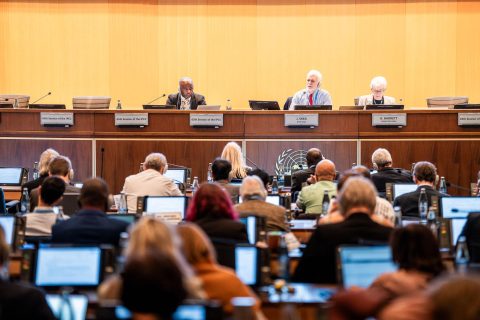
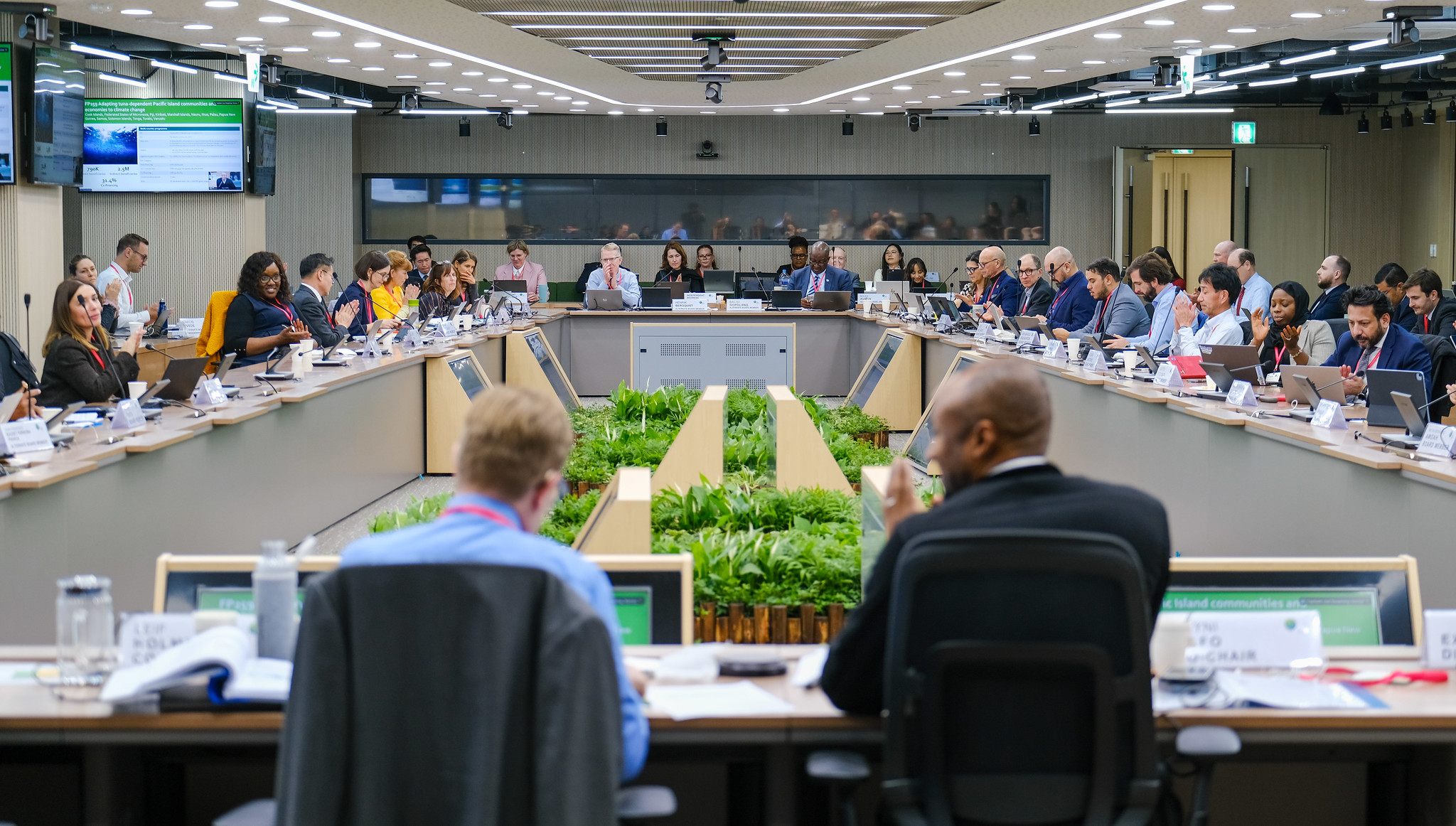
The United States did not turn up to the meeting, leaving an empty seat among the board’s 24 members. But the White House’s decision to rescind its GCF contributions, promised under previous Democrat administrations, cast a long shadow over the discussions this week in Songdo, South Korea.
Threat to ambition
The loss of US funding puts at risk the GCF’s plans to significantly increase the amount of money it provides to programmes that help developing countries adopt clean energy and adapt to climate change.
The GCF’s latest fundraising round for 2024 to 2027 raked in an ambitious $13.6 billion – up from $10 billion in the previous four-year period – after then US Vice President Kamala Harris announced a $3-billion pledge at COP28 in Dubai. Another $1 billion was still due from a promise made under the administration of Barack Obama.
But, with the US money now off the table under an administration that has taken an axe to development aid and climate finance, the GCF expects to deploy just over $10 billion through 2027. That puts it on a path to only marginally exceed a “low” or “status quo” scenario as outlined in its strategy documents.
Ahead of this week’s board meeting, GCF Executive Director Mafalda Duarte had urged world leaders not to step back from channelling “critical” climate finance to the developing world through the UN’s biggest climate fund.
Wealthy developing states urged to chip in
Board members reiterated her calls for additional contributions, but disagreed on where the extra money should come from.
Germany’s representative named “high-income, non-traditional donors” as a potential source of funding, alongside “non-sovereign contributors” and the private sector. While the board member did not single out specific countries, German diplomats have previously called on China and the Gulf States to pay towards the new UN climate finance goal agreed at COP29 last November.
Lula’s government pushes for new oil drilling in the Amazon – where it will host COP30
In South Korea, the Swedish delegate encouraged existing donors to put more money into the GCF and urged those not currently contributing to do so “according to their capacity”.
“This fund has already expanded its donor base over the years,” he highlighted.
Ten countries outside the industrialised group of nations defined under the UN climate convention in 1992 have made voluntary contributions to the GCF since its creation, including Chile, Colombia, Indonesia, Mexico and Israel. The bulk of the funding still comes from developed countries, with Germany, Japan, the UK and France the biggest providers.
Saudi hits back
In response, Saudi Arabia’s representative fiercely opposed suggestions that developing countries should be asked to put more money into the GCF’s coffers.
“We’re finding it troubling that we see a few board members […] attempting to apply pressure on developing countries to make up the contributions of one of the largest historical emitters and the largest economy in the world,” he said, referring to the United States.
Japan disregarded widespread calls to raise its 2035 emissions goal
The Saudi official then called on colleagues from developed countries to apply the same pressure on their partners across the Atlantic.
Like many other petrostates, Saudi Arabia’s wealth has grown significantly since it was classed as a developing country in 1992. Its majority state-owned oil company Saudi Aramco made $121 billion in profit in 2023.
The GCF discussion ended without a conclusion on how to make up the funding shortfall.
New projects and ‘regional presence’
In other business, the GCF board approved investments of $686.8 million for 11 projects spanning 42 countries at this week’s meeting, including its first ones in Togo and Serbia, bringing its total funding to $16.6 billion – three-quarters of it provided as grants.
“During these challenging times, GCF is showing how countries are able to reaffirm their individual and collective commitment to accelerating support to climate-vulnerable communities,” GCF board co-chair Leif Holmberg, also from Sweden, said in a statement.
The GCF expects to approve up to $3 billion in new projects in 2025 and aims to grow its total portfolio to at least $50 billion by 2030. But a spokesperson for the fund reiterated that “if pledges are not fully realized, our ability to support the climate ambitions of developing countries will be constrained”.
Aside from the US, Italy and Hungary have not yet confirmed pledges made in the latest fundraising round, while France and Canada have provided only partial confirmation of theirs. But the GCF’s administrative unit told board members that it “does not foresee any issues” with non-US money flowing into the fund.
The GCF board also decided this week to establish “a regional presence” to bring it closer to the countries it serves and to increase the climate impact of its projects, it said. The details are still to be worked out.
“If climate action is local action – which it is – then the Green Climate Fund needs to be local too,” said GCF chief Duarte. “I’m pleased that the Fund has taken a historic step in establishing a presence in key regions, bringing our world-class specialists closer to those who will benefit most from their support.”
The post After US retreat, countries clash over who should make up Green Climate Fund shortfall appeared first on Climate Home News.
After US retreat, countries clash over who should make up Green Climate Fund shortfall
Continue Reading
Three countries have been named by the Paris Agreement’s compliance committee for failing to submit a nationally determined contribution (NDC) and repeatedly snubbing offers of help with their climate plans.
After months of internal debate over whether to identify serial non-responders, the Paris Agreement’s Implementation and Compliance Committee (PAICC) named the three countries which have failed to engage with it over their NDCs on Friday.
It named Democratic Republic of Congo, Senegal and North Korea in a footnote of its annual report, adding that it decided to name them “with a view to facilitating engagement”, adding that representatives of the three nations had been invited to its meeting in early 2027 “with the purpose of identifying any challenges and constraints”.
“The Committee noted the importance of Parties engaging with the Committee in a timely manner, while noting that some delays may be due to the national capabilities and circumstances of the Parties”, the report said.
-
Under US pressure, World Bank says it will back gas “where appropriate”
The US wants the World Bank to expand its gas support while climate campaigners are pushing for it to end – its head spoke this week of limited backing for the fossil fuel -
IPCC scientists vow to press on with climate reports despite political deadlock
After governments again failed to agree a timeline, nearly 120 IPCC authors pledged to complete their assessment on time and with full scientific rigour -
Paris Agreement committee snubbed over missing NDC climate plans
Many governments have still not submitted a nationally determined contribution to the UN, breaching a key requirement of the Paris Agreement
In July, PAICC said 12 countries had ignored its repeated attempts to discuss why they had not published an NDC as required every five years under the 2015 Paris accord.
Members of the committee had been divided over whether to name them, but at a September meeting decided to do so in their annual report to the annual climate COP summit.
By the time the report was published on Friday, only Congo, Senegal and North Korea “had not communicated an NDC or submitted a [Biennial Transparency Report] and had not yet responded to any of the Committee’s notifications, despite several reminders issued by the Committee in this regard”.
Rainforest and renewable energy ambitions
The silence from Congo and Senegal is notable because the former is home to much of the Congo Basin rainforest while the latter has sought billions of dollars in climate finance to support its renewable energy ambitions.
After Brazil, Congo has more rainforest than any country in the world. This forest, and the country’s peatlands, absorb huge amounts of greenhouse gas but are fast being lost to expanding farmland, charcoal production, logging and mining.
Senegal signed a Just Energy Transition Partnership with Canada and wealthy European nations in 2023, to help it meet its renewable energy targets under the-then government of Macky Sall. It was chair of the Least Developed Countries group between January 2022 and December 2023.

Tejas Rao, who is researching the PAICC as part of a doctoral thesis at Cambridge University, said the governments of the three countries should engage with the committee.
“Engagement costs these governments very little and the committee has shown it will listen,” he said.
“Silence leaves the committee with no basis to help, and it leaves the [governments] exposed to the narrative that they are simply disengaged,” he told Climate Home News.
Paris Agreement requirement
The 2015 Paris Agreement requires all parties to publish an NDC every five years outlining their emissions reduction targets, with each plan meant to be more ambitious than the country’s last NDC.
The latest set – the third round of plans, with new targets for 2035 – was due in February 2025. While most countries missed this deadline, all but around 30 – mostly small emitters but including Egypt, Vietnam and Argentina – have now submitted them.
Over the year, the PAICC – which is made up of government climate officials from developed and developing countries – has been communicating with governments that have not submitted NDCs and trying to overcome barriers to them doing so.
Some nations have cited exceptional circumstances as the reason for not submitting an NDC, a process that requires a significant amount of work in tracking emissions and consulting on how to curb them across the economy. For example, a letter from a Sudanese official to the PAICC, seen by Climate Home News, said that the country’s civil war had led to the suspension of its NDC preparation.
-
IPCC scientists vow to press on with climate reports despite political deadlock
After governments again failed to agree a timeline, nearly 120 IPCC authors pledged to complete their assessment on time and with full scientific rigour -
Under US pressure, World Bank says it will back gas “where appropriate”
The US wants the World Bank to expand its gas support while climate campaigners are pushing for it to end – its head spoke this week of limited backing for the fossil fuel -
Who shapes climate science? The equity question facing the IPCC
Early completion of the next global climate science assessment reports risks excluding research from the Global South, which is key to ensuring the findings are fair
The US and Iran are not signed up to the Paris Agreement and so do not have active NDCs, nor does Taiwan, which is not a UN member state.
Rao said that because the PAICC is “facilitative and non-punitive”, naming the countries “is meant to open a door, not close one – the invited consultation is the point”.
“In recent months, governments that explained their constraints, whether capacity, finance or domestic process, have been met with follow-up and support rather than sanction, and the number of silent governments has fallen sharply,” Rao said.
The post Paris Agreement committee names three countries snubbing it over NDCs appeared first on Climate Home News.
Paris Agreement committee names three countries snubbing it over NDCs
Countries have failed – for the sixth time running – to agree on the timeline for publishing the Intergovernmental Panel on Climate Change’s (IPCC) next set of influential reports.
The IPCC’s 65th session (IPCC-65) was seen by many to be the final opportunity for countries to agree on a schedule where its seventh assessment report (AR7) would be published in time for the UN’s second “global stocktake” of climate action.
Before last week’s meeting in Addis Ababa, Ethiopia, IPCC chair Prof Sir Jim Skea had warned that releasing the reports in time for the stocktake in 2028 would depend on a timelines being agreed by the end of 2026.
But the week-long meeting descended into fraught disagreements between governments, resulting in Skea “suspending” the talks on Friday evening with no decision made.
Countries were also unable to agree on the IPCC’s budget for the rest of the AR7 cycle, leaving the body with a “serious funding crisis”.
The IPCC has pledged to reconvene the meeting at the “earliest opportunity”; however, it has not yet given an indication of when this will be.
In his concluding remarks, Skea described the Addis Ababa summit as a “profound disappointment” and “among the most difficult IPCC meetings”, according to reporting fro