

This week, Greenpeace France took a stand and, in a valiant act of environmental activism, took matters into their own hands. At sunrise on Wednesday, May 21, activists aboard the Arctic Sunrise ship dropped 15 very large limestone boulders into the Mediterranean Sea, targeting a protected area off the coast of Occitania known as the Gulf of Lion Marine Park.
Carefully placed in a grid pattern on the ocean floor, each rock weighs between one and two tons. That is equivalent to a fully grown male White Rhino! The goal was to physically block bottom trawlers—large fishing vessels that drag heavy nets across the ocean floor, a practice that has devastating impacts on marine ecosystems.
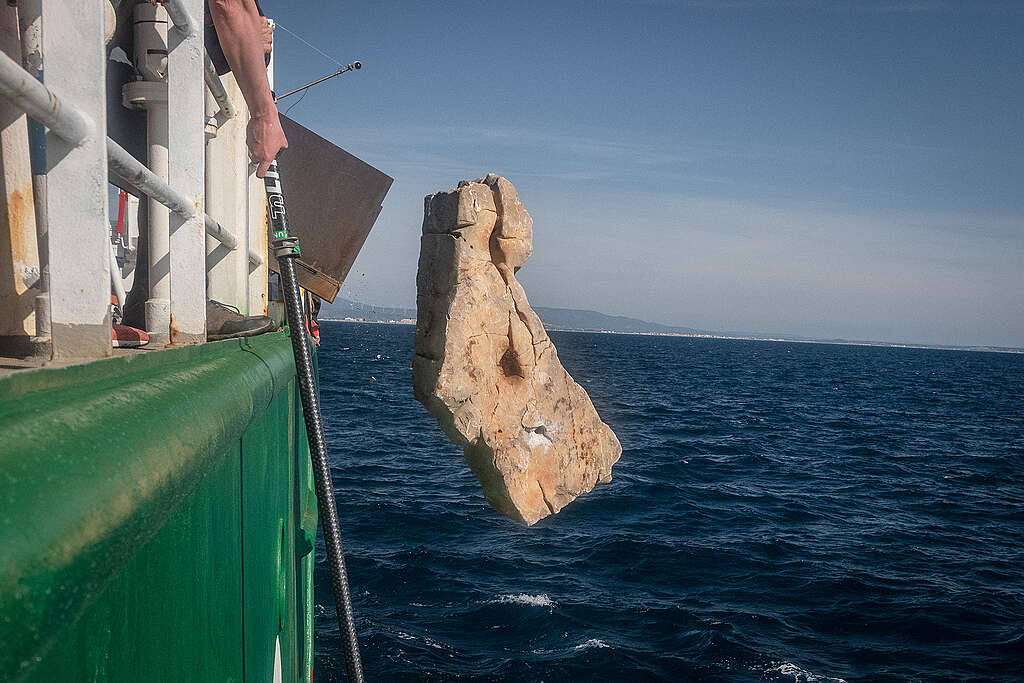
This action is the latest effort in an ongoing campaign highlighting the French government’s inaction on marine conservation. Greenpeace is calling for a ban on bottom trawling in marine protected areas (MPAs) before France co-hosts the United Nations Ocean Conference (UNOC-3) in Nice in June.
The Gulf of Lion is a vital and diverse ecology in the Mediterranean, renowned for its rich biodiversity. There are magnificent habitats like Posidonia meadows, Coralligenous reefs, which support vulnerable marine life including gorgonians, sea cicadas and bluefin tuna.
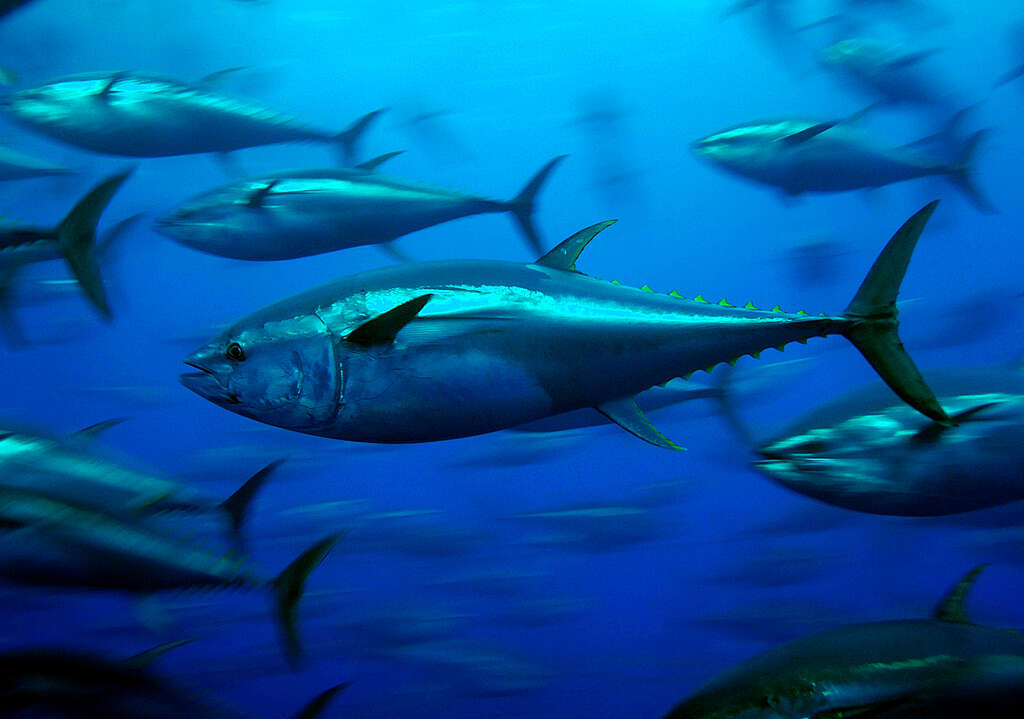
Although officially designated as a marine protected area, the region remains vulnerable to industrial fishing, which François Chartier, Oceans Campaigner at Greenpeace France, says undermines the very meaning of protection. “For several years now, France’s refusal to regulate destructive activities in its marine protected areas has been unanimously denounced by NGOs and numerous scientists,’ said François Chartier, Oceans Campaigner at Greenpeace France ‘The government still holds to an archaic vision of marine conservation and fishing. Agnès Pannier-Runacher refuses to comply with international standards on levels of protection in MPAs, preferring instead an unfounded “case-by-case” approach. The Minister must heed our request, which is also that of all ocean protection associations: she must ban bottom trawling in marine protected areas.”
This isn’t Greenpeace’s first move on the issue. In December 2024, the group exposed the presence of trawlers on the Bancs des Flandres, another protected zone. In April, it collaborated with CNRS to publish a report recommending a more meaningful and science-driven layout for MPAs across French waters. Now, by installing physical barriers in the form of boulders, Greenpeace is escalating its campaign to force the government’s hand.
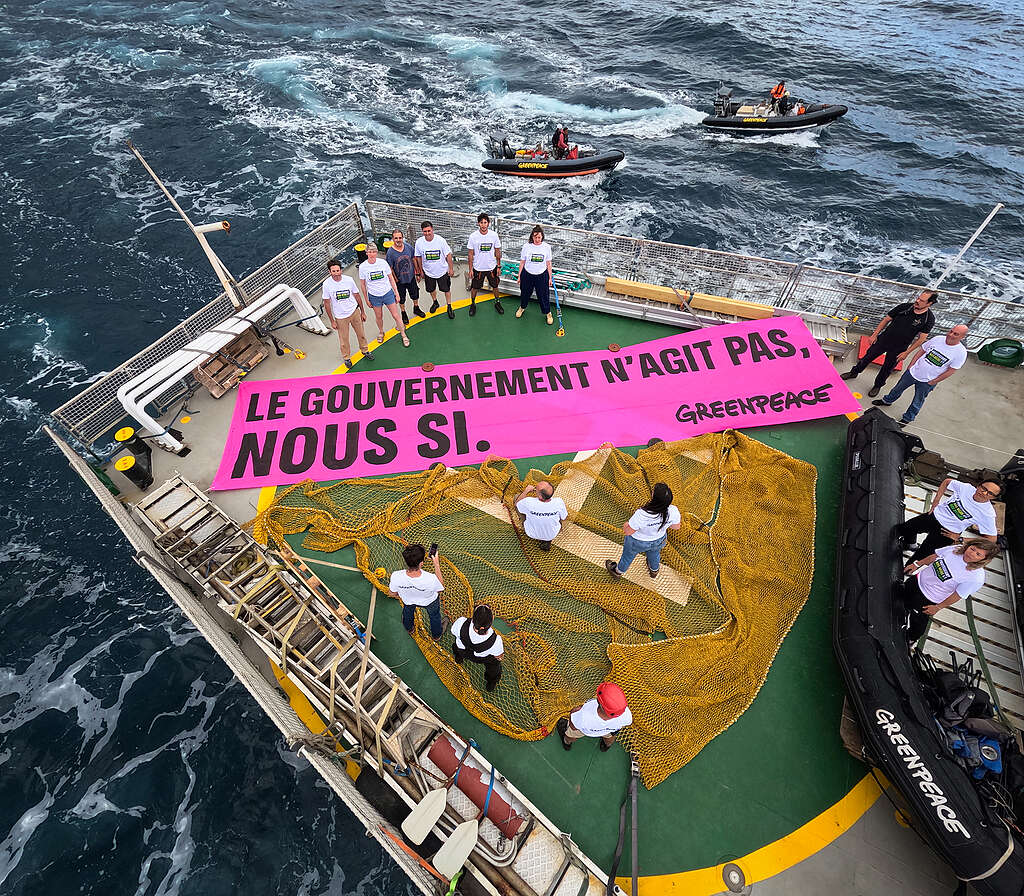
Activists aboard the Arctic Sunrise displayed banners that read “The government doesn’t act, we do” and “Marine area protection in progress.” It served as a direct affirmation of France’s stated dedication to ocean protection.
A critical opportunity to protect our oceans
With the UNOC-3 just weeks away, France has a critical opportunity to protect our big blue planet. While President Emmanuel Macron has made bold international pledges—opposing deep-sea mining and supporting the High Seas Treaty—it’s time for those global ambitions to be ratified. To truly lead on ocean conservation, France must start by securing the health of its own marine environments.
Greenpeace Australia Pacific is also calling on newly elected Environment Minister Murray Watt to ratify the Global Oceans Treaty within the first 100 days of office. Furthermore, Greenpeace Australia Pacific would like Minister Watt to propose a world-first high seas marine protected area in the Tasman Sea. This aims to protect marine life, including blue sharks, from the harmful impacts of industrial fishing.If you would like to learn more about Greenpeace Australia Pacific’s involvement, you can do so here.
A Rock-Solid Stand for the Ocean: Greenpeace France Blocks Bottom Trawling

Greenpeace International and Greenpeace organisations in the US filed on 27 March 2026 a motion for a new trial in North Dakota District Court. This demand for justice follows the absurd and flawed US$ 345 million judgment issued by the same court in Energy Transfer’s SLAPP lawsuit against the Greenpeace parties returned on 27 February 2026. Energy Transfer’s back-to-back SLAPP lawsuits are attempts to erase Indigenous leadership of the Standing Rock Movement, punish solidarity with the ongoing resistance to the Dakota Access Pipeline, and intimidate environmental activists from speaking out against Big Oil companies.
The motion for a new trial should be granted to prevent one of the largest miscarriages of justice in North Dakota’s history. We are demanding the court right the wrongs committed at trial and to ensure the rights and freedoms promised under the US constitution are protected.
Greenpeace will not rest until justice is served and Big Oil can no longer use and abuse the legal system in North Dakota or anywhere else.
Greenpeace International General Counsel Kristin Casper
There is no question the Greenpeace defendants were denied a fair trial — even a concise summary of the errors and injustices that marred the trial runs to over 100 pages.
Among the numerous egregious flaws documented in the motion for a new trial are:
- The Greenpeace defendants could not receive a fair and impartial trial in Morton County.
- Seven out of nine jurors that decided the case had clear biases due to fossil fuel industry ties, experiences with the Standing Rock protests, and/or preexisting negative views of the Greenpeace defendants.
- Despite the fact that thousands of individuals and hundreds of organisations were involved in actions at Standing Rock and speaking out against DAPL, and North Dakota law clearly requiring damages to be split among everyone who contributed to alleged harms, the jury and the court assigned 100% of the claimed damages to the Greenpeace defendants.
- The jury’s verdict was contrary to the weight of the evidence on each and every count.
- The jury verdict was tainted by the inclusion of inadmissible, prejudicial information.
- The jury was improperly prevented from hearing relevant, admissible evidence that was favorable to the Greenpeace defendants.
- The jury was provided erroneous and incomplete instructions and a flawed verdict form.
From shutting off sprinklers to closing ski resorts, communities and business owners are adapting to parched conditions out West. Things could get much worse, experts say.
Officials were already sounding the alarm bells in early March across the Western United States after a winter with historically low snowpacks, which supplies water for communities as it slowly melts throughout the spring and summer.
Water-Use Restrictions Follow Snow Drought and Heat Wave in the Western U.S.
The U.S. doesn’t have enough bio-based diesel to meet the administration’s new mandate, so blenders will have to import yet more foreign crop-based oils.
President Donald Trump stood on the Truman Balcony at the White House during the “Great American Agriculture Celebration” last week and announced what he called a “historic” boost to the nation’s farmers.
The Trump Administration’s New Biofuels Targets Threaten Carbon-Rich Rainforests



-
Climate Change8 months ago
Guest post: Why China is still building new coal – and when it might stop
-
Greenhouse Gases8 months ago
Guest post: Why China is still building new coal – and when it might stop
-

 Greenhouse Gases2 years ago
嘉宾来稿:满足中国增长的用电需求 光伏加储能“比新建煤电更实惠”
-
Climate Change2 years ago
Bill Discounting Climate Change in Florida’s Energy Policy Awaits DeSantis’ Approval
-

 Climate Change2 years ago
嘉宾来稿:满足中国增长的用电需求 光伏加储能“比新建煤电更实惠”
-
Climate Change Videos2 years ago
The toxic gas flares fuelling Nigeria’s climate change – BBC News
-

 Renewable Energy5 months ago
Sending Progressive Philanthropist George Soros to Prison?
-

 Carbon Footprint2 years ago
US SEC’s Climate Disclosure Rules Spur Renewed Interest in Carbon Credits