

Besides the dust that cloaks pathways, windowsills and gardens, the towering grey heaps of discarded rock are another unwelcome reminder of the platinum mine next door to the South African township of Chaneng.
In and around the city of Rustenburg, the low-grade platinum ore that has made South Africa the world’s top producer of the silvery metal creates massive waste piled in large rocky heaps known as tailings. For every tonne of metal extracted, hundreds of tonnes of waste rock is left behind in huge piles.
The transition to cleaner energy system is expected to push up global demand for platinum group metals (PGM) – which include palladium and other precious metals, as well as platinum. They are used in hydrogen-related technologies such as fuel cells and electrolysers that split water molecules as well as in hybrid cars that need catalytic converters to curb pollution.
To secure supplies, mining companies are starting to make use of what was once considered waste.
Efforts to green lithium extraction face scrutiny over water use
Reprocessing mine tailings using new technology can be a more sustainable form of producing minerals and metals needed for the energy transition because it is expected to reduce the size of existing waste heaps and boost output without the need to open new mines, which can cause more environmental destruction and community displacement.
“Tailings reprocessing offers genuine benefits, reducing pressure for new mining [and] addressing existing environmental liabilities,” said Mathikoza Dube, an expert on critical minerals based in Rustenburg.
“It offers the world a pathway to secure supplies of energy transition minerals while remediating waste that’s contaminated communities for generations,” Dube added, cautioning it is not a “magic solution” and should be approached in a way that ensures local communities benefit.
In Chaneng, where the tailings dumps loom over backyards, residents are wary.
“Same theft in new clothes”
They fear the plan to reprocess mining tailings at the neighbouring mine – operated by South African platinum miner Sibanye-Stillwater – is being dressed up as sustainable when in reality it will mean more contamination, blasting, dust and no end to their community’s problems.
Despite decades of mining, unemployment in the area remains high, many people say they never received compensation for the loss of their agricultural land and most households still lack access to basic sanitation infrastructure.
Water testing carried out by SRK Consulting in 2009 found elevated nitrate levels exceeding World Health Organization guidelines in community boreholes, and health practitioners document dramatic increases in respiratory diseases.
“Now they want to dig up the waste piles and call it progress? Show us the ownership papers. Show us the rehabilitation plan. Otherwise, it’s the same theft in new clothes,” said Johannes Kgomo, a community leader.
-
Self-taught mechanics give second life to Jordan’s glut of spent EV batteries
As EV sales boom in Jordan, a lack of formal infrastructure for dealing with end-of-life batteries is leading to some innovative solutions -
Bolivia’s shift to the right renews ambition to mine vast lithium reserves
The election of a centre-right president after 20 years of socialist rule could open up the nation’s lithium reserves to foreign investment – the US is paying attention -
COP30 draft text includes energy transition minerals in UN climate first
A draft negotiating text on defining principles for a just transition to clean energy systems recognises the social and environmental risks associated with mining critical minerals


South Africa’s mining legislation requires that 26% of mining assets are held by historically disadvantaged people including Black South Africans, and Chaneng residents are demanding a stake of 15% to 30% in any tailings operation on their land, allowing them to have a say in how the business is run.
They say that should be granted to them as compensation for the health and environmental problems they have endured as a result of the mine.
The community is also demanding comprehensive water testing and treatment, adequately resourced clinics with respiratory specialists, compensation for destroyed agricultural land, infrastructure repair and long-term health monitoring.
“We are not asking for handouts,” said Gideon Chitanga of the National Union of Mineworkers, which often takes the side of local communities in disputes with companies.
“These people have already paid with their health, their water, their land. That contamination, that suffering – that is their investment. Now they want returns and decision-making power,” Chitanga added.
A spokesperson for Sibanye-Stillwater declined to comment.
A mining industry source, who asked not to be identified, said conversations with community members were ongoing.
“Nobody disputes these communities have suffered. The question is how to structure ownership in a way that’s legally sound, financially viable, and genuinely empowering,” the source said.

New technology boosts metal recovery in waste
New reprocessing technology has made it economically viable to extract platinum group metals from tailings, and several operations are already underway in South Africa’s platinum mining belt, around the city of Rustenburg.
Sibanye-Stillwater already operates multiple retreatment facilities, processing thousands of tonnes of waste ore monthly.
Another South African miner Tharisa processes chromite from PGM tailings commercially. Chromite is used to obtain chromium, a metal used in the manufacture of wind turbines and some energy storage batteries.
“Historical tailings facilities contain economically viable concentrations that were unrecoverable with older technology,” said Leo Vonopartis from the University of the Witwatersrand’s BUGEMET research programme, which studies the geology of South Africa’s Bushveld Complex mining belt.
Tailings in the area around Rustenburg can contain up to 2.5 grammes per tonne of combined platinum, palladium and rhodium – along with chromite. Vanadium, cobalt and rare earth elements have also been found.
At current prices, which have rallied this year, it is worth extracting the rare metals, despite the challenges.
Breaking with the cycle of extraction and injustice
“The technology exists. The economics work. The question is whether we can structure these projects to genuinely benefit the people who have paid mining’s costs,” a spokesperson for one mining company said, asking not to be named.
Without that, local expert Dube said, the reprocessing of tailings is scarcely better than other forms of mining.
“Reprocessing tailings does not erase the damage that created them. If it is structured as extraction by another name – where companies profit and communities remain marginalised – we have just found a new way to perpetuate old injustices.”
Australia’s COP31 Co-President vows to fight alongside Pacific for a fossil fuel transition
Gesturing toward the tailings dam visible from her yard, Noxolo Mthembu recalls the days when her vegetable patch used to feed the family.
“We used to grow spinach, tomatoes, pumpkins,” she told Climate Home News. “Now nothing grows. The dust kills everything. My children have asthma. My husband died of lung disease at 54.”
Like many of her neighbours, she says any new cycle of mining activity – this time in the name of the clean energy transition – must not repeat the past.
“Show me the ownership papers with our names. Show me the water treatment plant. Show me the clinic with enough staff. Then I will believe this time is different.”
The post South Africa’s platinum mine dumps get a second look as clean energy lifts demand appeared first on Climate Home News.
South Africa’s platinum mine dumps get a second look as clean energy lifts demand

Next week, diplomats from around the world will descend on Yerevan, Armenia, to negotiate a series of decisions under the UN Convention on Biological Diversity (CBD).
Between 19 and 30 October, 196 parties will gather to hammer out the precise wording of the dozens of legal texts that make up the decisions under the Conference of the Parties (COP) to the CBD.
This year’s summit is particularly significant, as it marks the halfway point between the agreement of the Kunming-Montreal Global Biodiversity Framework and the deadline for achieving its targets.
The CBD has found that countries are currently not on track to meet 22 out of the framework’s 23 targets.
During the fortnight, delegates will also be negotiating decisions relating to the two supplemental protocols to the CBD: the Cartagena Protocol, which covers biosafety; and the Nagoya Protocol, which covers access and benefit-sharing for the use of genetic resources.
(The Cartagena and Nagoya Protocols, which are each governed by a “meeting of the parties”, or “MOP”, have fewer parties than the CBD as a whole, with 173 and 141, respectively.)
Carbon Brief is tracking the progress of countries towards consensus on dozens of negotiating texts using the interactive table below.
The tracker includes texts from the COP, as well as the MOPs for the Cartagena and Nagoya protocols. It also includes draft decisions from the most recent subsidiary body meetings, as these form the starting point for the negotiations in Yerevan.
The CBD has three subsidiary bodies: the subsidiary body on scientific, technical and technological advice (SBSTTA), the subsidiary body on implementation (SBI) and the subsidiary body on article 8(j) and other provisions (SB8J).
SB8J focuses on issues related to the Indigenous peoples and local communities. It was established at COP16 in Cali, Colombia, in 2024.
The first two columns of the interactive tracker list the topic of each agenda item and the relevant body, with subsequent columns including dates, page counts and links to the original documents.
The table is searchable and can be sorted using the arrows in the header.
Areas of disagreement in UN draft texts are denoted by square brackets. Counting the brackets in a particular iteration of a text therefore gives a sense of how far parties are from reaching consensus.
The bracket column is colour-coded, with dark green indicating a low number of brackets and red indicating a high number of brackets remaining.
Texts can also present parties with choices using “options” or alternatives (“alt”), which are counted together in the sixth column of the table.
The key discussions in Yerevan will centre around two agenda items in particular. The first is the global review, which will assess progress towards the GBF and make recommendations for accelerating action.
The second is finance, which can be separated into two parts: resource mobilisation and the financial mechanism. On resource mobilisation, biodiverse global south countries are likely to push for an increased amount of international finance for conservation.
Disagreement over the creation of the financial mechanism led to the suspension of COP16 in Cali in October 2024, as parties failed to find agreement on the mobilisation of finance before the end of the summit.
Global south countries want the establishment of a separate financial mechanism under the control of the CBD; global north countries largely prefer to maintain the existing mechanism, which sits under the Global Environment Facility.
At the resumed session of COP16 in Rome in early 2025, countries agreed on a roadmap that would lead to the establishment of a permanent mechanism.
related

Analysis: Lula presidency saved at least 20,000km2 of Brazilian Amazon since 2022
Why land-use emissions have fallen by a third this century – in six charts

Analysis: 84% of nations miss deadline to identify ‘nature-harming’ subsidies by 2025
UK withdraws millions in funding from world’s second-largest rainforest in Congo
The post Interactive: Tracking negotiating texts at the COP17 biodiversity summit appeared first on Carbon Brief.
Interactive: Tracking negotiating texts at the COP17 biodiversity summit
A beacon of love
On an outer island of Fiji, two thousand nautical miles from Sydney, is a shining light of hope and resilience for our troubled world.
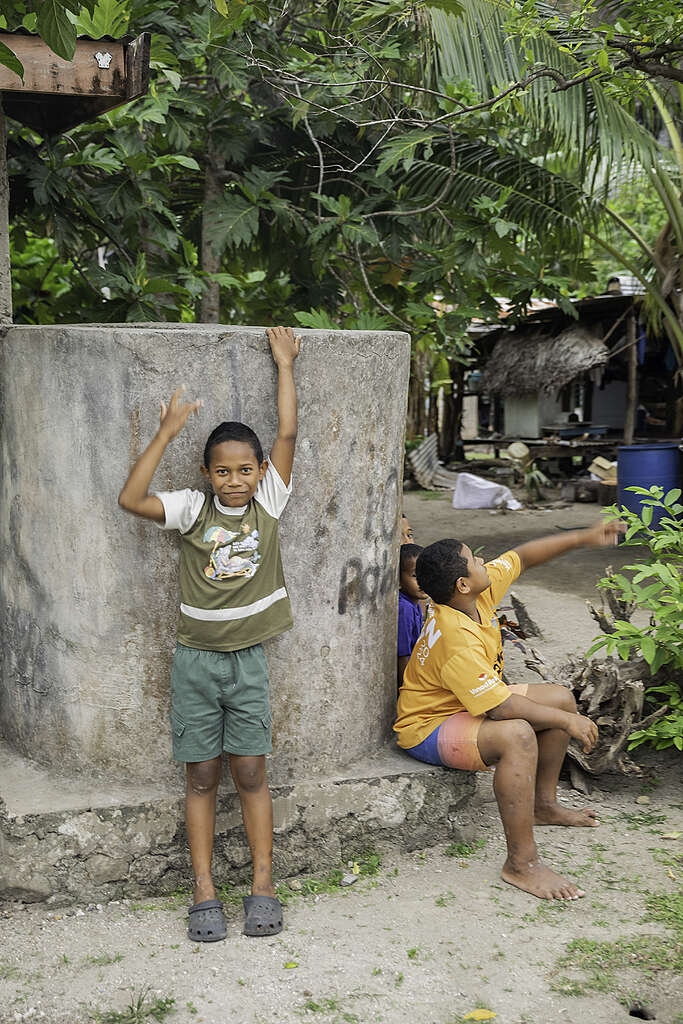
The island of Kioa is home to a Tuvaluan community who migrated from their atoll of Vaitupu in the late 1940s. It is a land of warm hearts, big smiles, and deep cultural roots; a place where the sound of a conch still summons the island together, where islanders paddle out to fish in carved outrigger canoes, and healthy happy children walk barefoot to school.
Here, culture is life. Kioans live sustainably through their traditional knowledge and practices. The island is alive with song, dance and the rhythms of a life tied to the tides, the winds, and the seasons.
Facing the future
Greenpeace has been lucky to have a relationship with Kioa for a number of years now, and we are continually learning from this remarkable community.
Last week, as part of our Voyaging Oceania project, we returned to the island. Our purpose was twofold —- to carry messages from the island to leaders gathering in Nadi this week for the Pacific Pre-COP, and to support the Kioa community in their efforts to improve water security for the island.
Unlike Tuvalu itself, with its eight atolls, Kioa is a mountainous, forested and richly fertile island. It will remain habitable far into the future. Kioans did not initially migrate from Vaitupu due to climate change, but the move was prophetic. They now have a lifeboat.
However, even Kioa faces challenges on our rapidly warming planet, in particular when it comes to water. Climate change is shifting once reliable rainfall patterns. On top of this, the island is already feeling the effect of this year’s intensifying El Niño event, which for Fiji means reduced rainfall and prolonged dry spells.
Right now, fresh water has to be carefully rationed, and is only available for a few hours a day. During last week’s visit aboard our campaigning ship Oceania, Greenpeace was privileged to work with the Kioa community on a new solar-powered water distribution project for the island.
Designed and led by the island, the project involves using a solar pump to move water from a reliable source to a storage tank and then using gravity to distribute the water around the village.
It was a lesson in how local knowledge and ingenuity can be the backbone of today’s climate solutions. To build a dam around the source, the local community knew the exact spot where they could gather gravel at low tide to mix with the cement. They took only what was needed, knowing that all resources must be carefully conserved. Kioa has no roads and no machinery, and it was an all-of-island effort to carry the materials up to the project site, including many heavy bags of sand and rock.
Such projects truly bring to life the vision of a resilient, locally-led, fossil fuel free Pacific.