

S&P Global and JPMorgan’s blockchain division, Kinexys, launched a pilot to tokenize carbon credits. They aim to use blockchain and smart contracts to improve voluntary carbon markets (VCMs), make them more transparent, trustworthy, and liquid.
Their initiative is important because the global carbon credit market is worth about $933 billion in 2025, and can grow to over $16 trillion by 2034. This move could unlock major climate finance opportunities by tackling key issues that have held the market back.
From Blocks to Credits: The Digital Carbon Evolution
The voluntary carbon credit market is worth about $4.04 billion in 2024. It could grow to $24 billion by 2030 with an annual growth rate over 35%. However, this market has many flaws. Multiple registries make it hard to compare credits.

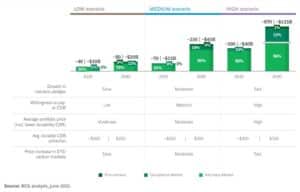
Transparency issues continue to raise concerns about fraud and double-counting—when the same carbon credit gets sold or claimed more than once—in carbon markets. Ghost credits, which are fake reductions, hurt market integrity. Overstated impact claims and double-counting also damage investor confidence, as shown in the chart below.

Estimates show that in 2021, hundreds of millions of tonnes of CO₂ equivalent credits faced issues. As the market grows, this number could rise significantly. To improve transparency, organizations are using blockchain tracking and better verification. These efforts aim to cut risks as the VCM grows. By 2030, analysts expect trade around 1.5 billion tonnes of CO₂ equivalent.
Low liquidity turns off big investors. Plus, no central exchange or standard contracts splits the market. This limits growth and makes it hard for institutions to join in.
These weaknesses undermine trust and prevent big capital from entering the market. By tokenizing credits, S&P and JPMorgan aim to fix these problems and transform carbon credits into reliable digital assets.
How Tokenization Changes the Game
The joint pilot combines the Environmental Registry from S&P Global Commodity Insights with JPMorgan’s Kinexys blockchain platform. Together, they can turn carbon credits into digital tokens. These tokens are stored on an unchangeable ledger that everyone can access.
This system performs the following:
- Standardizes credits across different projects—such as reforestation or direct air capture—to make them comparable.
- It ensures transparency by permanently logging the issuance, transfers, and retirement of each credit. This helps tackle fraud and double-counting issues that have affected the market.
- Enables smart contracts that automate tasks. For example, credits retire when purchased, which cuts transaction times from months to minutes.
- Enables cross-chain transfers, which lets tokens move smoothly between platforms and registries. It boosts interoperability and market depth.

Tokenized credits can act more like stocks or bonds by solving issues of fragmentation, trust, and liquidity. This makes them tradable, verifiable, and scalable.
In the JPMorgan and S&P Global partnership, tokenized carbon credits can move more easily between companies, countries, and investors. This allows credits to be part of new climate-related financial products. Examples are tokens that show a share in a reforestation project or investments in carbon removal tech.
By making carbon markets more efficient and trustworthy, tokenization could attract more money into projects that fight climate change. This is a vital step as demand for high-quality, verifiable credits continues to outpace supply.
- RELATED: The Energy Debate: How Bitcoin Mining, Blockchain, and Cryptocurrency Shape Our Carbon Future
JPMorgan and S&P Global’s Pilot Program
JPMorgan launched this pilot with Kinexys, its blockchain arm. Kinexys, once called Onyx, has handled over $1.5 trillion in transactions since 2015. This shows it can support large finance systems.
The bank teamed up with S&P Global Commodity Insights and top registries: EcoRegistry and the International Carbon Registry. This partnership aims to get real carbon credit data and test how well blockchain can track credits from issuance to retirement.
Keerthi Moudgal, Head of Product at Kinexys Digital Assets, Kinexys by J.P. Morgan, noted:
“The voluntary carbon market is primed for innovation, and we’re eager to collaborate with participants to develop and implement new blockchain technology. Our shared aim is to establish standardized infrastructure that enhances information and price transparency, paving the way for financial innovation and increased market liquidity.”
Why This Deal Matters for Investors and the Environment
This new digital approach to carbon credits matters for both financial markets and climate action. For investors, tokenization creates a new asset class that is transparent, secure, and easy to trade.
Investors can now track where their money goes and how it helps reduce emissions. It also helps diversify portfolios with climate-related assets. These assets might gain value as climate rules become stricter.
For the environment, a more transparent and accessible carbon market means more funding can go to projects like forest restoration, clean energy, and carbon removal. Notably, removal credits are expected to account for 35% of the voluntary carbon market by 2030.
When it’s easier to see that these projects provide real climate benefits, trust grows. Then, participation increases too. This is crucial for helping companies, especially in tough-to-decarbonize sectors, meet their climate goals effectively.
What This Means for Carbon Trading’s Future
Despite the promise of improving trust and market growth, this pilot still needs to tackle key challenges:
- Regulatory alignment: Different regions (e.g., EU vs. U.S.) have distinct rules on carbon accounting and tokenized assets. Global standards are still being developed. This uncertainty in regulations is a barrier to widespread adoption.
- Integration with existing systems: The tokenized model must link to current registries, such as Verra and Gold Standard. This connection prevents isolation and ensures market-wide interoperability.
- Market adoption: Tokenized credits need backing from investors, corporates, and funds. Without demand, liquidity may remain low, even as the voluntary market is projected to grow fivefold by 2030.
- Avoiding hype cycles: Blockchain projects risk attracting speculative investment. Tokenized carbon must demonstrate real value, not bubble-like behavior.
JPMorgan and S&P aim to resolve these by proving the approach in the coming months. Their success could set a global template for carbon finance.
Together, they are pioneering an important innovation to address transparency, trust, and liquidity problems in voluntary carbon markets. They aim to mix registry data with blockchain tech to create a secure, programmable, and tradable asset for climate financing.
The post S&P Global and JPMorgan Partner to Tokenize Carbon Credits appeared first on Carbon Credits.

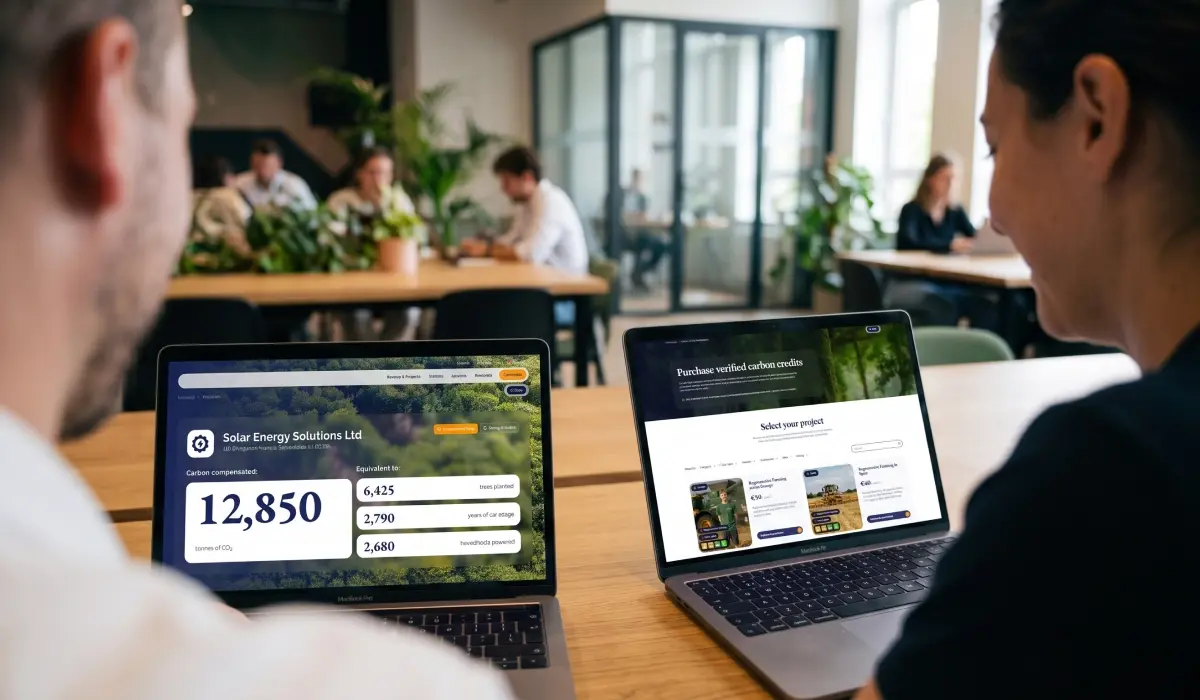
Most businesses that decide to act on their net-zero targets reach the same point of friction. Buying carbon credits has meant tracking down brokers, sitting through sales calls, and requesting a quote just to learn a price, sometimes with limited proof of what you are buying.

The earnings calls that quietly reframed climate from sustainability question to operating risk.
Three earnings calls in the last 18 months tell the story without any help from a press release.
Hershey, May 2024: cocoa price exposure compresses margin, and the company attributes part of the cost shock to West African weather. Olam, July 2024: coffee climate exposure quantified in the annual report. JBS, January 2025: supply chain climate disclosures expanded materially in response to investor pressure and regulatory expectation. None of these companies issued the announcement as climate news. They issued it as financial news. The climate-linked supply chain risk did not arrive with a sustainability framing; it arrived as a P&L line.
You are probably reading this article because you suspect the same thing is happening to your business. This piece walks through what is showing up on which earnings calls, how procurement and finance leaders are quantifying the exposure, and what serious corporates are doing about it before the regulator asks.
Where climate risk has already appeared in earnings
The pattern is consistent across resource-intensive sectors. A weather event compresses supply, the price spikes, the cost flows through the income statement, and the analyst on the call asks whether the event is anomalous or structural. Increasingly, the honest answer is the second one.
Cocoa is the cleanest example. The 2023 to 2024 West African harvest fell sharply on the back of erratic rainfall and disease. Cocoa futures more than tripled. Companies with concentrated West African sourcing absorbed the cost; companies with diversified sourcing absorbed less. The exposure was not climate as ESG topic. It was climate as cost of goods.
Coffee follows the same pattern. Brazilian and Vietnamese harvests have moved on weather more sharply across the last several seasons. Roasters with long-tenor supplier relationships and origin diversification have managed the volatility; roasters with spot-market exposure have not. Wheat, sugar, palm oil, beef: the same dynamic in different commodities, a pattern the IPCC AR6 Working Group II report projects will intensify across agricultural systems through mid-century.
What this means: climate risk is no longer a footnote in the 10-K. It is a line item the CFO has to explain on the call.
The three commodity exposures that hit margin first
For most companies with material Scope 3 exposure, three exposures dominate the near-term P&L risk.
- Concentrated single-origin sourcing in a climate-vulnerable region. If your tier-one supply for any material commodity sits in one geography, you have a concentration risk that climate amplifies. Diversification across origins is the obvious hedge, but it takes years to build and requires relationships you cannot acquire by tender.
- Supplier financial fragility under climate stress. Smallholder farmers, who supply a large share of the global cocoa, coffee, and palm oil market, do not carry the balance sheets to absorb yield shocks. When yields collapse, they exit. When they exit, your supply base shrinks, and the surviving suppliers raise prices. The risk is structural, not cyclical.
- Logistics and storage exposure to extreme weather. Hurricane disruptions to Gulf shipping, drought-driven Panama Canal restrictions, flooding in European inland waterways: each of these has moved input costs in the last three years, a pattern documented in Munich Re’s natural catastrophe data. The exposure shows up as a one-quarter event in the financial press but accumulates over time on the cost line.
TCFD and ISSB disclosure changes
The disclosure architecture has now caught up with the risk. The Task Force on Climate-related Financial Disclosures, whose recommendations are now embedded in the ISSB’s IFRS S2 climate standard, requires companies to disclose climate-related risks across physical and transition categories, with quantification where possible.
For physical risk specifically (the climate-linked supply chain risk you are reading about), the disclosure must address both acute exposures (extreme weather events) and chronic exposures (gradual changes in temperature, precipitation, and growing seasons). The disclosure must address the time horizon over which the risk is material, the parts of the value chain exposed, and the financial impact under different scenarios.
The CSRD imposes similar requirements under European law, with double materiality (both financial and impact materiality) embedded in the assessment. The practical effect: your auditors and your investor relations team now need a defensible answer to the climate-linked supply chain risk question, and the answer needs to be quantified.
What procurement and finance can do now
Three actions matter near-term.
Map your exposure. Most companies do not have a clear view of which tier-one and tier-two suppliers sit in which climate-vulnerable geographies. Without the map, you cannot quantify the risk, and without the quantification, you cannot disclose it credibly. The map is the foundation, and World Resources Institute climate risk research provides useful public tooling to start.
Diversify and deepen, in that order. Diversification across origins reduces concentration risk, but the deeper move is to invest in the resilience of the suppliers you already have. Regenerative practices, agroforestry, soil health interventions: these reduce yield volatility under climate stress and protect your input cost trajectory.
Embed the climate spend inside procurement, not outside it. Treating climate risk as a sustainability cost line subordinates it to the ESG budget. Treating it as a procurement and resilience investment puts it in the budget that matters, which is the cost-of-goods budget that the CFO defends quarterly.
Nature-based supply chain investments are the asset class designed for exactly this purpose. They sit inside the value chain, they reduce climate-linked supply risk, they generate verifiable Scope 3 reductions, and they produce the documentation an auditor and a regulator can both test.
If you are quantifying climate-linked supply chain risk in advance of the next earnings cycle or the next disclosure period, the carbon and sustainability experts at Carbon Credit Capital can help you map your exposure and structure a Dual-Value Model response that addresses reduction, resilience, and disclosure-readiness in a single program. Schedule a consultation.

More and more small and medium-sized businesses are hearing the same question from their larger customers: What is your carbon footprint? That question now travels down entire supply chains, and it arrives next to tender requirements, certification criteria, and rising customer expectations.




-
Climate Change1 year ago
Guest post: Why China is still building new coal – and when it might stop
-

 Greenhouse Gases2 years ago
嘉宾来稿:满足中国增长的用电需求 光伏加储能“比新建煤电更实惠”
-
Greenhouse Gases1 year ago
Guest post: Why China is still building new coal – and when it might stop
-

 Climate Change2 years ago
嘉宾来稿:满足中国增长的用电需求 光伏加储能“比新建煤电更实惠”
-
Climate Change2 years ago
Bill Discounting Climate Change in Florida’s Energy Policy Awaits DeSantis’ Approval
-

 Renewable Energy11 months ago
Sending Progressive Philanthropist George Soros to Prison?
-
Greenhouse Gases1 year ago
嘉宾来稿:探究火山喷发如何影响气候预测
-

 Carbon Footprint2 years ago
US SEC’s Climate Disclosure Rules Spur Renewed Interest in Carbon Credits