

The following is a guest article by Ramsey Nix, a mother of two and UGA journalism professor based in Athens, Georgia.
Ramsey Nix and her children at Senator Ossoff’s Atlanta office.
I first learned about climate change when I was in the eighth grade at my public middle school in Atlanta. The evidence back then was already clear: the fossil fuels we burn to power our buildings and transportation were causing the climate to change.
As my science teacher illustrated future climate projections on the blackboard, I remember thinking that surely the way we power our system would change by the time I grew up.
That was more than 30 years ago. Average temperatures have already climbed 2 degrees. And while more people than ever care about climate and are taking individual steps to reduce their carbon footprints, we still haven’t made the systemic change required to solve the problem.
Now that my own children are learning the truth about climate change, I want their experience to be different from mine. I want them to understand the problem and to know the adults they rely on–their parents, their school district, their government–are actually addressing it. Imagine what they could learn from that!
On the heels of the Athens-Clarke County government taking the bold step in 2017 to adopt a 100% clean and renewable energy plan for all public facilities, I began to wonder how our school district could opt into that plan. Our schools and buses are public facilities so it only made sense to me. I began meeting with local clean energy advocates and individual members of our school board to brainstorm.
Taking Action at the School District?
In the meantime, a group of students at my son’s middle school had begun advocating for solar panels on the roof of their soon-to-be constructed new school building. Their action provided the impetus for me to draft a clean energy resolution and present it before the Clarke County School Board.
As a result, the board appointed an ad hoc committee of community members, district staff, teachers, students and sustainability experts from the University of Georgia and the local government to provide recommendations to minimize risks and maximize opportunities for our students related to climate resilience.
Serving on the transportation subcommittee of this group opened my eyes to the immediate health impacts of bus emissions, learning that fossil fuel air pollution is responsible for 1 in 5 deaths worldwide. Children riding on diesel buses are exposed to 4 times more air pollutants than the general population. Diesel exhaust can cause respiratory illness, chronic respiratory inflammation, and trigger asthma attacks. Children are especially vulnerable to any air pollution because their lungs are still growing and they breathe more air for their body size than adults.
School buses also contribute an outsized amount to Georgia’s greenhouse gas emissions. Nearly one million children attend K-12 public schools in Georgia, and 55% of those children ride buses to school. Replacing one diesel school bus with an electric bus is estimated to eliminate 54,000 pounds of carbon dioxide annually, according to Drawdown Georgia.
The statistics are universal, but when your kids ride the bus, the desire for a healthier alternative is personal. So many of my kids’ classmates suffer from asthma exacerbated by poor air quality. Our Athens-Clarke County transit runs hybrid buses, and UGA began adopting electric buses in 2019. The fact that Clarke County’s K-12 students still ride on predominantly diesel buses feels like an injustice.
I found other advocates addressing that injustice through SACE, Moms Clean Air Force, and Mothers and Others for Clean Air. These organizations helped me understand how our district could afford electric buses with the help of the EPA’s Clean Bus Program.
Our advocacy resulted in the district purchasing its first two electric buses, which will serve as a pilot program to monitor their performance, range, charging times, and maintenance needs. The district will use that data to inform future bus purchases.
Funding and Progress Threatened
Now that the federal funding for the Clean Bus Program is threatened, the urgency to advocate is greater than ever. When I had the opportunity to visit Senator Ossoff’s office last week for World Asthma Day, I took my kids out of school to experience a day of advocacy with me. We thanked Ossoff for his past support and asked that he continue fighting for the release of the clean bus funds that were approved and appropriated through the Bipartisan Infrastructure Law in 2021.
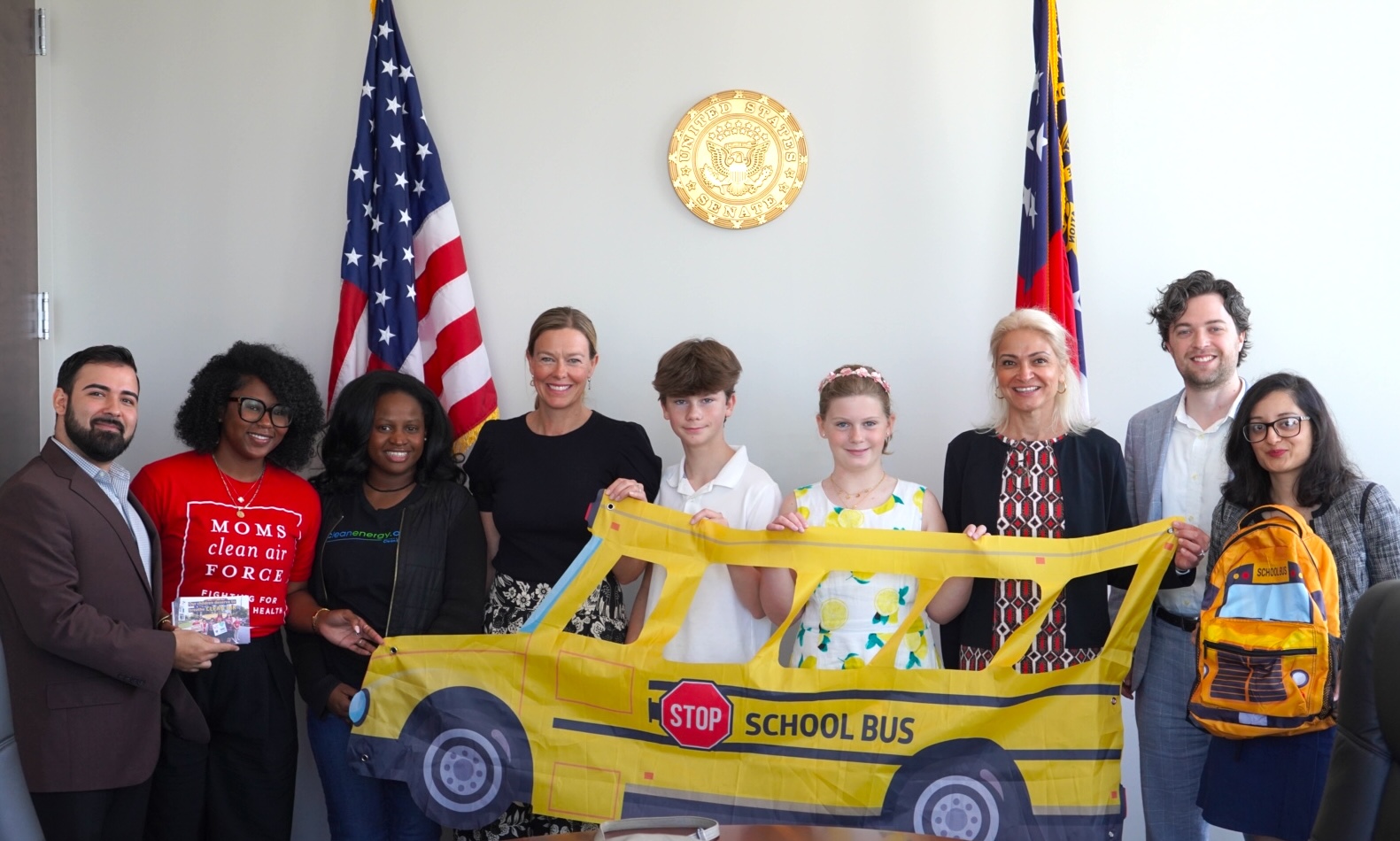
Left to right: Neal Vanmarter (Sen. Ossoff staff); Kiya Stanford (MCAF); Janet Miller (SACE); Ramsey Nix and her children Tommy and Catie Jo; Dory Larsen (SACE), Alex White (Sen. Ossoff staff); and Yesha Joshi (CAC).
It’s unprecedented and illegal that the executive branch could withhold public funding that has already been appropriated. School districts have already worked these funds into their budgets, kids need these buses and the buses are already in production in plants based here in the Southeast.
With so much at stake, we must continue to build coalitions of folks who understand that fighting climate change offers a powerful way to address other issues like health and safety, equity, and economic development. There’s truly a seat for everyone at this table, and there is strength in numbers. Ever since I brought kids into this world, climate action has felt like an act of love. We have a moral responsibility to create a safe and healthy climate for our children, and so we must demand action from our government.
Urge Congress to Protect Clean School Buses
Ramsey Nix is a mother of two in Athens-Clarke County, Georgia. She teaches writing at the University of Georgia’s Grady College of Journalism and Mass Communication. She is also a local advocate for sustainability initiatives, particularly in the Athens-Clarke school district.
The post From Classroom to Climate Action appeared first on SACE | Southern Alliance for Clean Energy.

 To the author of the meme here, FWIW, I agree. My wife employed a decent number of immigrants from Mexico for her horse breeding operation, and I found them to be hardworking, honest, respectful, and family-oriented.
Weather Guard Lightning Tech

Ørsted Finishes Drone Trial, Iberdrola Exits South Korea
Allen covers Ørsted’s Hornsea 2 drone trial, the DeepWind test site, Germany’s proposed land rent cap, and Iberdrola’s Korea exit.
The Uptime Wind Energy Podcast is brought to you by Weather Guard Lightning Tech, creators of the StrikeTape Ultra LPS retrofit. Subscribe to Uptime’s Substack newsletter. And check out Rosemary’s “Engineering with Rosie” Youtube channel. Have a question we can answer on the show? Email us!
 The vast majority of Americans have liberal views. We favor a woman’s right to choose abortion, high-quality public education, affordable healthcare, clear air and water, the use of science in policymaking, equal rights for minority ethnicities and religions, and efforts to trim the enormous gap between rich and poor.
It would be very interesting to know what percentage of U.S. voters believe that liberals hate America, that we believe our country “is fundamentally evil and the only remedy is destroying our nation with mass migration (sic).”
Trump’s approval rating is about 30%, and a few percent of that is the amoral super-rich. So, possibly it’s in the high 20s.
But aren’t there at least some MAGA folks who would concede that educated people don’t necessarily hate America? My mother lived on a steady diet of Fox News, but even she had respect for Bernie Sanders, about whom she said, “I admire his sincerity, misguided though it is.”
An Important Republican Position: The Left Really IS “Radical”–But Who Believes This?



-
Climate Change1 year ago
Guest post: Why China is still building new coal – and when it might stop
-

 Greenhouse Gases2 years ago
嘉宾来稿:满足中国增长的用电需求 光伏加储能“比新建煤电更实惠”
-
Greenhouse Gases1 year ago
Guest post: Why China is still building new coal – and when it might stop
-

 Climate Change2 years ago
嘉宾来稿:满足中国增长的用电需求 光伏加储能“比新建煤电更实惠”
-

 Renewable Energy12 months ago
Sending Progressive Philanthropist George Soros to Prison?
-
Climate Change2 years ago
Bill Discounting Climate Change in Florida’s Energy Policy Awaits DeSantis’ Approval
-
Greenhouse Gases1 year ago
嘉宾来稿:探究火山喷发如何影响气候预测
-

 Climate Change2 years ago
Analysis: China’s CO2 falls 1% in Q2 2024 in first quarterly drop since Covid-19