

President Donald Trump’s move on Thursday to kickstart deep-sea mining could be a lifeline for the Canadian company that is pushing to be the first to supply strategic minerals from the ocean floor.
The firm signalled its intention weeks ago to seek permits from the US administration for the activity in a challenge to UN governance, but whether the gambit pays off remains to be seen. The plan faces strong opposition from many countries and scientists who fear the industry could have catastrophic effects on the ocean ecosystem.
Years of deadlock in global efforts to agree rules for commercial mining of the ocean floor had been straining the finances and patience of the Vancouver-based The Metals Company (TMC) – one of the most prominent among a clutch of aspiring deep-sea mining companies.
Then, in an abrupt shift in company policy, TMC Chief Executive Gerard Barron said in a statement at the end of March that it was time to bypass the International Seabed Authority (ISA) – the little-known UN body created by the United Nations Convention on the Law of the Sea (UNCLOS).
“What we need is a fair hearing and a regulator willing to engage,” said Barron, going on to accuse various actors at the ISA of acting in “bad faith” by obstructing the completion of a mining code.
“Looking back at our 16-year experience of the ISA brand of multilateralism, we believe the United States made the right decision when they chose not to ratify UNCLOS,” Barron said.
Trump tries to upend international order
The company’s share price – which has struggled since it listed in 2021 – jumped this week after Trump signed an executive order calling for deep-sea mining, including beyond US territorial waters, in a bid to secure critical minerals like nickel, cobalt and copper and counter China’s dominance in the sector.
“Vast offshore seabed areas hold critical minerals and energy resources,” Trump said in the order. “These resources are key to strengthening our economy, securing our energy future, and reducing dependence on foreign suppliers for critical minerals.”
Xi commits China to full climate plan but emissions-cutting ambition still unclear
He directed his administration to expedite the issue of mining permits under the Deep Seabed Hard Mineral Resource Act (DSHMRA), a piece of largely untested legislation dating back to 1980 before UNCLOS existed.
Following Trump’s announcement, TMC’s Barron said that “with a stable, transparent, and enforceable regulatory pathway available under existing US law, we look forward to delivering the world’s first commercial nodule project – responsibly and economically”.
Financial lifeline
Crucially, the step could give TMC some financial breathing space.
“They have had very little money, and a lot of debt, for a long time,” Bobbi-Jo Dobush, a US.-based environmental attorney, told Climate Home before Trump’s order was signed on Thursday.
TMC made a net loss of over $81 million last year, with a total deficit of $631 million piled up since it began operating. According to its latest annual accounts, the company had only $3.5 million in the bank at the end of 2024 and access to a potential $41.5 million loan offered by its main investors, Silicon Valley financier Andrei Karkar and Gerard Barron himself.
A company spokesperson declined to comment on its financial position.
The wider deep-sea mining industry has been in choppy financial waters due to persistent uncertainty over its viability. Norwegian company Loke Marine Minerals filed for bankruptcy earlier this month after a long search for additional capital from investors proved unsuccessful, its CEO Walter Sognnes was quoted as telling Norwegian newspaper DN.
International backlash
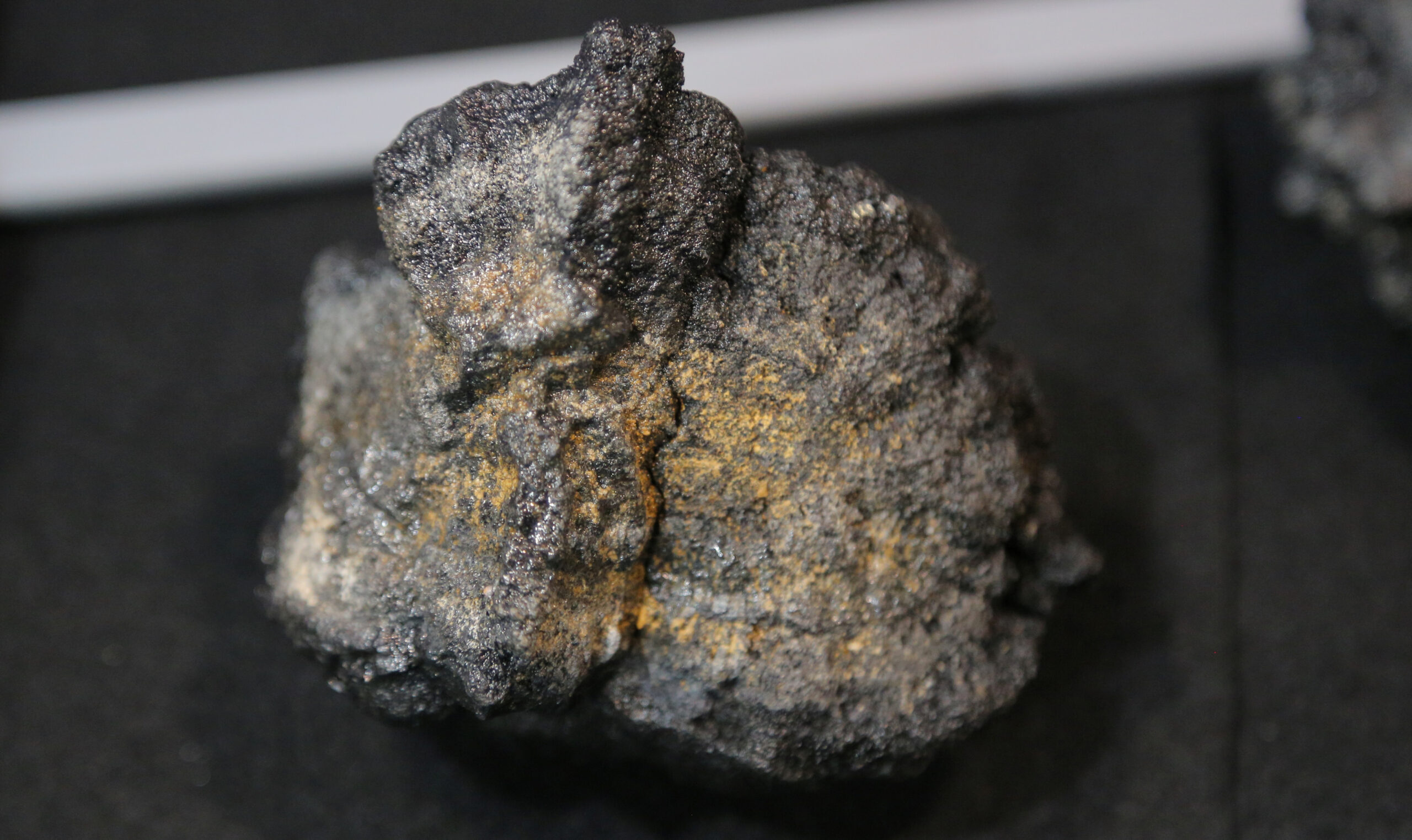
The ISA has under its supervision huge swathes of the Pacific Ocean beyond national jurisdictions that hold the world’s largest reserves of polymetallic nodules – potato-sized rocks packed with minerals that have a multitude of industrial uses – from weapons to clean energy technology.
For years, diplomats at the ISA have been trying to hash out deep-sea mining standards but deep divisions persist and much work remains to be done. Thirty-two countries, including France, Germany and Canada, have also called for either a full ban or a precautionary pause in deep-sea mining activities.
That means Trump’s unilateral decision to expedite licences in both US and international waters is likely to spark a backlash from the international community.
“Any unilateral action would constitute a violation of international law and directly undermine the fundamental principles of multilateralism, the peaceful use of the oceans and the collective governance framework,” said Leticia Carvalho, the secretary general of the ISA, when TMC unveiled its plans in March. Dozens of nations, both in the Global North and South, echoed her opposition.
China’s Foreign Ministry spokesperson Guo Jiakan said on Friday the US move “violates international law and harms the collective interests of the international community”. China holds the largest number of exploration permits in the Pacific Ocean under the ISA, but it has been waiting for the mining rulebook’s completion before conducting any commercial extraction activity.
‘Rip up the deep sea for profit’
Trump’s executive order also drew immediate condemnation from environmentalists who say deep-sea mining would cause irreversible damage to the ocean ecosystem while being financially prohibitive and unnecessary because land-based mineral resources and recycling could cover demand.
“Authorizing deep-sea mining outside international law is like lighting a match in a room full of dynamite – it threatens ecosystems, global cooperation, and US credibility all at once,” said Arlo Hemphill of Greenpeace.
“The United States government has no right to unilaterally allow an industry to destroy the common heritage of humankind, and rip up the deep sea for the profit of a few corporations,” he added.
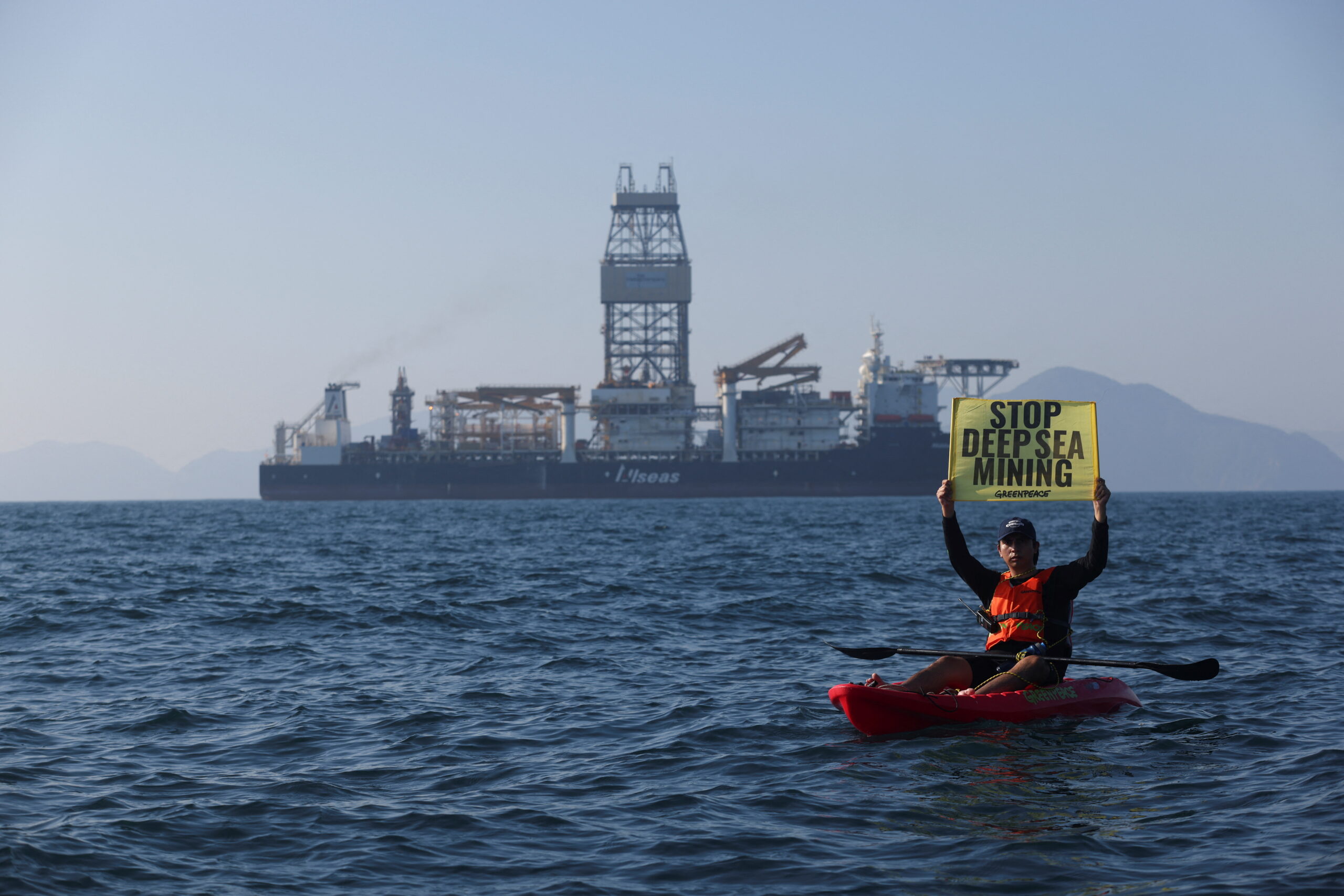
TMC is one of the companies with the most to potentially gain.
In a call with analysts in late March, an executive from the Vancouver-based firm indicated that the US backing could be a much-needed spur to attract external investment.
“If we get to the point where regulatory uncertainty is no longer there and, you know, things are moving along at a very fast clip, let’s say through the US process, well that may put us in a different financial position,” said Craig Shesky, the company’s CFO.
TMC’s rapid pivot
As recently as a few months ago, the company was still lobbying US lawmakers to get behind new legislation calling on the US government to support international governance of seafloor resource exploration.
TMC spent $312,000 on US lobbying activities in 2024, according to lobbying disclosure records.
It is unclear why TMC’s longstanding policy position changed, but during a presentation with analysts, company executives name-checked Steven Groves, a former White House staffer during Trump’s first term.
At energy security talks, US pushes gas and derides renewables
Groves is a policy director at the Heritage Foundation, a fossil-fuel funded think-tank that routinely opposes climate policies and casts doubts on universally accepted climate science. He also co-edited ‘Project 2025’, the controversial 900-page conservative policy blueprint for reshaping the federal government.
TMC’s Shesky said Groves agreed that applying for a mining licence under DSHMRA would be “a viable path based on robust and well thought out regulations”.
Choppy waters ahead
But other experts vehemently disagree. Dobush told Climate Home it is “very ironic and highly likely untrue” that going through the United States provides regulatory certainty when the national legislation has never been used for exploitation.
In 2022, weapons maker Lockheed Martin – the only existing holder of DSHMRA exploration permits – said that activities had been delayed as a result of a lack of international recognition of the US licences.
Duncan Currie, legal advisor at the Deep Sea Conservation Coalition, said he expected plenty of potential legal issues down the line for TMC before any mining takes place.
For instance, countries like Canada, Switzerland and the Netherlands – where TMC and its partner Allseas are respectively based – could risk breaching the terms of the UNCLOS if they fail to prevent the companies from acting unilaterally, he said.
Nations that rely on the UNCLOS to protect their freedom of navigation or fisheries rights may also be motivated to prevent the US government from setting a precedent in sidestepping international governance.
“Island states and seafaring nations place a great deal of importance on UNCLOS,” added Currie. “I would imagine that those countries will be working to ensure that this doesn’t happen.”
The post Trump throws lifeline to Canadian deep-sea miner, setting scene for international clash appeared first on Climate Home News.
Trump throws lifeline to Canadian deep-sea miner, setting scene for international clash

Next week, diplomats from around the world will descend on Yerevan, Armenia, to negotiate a series of decisions under the UN Convention on Biological Diversity (CBD).
Between 19 and 30 October, 196 parties will gather to hammer out the precise wording of the dozens of legal texts that make up the decisions under the Conference of the Parties (COP) to the CBD.
This year’s summit is particularly significant, as it marks the halfway point between the agreement of the Kunming-Montreal Global Biodiversity Framework and the deadline for achieving its targets.
The CBD has found that countries are currently not on track to meet 22 out of the framework’s 23 targets.
During the fortnight, delegates will also be negotiating decisions relating to the two supplemental protocols to the CBD: the Cartagena Protocol, which covers biosafety; and the Nagoya Protocol, which covers access and benefit-sharing for the use of genetic resources.
(The Cartagena and Nagoya Protocols, which are each governed by a “meeting of the parties”, or “MOP”, have fewer parties than the CBD as a whole, with 173 and 141, respectively.)
Carbon Brief is tracking the progress of countries towards consensus on dozens of negotiating texts using the interactive table below.
The tracker includes texts from the COP, as well as the MOPs for the Cartagena and Nagoya protocols. It also includes draft decisions from the most recent subsidiary body meetings, as these form the starting point for the negotiations in Yerevan.
The CBD has three subsidiary bodies: the subsidiary body on scientific, technical and technological advice (SBSTTA), the subsidiary body on implementation (SBI) and the subsidiary body on article 8(j) and other provisions (SB8J).
SB8J focuses on issues related to the Indigenous peoples and local communities. It was established at COP16 in Cali, Colombia, in 2024.
The first two columns of the interactive tracker list the topic of each agenda item and the relevant body, with subsequent columns including dates, page counts and links to the original documents.
The table is searchable and can be sorted using the arrows in the header.
Areas of disagreement in UN draft texts are denoted by square brackets. Counting the brackets in a particular iteration of a text therefore gives a sense of how far parties are from reaching consensus.
The bracket column is colour-coded, with dark green indicating a low number of brackets and red indicating a high number of brackets remaining.
Texts can also present parties with choices using “options” or alternatives (“alt”), which are counted together in the sixth column of the table.
The key discussions in Yerevan will centre around two agenda items in particular. The first is the global review, which will assess progress towards the GBF and make recommendations for accelerating action.
The second is finance, which can be separated into two parts: resource mobilisation and the financial mechanism. On resource mobilisation, biodiverse global south countries are likely to push for an increased amount of international finance for conservation.
Disagreement over the creation of the financial mechanism led to the suspension of COP16 in Cali in October 2024, as parties failed to find agreement on the mobilisation of finance before the end of the summit.
Global south countries want the establishment of a separate financial mechanism under the control of the CBD; global north countries largely prefer to maintain the existing mechanism, which sits under the Global Environment Facility.
At the resumed session of COP16 in Rome in early 2025, countries agreed on a roadmap that would lead to the establishment of a permanent mechanism.
related

Analysis: Lula presidency saved at least 20,000km2 of Brazilian Amazon since 2022

Why land-use emissions have fallen by a third this century – in six charts

Analysis: 84% of nations miss deadline to identify ‘nature-harming’ subsidies by 2025

UK withdraws millions in funding from world’s second-largest rainforest in Congo
The post Interactive: Tracking negotiating texts at the COP17 biodiversity summit appeared first on Carbon Brief.
Interactive: Tracking negotiating texts at the COP17 biodiversity summit
A beacon of love
On an outer island of Fiji, two thousand nautical miles from Sydney, is a shining light of hope and resilience for our troubled world.
The island of Kioa is home to a Tuvaluan community who migrated from their atoll of Vaitupu in the late 1940s. It is a land of warm hearts, big smiles, and deep cultural roots; a place where the sound of a conch still summons the island together, where islanders paddle out to fish in carved outrigger canoes, and healthy happy children walk barefoot to school.
Here, culture is life. Kioans live sustainably through their traditional knowledge and practices. The island is alive with song, dance and the rhythms of a life tied to the tides, the winds, and the seasons.

Facing the future
Greenpeace has been lucky to have a relationship with Kioa for a number of years now, and we are continually learning from this remarkable community.
Last week, as part of our Voyaging Oceania project, we returned to the island. Our purpose was twofold —- to carry messages from the island to leaders gathering in Nadi this week for the Pacific Pre-COP, and to support the Kioa community in their efforts to improve water security for the island.
Unlike Tuvalu itself, with its eight atolls, Kioa is a mountainous, forested and richly fertile island. It will remain habitable far into the future. Kioans did not initially migrate from Vaitupu due to climate change, but the move was prophetic. They now have a lifeboat.
However, even Kioa faces challenges on our rapidly warming planet, in particular when it comes to water. Climate change is shifting once reliable rainfall patterns. On top of this, the island is already feeling the effect of this year’s intensifying El Niño event, which for Fiji means reduced rainfall and prolonged dry spells.
Right now, fresh water has to be carefully rationed, and is only available for a few hours a day. During last week’s visit aboard our campaigning ship Oceania, Greenpeace was privileged to work with the Kioa community on a new solar-powered water distribution project for the island.
Designed and led by the island, the project involves using a solar pump to move water from a reliable source to a storage tank and then using gravity to distribute the water around the village.
It was a lesson in how local knowledge and ingenuity can be the backbone of today’s climate solutions. To build a dam around the source, the local community knew the exact spot where they could gather gravel at low tide to mix with the cement. They took only what was needed, knowing that all resources must be carefully conserved. Kioa has no roads and no machinery, and it was an all-of-island effort to carry the materials up to the project site, including many heavy bags of sand and rock.
Such projects truly bring to life the vision of a resilient, locally-led, fossil fuel free Pacific.